- 240 pages
- English
- ePUB (mobile friendly)
- Available on iOS & Android
eBook - ePub
About this book
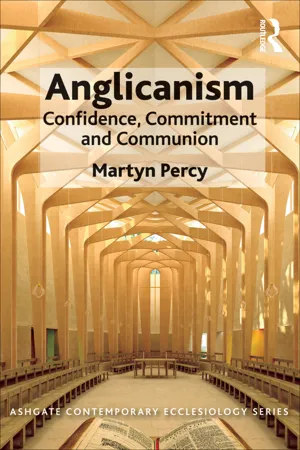
This focused concentration and celebration of Anglican life could not be more timely. Debates on sexuality and gender (including women bishops), whether or not the church has a Covenant, or can be a Communion, and how it is ultimately led, are issues that have dominated the ecclesial horizon for several decades. No book on Anglicanism can ever claim to have all the answers to all the questions. However, Martyn Percy's work does offer significant new insights and illumination - highlighting just how rich and reflexive the Anglican tradition can be in living and proclaiming the gospel of Christ. These essays provide some sharply-focused snapshots of contemporary Anglicanism, and cover many of the crucial issues affecting Anglicans today, such as the nature of mission and ministry, theological training and formation, and ecclesial identity and leadership. Church culture is often prey to contemporary fads and fashion. Percy's work calls Anglicanism to deeper discipleship; to attend to its roots, identity and shape; and to inhabit the world with a faith rooted in commitment, confidence and Christ.
Information
Confidence in Formation
Chapter 1
A Flight of Starlings: Cuddesdon and the Forming of Anglicanism
Here’s an old joke about Anglican polity. One day, the queues of people to get into heaven are so long and thick that the Angels guarding the Pearly Gates begin to panic. They fly off to see Jesus and ask for advice. Jesus suggests that potential entrants are graded. He will ask a question of everyone seeking entry, and depending on how they answer, they will either be placed in the slow track, or granted immediate entry. The question Jesus proposes to use is the same question he once put to the disciples: ‘Who do you say that I am?’ The first person Jesus encounters at the gates is a Methodist minister. Jesus asks her, ‘who do you say that I am?’ The minister hesitates, and then answers ‘well, at Conference last year …’. But Jesus interrupts her immediately. ‘I am sorry’, he says, ‘but I asked you for your opinion, and not for your denominational line. Would you mind going to the back of the queue? Thank you.’ The next person to step forward is a Roman Catholic monk. Jesus poses the same question, to which the monk replies, ‘well, our Pope says…’. But Jesus again interrupts, and points out that he wanted the monk’s opinion, not the Pope’s. Third, a Baptist minister approaches. His response to Jesus’ question is emphatic: ‘the Bible says …’. But Jesus again interrupts, and reminds the minister that he wanted his opinion, not his knowledge. Finally, an Anglican priest approaches. Jesus regards the minister somewhat quizzically and with suspicion, but puts the question to him nonetheless. The Anglican replies categorically: ‘You are the Christ – the Son of the living God.’ Jesus is slightly taken aback by such an ardent response from an Episcopalian, and is about to let the Anglican priest in, when the minister adds, ‘but then again, on the other hand…’.
Some years ago my two sons encountered the joys of a Thesaurus for the first time, and delighted in discovering new and familiar words, and their alternative meanings. The first modern Thesaurus was published by Dr Peter Mark Roget in 1852. ‘Thesaurus’ means ‘treasury’ or ‘storehouse’; but what words, I wonder, would Roget have linked to ‘Anglican’? It is a potentially awkward question, since the answer will almost certainly depend on the virtues or vices that the enquirer has already attributed. For some, it will be: indecisive, vacillating or compromised. For others: solid, reliable and predictable. Still for others: conservative – or liberal; historic – or innovative; Protestant – or Catholic.
Interestingly, Roget did include ‘Anglican’ in his original Thesaurus, and attributed only one comparable word to the term: Protestantism. But then beneath this entry, under ‘Anglicism’ (not Anglicanism, note – but a near neighbour, so to speak), he suggests ‘dialect’ – a particularly distinctive mode of speech. It is a matter of debate as to whether Anglicanism is a distinctive mode of English Protestantism. It is; and then again it isn’t; it is more than that. But Roget’s range of allusion set us an intriguing question: what does the word ‘Anglican’ mean today?
There is complex history to the term. It is a seventeenth-century ‘nickname’ that did not acquire common usage until quite late in the nineteenth century – and only then to describe a church that had always known what it was in itself, but had never really needed to offer an explicit articulation of that self to others. But whatever the word might have meant theologically or liturgically, it is its ecclesiological use that is the most elastic. So much so, in fact, that the term ‘Anglican’ has become a cipher for linking a series of opposites or polarities, that in turn express its diversity. So, if one is to return to Roget’s Thesaurus for a moment, what words might Anglicans add from their own treasury to the label? Solid, yet flexible; strong, yet yielding; open, yet composed; inclusive, yet identifiable. The list could go on. But I suppose that in pointing out the connection of opposites, I am appealing for having some confidence in our un-decidability and elasticity, in the very midst of our concreteness. Anglican identity only begins to make proper sense when it is related to its mirror image or opposite number. No one wing or facet of the church can begin to be true without relation to its contrary expression.
We need both, of course. And at a time when we are being sorely pressed to decide and define instead of living together in patience, we need to have the courage to be, above all, Anglican. And this is especially suggestive for the way in which the church might be led at present. Holding together polarities is no easy business, especially when competing convictions can themselves be held with passion and zeal that will not only refuse to compromise, but perhaps even to dialogue. Are there systems that can enable the Anglican Communion or Church of England to negotiate intense disagreements, or navigate through complex arguments? Is it possible to find consensus in the midst of heated debates and a distancing in relations? Unsurprisingly, I don’t have the answers to these questions, but here are three modest pointers as to how the polity might be held together, as it attempts to negotiate its own future within a context of increasing diversity and difference.
First, Anglicanism is generally easier to identify through persons rather than systems: examples of faith and polity matter rather than theories of it. In this respect, heroes or exemplars of the faith turn out to be those characters, individuals or communities that exhibit the gifts and fruits of the Holy Spirit. Although Anglicanism has articles of faith (39 of them), it is rare to appeal to these when pointing to striking and inspiring exemplars of Anglican ecclesial polity. Our heroes, therefore, are Herbert and Hooker, or Tutu and Temple – to name but a few.
Second, those charged with the ministry of oversight may need to come to some understanding of how those under them learn. Often, this is not done through the simple or mechanistic transferral of principles, rules and propositions. It is, rather, through a deeper formational wisdom rooted in tactical suavity, emotional intelligence, reflexivity and responsiveness. Often, we learn from those in oversight who are able to display character and virtue, not just skill; enormous reserves of resilience, patience and energy. In which insight and courage are fused to gentle but firm will.
Third, the realisation that exemplars matter to the shaping of our polity has profound implications for the practice of the church. Much of this is tacit. Clergy, for example, when they gather and share, often discuss the most testing funerals or occasional offices they have presided over of late. Generally, this is not boastful behaviour. It actually points to something deeper in ordained life here; namely that the church reflects on experiences, and draws from that principles, ideas and conclusions about how it is incarnate in particular times and places. In other words, it elaborates and reflects upon how it is being Christ for others, and bread for the world. This is theological reflection.
Starlings and Anglican Identity
With these comments in mind, let me say something about Anglican distinctiveness in the midst of our current cultural diversity. It would be quite possible here to talk at length about our explicit theological identity. But I prefer instead to address a few aspects of what I take to be our anthropological identity, which in turn suggests a nascent value-based implicit theological shape. It is said that Henry Scott Holland once stood on the hill at Garsington shortly before his death, and gazed over the valley to Cuddesdon College and parish church, where he had asked to be buried. He noticed a flock of starlings flying past, and remarked how like the Anglican Church they were. Nothing, it seemed, kept the flock together – and yet the birds moved as one, even though they were all apart and retained their individual identity. In an increasingly diverse and cosmopolitan world, of which the Anglican Communion is a part, birds of a feather still need to flock together, even though each creature is individual.
Holland’s observation allows us to develop another analogy here, centred on the identity of the species. The Anglicanism of the twenty-first century is recognisably different from that of the end of the nineteenth century. The flock, if you like, is no longer one type of bird. Evolution – through cultural and theological diversity – has meant that many Anglican provinces have evolved to ‘fit’ their contexts, and the ultimate diversity of the species clearly threatens its unity. But to extend the analogy just a little further, is it possible to still speak of a connecting DNA – some of the deep, core but hidden constituents of our identity which relate us, even though they may not be immediately apparent?
The Church of England, on the whole, has a somewhat understated ecclesiology: its self-understanding, a bit like DNA, is often a matter of deeply coded and implicit language, not explicit statements. As one commentator has recently noted, can it really be any accident that cricket is the preferred game of the clergy in the Church of England? An individual, yet collaborative game; full of manners, codes of conduct – ‘sporting’ sport; strenuous and restful by turns, combining subtlety and strength (speed is rarely valued); where all may have different gifts and functions, yet be equally valued; and where the side about to lose can gain an honourable or even heroic draw, either due to rain or bad light. Results really don’t matter; it’s how you play. The other game that clergy play a lot of is chess (with their own magazine, Chess Minister). It’s all about plots, pace and plans; a kind of surrogate for the Parochial Church Council (PCC). So there is perhaps no need to speculate on the significance of clergy and model railway clubs – you can probably begin to work that out for yourselves; it’s all to do with things running to order, and on time – quite unlike normal ministry.
It was Jeremy Paxman who once quipped that the Church of England is the kind of body that believes that there was no issue that could not be eventually solved over a cup of tea in the Vicar’s study. This waspish compliment directed towards Anglican polity serves to remind us that many regard its ecclesial praxis as being quintessentially peaceable and polite, in which matters never really get too out of hand. For similar reasons, Robert Runcie once described Anglican polity as a matter of ‘passionate coolness’. In the past, and in my own reflections on Anglican polity, these are sentiments with which I have tended to concur:
In some of my conversations with Anglican theologians … I have been struck by how much of the coherence of Anglicanism depends on good manners. This sounds, at face value, like an extraordinarily elitist statement. It is clearly not meant to be that. What I mean by manners is learning to speak well, behave well, and be able to conduct yourself with integrity in the midst of an argument … It is often the case that in Anglicans’ disputes about doctrine, order or faith, it is actually the means that matter more than the ends … politeness, integrity, restraint, diplomacy, patience, a willingness to listen, and above all, not to be ill-mannered – these are the things that enable the Anglican Communion to cohere.1
In macro-theological disputes, such as those over the ordination of women, part of the strategy that enables unity can be centred on containing some of the more passionate voices in the debate. Extreme feelings, when voiced, can lead to extreme reactions. And extreme reactions, when allowed full vent, can make situations unstable. Nations or federations fall apart; Communions can fracture; families may divide. Things said briefly in the heat of a moment can cause wounds that may take years to heal. What is uttered is not easily retracted.
Good manners, then, is not a bad analogy for ‘ideal’ Anglican polity. In a church that sets out to accommodate many different peoples of every theological hue, there has to be a foundation – no matter how implicit – that enables the Communion to cohere across party lines, tribal borders and doctrinal differences. And just as this is true for macro-theological disputes, so is it also true for micro-ecclesial squabbles. Often, congregational unity in the midst of disputes can only be secured by finding a middle open way, in which the voices of moderation and tolerance occupy the central ground and enable a church to move forwards.
This is something that the Windsor Report2 understands, and it is interesting to note how much attention the Report gives to the virtues of patience and restraint, whilst also acknowledging the place of passions and emotions in the sexuality debate. Clearly, there is a tension between these polarities (the polite–passionate axis), which is partly why the cultivation of ‘mannered-ness’ in ecclesial polity can be seen to be as essential as it is beguiling.
This means, of course, continually listening to the experiences that lead to anger, and seeing them as far as possible from the perspective of those with less power. It means humility on the part of those who hold power, and an acknowledgement of the fear of losing power and control. It means a new way of looking at power relationships that takes the gospel seriously in their equalising and levelling. I am aware that this is one of the most demanding aspects of oversight, namely having the emotional intelligence, patience and empathy to hold feelings, anger, disappointment and frustration – other people’s, as well as your own. Oversight, it seems to me, is less about strategy and more about (deeply learnt) poise, especially in holding together competing convictions and trying to resolve deep conflicts.
But before conflicts can be resolved, they must first of all be held. And here we find another of the most demanding aspects of oversight within the context of considerable theological and cultural diversity. Because one of the tasks of the church is to soak up sharp and contested issues, in such a way as to limit and blunt the possibility of deep intra- and inter-personal damage being caused, as well as further dislocation in people’s sense of faithful identity. Retaining composure, and somehow holding people together who would otherwise divide (due to the nature of their intense and competing convictions), is a stretching vocation.
Anyone exercising a ministry of oversight will understand the costly nature of this vocation – a kind of servant leadership – that understands that much of Anglican polity is ‘open’ in its texture; and although it has a shape, is nonetheless unresolved and incomplete. Therefore, issues that cannot be determined often require being held; a deliberate postponement of resolution. Put another way, there is a tension between being an identifiable community with creeds and fundaments; and yet also being a body that recognises that some issues are essentially un-decidable in the church. Indeed, ‘Anglican un-decidability’ (a phrase coined by Stephen Pickard), may turn out to be one of the chief counter-cultural Anglican virtues; it is very far from being a problem, as some appear to believe.
The desire and need to sometimes reach settlements that do not achieve closure, is itself part of the deep ‘habit of wisdom’ that has helped to form Anglican polity down the centuries. It is embodied liturgically in the Book of Common Prayer, but can also be traced in pastoral, parish and synodical resolutions that cover a significant range of issues. Essentially, this ‘calling’ is about inhabiting the gap between vocation, ideals, praxis and action. No neutral or universally affirmed final settlements can be reached on a considerable number of issues within the church. But provisional settlements have to be reached that allow for the possibility of continuing openness, adjustment and innovation. Inevitably, therefore, any consensus is a slow and painful moment to arrive at, and even when achieved, will usually involve a degree of provisionality and more open-endedness. This is, of course, a typical Anglican habit, embodying a necessary humility and holiness in relation to matters of truth, but without losing sight of the fact that difficult decisions still need to be made.
Allied to this, of course, is an appreciation that one of the chief virtues of living within a Communion is learning to be patient. Churches, each with their distinctive own intra-denominational familial identity, all have to learn how to negotiate the differences they find within themselves. For some churches in recent history, the discovery of such differences – perhaps on matters of authority, praxis or interpretation – has been too much to bear: lines have been drawn in the sand, with the sand itself serving only as a metaphor for the subsequent atomisation. Yet where some new churches, faced with internal disagreement, have quickly experienced fragmentation, most historic denominations have been reflexive enough to experience little more than a process of elastication: they have been stretched, but they have not broken. This is perhaps inevitable, when one considers the global nature of most mainstream historic denominations. Their very expanse will have involved a process of stretching (missiological, moral, conversational, hermeneutical, etc.), and this in turn has led directly to their (often inchoate) sense of accommodation. However, this process itself has led to two very different versions of the Communion and its future, and these polarities need sketching briefly.
The first sees Anglicanism in concrete terms. Here, the polity will be governed by law, and scripture will be its ultimate arbiter. Here, Anglicanism will become a tightly defined denomination in which intra-dependence is carefully policed. Diversity of belief, behaviour and practice will continue, but they will be subject to scrutiny and challenge. The second sees Anglicanism as a more reflexive polity; one that has a shape, but is able to stretch and accommodate considerable diversity. Here the polity will be governed by grace, not law, and the Communion itself will continue to operate as both a sign and instrument of unity. Anglicanism will continue to be a defined form of ecclesial polity, but one that tolerates and respects the differences it finds within itself.
Personally, I pra...
Table of contents
- Cover Page
- Half Title page
- Series page
- Title Page
- Copyright Page
- Dedication Page
- Contents
- Chapter Sources
- Acknowledgements
- Introduction Contexts, Challenges and the Church
- Part I Confidence in Formation
- Part II Commitment and Mission
- Part III Communion and Polity
- Bibliography
- Index
Trusted by 375,005 students
Access to over 1.5 million titles for a fair monthly price.
Study more efficiently using our study tools.
Frequently asked questions
Yes, you can cancel anytime from the Subscription tab in your account settings on the Perlego website. Your subscription will stay active until the end of your current billing period. Learn how to cancel your subscription
No, books cannot be downloaded as external files, such as PDFs, for use outside of Perlego. However, you can download books within the Perlego app for offline reading on mobile or tablet. Learn how to download books offline
Perlego offers two plans: Essential and Complete
- Essential is ideal for learners and professionals who enjoy exploring a wide range of subjects. Access the Essential Library with 800,000+ trusted titles and best-sellers across business, personal growth, and the humanities. Includes unlimited reading time and Standard Read Aloud voice.
- Complete: Perfect for advanced learners and researchers needing full, unrestricted access. Unlock 1.5M+ books across hundreds of subjects, including academic and specialized titles. The Complete Plan also includes advanced features like Premium Read Aloud and Research Assistant.
We are an online textbook subscription service, where you can get access to an entire online library for less than the price of a single book per month. With over 1.5 million books across 990+ topics, we’ve got you covered! Learn about our mission
Look out for the read-aloud symbol on your next book to see if you can listen to it. The read-aloud tool reads text aloud for you, highlighting the text as it is being read. You can pause it, speed it up and slow it down. Learn more about Read Aloud
Yes! You can use the Perlego app on both iOS and Android devices to read anytime, anywhere — even offline. Perfect for commutes or when you’re on the go.
Please note we cannot support devices running on iOS 13 and Android 7 or earlier. Learn more about using the app
Please note we cannot support devices running on iOS 13 and Android 7 or earlier. Learn more about using the app
Yes, you can access Anglicanism by Martyn Percy in PDF and/or ePUB format, as well as other popular books in Theology & Religion & Religion. We have over 1.5 million books available in our catalogue for you to explore.