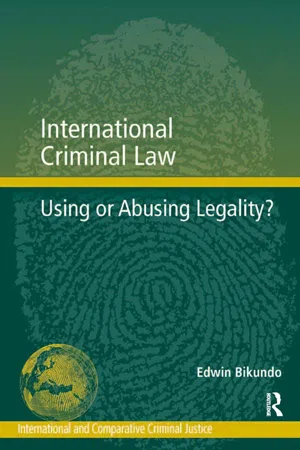
- 222 pages
- English
- ePUB (mobile friendly)
- Available on iOS & Android
eBook - ePub
About this book
This book analyses the relationship between law and violence, the utility of law over violence and whether legality as an approach has an inherent disability in addressing mass violence as a crime. The study is located within international law and assesses whether prosecuting political violence would necessarily entail an abuse of the legal process. The intention is to encourage definition of criminal aggression via legal processes laid down by the International Criminal Court, rather than giving favour to political action under the United Nations Charter. Issues discussed in the book include the controversies over the location of the crime of aggression in either law or politics, taking a legal approach to the problems outlined. Using examples from Libya, the Ivory Coast, and Kenya, the work will be of interest to those working in the areas of international criminal justice, international law, legal theory, and international relations.
Chapter 1
The Responsibility to Protect Civilians from Political Violence: Locating Necessity between the Rule and its Exception
The promise of international law to promote and protect human welfare is limited by the means at the disposal of the international community where, normatively speaking, peace is the rule and armed conflict the exception. The consequential but regrettable necessity of a forcible response to real or threatened mass atrocities underscores this fundamental undesirability of violence versus its inevitability. The compromise forged is that force, although inevitable, should be used sparingly and only where necessary: specifically in emergencies and especially to protect civilians from mass atrocities. There are two, on the face of it contradictory, approaches clear in the debate on the role of force or violence in international law. The first relates to the fundamental undesirability of violence generally. The second relates to the inevitability of violence and consequential regrettable necessity of a forcible response in defence. The role of law in this debate is to navigate between these two coasts of undesirability and inevitability on the ship of necessity. This meandering approach is crystallized in the rules relating to the use of force, which try to restrict force only to extreme circumstances. The compromise reached is that force, although inevitable, should only be used sparingly.
Managing the Necessity to Use Force
The principled management of necessity therefore increasingly governs how the responsibility to protect civilians is achieved in international affairs. The responsibility to protect (R2P) is not of itself a legal concept. It is better viewed as a meta-legal concept from which a number of legal rules and principles can be derived. These include the rules and principles regarding the protection of civilians (POC). Force is made available to protect human life and violence is outlawed precisely because it is targeted against human life. In order to counter illegal violence, R2P may be viewed as reconciling the undesirability of violence to the inevitability of lawful force. Force is in this way legitimated as a means by which the ends of POC are to be achieved.
Linking force and the sanctity of human life through a means–ends relationship, where force is the means by which the sanctity of human life is protected, reconciles otherwise intractable contradictions. This approach can be seen in the UN Charter’s preamble when reciting the background to the United Nations, its aims and the means to achieve those aims. The foundational principles of the United Nations are to save humanity from war, reaffirm human rights, establish the conditions for achieving justice and the international rule of law and to promote social progress and better living standards in enlarging freedom. These principles of course are accompanied with the sovereign equality of states, the self-determination of peoples and non-intervention in essentially domestic issues. The ends of the United Nations are to be achieved by practising tolerance and peaceful coexistence and uniting in strength to maintain international peace and security. Most crucially for this discussion, armed force shall not be used except in the common interest, and the international machinery shall be employed for the promotion of the economic and social advancement of all peoples. As a rule the use of force is generally prohibited. The traditionally accepted exceptions to this rule are legitimate self-defence and action taken under the UN Charter for the restoration and maintenance of international peace and security. Peace is the rule and war (armed conflict) the exception. In fact, armed force is only justifiable for facilitating the return to peace. This is why it is notable, for example, that even United Nations Security Council (UNSC) resolutions authorizing the use of force do not do so explicitly but instead use wording referring to all necessary means or measures to achieve their object. Such wording is deemed sufficient to permit the use of force without specifically recommending it (Freudenschuß 1994: 492, Baker and DeFrank 1995: 304–305). That in principle is what the member states of the United Nations have signed up to, to pool their collective capacities for the maintenance of peace and security within a legal framework. This legalization of the legitimate use of force by progressively outlawing political violence is supposed to promote and provide the rule of law in international affairs. This rule of law discourages war/armed conflict and instead promotes peace principally through differentiating of the legal regimes that are applicable during war and peace. Consequently this chapter’s thesis is that a rule and exception scheme where peace is the norm and violence the exception generates an outlawing and criminalization of political violence.
The recent return to UNSC resolutions to authorize the use of force under Chapter VII of the UN Charter in the Libyan Arab Jamahiriya and Côte d’Ivoire appear to continue the long-term trend towards bringing violence within the ambit of legality. This relationship brought about between law and violence has at least two facets. The first involves criminalizing political violence. The second increasingly invokes legality to justify or excuse the use of force against political violence. The occurrences of political violence in Libya and Côte d’Ivoire that are now under consideration by the International Criminal Court (ICC) can be used as examples of political violence, not of criminal aggression. The broad question of the illegal use of violence brings together international humanitarian law/the law of armed conflict, public international law and both international and domestic criminal law. The legitimacy and legality of the use of force has two senses: not only a negative prohibition on deliberately targeting civilians but a positive obligation that any use of armed force is to protect civilians. Or at the very least that civilians must not be deliberately targeted (even when states use force to ensure self-determination or to protect against secession or insurgencies). As is to be demonstrated below, the responsibility to protect (R2P) can be conceived of as a subset of the POC.
Reconciling Sovereignty and Intervention
In conceptualizing R2P the International Commission on Intervention and State Sovereignty (ICISS) managed to reconcile the ostensibly incompatible principles of sovereignty and humanitarian intervention (Knight 2011: 34). Indeed one contributing factor animating the ICISS was to avoid any terminology that espoused military force as either the primary or the sole way to respond to actual or impending mass atrocities (ICISS 2001: 40). Apart from the use of force as a last resort other criteria for using force during R2P intervention are: the right authority, a just cause, the right intentions, a proportionate response and a reasonable likelihood of success (ICISS 2001: 47). These are substantially a reiteration of jus ad bellum principles enjoying a long pedigree (Aquinas 1981, Augustine 2003, Walzer 1977).
R2P principles hold that each state has the responsibility to protect its populations from genocide, war crimes, ethnic cleansing and crimes against humanity (UNGA 2005, paras 138 and 139). The international community should encourage and help states to exercise this responsibility. There is a view that the United Nations through then Secretary-General Kofi Annan’s reform agenda established the responsibility to protect as a new norm legalizing humanitarian intervention (Stedman 2007: 938). The Security Council likewise has a responsibility to protect populations by using appropriate collective action via diplomatic, humanitarian and other peaceful means under Chapters VI and VIII of the UN Charter. Should peaceful means be inadequate and national authorities fail to protect their populations as required, then resort may be had to Chapter VII of the UN Charter, which authorizes the use of necessary measures including armed force. UN Secretary-General Ban Ki-moon (UNSG 2009) refers to these as three equal and mutually reinforcing pillars. A contrary take on this is that the 2005 World Summit agreement and the affirmation of this agreement in Security Council and the General Assembly resolutions in themselves did not constitute new legal norms about the responsibilities of the international community to protect populations from genocide, ethnic cleansing, war crimes and crimes against humanity. They merely contributed to interpret and clarify existing international legal responsibilities in customary international law (Rosenberg 2009: 445–6).
The Obama administration’s National Security Strategy appears to reaffirm America’s commitment to pursue its interests through an international system in which all nations have both rights and responsibilities. These include preventing genocide and mass atrocities under the UN auspices via R2P (US National Security Strategy 2010: 48). This recognizes that, although the primary responsibility for preventing genocide and mass atrocity rests with sovereign governments, this responsibility passes on to the broader international community either when it is sovereign governments themselves who commit genocide or mass atrocities, or when they prove unable or unwilling to take necessary action to prevent or respond to such crimes inside their borders (US National Security Strategy 2010: 48). This is a departure by Obama in relation to R2P from the Bush era doctrine of pre-emptive and if necessary unilateral use of force (Reinold 2011). R2P, including its potential for collective action, is increasingly supported by globally shared understandings (Brunnée and Toope 2010: 211). It is, however, considered a threat to national sovereignty (Eckhard 2011: 90); moreover, there is a predominant view that it is yet to become a binding norm of international law (Matthews 2008, Stahn 2007: 102).
Concepts of Sovereignty
The European Treaty of Westphalia in 1648 marked the first phase in the development of modern notions of sovereignty, which established a system of modern nation states in which the sovereign reigned supreme domestically as well as in the state’s international relations (Deng 2010: 356). As early as 1651 Thomas Hobbes wrote that the end for which sovereigns were entrusted with authority was the protection of the safety of the people (Hobbes 1996: 222). Even in international law ‘the raison d’être of the State is the protection of its citizens’ (Brownlie 1963: 289). R2P has conceptualized sovereignty as responsibility rather than only authority (Thakur 2006: 255). This means that current understandings hold that the international community is obligated by humanitarian and human rights norms to protect populations from mass deprivation and death, all of which make humanitarian intervention imperative (Deng 2010: 354).
The second phase in conceptualizing sovereignty is traceable to the end of the Second World War in 1945 in which sovereign power was challenged by the domestic development of democratic values and institutions and by accountability to an international community that sought adherence to human rights and humanitarian standards (Deng 2010: 356). The third phase was brought about during the 1990s through the end of the Cold War, which rendered state sovereignty vulnerable to international scrutiny (Deng 2010: 356). The fourth phase of this phenomenon is the contemporary pragmatic attempt to reconcile state sovereignty over domestic affairs with responsibility for the welfare of its citizens (Deng 2010: 356). To sum up, the current normative status of sovereignty is derived from humanity, as the legal principle that human rights, interests, needs and security must be respected and promoted, and this is also the telos or final purpose of the international legal system (Peters 2009: 514).
The Law on the Use of Force
Ramesh Thakur (2010: 10) recently observed that ‘repeated US assaults on UN-centred law governing the international use of force have undermined the norm of a world of laws, international law’s efficacy and the UN’s legitimacy as the authoritative validator of international behaviour’. According to Thakur, because international law is intended to align political power to legal justice, when the powerful subvert the law to make it serve their agenda for keeping others in line, many will resist such perversion of justice (2010: 24). Taking a cue from Thakur’s admonition regarding aligning political power to legal justice, this chapter argues that civilians are increasingly protected by both the regimes of law relating to the law on the use of force, jus ad bellum, and the law relating to the resort to force, jus in bello. The chapter does this principally by examining recent UNSC practice evidencing the coordination and convergence of the Protection of Civilians, the Responsibility to Protect and referrals to the ICC for political violence. In the light of recent practice an argument can be made that the international community bears a moral, legal and political responsibility to protect (Glanville 2010).
POC, moreover, seems to be emerging as more than mere political rhetoric and more of a jus cogens norm in the following ways. First it is impermissible for states themselves to use violence against their own citizens in a way that would cause atrocity crimes to happen (Stahn 2007). Second and following on from the first, it is at the very least permissible for the international community to intervene under the Third Pillar of R2P to protect civilians from political violence leading to atrocity crimes. In other words, high-level and sustained armed force may not be used deliberately contrary to the welfare of civilians and, if it is nevertheless consciously used against them to the level of committing mass atrocities contrary to this stipulation, then that would be criminal under international law and a justification for armed force against the responsible government.
In public international law, the central provision relevant to R2P and now POC is the United Nations Charter’s Article 39:
The Security Council shall determine the existence of any threat to the peace, breach of the peace, or act of aggression and shall make recommendations, or decide what measures shall be taken in accordance with Articles 41 and 42, to maintain or restore international peace and security.
Historically, the origin of the Article as reflected in the framer’s intent was to give as unrestricted a hand as possible to the UNSC for freedom of action (Frowein and Krisch 2002: 718–19). With reference to international criminal law, it and related articles were expansively construed in the Tadić case discussed below (Prosecutor v Tadić 1995). More recently, it was considered by the ICC state parties to be closely related to the ICC Statute’s (Rome Statute) Article 15 (UN Diplomatic Conference 1998), which was drafted in contemplation of the UN Charter. Prior to the state parties agreeing to a definition, the connection between the identical word ‘aggression’ in public international law and international criminal law was by no means co-extensive. The same word in the same language and discipline could nevertheless have different semantic effect, let alone tenor and import; for instance, aggression under the UN Charter and aggression in the Nuremberg Charter, Judgment and Principles. The former relates to law on the use of force by states under public international law, and the latter to individual criminal responsibility under international criminal law by natural persons. Now the Rome Statute has blurred the boundary between the two meanings to a certain extent. Additionally R2P is specifically tied to four core international crimes: genocide, war crimes, ethnic cleansing and crimes against humanity (Orford 2009: 1006). R2P was therefore boosted by the establishment of the ICC (Sarkin 2010). Even the International Court of Justice (ICJ) has ruled that states are obliged to take all reasonable measures within existing international law to prevent genocide and punish the perpetrators (Bosnia v Serbia [2007]: para. 425). R2P’s First Pillar is therefore a jus cogens or peremptory norm of customary international law, imposing on states the legal responsibility to protect their populations from genocide, war crimes, ethnic cleansing and crimes against humanity (Bellamy and Reike 2010: 285–6). Côte d’Ivoire and Libya before the UNSC serve as locations where R2P, POC and international criminal responsibility are utilized in tandem to address international peace and security challenges.
Côte d’Ivoire
Following disputed presidential elections and civil armed conflict in Côte d’Ivoire, the UNSC authorized the UN Operation in Côte d’Ivoire (UNOCI) to use ‘all necessary means’ under Chapter VII of the UN Charter to carry out its mandate of protecting civilians under threat of imminent physical violence (UNSC 2004: para. 8, UNSC 2007: para. 5). The UNSC also authorized French forces stationed in Côte d’Ivoire to use ‘all necessary means’ in order to help protect civilians (UNSC 2004: para. 16, UNSC 2010: para. 17). Furthermore, the UNSC urged Laurent Gbagbo, the previous incumbent president, to hand over power to Alessane Ouattara, the internationally recognized winner of the elections, in accordance with the voting result. The ICC Prosecutor on his part stated that widespread or systematic killings in Côte d’Ivoire might trigger an investigation (ICC 2011). Alessane Ouattara, the incoming president, promised legal action against Laurent Gbagbo for atrocities committed during the post-election violence (Kaka 2011).
Libya
Regarding Libya, on 26 February 2011 the UNSC unanimously adopted Resolution 1970 under Chapter VII, Article 41 (measures not involving the use of armed force) of the UN Charter (UNSC 2011a). This was in consideration of ‘widespread and systematic attacks’ taking place in Libya against the civilian population, possibly amounting to crimes against humanity. Invoking the Libyan authorities’ responsibility to protect its population, the UNSC decided to refer that situation dating from 15 February 2011 to the ICC Prosecutor. Speaking in favour of the resolution, Nigeria’s representative was convinced not only would it address the ongoing violence, but it would also provide for the protection of civilians as well as enhance respect for international humanitarian and human rights law. The Brazilian representative agreed that the measures adopted were meant to halt the violence, ensure the protection of civilians and promote respect for international law (except for the exemption from jurisdiction of nationals of those countries not parties to the Rome Statute). In fact the Prosecutor was reported as being confident of charges ultimately being brought against Muammar Gaddafi, the now deceased Libyan leader (Richey 2011). On 17 March 2011 the UNSC adopted Resolution 1973 (UNSC 2011b) by a vote of 10 in favour to none against (Brazil, China, Germany, India and the Russian Federation all abstained). In it, while reiterating the primary responsibility of the Libyan authorities to protect the Libyan population, the Council authorized member states, acting nationally or through regional organizations or arrangements, to take all necessary measures to protect civilians under threat of attack in the country, outside deploying ground troops (UNSC 2011b).
The representatives of the United Kingdom, Lebanon and Colombia stated that the Libyan authorities had lost all their legitimacy and therefore the UNSC resolution was aimed at protecting Libyan civilians. Lebanon’s representative hoped that the resolution would have a deterrent role and end the Libyan authorities’ use of force against its civilians. Germany’s representative, for their part, said the UNSC’s intention was to stop the violence in Libya. The United States agreed, saying the Council had responded to the Libyan people’s cry for help and the purpose was to protect Libyan civilians. Bosnia and Herzegovina’s representative was of the view that the Libyan people desperately needed humanitarian assistance, and the unimpeded access of that relief was an absolute necessity. He therefore called on the Libyan authorities to end their violence against the Libyan people and believed that the resolution was an answer to their legitimate call.
Colombia’s representative said his delegation was convinced that the purpose of the new resolution was essentially humanitarian and was conducive to bringing about conditions that would lead to the protection of civilians. In their view the Council had acted because the Libyan government, through its actions, had shown that it was not up to protecting and promoting the rights of its people. The Russian Federation abstained, while making clear their opposition to violence against civilians. Portugal’s representative said his country had voted in favour of the text because the attacks against civilians had continued after the passage of the last Council resolution, and affirmed that today’s resolution addressed his country’s priorities, including protecting civilians and the facilitation of unimpeded humanitarian aid.
Nigeria’s representative said the resolution had been necessitated by the persistently grave and dire situation in Libya. This created the need to ensure the protection of civilians and the delivery of humanitarian assistance to those most in need, adding that when the fate of innocent civilians was in question, the international community must be ready to respond. The League of Arab States and the African Union had spoken with one voice in condemnation o...
Table of contents
- Cover
- Half Title
- Title Page
- Copyright Page
- Dedication
- Table of Contents
- Table of Cases
- Table of Legal Instruments
- Preface
- 1 The Responsibility to Protect Civilians from Political Violence: Locating Necessity between the Rule and its Exception
- 2 International Criminal Law: From Hostis to Hostia Humani Generis
- 3 Between Necessity and Contingency: Representing Legality as a Faustian Pact
- 4 Global Law: From Force and Law to Aggression and Legality
- 5 The Deficiencies of Law before Overwhelming Violence
- 6 A Possible Methodology of Judicial Discourse in Marshalling, Interpreting, and Construing Aggression Clauses
- 7 Exclusion and Inclusion: From Biopolitics to Biolegality
- 8 Abuse of Legality: The Illegal Use of the Legal
- 9 Reframing Criminal Aggression from Outside to Inside Law
- 10 Legality and Resolving Ambiguity
- References
- Index
Trusted by 375,005 students
Access to over 1.5 million titles for a fair monthly price.
Study more efficiently using our study tools.
Frequently asked questions
Yes, you can cancel anytime from the Subscription tab in your account settings on the Perlego website. Your subscription will stay active until the end of your current billing period. Learn how to cancel your subscription
No, books cannot be downloaded as external files, such as PDFs, for use outside of Perlego. However, you can download books within the Perlego app for offline reading on mobile or tablet. Learn how to download books offline
Perlego offers two plans: Essential and Complete
- Essential is ideal for learners and professionals who enjoy exploring a wide range of subjects. Access the Essential Library with 800,000+ trusted titles and best-sellers across business, personal growth, and the humanities. Includes unlimited reading time and Standard Read Aloud voice.
- Complete: Perfect for advanced learners and researchers needing full, unrestricted access. Unlock 1.5M+ books across hundreds of subjects, including academic and specialized titles. The Complete Plan also includes advanced features like Premium Read Aloud and Research Assistant.
We are an online textbook subscription service, where you can get access to an entire online library for less than the price of a single book per month. With over 1.5 million books across 990+ topics, we’ve got you covered! Learn about our mission
Look out for the read-aloud symbol on your next book to see if you can listen to it. The read-aloud tool reads text aloud for you, highlighting the text as it is being read. You can pause it, speed it up and slow it down. Learn more about Read Aloud
Yes! You can use the Perlego app on both iOS and Android devices to read anytime, anywhere — even offline. Perfect for commutes or when you’re on the go.
Please note we cannot support devices running on iOS 13 and Android 7 or earlier. Learn more about using the app
Please note we cannot support devices running on iOS 13 and Android 7 or earlier. Learn more about using the app
Yes, you can access International Criminal Law by Edwin Bikundo in PDF and/or ePUB format, as well as other popular books in Law & Criminal Law. We have over 1.5 million books available in our catalogue for you to explore.