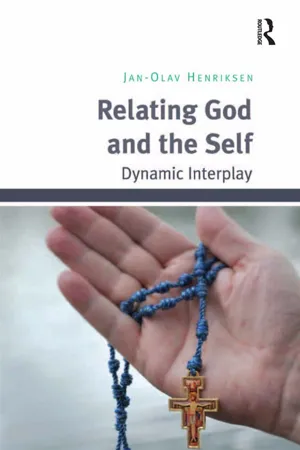
- 214 pages
- English
- ePUB (mobile friendly)
- Available on iOS & Android
eBook - ePub
About this book
Religion is not only about understanding the world - it is just as much about how to develop and shape the self's experience of itself. Because the religious self is shaped by our symbols of God - and symbols of God are also shaped by the self, theology and philosophy of religion cannot ignore this interplay, or the psychological dimension, when they discuss what symbols of God are adequate and not. By discussing critically different ways the symbol of God functions in the formation of the self, the book develops a nuanced and original approach to the interplay between God and the self. It suggests that play is actually an important metaphor in order to develop a dynamic understanding of religion's way of relating God and the Self. This approach challenges understandings of religion focussing only its cognitive claims, as well as those who emphasize doctrinal orthodoxy as the most important element in religion.
Information
1 From Soul to Self
DOI: 10.4324/9781315604664-2
1.1 Elements in the History of the Understanding of the Self as Challenges to the Philosophy of Religion
The Purpose of the Present Chapter
The postmodern movements in philosophy and the philosophy of religion have brought the self into focus. This, however, does not mean that no attention was paid to it previously. As we shall see, the self has had many names over the course of history.1 These names serve as indicators of what has been emphasized when speaking of the self. In the present chapter, I will present some of this material. The intention is not to cover the story of the different terms in its entirety, nor to give a thorough description of all of the relevant positions. Instead, the aim is to identify some main elements that will require consideration when we later try to develop a more systematic understanding and conception of the self.
When we look back at the history of Western ideas, we can see that what we call the “self” used to be understood as the “soul”. The soul, as the internal world of the human, was taken to be the “real” core of humanity, or that which defined it. As time went by, the soul “became increasingly understood in static, otherworldly terms, cut off from the flow, movement and the dynamism necessary for a full subjectivity.”2 As William Schmidt comments, this development emerged as a result of an understanding of the soul on the basis of an alliance between rationality on the one hand and “transcendent and largely dualistic religious and philosophical constructs of various epochs” on the other (Schmidt 1994, 1). However, today, this understanding of the soul or self is no longer firmly grounded in theory.
The analysis that Schmidt suggests immediately poses two challenges to theology and the philosophy of religion: first, these ways of thinking about the human need to develop their understanding of the self in accordance with current ways of thinking about humanity, and leave behind understandings that have become obsolete. Furthermore, this means that one has to develop an understanding of the relationship between God and the self that takes fully into account the historical conditioning of all of the elements that contribute to the development of the self. Thereby, one can hope to overcome the predicaments of a dualistic way of thinking about what a human self is when speaking about it from the point of view of the philosophy of religion.
This approach may also bring about an important benefit: it may help to clarify more concretely and empirically how and why the symbol of “God” contributes to the historical development of the self as a dimension of experience. As we will see in the next chapter, this understanding of the self emerges out of recent phenomenology, and may therefore also be understood as a way of addressing the development of the self in terms of its emotional development, or in terms of the development of a more cognitive type of narrative identity. However, we will first briefly examine some of the basic elements in the history of Western ideas that may help us to understand the self. As previously indicated, the aim is not to work through all of history, but to present some positions that may serve as models and means for preliminary reflection in the present chapter, and then for more extensive reflection in later chapters.
Plato
A first model for understanding the self (as the soul) and the thereby implicit relationship between the self and God can be found in Plato's thinking. As we shall see, Plato (and Augustine after him) was right in identifying a connection between God and the soul which has consequences for our perception of reality, but the way in which he developed this relation was deeply problematic. Two problems faced Plato as well as other early Greek philosophers: the question of origin (arché), and the problem of constancy and change. According to Plato's thinking, the solution to these problems lies in his understanding of the ideas: the ideas are the eternal forms from which everything originates. They secure and represent stability and constancy in a world that appears (to the senses) to be changing all the time.
With the experience of change as his point of departure, Plato's understanding of human experience is framed in a specific way: it is because we detect change and change only when dealing with sensory experience that the sensory world and the senses by which we experience it cannot be trusted. But something more than change appears in the human mind, something that seems to be stable and independent of change: our concepts, which mirror the eternal ideas. These concepts and ideas are only accessible by means of our rational faculties, and not through our senses. The senses only contribute by sending us into a reflective mode in which we can transcend the world of sensuous change by means of our rational faculties.
The body, then, can be experienced through our senses, but our thoughts and our internal world cannot. With these thoughts, Plato sets the stage for the important dichotomization of Western anthropology. There are two elements to consider in this regard: first, the soul is, according to Plato, self-moving, and needs no other cause in order to develop. It is self-directed, and has its source and its goal within itself (Schmidt 1994, 11). As regards its contents, the soul contains different movements such as will, attention, deliberation, joy, sorrow, fear, hatred and love. Therefore, and secondly, the soul harbors emotions.
Of course, the central issue in the work of Plato then becomes the relationship between the body and the soul. The soul, having its aim in itself, uses the body to achieve the necessary means for reflection. Through reflection, it orders and understands the world as something specific. Plato's hermeneutical point is that without the soul and the understanding it provides, we simply cannot understand the world as something definite. The world appears to us as a specific world only because we have a soul that helps us to understand it. However, without the body, we would not have access to the material that is the prerequisite for understanding what the world is truly like.
Thus far, this simplistic description of Plato's position indicates that there are two main components of the soul: emotions and rationality. This means that Plato, when developing different interpretations of the soul, suggests that the soul itself is divided (reason vs irrational desire), or even tripartite, due to the degree to which the soul's content is conditioned by the imports of the body's organs: The soul's passions, appetite and desire are all clearly conditioned by the external world and by our ability to form sensuous impressions.
The mature map of the soul according to Plato consists of three parts: (1) Reason, which is self-sufficient, and which guides us and provides us with the necessary framework for understanding our world as an ordered world, and not as chaos. Reason is therefore also a prerequisite for governing the other functions of the soul. (2) Will. This is the force by which the directions given by reason are carried out, as well as those of the inclinations of desire. The latter are the erotic forces that constantly seek higher or lower goals, without rest. (3) Appetite – for bodily self-preservation. Here, reason is only present indirectly because the satiation of some desires is necessary in order to continue living.
Plato's position on the soul is relevant for the philosophy of religion in the following way: as reason has its origin in the world of ideas or forms, and these forms are the origin of the world, this means that when the capacities of reason are employed, humans are employing that which makes them essentially human. In this manner, Plato's soul is essentialist: it defines the essence of humanity, but the experiences that provide the content of the second and third parts of the soul are contingent and not in any way necessary. When joined together with an understanding of God as immaterial, the understanding of both God and the soul tends to separate the world of experience from what is considered religiously relevant. This position not only leaves God with no function as regards the experiential dimensions of the self (thereby rendering God irrelevant in relation to human worldly experience); it also suggests that the self is essentially not related to the world of human experience. The experiential realm of human life is of no vital interest. In Plato, we can therefore see the emerging patterns of a way of thinking about the self that presents itself as a challenge to any type of theology or philosophy of religion that sees God as linked to, contributing to and opening up to concrete human experience of flux, change, development, growth and creativity.
Aristotle
Aristotle presents a clear alternative model to Plato's understanding of the soul, and is famous for his opposition to Plato's world of ideas. His alternative to the world of ideas has direct bearing on how he understands the human soul. First, Aristotle sees the soul as something whose contents have their foundation in experience. The only things we know are those we have experienced. Moreover, Aristotle is far more interested in individuality than Plato. Whereas Plato only allows for the individual as an opportunity to seek the eternal behind the individual, Aristotle focuses on the individual in order to understand the individual as a concept in itself. Hence, processes and development shape the focus in fairly different ways in Aristotle and Plato.
Where does this leave the soul? First, the rationality of the soul is neither a basis for its immortality, nor for its participation in a world other than the present one. All rationality is based on what we can understand due to our experience of this world. Rationality is concretely tied to human functions, but it can only be assessed and developed if we are able to determine the goal (telos) of human life. Thus, the telos is the determining factor for human change and development, and the telos is integrated into and conditions the concrete life-processes of humans.
One way of defining the soul is therefore to see it as “not divorced from matter, but [as] the very form of matter which allows an organism to function in a particular way” (Schmidt 1994, 20). Human development in all its forms, including bodily development and the development of skills and capabilities for judgment and action, is dependent upon the soul contributing to the change in matter in such a way that these different types of development can take place.
From a contemporary point of view, and with regard to the topic of this book, two immediate reflections arise from these initial considerations: First, Aristotle's monism allows us to see the soul (self) as something that contributes to human development when it works in cooperation with rational, bodily and emotional capacities. Human change and development are therefore necessarily dependent upon the cooperation between soul and body, as the soul is what presents the potentialities of human life with the telos of its actualization. The soul cannot reach its goal without the experiences and capacities of the body, and the body and our experiences cannot contribute to the development of human life unless guided by and worked over by the contents of the soul. This means, furthermore, that Aristotle is able to tie concrete human experience and development to the contents of the soul – even though we may no longer have the same idea of the telos of human life. W. Schmidt sums this up nicely:
What is so noteworthy in this Aristotelian viewpoint is not that the organism is the actualization of the potential of the soul, but its opposite, that soul is the actualization or realization of the potential of the natural body. Soul is the functional and structural accomplishment or completion gained by an organism. No longer is organized matter simply a poor reflection of a separate eternal essence, but the functioning of a material body is the essence of the soul. (Schmidt 1994, 20, my italics)
The importance of the pattern that Aristotle develops for understanding the soul also has bearings on contemporary understandings of the self: he opens up ways of understanding human development which differ from those presented by Plato. The soul is not given, but develops and becomes; it does so as an organism, and not as a separate entity. As Schmidt says, this means that “Aristotle can affirm a psychosomatic unity with a soul serving as source goal and essence of its bodily manifestation” (Schmidt 1994, 20). This soul (or self) develops itself along functional lines. Moreover, here is created an opening for the possibility that organisms may contain capacities for adaptation. The functions of the soul may be described briefly thus: the first level is the nutritive or vegetative function. This is followed by the animal or sensate function, which implies the capacity for seeing, touching, hearing, desiring, etc. The impressions received through the senses are ordered by our common sense, which synthesizes sensations into a coherent order. Desire causes movement in the soul and operates as a result of sensation and the pleasure or lack of pleasure to which sensation gives rise. Only after all these functions have been described does Aristotle move on to the human function of reason or rationality (Schmidt 1994, 21–5). It is striking that Aristotle identifies elements that are of vital importance for the early development of the infant, as later psychology has pointed out.
We need not go into this analysis in further detail. What is important about Aristotle's view of the soul is the way in which every part is linked to, and integrated into, the other parts, and that the functions are interdependent. There is, however, one point that I would like to mention, which may serve as a relevant bridge to the following reflections from the point of view of the philosophy of religion: The ability to use and engage all of the functions of the soul is, according to Aristotle, a condition for living a good life and for happiness. This understanding should not be interpreted first and foremost in terms of constantly shifting emotions, but should rather be seen as a basis for a thriving existence. Why point this out? Often, as we shall see, one is confronted with ideas about how God is against the development of personal skills, that “God” negates the conditions for pleasure and that the importance of thriving may be downplayed in forms of religion that underscore the necessity of obedience, putting one's own interests aside, and so on. As we will see later on, it is my contention that such ideas about religious life, as opposed to a life in which one thrives, contribute to the impediment and the obstruction of the development of the self. Thus, those who criticize modes of religion based on a spirit–body duality will have good reason to side with the insights of Aristotle. We will return to these matters in due course.3
Here, I will conclude only by commenting briefly...
Table of contents
- Cover
- Half Title Page
- Title Page
- Copyright Page
- Table of Contents
- Acknowledgments
- Introduction: God and the Self
- 1 From Soul to Self
- 2 On What Psychology May Say About “God” and the Self
- 3 The Theologies of Relational Pathologies and their Alternatives
- 4 Self, God and Religion: The Hermeneutical Interplay
- Bibliography
- Index
Trusted by 375,005 students
Access to over 1.5 million titles for a fair monthly price.
Study more efficiently using our study tools.
Frequently asked questions
Yes, you can cancel anytime from the Subscription tab in your account settings on the Perlego website. Your subscription will stay active until the end of your current billing period. Learn how to cancel your subscription
No, books cannot be downloaded as external files, such as PDFs, for use outside of Perlego. However, you can download books within the Perlego app for offline reading on mobile or tablet. Learn how to download books offline
Perlego offers two plans: Essential and Complete
- Essential is ideal for learners and professionals who enjoy exploring a wide range of subjects. Access the Essential Library with 800,000+ trusted titles and best-sellers across business, personal growth, and the humanities. Includes unlimited reading time and Standard Read Aloud voice.
- Complete: Perfect for advanced learners and researchers needing full, unrestricted access. Unlock 1.5M+ books across hundreds of subjects, including academic and specialized titles. The Complete Plan also includes advanced features like Premium Read Aloud and Research Assistant.
We are an online textbook subscription service, where you can get access to an entire online library for less than the price of a single book per month. With over 1.5 million books across 990+ topics, we’ve got you covered! Learn about our mission
Look out for the read-aloud symbol on your next book to see if you can listen to it. The read-aloud tool reads text aloud for you, highlighting the text as it is being read. You can pause it, speed it up and slow it down. Learn more about Read Aloud
Yes! You can use the Perlego app on both iOS and Android devices to read anytime, anywhere — even offline. Perfect for commutes or when you’re on the go.
Please note we cannot support devices running on iOS 13 and Android 7 or earlier. Learn more about using the app
Please note we cannot support devices running on iOS 13 and Android 7 or earlier. Learn more about using the app
Yes, you can access Relating God and the Self by Jan-Olav Henriksen in PDF and/or ePUB format, as well as other popular books in Theology & Religion & Religion. We have over 1.5 million books available in our catalogue for you to explore.