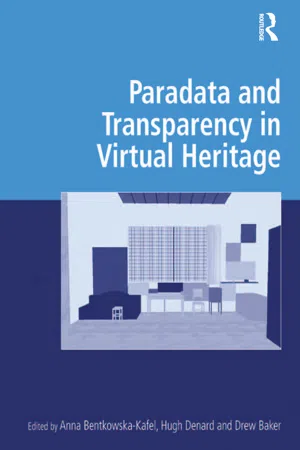
Computer-Generated Images (CGIs) are widely used and accepted in the world of entertainment but the use of the very same visualization techniques in academic research in the Arts and Humanities remains controversial. The techniques and conceptual perspectives on heritage visualization are a subject of an ongoing interdisciplinary debate. By demonstrating scholarly excellence and best technical practice in this area, this volume is concerned with the challenge of providing intellectual transparency and accountability in visualization-based historical research. Addressing a range of cognitive and technological challenges, the authors make a strong case for a wider recognition of three-dimensional visualization as a constructive, intellectual process and valid methodology for historical research and its communication. Intellectual transparency of visualization-based research, the pervading theme of this volume, is addressed from different perspectives reflecting the theory and practice of respective disciplines. The contributors - archaeologists, cultural historians, computer scientists and ICT practitioners - emphasize the importance of reliable tools, in particular documenting the process of interpretation of historical material and hypotheses that arise in the course of research. The discussion of this issue refers to all aspects of the intellectual content of visualization and is centred around the concept of 'paradata'. Paradata document interpretative processes so that a degree of reliability of visualization outcomes can be understood. The disadvantages of not providing this kind of intellectual transparency in the communication of historical content may result in visual products that only convey a small percentage of the knowledge that they embody, thus making research findings not susceptible to peer review and rendering them closed to further discussion. It is argued, therefore, that paradata should be recorded alongside more tangible outcomes of research, preferably as an integral part of virtual models, and sustained beyond the life-span of the technology that underpins visualization.
- 344 pages
- English
- ePUB (mobile friendly)
- Available on iOS & Android
eBook - ePub
Paradata and Transparency in Virtual Heritage
About this book
Table of contents
- Cover Page
- Title Page
- Copyright Page
- Dedication
- Contents
- List of Figures and Tables
- List of Plates
- Notes on Contributors
- Series Preface
- Acknowledgements
- Abbreviations and Acronyms
- 1 Introduction
- PART I CONVENTIONS AND EMERGING STANDARDS
- PART II DATA INTERPRETATION: METHODS AND TOOLS
- PART III DATA MANAGEMENT AND COMMUNICATION
- PART IV CONCLUSION
- Glossary of Terms
- Selected Bibliography
- Index
Trusted by 375,005 students
Access to over 1.5 million titles for a fair monthly price.
Study more efficiently using our study tools.
Frequently asked questions
Yes, you can cancel anytime from the Subscription tab in your account settings on the Perlego website. Your subscription will stay active until the end of your current billing period. Learn how to cancel your subscription
No, books cannot be downloaded as external files, such as PDFs, for use outside of Perlego. However, you can download books within the Perlego app for offline reading on mobile or tablet. Learn how to download books offline
Perlego offers two plans: Essential and Complete
- Essential is ideal for learners and professionals who enjoy exploring a wide range of subjects. Access the Essential Library with 800,000+ trusted titles and best-sellers across business, personal growth, and the humanities. Includes unlimited reading time and Standard Read Aloud voice.
- Complete: Perfect for advanced learners and researchers needing full, unrestricted access. Unlock 1.5M+ books across hundreds of subjects, including academic and specialized titles. The Complete Plan also includes advanced features like Premium Read Aloud and Research Assistant.
We are an online textbook subscription service, where you can get access to an entire online library for less than the price of a single book per month. With over 1.5 million books across 990+ topics, we’ve got you covered! Learn about our mission
Look out for the read-aloud symbol on your next book to see if you can listen to it. The read-aloud tool reads text aloud for you, highlighting the text as it is being read. You can pause it, speed it up and slow it down. Learn more about Read Aloud
Yes! You can use the Perlego app on both iOS and Android devices to read anytime, anywhere — even offline. Perfect for commutes or when you’re on the go.
Please note we cannot support devices running on iOS 13 and Android 7 or earlier. Learn more about using the app
Please note we cannot support devices running on iOS 13 and Android 7 or earlier. Learn more about using the app
Yes, you can access Paradata and Transparency in Virtual Heritage by Anna Bentkowska-Kafel,Hugh Denard in PDF and/or ePUB format, as well as other popular books in Business & IT Industry. We have over 1.5 million books available in our catalogue for you to explore.