- 180 pages
- English
- ePUB (mobile friendly)
- Available on iOS & Android
eBook - ePub
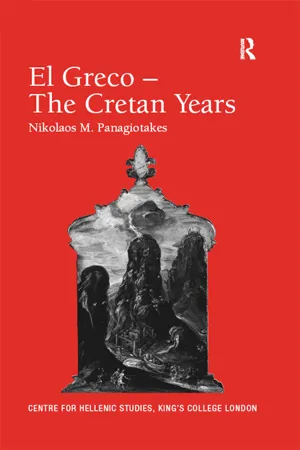
El Greco – The Cretan Years
About this book
Exploring all the available sources, this study, which until now was only available in Greek, presents us with an account of El Greco's life up to the time he left Crete for Italy in 1567 at the age of twenty-six, already an accomplished professional painter. Nikolaos Panagiotakes provides a thorough assessment of earlier research on Crete of the 16th century then goes on to present new conclusions on the life of El Greco deriving from the author's firsthand reading of Venetian archive material, including questions relating to his birthplace, family, name, religious affiliation, and apprenticeship as a painter. The evidence indicates that El Greco was an established professional 'master painter' earlier than had previously been thought and also that he had a family before leaving Crete, thus perhaps explaining why he did not later marry Jerónima de las Cuevas, with whom he had a son in Toledo. This work marks a valuable contribution to El Greco scholarship, particularly in its thoroughly substantiated assessment of the evidence regarding the formative years in the life of El Greco, one of the greatest of all European artists.
Part I
The Story So Far
1
Prior to 1961
Until the early twentieth century, the only fact known with much certainty about the early years in the life of El Greco was that he was born in Crete. He himself stated as much – indeed, not without some pride,1 though with the passing of time and as he settled into life in his new homeland these references became less frequent2 – in at least twelve of his signed works: ‘Made by Domenikos Theotokopoulos the Cretan’ (Δομήνικος Θεοτοκόπουλος ὁ Κρὴς ἐποίει).3 Another piece of information, from a Spanish source, referring also to the early period in the life of El Greco, had been insufficiently noted. This information is contained in three verses from one of the four sonnets dedicated to El Greco by the Trinitarian monk Fray Hortensio Félix Paravicino y Arteaga (1580–1633), a celebrated rhetorician and poet of the period (Plate 1).4 The last three lines of the sonnet composed by Paravicino for the tomb of El Greco in Toledo read as follows:
Creta le dió la vida y los pinceles,
Toledo mejor patria, donde empieza
a lograr, con la muerte, eternidades.
The lines are open to more than one reading, depending on where one places the first comma: after pinceles or after Toledo. As punctuated here, mejor patria is the object of dió: literally ‘Crete gave him life and paintbrushes; Toledo [gave him] a better home, where through death he began to attain eternity’. If, however, we omit the comma after pinceles, leaving the enjambment of the first to second verses, and place it instead after Toledo, the mejor patria stands in apposition to Toledo, and the meaning changes: ‘Crete gave him life, and Toledo – a better home – [gave him] paintbrushes etc.’ There can be little doubt that the first reading is both metrically and syntactically more satisfying, besides yielding a better meaning. Paravicino was hardly likely to claim that Domenikos, who arrived in Spain in 1577 at the age of thirty-six or thirty-seven, learnt the art of painting in Toledo. Remarkably, in the past many El Greco scholars preferred this second reading.5 Today, however, particularly since the discovery of documents concerning the Cretan period in his life, this interpretation has been abandoned.6 Paravicino’s statement that El Greco learnt to paint in Crete acquires more weight if we bear in mind the fact that the source of his information was in all probability El Greco himself. We know, for instance, that Paravicino was a close friend and admirer of El Greco, and even had his portrait painted by him in 1609, today in the Museum of Fine Arts, Boston, and described by William Jordan as ‘one of the great portraits in the history of art’.7
In 1903, the discovery of archive material threw new light on the precise place of birth of El Greco. At a trial of the Inquisition in Toledo (1582), where a seventeen-year-old Greek boy by the name of Michel Rizo Carcandil (the original Greek name may have been Chalkokondylis or Korkondeilos) was accused of being a crypto-Muslim (morisco), El Greco assisted as interpreter. At the trial he identified himself as born in the city of Candia, Crete (‘natural de la ciudad de Candia’),8 the capital of the island, today known as Heraklion (it is worth pointing out, however, that the name Candia in Western sources was generally applied to the island as a whole). Later, in 1927, further archive material revealed the year of his birth. During the course of protracted litigation between El Greco and the trustees of the Hospital of Charity, Illescas, concerning payment for an altarpiece he had painted for its church, El Greco twice stated, on 31 October and 4 November 1606, that he was sixty-five years old (‘de hedad de sesenta y cinco anos’).9 In other words, he must have been born in 1541 or, at the very earliest, between 4 November and 31 December 1540. In accepting his statement as fact, we have to assume of course that El Greco himself knew exactly how old he was – a state of affairs that cannot always be taken for granted at this period.
This limited but valuable information regarding his date and place of birth, and his apprenticeship as an artist, is all we can glean from the wealth of published material from Spanish archives, which nevertheless shed considerable light on the life and career of El Greco after his arrival in Spain, from 2 July 1577 until his death on 7 April 1614. For the first half of his life – that is, the formative Cretan and Italian periods (1540/1–1577) – our knowledge was frustratingly limited.10 It should come as no surprise, therefore, that until just two decades ago scholars tended to pass over El Greco’s Cretan period in somewhat embarrassed haste, despite the significance it surely has for an assessment of his personality and art. What is more surprising is that earlier scholars rarely took the trouble to consult the available accounts of Crete in the sixteenth century and the so-called Cretan Renaissance. With the exception of routine comparisons of El Greco’s style with the art of Byzantium and of post-Byzantine Crete, most commentators tended to view his homeland as a remote, exotic and somewhat unlikely location, which historical accident had appointed as birthplace of the great painter. Moreover, there was a tendency to date El Greco’s arrival in the West as early as possible so as to extend the period of his apprenticeship and artistic career in Venice and Rome, though efforts to reconstruct this apprenticeship and artistic activity remained for the most part guesswork.11 The main emphasis, naturally, was placed on his Spanish period, which was also the best documented. But this partial and somewhat misleading account inevitably led to a limited view of the personality of the Cretan artist, which virtually turned him into a Spaniard.12 There is no denying, of course, that El Greco’s thirty-seven years in Spain were the most creative of his career, when he produced works that earned him the ‘eternity’ foreseen in Paravicino’s verses. However, it is also clear that when in far-off Spain El Greco made a conscious effort to preserve his Greek identity and not be totally assimilated into his adopted environment. This is demonstrated not only by the signatures on his paintings, all of which are in Greek (though he knew Latin, Italian and Spanish, and lived for a total of forty-seven years in a primarily Latin-speaking environment),13 but also by the fact that he was known as ‘El Greco’ (an appellation that he formally adopted),14 that he had many Greek books in his library, and that his circle of friends included Greeks of Toledo until the last years of his life.15
Notes
1 H.E. Wethey, El Greco and his School, Princeton, N.J.: Princeton University Press 1962, vol. 1, 111, claims that the use of the word ‘Cretan’ by El Greco should not be understood as evidence of excessive pride or vanity with regard to his origins, since a considerable number of Italian painters of the time (e.g. Vasari, Titian, Raphael) frequently signed their works with their name and city or province of origin. However, the reference to his nationality, when considered alongside the fact that throughout his career he unfailingly used Greek when signing his works, suggests that it was more than a simple statement of geographical provenance or imitation of common practice. True, Wethey remarks that it was not unknown for even some Italian artists of the Renaissance to sign, on occasion, their works in Greek, but this was hardly the rule and cannot be compared with the practice of El Greco, whose mother tongue was Greek. See also below, pp. 19–20 notes 13–15. On the unbridled affection of Cretans in this period for their home island when in foreign lands, sometimes expressed in extravagant terms, see N.M. Panagiotakes and A.L. Vincent, ‘Νέα στοιχεῖα γιὰ τὴν Ἀκαδημία τῶν Stravaganti τοῦ Χάνδακα’, Thesaurismata 7 (1970), 63 and note 39, and Panagiotakes, ‘Ὁ ποιητὴς τοῦ Ἐρωτοκρίτου’, Πεπραγμένα τοῦ Δ´ Διεθνοῦς Κρητολογικοῦ Συνεδρίου, vol. 2, Athens, 318 and note 26.
2 See also Wethey, El Greco and his School, vol. 1, 111–12. Out of a total of twelve paintings in which El Greco uses the word Κρής (Cretan), four date from his Italian period (1567–1577) (nos. 62, 104, 105, 134), seven from his first four years in Spain (1577–1580), and just one (no. 29) from the period 1590–1595. That he kept the memory of his homeland alive until the end of his life is indicated by two of his paintings (c. 1605–1610 and c. 1610–1614) depicting the apostle Paul writing his epistle to Titus, ‘first to be ordained bishop of the Church of the Cretans’, ‘Πρὸς Τῖτον τῶν Κρητῶν ἐκκλησίας πρῶτον ἐπίσκοπον χειροτονηθέντα’; see N. Cossío de Jiménez, El Greco, Notes on his Birthplace, Education and Family, Oxford: Dolphin Book Co. 1948, 8–9 (though she seems to be confused about the location of Balsamonerou monastery, which is situated close to both the church of St Titus at Gortyna and Kaloi Limenes), and Wethey, El Greco and his School, vol. 1, 79 and vol. 2, 104, 106. Other evocations of Crete that have been noted by scholars in El Greco’s work of his Spanish period are less convincing: for instance, that the headscarf of the Lady in a Fur Wrap (whose sitter has been identified by some as El Greco’s companion Jerónima de las Cuevas) is Cretan (Wethey, El Greco and his School, vol. 2, 93) or that in the painting of the apostle Andrew with St Francis (c. 1590–1595) (Wethey, El Greco and his School, vol. 2, 110) the mountain behind St Francis represents Mount Ida on Crete (Cossío de Jiménez, El Greco, 9–10).
3 That is, nos. 1, 29, 62, 78, 80, 81, 104, 105, 116, 117, 134 and 265 in the list drawn up by Wethey, El Greco and his School, vol. 2, pp. 5, 29, 43–4, 51–4, 55–6, 68–9, 75–7, 134–5, 140, of 285 works by El Greco considered genuine. In one case (no. 1), instead of ἐποίει (lit. ‘made’) he wrote ὁ δείξας (‘he who painted’) (this formulation also appears in his painting of the Dormition of the Virgin found in Ermoupolis, Syros: see below, p. 30 note 11), while in one other work (no. 104) the word ἐποίει is omitted. By contrast, El Greco signs no fewer than 88 works without adding the epithet ‘the Cretan’, particularly in works that date from his later period (1580–1614) [Δομήνικος Θεοτοκόπουλος (or Θεοτοκόπολι{ς}) ἐποίει]. On seven occasions he signs his work just with his name, on thirteen occasions he uses his initials Δ. Θ., on three occasions he signs with χεὶρ Δομήνικου (‘the hand of Domenikos’), while in seven other works the signature has either not survived at all or only in part. However, much of what Wethey writes in his detailed examination of the signatures of El Greco (El Greco and his School, vol. 1, 111–14) is erroneous or unfounded, as noted by M. Chatzidakis, ‘Παρατηρήσεις στὶς ὑπογραφὲς τοῦ Δομήνικου Θεοτοκόπουλου’, Ζυγός 103–4 (October 1964), 79–83, which still remains the best treatment of this subject to date. It is worth noting that the formulations Θεοτοκόπολις and Θεοτοκόπολι, which El Greco occasionally uses when signing his works, should probably not be seen as an archaising form of Θεοτοκόπουλος, but rather as the Greek transliteration of the Latin/Italian form of his name, Theotocopoli. This rendering of Greek names ending in -opoulos arising from the false etymology that associates the word with place names of the type Constantinopoli, Monopoli, Napoli, Tripoli and so on is found often in Latin documents: see, for instance, J. Longnon and P. Topping, Documents sur le régime des terres dans la principauté de Morée au XIVe siècle, Paris 1979, 69–94 (Basilopoli, Calchiopoli, Coropoli, Demetropoli, Dimetropoli, Exenopoli, Lazaropolis, Maniopoli, Nicolop{o}li, Pesopoli, Philippopoli, Piropoli, Stephanopoli, Ynizopoli, Vasilopoli, in the year 1354), 159 (Ghaliopoli, in 1365), and, in Crete, Dragondopoli (1438) (F. Thiriet, Déliberations des assemblées vénitiennes concernant la Romanie, vol. 2 (1364–1465), Paris and The Hague 1971, 169, nos 1361–1362); Thodorin Constantinopoli, (K. Panagiotopoulos, ‘Ἕλληνες ναυτικοὶ καὶ πλοιοκτῆτες ἀπὸ τὰ παλαιότερα οἰκονομικὰ βιβλία τῆς Ἑλληνικῆς Ἀδελφότητας Βενετίας (1536–1576)’, Thesaurismata 11 (1974), 291 note 30) (Constantinopoli was a seaman and merchant of Candia (see DC, b. 35bis (Memoriali), libro 24, f. 84r, 306v (1555, 1556), whose name in Greek was Θεόδωρος Κωνσταντινόπουλος: see NC, b. 159, (Michele Marà), f. φςv, 17 November 1566; Pappagianopoli (1599) (A. Tenenti, Naufrages, corsaires et assurances maritimes à Venise, 1592–1602, Paris: SEVPEN 1959, 565), the surnames Papadopoli, Alvisopoli and others. Cf. also N.V. Tomadakis, ‘Κρητικὰ ἐπώνυμα σὲ -όπουλος τῆς Ἑνετοκρατίας’, Ἀθηνᾶ 75 (1974–1975) (Βυζαντινὰ καὶ μεταβυζαντινά. Φιλολογικαί, ἱστορικαὶ καὶ γλωσσικαὶ μελέται ἀνατυπούμεναι μετὰ προσθηκῶν καὶ πινάκων, vol. 2, Athens 1978, 112).
4 On Paravicino and his relations with El Greco see J. Camón Aznar, Dominico Greco, Madrid: Espasa-Calpe 1950, vol. 2, 1136–42 and J. Brown, ‘El Greco, the Man and the Myths’, in El Greco of Toledo, Boston: New York Graphic Society 1982 (this volume is th...
Table of contents
- Cover
- Half Title
- Title Page
- Copyright Page
- Dedication
- Table of Contents
- Acknowledgements
- About the author
- Preface
- Translator’s note
- Abbreviations
- List of illustrations
- Introduction: Education and culture in Venetian Crete
- Part I: The Story So Far
- Part II: New Discoveries
- Appendix 1. The documents
- Appendix 2. Churches and works of art in Candia listed by Stella (1625)
- Bibliography
- Select publications since 1990
- Index
Trusted by 375,005 students
Access to over 1.5 million titles for a fair monthly price.
Study more efficiently using our study tools.
Frequently asked questions
Yes, you can cancel anytime from the Subscription tab in your account settings on the Perlego website. Your subscription will stay active until the end of your current billing period. Learn how to cancel your subscription
No, books cannot be downloaded as external files, such as PDFs, for use outside of Perlego. However, you can download books within the Perlego app for offline reading on mobile or tablet. Learn how to download books offline
Perlego offers two plans: Essential and Complete
- Essential is ideal for learners and professionals who enjoy exploring a wide range of subjects. Access the Essential Library with 800,000+ trusted titles and best-sellers across business, personal growth, and the humanities. Includes unlimited reading time and Standard Read Aloud voice.
- Complete: Perfect for advanced learners and researchers needing full, unrestricted access. Unlock 1.5M+ books across hundreds of subjects, including academic and specialized titles. The Complete Plan also includes advanced features like Premium Read Aloud and Research Assistant.
We are an online textbook subscription service, where you can get access to an entire online library for less than the price of a single book per month. With over 1.5 million books across 990+ topics, we’ve got you covered! Learn about our mission
Look out for the read-aloud symbol on your next book to see if you can listen to it. The read-aloud tool reads text aloud for you, highlighting the text as it is being read. You can pause it, speed it up and slow it down. Learn more about Read Aloud
Yes! You can use the Perlego app on both iOS and Android devices to read anytime, anywhere — even offline. Perfect for commutes or when you’re on the go.
Please note we cannot support devices running on iOS 13 and Android 7 or earlier. Learn more about using the app
Please note we cannot support devices running on iOS 13 and Android 7 or earlier. Learn more about using the app
Yes, you can access El Greco – The Cretan Years by Nikolaos M. Panagiotakes,translated by John C. Davis in PDF and/or ePUB format, as well as other popular books in History & World History. We have over 1.5 million books available in our catalogue for you to explore.