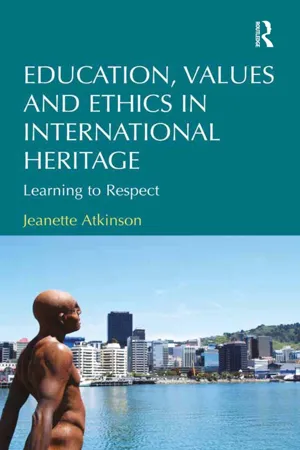
eBook - ePub
Education, Values and Ethics in International Heritage
Learning to Respect
- 240 pages
- English
- ePUB (mobile friendly)
- Available on iOS & Android
eBook - ePub
About this book
The changing and evolving relationship between museums and communities, Indigenous, ethnic and marginalized, has been a primary point of discussion in the heritage sector in recent years. Questions of official and unofficial heritage, whose artefacts to collect and exhibit and why, have informed and influenced museum practice. Developing from this, a key issue is whether it is possible to raise awareness of differing cultural perspectives, values and beliefs and incorporate this into the education and training of heritage professionals, with the aim of making 'cultural awareness' an integrated and sustainable core part of future heritage training and practice. This book discusses perceptions of values and ethics, authenticity and significance, and documents the historical, heritage and education context in North America, Scandinavia and the United Kingdom, with a particular emphasis on Aotearoa New Zealand. The author explores whether it is possible to learn respect for differing cultural perspectives through the undertaking of educational programmes, identifies various approaches that could complement the development of students and professionals in the cultural heritage and preservation sectors, and offers a means of actively engaging with cultural and professional values through a Taxonomy for Respecting Heritage and Values.
Information
Chapter 1 Concepts of Engagement in Aotearoa New Zealand
DOI: 10.4324/9781315578866-2
In establishing the context for the ideas and developments discussed in this book, this chapter introduces the research location – Aotearoa New Zealand. The country has a long pre-colonial history under Māori settlement, but since European colonization Māori culture has faced severe acculturation, which has only slowly been changing since the mid to late 1960s. In the heritage sector, too, Eurocentric ideas of museum practice have dominated the curation and preservation of artefacts, regardless of their origins. This chapter explores the effects of this practice and how it is now developing to be more inclusive and aware of differing attitudes to cultural treasures.
Historical Development of Aotearoa New Zealand
The date of Māori occupation of Aotearoa New Zealand has long been disputed. Non-Māori historians in the early twentieth century collated Māori migration myths and from these suggested a discovery date of 925–950 CE and a settlement date of 1150–1350 CE (Hiroa 1949; Sinclair 1959; Schwimmer 1966; Metge 1967). This became the accepted start date for Māori settlement. When Hanson (1989) questioned the basis on which these dates had been formulated in his controversial article ‘The Making of the Māori’, suggesting that this was a ‘cultural invention’, he was strongly criticized, not least by Māori themselves, who perceived the criticism to be of their culture – of Māoridom. One of the consequences of the article was that the subject of the Moriori people was again raised. It was suggested not only that these migrants, originating from Melanesia, were the first settlers in Aotearoa New Zealand but that the subsequent Māori colonizers either had driven them from the land or had decimated their population. These opinions suggested to some people that, as Māori were also colonizers, and as they were not the first settlers, they had no more right to the land than did the Europeans (King 1999).
This situation had serious political implications for Māori land claims and calls for compensation through the Waitangi Tribunal (an official body instituted in 1975 to examine Māori claims over land rights and to adjudicate on compensation for loss of land, where appropriate; see Sharp 1997: 4). King (1997, 2003) sought to quell the controversy in his History of New Zealand. He detailed the origins of the Moriori, describing them as early Polynesian settlers of Māori ethnicity; he then outlined their migration from Aotearoa New Zealand to the Chatham Islands, to the east of Aotearoa New Zealand, and the subsequent colonization of Aotearoa New Zealand by a further wave of settlers, the ancestors of the current Māori population. Māori settlement of Aotearoa New Zealand is now thought, from archaeological evidence, to be more akin to the late thirteenth century.
Abel Janszoon Tasman was the first European to discover Aotearoa New Zealand in 1642, but it was not until 1769, when the, then, Lieutenant James Cook set foot there, that the gradual colonization of the country by Europeans began. Initially, it was predominantly sailors, whalers, sealers and escaped criminals from prison colonies in Australia who frequented the islands. French explorers also made contact with the Māori people: Jean de Surville shortly after Cook and Marc-Joseph Marion du Fresne in 1772 (Belich 1996; King 2003).
European interaction with local Māori iwi (tribes), especially in the north of the North Island, led to trading and intermarriage. A number of Americans and Europeans, predominantly British, became members of local iwi, married within the tribes, fought with them against other iwi and had their faces and bodies tattooed (moko). They lived, and were treated by Māori, as Māori. Some were kept as slaves, some warriors, while others attained the status of ‘white chiefs’. The majority were men and these became known as ‘Pākehā Māori’.1 One of the most well-known Pākehā Māori was Frederick Edward Maning, author of History of the War in the North of New Zealand, Against the Chief Heke (1862) and Old New Zealand: A Tale of the Good Old Times (1863). Born in Dublin in 1811, he lived in Aotearoa New Zealand from 1833 to 1882 (Maning and Calder 2001). Although a handful of women married into iwi (either voluntarily or otherwise) and assisted in Māori/European interactions, they were not known by this term (Bentley 1999; see also Maning and Calder 2001).
In 1835, representatives of the British Crown drew up the Declaration of the Independence of New Zealand in Waitangi. Although Māori had no input into the writing of the document, some iwi did sign it. However, a statement claiming that a ‘Confederation of United Tribes’ had signed the document was inaccurate, as there was not one cohesive Māori nation but a collection of nations (King 2003: 154–5). The document had no constitutional status, and ‘an official in the Foreign Office in London referred to it as “silly and unauthorised”’ (King 2003: 155). However, it ‘became a foundation for the assertion of Indigenous rights, and it was another step in the direction of a formal constitutional relationship with Great Britain’ (King 2003: 155; emphasis in original).
Trading with the country expanded further with the establishment of the New Zealand Company in 1838. Under the management of Edward Gibbon Wakefield, the company started to buy land cheaply from Māori, with a view to making a profit from the European settlers who were starting to move to the country (Belich 1996). Wakefield and the company also had plans to set up a government in Aotearoa New Zealand, a situation that prompted the British Government to act in order to establish the country as a colony. It was as a consequence of these actions, together with concerns over lawlessness and the safety of both British settlers and the Māori, that Aotearoa New Zealand was annexed and the Treaty of Waitangi was drawn up (King 2003).
The Treaty was to prove a key factor both in legitimizing colonial rule in Aotearoa New Zealand and in the subsequent process of decolonization of the country (Perrott 2005). Representatives of the British Crown and Māori chiefs signed it on 6 February 1840 (London 1994; Cohen 1998). The two versions, one in English and the other in Māori, presented at the signing, in Waitangi in the north of the North Island, contained significant differences in wording within their texts. This led to disputes over their interpretation, which would ultimately have long-term repercussions for relations between the European settlers and Māori iwi (tribes).
The British Crown and Māori iwi interpreted concepts such as ‘governance’ and ‘sovereignty’ quite differently (Belich 1996; King 2003).1 In the Māori version of the Treaty, the word ‘sovereignty’ was translated as ‘kāwanatanga’, which literally meant ‘governorship’, a very different concept. In contrast, in the Declaration of the Independence of New Zealand, sovereignty had been translated as ‘mana’ (prestige, power, customary authority), a more appropriate comparison for Māori people. The words ‘tino rangatiratanga’ were also contentious. Māori understood this concept as being able to ‘exercise their chieftainship over their lands, villages and all their treasures’; in other words, have sovereignty over their lands. In the English version, however, the wording was somewhat less strong, stating that Māori could have ‘full exclusive and undisturbed possession of their Lands and Estates Forests Fisheries and other properties’ (King 2003: 160). Therefore, by signing the document, Māori believed that they were granting the British the right to govern while, in fact, the British Crown was establishing supreme authority over Aotearoa New Zealand.
Perceptions of the importance of the Treaty were also different. Many chiefs had signed the Treaty with their tattoo, their moko, rather than a signature, as this increased the mana and, therefore, importance of the document (King 1978: 14). New Zealand history indicates that it is debatable, however, whether the British placed the same level of importance on the document. These misunderstandings and misinterpretations were to have a fundamental influence on the historical and political development of Aotearoa New Zealand, which eventually culminated in the establishment of the Waitangi Tribunal in 1975 to settle Māori land claims.
The Treaty itself (comprising nine original documents, which had toured the country being signed) was, after being saved from a fire, stored in a safe until 1908. At this time, it was found to have been both water- and rodent-damaged. The subsequent attempts at repair in 1913 further damaged the documents, causing more staining. It was not until 1977 and 1978, following more than 15 years of exhibition, that initial conservation work was finally carried out. The final conservation of the Treaty was completed in 1987 and it was housed in its current secure display in 1990. Named the Constitution Room, the exhibition of the Treaty in its current surroundings in Archives New Zealand (ANZ) places it as the ‘founding document’ of Aotearoa New Zealand, a catalyst for the resurgence of Māori cultural identity and the land claims being negotiated through the Waitangi Tribunal (Archives NZ 2012a; SSC 2005).
In the decades after the signing of the Treaty, Europeans increasingly settled in Aotearoa New Zealand. Predominantly from the United Kingdom, but from various other European countries as well (particularly France and Germany), migrants moved to the major settlement towns of Auckland and Wellington in the North Island, and Christchurch and Dunedin in the South Island. Many of the settlers were poor people looking for a better life, where they could work for themselves, rather than as servants as had been the case in the United Kingdom. This founding sentiment has had an effect on the political development of the country, resulting in an egalitarianism that now permeates all levels of society (King 2003).
The effect of so many settlers, however, resulted in an increasing requirement for land. Some Māori iwi (tribes) were apparently willing to sell land to Europeans; others lost their land through unscrupulous deals by an individual or several individuals within an iwi; still others had their lands confiscated when they opposed the rule of the British Government. This latter action led to wars over land between Māori and Europeans in both the 1840s and 1860s, known as the New Zealand Wars (Cannadine 2001). From having possession of all the land pre-Europeanization, by 1891 Māori held only 17 per cent of the land in Aotearoa New Zealand and their numbers had also reduced from being 50 per cent of the population in 1860 to only 10 per cent in 1891 (King 2003). Some iwi suffered more than others did. If an iwi was believed to have harboured a fugitive, for example, then this could automatically lead to land confiscation. This was the case for a number of iwi, particularly Tūhoe, around the Bay of Plenty region. Between 1868 and 1872, at the time of the New Zealand Wars, they were associated with Te Kooti Arikirangi Te Turuki, who was believed, by some Māori, to be a missionary and resistance leader, but was considered an outlaw and murderer by the British (Belich 1996; King 2003).
In addition to losing land, Māori culture was gradually eroded through acculturation and prohibitions on speaking the Māori language. Until the Second World War, many Māori still lived in rural tribal communities. Status was determined by mana and importance placed on whakapapa (genealogy). Instead of being allowed to learn on the marae (central area of Māori village and its buildings), however, as was traditional in Māori society, children were taught in Native Schools ...
Table of contents
- Cover Page
- Half-Title Page
- Dedication
- Title Page
- Copyright Page
- Table Of Contents
- List of Tables and Figure
- List of Abbreviations
- A Note on Māori Language and Pronunciation
- Glossary
- Acknowledgements
- Preface
- Introduction
- 1 Concepts of Engagement in Aotearoa New Zealand
- 2 Concepts of Engagement in the Wider Context
- 3 Values and Ethics from an International Perspective
- 4 Defining Values, Exploring Ethics
- 5 Authenticity and Significance
- 6 Education and Heritage
- 7 The Intersection of Museums and Communities
- 8 Language and Context for Understanding
- 9 Communicating Values: Affective Principles
- Conclusions
- Bibliography
- Index
Trusted by 375,005 students
Access to over 1.5 million titles for a fair monthly price.
Study more efficiently using our study tools.
Frequently asked questions
Yes, you can cancel anytime from the Subscription tab in your account settings on the Perlego website. Your subscription will stay active until the end of your current billing period. Learn how to cancel your subscription
No, books cannot be downloaded as external files, such as PDFs, for use outside of Perlego. However, you can download books within the Perlego app for offline reading on mobile or tablet. Learn how to download books offline
Perlego offers two plans: Essential and Complete
- Essential is ideal for learners and professionals who enjoy exploring a wide range of subjects. Access the Essential Library with 800,000+ trusted titles and best-sellers across business, personal growth, and the humanities. Includes unlimited reading time and Standard Read Aloud voice.
- Complete: Perfect for advanced learners and researchers needing full, unrestricted access. Unlock 1.5M+ books across hundreds of subjects, including academic and specialized titles. The Complete Plan also includes advanced features like Premium Read Aloud and Research Assistant.
We are an online textbook subscription service, where you can get access to an entire online library for less than the price of a single book per month. With over 1.5 million books across 990+ topics, we’ve got you covered! Learn about our mission
Look out for the read-aloud symbol on your next book to see if you can listen to it. The read-aloud tool reads text aloud for you, highlighting the text as it is being read. You can pause it, speed it up and slow it down. Learn more about Read Aloud
Yes! You can use the Perlego app on both iOS and Android devices to read anytime, anywhere — even offline. Perfect for commutes or when you’re on the go.
Please note we cannot support devices running on iOS 13 and Android 7 or earlier. Learn more about using the app
Please note we cannot support devices running on iOS 13 and Android 7 or earlier. Learn more about using the app
Yes, you can access Education, Values and Ethics in International Heritage by Jeanette Atkinson in PDF and/or ePUB format, as well as other popular books in Art & Museum Studies. We have over 1.5 million books available in our catalogue for you to explore.