- 250 pages
- English
- ePUB (mobile friendly)
- Available on iOS & Android
eBook - ePub
Political Rock
About this book
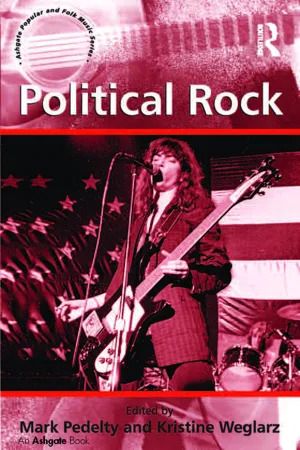
Political Rock features luminary figures in rock music that have stood out not only for their performances, but also for their politics. The book opens with a comparative, cultural history of artists who have played important roles in social movements. Individual chapters are devoted to The Clash and Fugazi, Billy Bragg, Bob Dylan, Rage Against the Machine, Pearl Jam, Sinead O'Connor, Peter Gabriel, Ani DiFranco, Bruce Cockburn, Steve Earle and Kim Gordon. These artists have been chosen for their status as rock musicians and connections to political moments, movements, and art. The artists and authors show that rock retains a critical strain, continuing a tradition of rock politics that matters to fans, activists, and movements alike.
Information
Chapter 1
The Clash and Fugazi: Punk Paths Toward Revolution
Mark Andersen
Punk rock has always been about more than music. Born largely as a reaction to the self-indulgent excesses and perceived failure of the Sixties rock/revolution, punk offered a blistering critique of idealism sold out or gone bad. This stance was a double-edged sword. Punk’s “ruthless criticism of everything existing” (Tucker 1978, 13) spared no one, and could slip towards nihilist extremes. As such, it made the idea of harnessing music for radical change an ever more perilous venture, where only angels or fools might dare to tread. Beneath noisy blasts of illusion-shattering negation, however, an unbending belief in the power of music to generate transformation still lurked. This sense of mission defined no band—punk or otherwise—more profoundly than The Clash. Dubbed “The Only Band That Matters” by record company PR, the moniker nonetheless accurately evoked the risk-taking heroic spirit the band sought to embody.
If the early Clash track “Hate And War” encapsulated the band’s dismissal of the 1960s, they nonetheless borrowed freely from certain currents of that era. Indeed, their jagged, relentless music, close-cropped hair, quasi-military garb, and fierce sense of purpose suggested nothing less than a marriage of Detroit agit-rock legends MC5 with the Chinese Cultural Revolution. If their embrace by the punk underground proved short-lived as the band stretched towards broader horizons, The Clash never fully forsook that initial commitment or community.
Many bands rose in the wake of The Clash also willing to risk the ridicule that might come with marrying rock to the pursuit of revolution. Of this hardy breed, the DC punk juggernaut Fugazi was perhaps the most worthy of The Clash mantle. Fugazi would likely not have existed without The Clash before them, but in many ways they lived out the band’s rhetoric in a much more consistently convincing manner. Joe Strummer would essentially acknowledge this in the last years of his life, offering them accolades on several occasions, even going so far to identify Fugazi as the single band who best exemplified “the spirit of punk” in a Rolling Stone interview in 2000 (Andersen and Jenkins 2003, 411).
The two bands both shone with a sense of defiant grandeur, and their sound often shared a similar anthemic roar, freely mixing dub and raw rock power. Nonetheless, their respective paths could hardly have been more different. Indeed, in certain ways The Clash provided an object lesson to Fugazi on what not to do. Tracing the divergent trajectories of The Clash and Fugazi can sketch the wide parameters of possibility that punk facilitated. Together, they suggest both the power and pathos of seeking to promote revolution within a system of, by, and for multinational corporations, while utilizing an artistic form that many look to simply for entertainment.
The Clash: The Power of Revolutionary Contradiction
From the beginning, The Clash were a vibrant, fascinating—and often infuriating—mix of contradictions. No band was more associated with punk’s “Year Zero” stance, blithely dismissing rock icons The Beatles, the Rolling Stones and Elvis Presley in “1977,” the b-side of their debut single, “White Riot.” But if the songs warned of class war, suggesting that racial and generational differences be set aside for a more fundamental confrontation, this incendiary piece of art was made possible through the largesse of CBS Records, then one of the massive behemoths dominating the rock music industry.
“Punk died the day The Clash signed to CBS”—fiery punk scribe Mark Perry famously declaimed in his flagship fanzine Sniffin’ Glue in 1977 (Echenberg and Perry 1996, 51). Proved demonstrably false by the decades that followed, Perry’s words nonetheless suggested both the immense meaning and deep contradiction fixed from birth at the heart of The Clash: they wanted to be the biggest rock band in the world while somehow still remaining “death or glory” heralds of revolution. If their inability to live this paradox on a lasting basis would bring the band crashing to earth within a decade, it also could not erase the genuine idealism and undeniable vision that The Clash brought to their art.
Lead singer/lyricist Joe Strummer was not only the eldest member of the band, but also its soul. Rising out of the British squat scene, he was fascinated by American folk radical Woody Guthrie as well as the dwindling embers of late 1960s’ revolt. Already active with a rising roots rock band, The 101ers—named after the ramshackle squat where the band mostly lived and practiced—Strummer was wrenched out of his backward gazing by a blistering Sex Pistols show in April 1976. Shortly thereafter, he was poached from The 101ers by guitarist Mick Jones and bassist Paul Simonon to front their nascent punk unit. This gifted pair had fallen under the spell of agitator/sometime-manager Bernie Rhodes who played a catalytic role in not only assembling the band, but in encouraging them to write about urgent sociopolitical issues.
If the Sex Pistols lit the fuse of the punk explosion, The Clash sought to guide the movement’s subsequent momentum in a constructive direction, making the implicit affirmation behind “no future” rants more explicit and convincing. “We never came to destroy,” Strummer noted to Melody Maker in 1978 (Jones 1978), adding years later in a punk retrospective, “We had hope in a sea of hopelessness” (Haimes 1995). After the collapse of 1960s’ rock idealism, however, this was a tricky line to walk. Strummer captured the ambivalence well in a March 1977 interview with Melody Maker journalist Caroline Coon, later reprinted in her landmark book, 1988: The New Wave Punk Rock Explosion. Asked how potent a rock band can be in making political change, Strummer responded, “Completely useless! Rock doesn’t change anything. But after saying that—and I’m just saying that because I want you to know that I haven’t got any illusions about anything, right—having said that, I still want to try to change things” (Coon 1977, 74).
Although The Clash were careful never to accept a narrow ideological label, they stood on the revolutionary socialist Left, as Strummer acknowledged elsewhere. Given this anti-capitalist stance, Strummer admitted to Coon—who later would briefly manage the band—that, “signing that contract (with CBS) did bother me a lot” (Coon 1977, 79). However, despite their roots in the emergent punk underground, The Clash were not interested in being captured by a narrow subculture; no, world conquest was their aim. If the Top Ten beckoned, it was ostensibly in the hopes of bringing a message of radical change to the broadest possible segment of the population.
In retrospect, The Clash signing to a major label like CBS seems preordained. Simply put, capitalism would provide the avenue for reaching the masses that then, in principle, could be mobilized to overturn that same system and build something better. CBS, of course, had been home to Bob Dylan, Janis Joplin, and other 1960s’ countercultural heroes, and the label put out an ad in the tumultuous year of 1968 that promised “The Man Can’t Bust Our Music” (Andersen and Jenkins 2009, xiv). Such stretches of rhetorical audacity seemed thinly disguised folderol then; by the mid-1970s, such pretensions sounded dubious indeed.
Not surprisingly, new bands arose, inspired by The Clash, yet as hostile to the band’s compromises as punk had been to those of the hippie generation. Among them was anarchist trailblazer Crass. In 1978 Crass co-founder Penny Rimbaud acidly noted that “CBS promotes the Clash—but it ain’t for revolution, it’s just for cash” (MacKay 1996, 91). For his part, Strummer dismissed Crass as “a storm in a teacup,” critiquing their DIY self-sufficiency as “self-defeating, ’cos you’ve got to be heard” (Crassical Collection, Penis Envy 2010, back cover).
If some of this was self-serving, Strummer’s words also offered a valuable corrective. Their third album, London Calling, pushed back against a version of punk that was growing ever narrower. As Strummer groused in 1979:
I don’t want to see punk as another slavish image and everything is pre-planned and pre-thought out for you to slip into comfortably like mod or hippie music or Teddy Boy rock’n’roll. In ’76 it was all individual. There was a common ground, it was punk, but everything was OK. Punk’s now become ‘he’s shouting in Cockney making no attempt to sing from the heart and the guitarist is deliberately playing monotonously and they’re all playing as fast as possible so this is punk’ … God help us, have we done all that to get here? (Andersen 1981, 4)
To Strummer, punk was a spirit, an attitude and approach to life, not a set of clothes, a haircut, or even a style of music (Andersen and Jenkins 2009, 415). If this was, once again, possibly convenient for the band’s commercial aims, the critique rang true. Soon many of The Clash’s hardcore underground punk critics would find themselves striving to transcend self-made straitjackets. In this way, the revolutionary political ambition of The Clash was matched with a parallel all-encompassing musical openness.
With London Calling the Clash began to stake its claim not only on underground insurgency, but also on the broader arena of mainstream rock’n’roll. In so doing, they abandoned their disavowal of pre-punk sounds for a fervent embrace of the many forms and faces of rebel music. While the album quickly rose into the American Top Twenty, the full measure of its success came ten years later when the record was honored as “The Album of the Eighties” by Rolling Stone (Gray 2010, 479). This global vision was made even clearer by the following triple album set Sandinista. This album sought to articulate—with wildly varying degrees of success—a world music that spanned jazz, salsa, reggae, funk, rap, folk, steel drum, disco, and rock tied together only by a common grass-roots focus and a radical political commitment. The latter was made obvious by the album’s title, an approving nod to victorious Central American Marxist revolutionaries then bedeviling the Reagan Administration. The band itself created anguish for its corporate sponsors in certain ways. This began as early as 1977 with their third single “Complete Control” which lambasted record company machinations in savagely direct terms. Likewise, the band won few friends in the CBS boardrooms with their insistence on first putting out the double LP London Calling for the price of a single album, only to then up the wager with the three-for-the-price-of-one Sandinista. In the end, however, the band was playing the rock industry game, one arguably as fixed as any casino. In 2001, Strummer offered a sober assessment that The Clash had become “corporate revolutionaries,” acknowledging that the band’s success spread their message, but also made mountains of money for its corporate overlord, all at tremendous cost to their humanity:
(I was) professionally paid to be a rebel, which is truly insane. And it was only going to get worse. Say we’d gotten as big as U2 … life would only be—“Photo shoot. Do the interview. Go to the video shoot. Go do another interview. Fly to Rio. Play the Asshole Stadium. Come back in a helicopter.” And all the time you’re supposed to try and write something real, or think real, or get through to real people—to “keep it real,” as they say. Im-fucking-possible. (Mills 2001)
Seen from a 21st-century vantage point, CBS seems the victor over The Clash in practical political terms; far more corporate profit than revolution resulted from the uneasy marriage. Still, a fair observer would grant that the band wanted it both ways, to be stars and revolutionaries, much like the failed effort by protest folkie-gone-rocker Phil Ochs to revolutionize America by developing a hybrid of Elvis Presley and Che Guevara (Eliot 1989, 190).
Fortunately, The Clash had the artistic gifts to walk that fine line, at least for a time. Surely songs like “Clampdown,” “Guns Of Brixton,” “Lost In The Supermarket,” and “Death Or Glory” (from London Calling), or “The Magnificent Seven,” “The Call Up,” “Charlie Don’t Surf,” “The Equaliser,” and “Washington Bullets” (from Sandinista) packed as much radical punch as any of their early work, albeit in more diverse and accessible musical forms. Articulating an internationalist anti-capitalist, anti-imperialist, anti-war vision amidst the dark days of Reagan and Thatcher, The Clash created tunes that could move millions of units in stores, but also move bodies into action in the streets.
Their mission to bring “revolution rock” to the mainstream seemed to be succeeding when the band broke through to Top Ten acclaim in 1982 with their fifth album Combat Rock and embarked on a stadium tour with none other than 1960s’ icon The Who. Skeptics, however, pointed out that the songs—London Calling’s “Train In Vain” and Combat Rock’s “Should I Stay or Should I Go”—that brought the Clash mass acclaim were anything but insurrectionary calls to arms. If the third of their hit singles—“Rock The Casbah”—had more depth musically and lyrically, its liberatory message was undermined by the silliness of its companion MTV video. Moreover, it faced swift co-optation for reactionary ends, especially as radical Islam became the latest “free world” bogeyman, replacing Red Scare anti-communism. Strummer was said to have burst into tears years later upon hearing that the song’s name was painted on American bombs used in the Persian Gulf War, thus becoming a tool of the militaristic imperialism the band had always opposed (Temple 2007).
This ugly turn suggested the dangers and limitations of revolution through consumption. But if The Clash’s politics were becoming a bit muddled or watered down by 1983, personal affairs within the band were even dodgier. First, gifted drummer Topper Headon was ejected from the band because of his heroin addiction, and then co-founder and musical mainstay Mick Jones was kicked out due to rock star tendencies. Remaining originals Strummer and Simonon soldiered on with returned manager Rhodes, assembling a new Clash with relative newcomers: guitarists Nick Sheppard and Vince White, and drummer Pete Howard. Meanwhile, rumors of lawsuits over the band’s name swirled and Clash bank accounts were frozen in the subsequent disputes with Jones (Lacey 1984, E3).
The rhetoric of this revamped Clash suggested that Strummer had been listening to his underground critics. The band disavowed their mainstream path and moved back towards raw rebel punk. For a time this leap seemed like it might succeed; the “revolution rock” banner flew boldly once again in new songs such as “The Dictator,” “Are You Ready For War?,” “North And South,” “Three Card Trick,” “Sex Mad Roar,” and “This Is England.” However, behind-the-scenes chaos and internal contradictions within the unit—exacerbated by Strummer’s depression after the death of his father and his mother’s subsequent terminal illness—crushed the promise of the moment. As a result, this latest Clash stab at cultural revolution flamed out prematurely not long after a risky but bracing “busking tour” in mid-1985. “We made all the rock band mistakes in the book,” Strummer conceded ruefully later, “And maybe even invented a few of our own” (Letts 2000).
From London to Washington, DC
While this drama was playing out, the reverberations of The Clash’s music and politics had been rippling out across the globe. In late 1978, an unlikely but ferocious new band rose from the African-American communities of Southeast, Washington, DC, and neighboring Prince George’s County, Maryland. While dubbed Bad Brains—an obvious reference to NYC punks, The Ramones—this imposing all-black quartet drew much of its inspiration from one-time Clash manager Caroline Coon’s seminal punk book, 1988, and in particular its sections on The Clash.
A local 1979 feature on Bad Brains noted that the band had been energized by “the example of The Clash playing for free in disadvantaged areas of London,” an approach they had read about in 1988 and also in Overthrow, the newspaper of the 1960s’ holdover Youth International Party, more commonly known as the Yippies, who were still active in DC and a few other locales (Andersen and Jenkins 2009, 44). In part, this was a reference to one of the most successful mixing of music and politics in the punk-era UK: the Rock Against Racism campaign, instigated and influenced by members of the Socialist Workers Party, among others (Widgery 1986, 42). The Clash stood right at the nexus of rock and reggae that gave this movement its artistic force as well as its cachet in youth culture circles, bringing black, brown, and white together in a concerted, creative effort to turn back the then-rising tide of neo-fascism in Britain.
Together with other punk-related artists such as X-Ray Spex, Stiff Little Fingers, Tom Robinson Band, and The Specials, The Clash were early supporters of Rock Against Racism, and essentially headlined their largest and most celebrated event, the massive outdoor concert and rally at Victoria Park in 1978. While the unique conditions that generated the potency of this movement were not easily replicable outside of Britain, its example did help spur Clash fans such as Bad Brains into action. Given that Washington, DC, was partly built by slave labor and suffered decades of segregation and racial tension, Rock Against Racism seemed particularly relevant. When Bad Brains performed their own audacious Rock Against Racism concerts in the notorious Valley Green public housing complex in 1979 and 1980, they drew a committed knot of their mostly white fan base across DC’s volatile racial dividing lines. Among those electrified by the music and audience at the first Valley Green show—and performing at the second via the band Teen Idles—was a white teenage punk named Ian MacKaye.
A long-haired skater kid into Ted Nugent and other hard rock luminaries, MacKaye had been initially exposed to the punk rebellion through listening to Georgetown University radio station WTGB. After experiencing punk live for the first time—a chaotic, mind-blowing performance by The Cramps at a February 3rd, 1979 benefit protesting the closing of WGTB—the 16-year-old MacKaye cut off his shoulder-length locks in preparation for his second show two weeks later: The Clash at Ontario Theatre on their first US tour. That evening served to cement his new path (Andersen and Jenkins 2009, 34).
Shortly thereafter, MacKaye was bushwhacked by the staggering power of Bad Brains op...
Table of contents
- Cover Page
- Title Page
- Copyright Page
- Contents
- Notes on Contributors
- An Introduction to Political Rock: History, Genre, and Politics
- 1 The Clash and Fugazi: Punk Paths Toward Revolution
- 2 Peter Gabriel: The Masked Activist
- 3 Bob Dylan: Someone Else’s Stage
- 4 Bruce Cockburn: Canadian, Christian, Conservationist
- 5 Billy Bragg: Mixing Pop and Politics
- 6 Sinéad O’Connor: The Collision of Bodies
- 7 Steve Earle: The Politics of Empathy
- 8 Kim Gordon: Ordinary, Feminist, Musician
- 9 Ani DiFranco: Making Feminist Waves
- 10 Pearl Jam: The Conscience of Arena Rock
- 11 Rage Against the Machine: Militant Poetics
- Index
Trusted by 375,005 students
Access to over 1.5 million titles for a fair monthly price.
Study more efficiently using our study tools.
Frequently asked questions
Yes, you can cancel anytime from the Subscription tab in your account settings on the Perlego website. Your subscription will stay active until the end of your current billing period. Learn how to cancel your subscription
No, books cannot be downloaded as external files, such as PDFs, for use outside of Perlego. However, you can download books within the Perlego app for offline reading on mobile or tablet. Learn how to download books offline
Perlego offers two plans: Essential and Complete
- Essential is ideal for learners and professionals who enjoy exploring a wide range of subjects. Access the Essential Library with 800,000+ trusted titles and best-sellers across business, personal growth, and the humanities. Includes unlimited reading time and Standard Read Aloud voice.
- Complete: Perfect for advanced learners and researchers needing full, unrestricted access. Unlock 1.5M+ books across hundreds of subjects, including academic and specialized titles. The Complete Plan also includes advanced features like Premium Read Aloud and Research Assistant.
We are an online textbook subscription service, where you can get access to an entire online library for less than the price of a single book per month. With over 1.5 million books across 990+ topics, we’ve got you covered! Learn about our mission
Look out for the read-aloud symbol on your next book to see if you can listen to it. The read-aloud tool reads text aloud for you, highlighting the text as it is being read. You can pause it, speed it up and slow it down. Learn more about Read Aloud
Yes! You can use the Perlego app on both iOS and Android devices to read anytime, anywhere — even offline. Perfect for commutes or when you’re on the go.
Please note we cannot support devices running on iOS 13 and Android 7 or earlier. Learn more about using the app
Please note we cannot support devices running on iOS 13 and Android 7 or earlier. Learn more about using the app
Yes, you can access Political Rock by Kristine Weglarz, Mark Pedelty in PDF and/or ePUB format, as well as other popular books in Media & Performing Arts & Music. We have over 1.5 million books available in our catalogue for you to explore.