![]()
Chapter 1
Prologue
For some Arabs the past is an ephemeral existence on the fringes of desert or sea; for others it begins with the Pharaohs or the Mediterranean of Phoenician and Classical times. Yemen is different: it is one of those rare places where the past is not another country. I have eavesdropped on tribesmen visiting the National Museum and heard them expressing surprise, not at the strangeness of the things they see, but at their familiarity. Asking the way to al-Qalis, the site of Abrahah’s ecclesia in Sana, I have been quoted the Qur’anic account of his defeat on the Day of the Elephant as if it had happened yesterday. There is a feeling in Yemen that the past is ever-present.
Tim Mackintosh-Smith, Yemen: the Unknown Arabia, 2000
Yemenis don’t get it: they don’t understand that we’re not on the same time line.
World Heritage Center official, May 2004
Now everyone is aware of heritage. Before it was something they just did.
Sanaa native and wife of a builder, June 2005
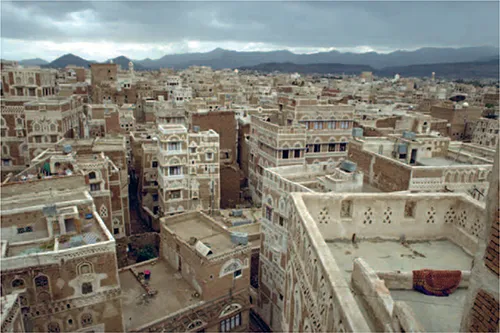
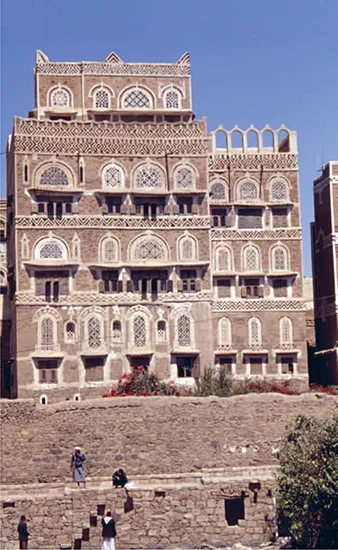
The city of Sanaa has inspired travelers, historians, and architects for centuries—from medieval geographers and travelers, to present-day devotees of “vernacular” architecture and heritage sites. As in other fortified towns in Yemen, the basic building element of Sanaa is the tower house—here made of stone and brick, its openings decorated with exuberant plasterwork (figures 1.1, 1.2). Rising majestically from an agricultural plain, flanked by palace precincts and several low walled suburbs, Sanaa presented a striking image to the traveler, as captured by the off-cited saying:
One must go to Sanaa no matter how long the journey
Though the hardy camel droop, leg-worn along the way.1
The image of the city remained more or less intact through the middle decades of the twentieth century. Today, visitors to Sanaa experience a very different place. The old quarters are embedded in a sprawling metropolis, which apart from certain traditional decorative features, looks much like cities in other developing countries. Within the space of a few decades, the Sanaa of history and legend—the everyday city that middle-aged Yemenis remember from their childhoods—has become the “old city.” The walled core has been assigned to what preservationists call the “historical timeline”: a place representative of a past which, at least in theory, has been superseded.
Figure 1.1 View of the old city of Sanaa, 1995
Source: © Aga Khan Award for Architecture/Courtesy of the Architect.
Conservation (or historic preservation, as it is called in the U.S.) can be understood as a complex of ideas, practices, and institutions that are unique to the modern era. The aim of conservation, as described by practitioners, is to save and preserve artifacts of the past so that they may be transmitted to future generations. While all cultures have selectively maintained and preserved elements of the past, the modern era is distinguished by an ideology of conservation constructed in opposition to, and in many ways mirroring, the ideology of progress. The contest between the two has been played out in the physical and social fabric of cities: while grand schemes and urban renewal have destroyed historic districts, conservation policy has tended to reify them; both strategies have isolated and circumscribed the traditional within the modern.
In many ways, the formation of a heritage discourse in Yemen has followed a similar trajectory: the old city of Sanaa and other heritage sites are portrayed as symbols of the past, as the country strides confidently into the future.2 But what is unusual about Sanaa, and other towns in Yemen, is that they have come to be seen as “historic” within the space of a single generation.
Modernization is relatively recent in much of Yemen, at least in terms of its material and economic impact; this is especially true in the northern highlands, where the city of Sanaa is located. It did not begin in earnest until the end of civil conflict in the late 1960s (following the 1962 revolution); it rapidly gathered momentum with the mass migration of Yemeni workers to the Gulf during the oil boom of the 1970s, and the influx of cash remittances. Until this time the city of Sanaa consisted of the walled core, and adjacent suburbs and palace precincts. Now the city was engulfed by development, and stretches of wall were demolished to facilitate it. Conditions in the old core deteriorated as residents left, trash accumulated, and the installation of a modern water system swelled the groundwater, destabilizing the massive tower houses. Foreigners working in the city, along with several local professionals, warned that the “old city”—a kind of living relic—was in danger and that something had to be done to save it. The World Heritage Convention had just been adopted by UNESCO in 1972. Planning began for an International Safeguarding Campaign for the old city of Sanaa, the capital of what was then North Yemen, and also for Shibam-Hadhramaut, in what was then South Yemen.3 European and Arab advocates saw in these places outstanding examples of traditional vernacular settlements, embodying qualities that modern cities had lost.
Figure 1.2 Al-Qasimi House, overlooking one of the old city’s many urban gardens
The UNESCO Campaign for Sanaa has been internationally recognized, most notably by an Aga Khan Award for Architecture in 1995. At least initially, it emphasized urban upgrading and revitalization rather than monuments conservation. The authors of the Campaign and Yemeni policymakers insisted that the old city was both living and historic: it should not be turned into a museum. As such, conditions had to be improved to keep people living there. The Campaign set the tone for conservation activities throughout the country: conservation and modernization were seen not as conflicting operations, but rather as complementary.4 It is important to note that when the Campaign was launched, there were no planning mechanisms to guide new development; decades later, they exist but are deficient. This makes the effort to safeguard the old core even more remarkable: today it is one of the best-serviced sector of the city, although it makes up a fraction of its area.5
Conservation is part of a wider, and remarkably vibrant, public discourse about architecture, building practice, and public space.6 It is seen as a new, imported idea and yet also as strangely familiar—in part, because the protected buildings and places are not fully part of the “past.” In contrast to other parts of the world where conservation was introduced at a later date to remediate the effects of modernization, in Yemen the two processes have been more or less concurrent. This has resulted in a paradox: unlike many other countries in the Middle East that abandoned traditional construction practices in the nineteenth century, in Yemen these building practices have not died out: builders now in their forties and fifties, trained as apprentices to old ustas (master builders), or having acquired “traditional” skills after working in modern construction, continue to practice. At the same time, the social forms that helped shape, and were shaped by, the built fabric persist in both the old city and the new districts. Middle-aged and older individuals see the houses they grew up in exalted as “heritage.” Yemenis, in effect, are not separated from their heritage by an historical divide; rather, living traditions are to be conserved. Yet this everyday environment is increasingly seen as “historic”—and it is this passage that is the subject of the present work.
The rapidity of development, and the great contrast between the old and new districts, reinforced the image of old Sanaa as a medieval city frozen in time. The trope is common in conservation literature and in discourse about the city in general:
The Old City of Sanaa is unique in Yemen and also in the World. Its value lies in the unforgettable impression made by the whole; an entire city of splendid buildings combined to create an urban effect of extraordinary fascination and beauty. The Old City is untouched by time; it is a functioning city of the Islamic ages.7
The idea of the old city as “a functioning city of the Islamic ages” still resonates with many in Sanaa. Like much of the highland plateau, the city was insulated from development pressures until the mid-twentieth century, largely because of the isolationist policies of the ruling imams. When the country opened to the global market, it had the force of a sudden shock. For historian Muhammad Jazim, who worked with the UNESCO Campaign, the changed conditions of materials life led to a new conception of the past:
Before modernity, everything related to the past, not the present—the ancestors (al-ajdad), and so forth … As for turath, heritage, it’s a modern usage, Egyptian or Lebanese in origin. None of the old [Yemeni] documents refer to crafts, buildings, or customs as turath … Material life was part of religious and social life. Once the material effects of modernity happened, people came to see these things as part of the past.8
These material changes correspond to shifting social relations and cultural practices. It is a complex and nuanced process—as suggested by the opening quotations. Individuals and groups are confronted with representations of the historic past—but they often see themselves as representing and embodying this past, or traditional practices and ways of life. They confront these representations with ambivalence. The heritage of Yemen is now celebrated on the world stage: Yemenis from all walks of life, working within the heritage field and outside it, are proud of this. Yet for some, heritage recalls a legacy of oppression and backwardness that continues to color the present. When the builder’s wife quoted above bumped her head on a low ceiling in her house in the old city, she gestured toward the ceiling and laughed: “This is turath (heritage)!”—meaning that what outsiders see as heritage can only be backward and inconvenient.
But in many cases, Yemenis of various backgrounds are protective of “tradition.” One example is the taste for neo-traditional architecture—what some builders call “new heritage” (turath jadid). It can be seen throughout the new districts, and in the old city itself (Figure 1.3).9 This new turath prompted the remark we heard earlier by the World Heritage Center official:
Yemenis don’t realize that the toy is broken. In the past, techniques developed over very long periods of refinement and adjustment; building was firmly grounded in hundreds of years of tradition. Rulers of the past could not go wrong: people knew what was good and what was bad. But now we don’t have the same confidence: the magic touch is gone. We no longer have the capacity to transform our historic cities. It’s a different era: we are not on the same time line.10
The implication is, of course, that traditional forms should be abandoned in favor of modern ones (an experiment which, incidentally, was tried under the Egyptian occupation of the 1960s, and largely rejected). The official added that Yemenis are attached to their heritage, even though they conceive of it differently. “The strange thing about Yemen,” he mused, “is that it didn’t go through a conceptual process.” The past, in effect, is too close to be fully “other.”
The heritage enterprise is part of the larger project of history-making—a project which has, over the last several decades, come to hold increasing interest for scholars. Because of the country’s relatively recent modernization, we have a unique opportunity to observe how modern understandings of the past build on older forms.11 Sanaa is a fascinating case study of this process—revealing a texture and richness that is usually missing in current coverage of the country. But the relevance of the case study is wider: it allows us to gain distance from our own assumptions and practices, and to denaturalize them.
Our “modern” view of the past developed under specific cultural-historical conditions in early modern Europe. It is the product of a developmental view of history, based on the notion of perpetual progress that leaves the past behind—irrelevant to the present and the future. This radical “otherness” of the past has had, and continues to have, profound effects on the collective psyche and culture. It has been inscribed in our built environment, in the ideologies of both high modernism and conservation, which in many ways mirror each other.12 Reinforced...