eBook - ePub
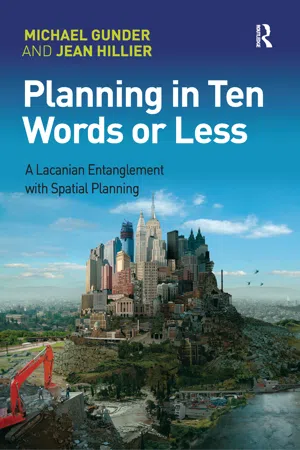
Planning in Ten Words or Less
A Lacanian Entanglement with Spatial Planning
- 256 pages
- English
- ePUB (mobile friendly)
- Available on iOS & Android
eBook - ePub
Planning in Ten Words or Less
A Lacanian Entanglement with Spatial Planning
About this book
This book takes a Lacanian, and related post-structuralist perspective to demythologize ten of the most heavily utilised terms in spatial planning: rationality, the good, certainty, risk, growth, globalization, multi-culturalism, sustainability, responsibility and 'planning' itself. It highlights that these terms, and others, are mere 'empty signifiers', meaning everything and nothing. Based on international examples of planning practice and process, Planning in Ten Words or Less suggests that spatial and urban planning is largely based on the construction and deployment of ideological knowledge claims.
Information
Chapter 1
Planning as an Empty Signifier
Introduction
Political language … is designed to make lies sound truthful and murder respectable, and to give an appearance of solidity to pure wind.
George Orwell, Politics and the English Language, cited in Watson 2004, 1
Cities are places of contested desire. Some of these strands of aspiration and hope are shaped and channelled into collective action for a better tomorrow through the deployment of techno-political narratives which strive to signify potentially better futures. These spatial planning narratives and the words that summarise and label them are largely predicated on the implication that something in the present is lacking or incomplete. The city would be better, if only …
Spatial planning practice performs a dialogue between planning and urban governance that is full of signifying terms and labelling buzzwords, or ‘weasel words’ as Watson (2004) terms them, many of which imply innovative means to achieve desired states of urban well-being, such as deploying ‘Smart Growth’, ‘new urbanism’ or ‘bohemian indexes’ to plan for ‘sustainable’, ‘globally competitive’, and ‘liveable’ cities. We argue that these terms, and many others, are mere ‘empty signifiers’, meaning everything and nothing – comfort terms – all things to all people. These desirous states of living and being, which most of us would aspire towards and, accordingly, attempt to shape our cities to achieve, are often illusions, attained, at best, with limited success.
In this book we demythologise ten of the most heavily utilised terms in the spatial planning literature and practice: certainty, the good, risk, growth, globalisation, multiculturalism, sustainability, responsibility, rationality and ‘planning’ itself. Our analytical ‘debunking’ frame for this ‘game of buzzword bingo’ is predominantly Lacanian in origin and especially the contemporary Lacanian-inspired thought of Slavoj Žižek, although we also refer to other poststructuralist authors including Michel Foucault, Gilles Deleuze, and Jacques Derrida and touch on the sociology of Ulrich Beck, Pierre Bourdieu, Anthony Giddens, Jürgen Habermas and Henri Lefebvre. Our specific objectives in this book are:
• To engage with the ideological underpinnings of orthodox spatial planning theory and practice – city-making – from a post-structuralist cultural studies perspective.
• To understand the dimensions of desire, aspiration and fantasy embedded in our construction of human settlements and how our dreams are integral in the shaping of social reality and the actualisation or materialisation of our built environments.
• To illustrate how these desires are channelled by mechanisms of power in situations of contemporary governance.
• To consider alternative perspectives from which to engage with, and challenge, contemporary spatial planning practice.
We explore each of the ten heavily used, but often contested, planning words drawing on examples of planning practice and process from the UK, North America and Australasia. We conclude that ‘city-making’ in the 21st century should shed its tradition of seeking impossibly idealised end-states through means-end orientated planning. In place of this still largely instrumental form of planning, we suggest that spatial planning might be more effective as a process of contingent emergence and trajectory without closure. We trust that the readers of this book will gain a new insightful understanding of city-shaping and the role that contemporary spatial planning plays in this process. We also wish to illustrate the important role of ideology in this approach. Indeed, we will contend that social reality is largely constructed by the materialisation of our fantasies through our actions. We hope that this book contributes to the exposure of such constructs and empty signifiers, including that of ‘planning’ itself.
This introductory chapter will begin by questioning the ontological nature of spatial planning. Is planning an art, is it a science, or is it merely an ideology? We will suggest that planning has dimensions of both art and science largely tied together via constructs of ideological illusion. The chapter will then suggest why the psychoanalytical insights of Jacques Lacan, and his adherents, are useful to engaging with the ideological constructs of planning and that of wider social reality. It will also outline why the application of Lacanian thought is often criticised. We then introduce the reader to the Lacanian concept of ‘master signifiers’ and the implications that these have for both the construction of knowledge and our identifications with others through our social, political and cultural networks, which in aggregate constitute society. We apply the concept of master signifiers to our ten contestable words of spatial planning to illustrate how we will deploy this concept, as well as other aspects of Lacanian theory, to demystify the symbolic1 equipment of planning. The chapter concludes with an overview of the book’s structure.
An Introduction to Spatial Planning: Art, Science or merely Ideology?
[P]lanners are strange characters. They traffic in fiction, and at the same time ask us to take it all seriously. Even more surprising, those of us who are not planners do take them at their word and grant them the authority they crave. This open-eyed reliance on fiction as a basis for public policy is remarkable, to put it mildly, and requires explanation. (Van Eaten and Roe 2000, 58)
According to the 19th-century founder of linguistics, Ferdinand de Saussure (2006, 67), all words in any language have two dimensions. The first is the word’s identity, what it looks or sounds like, the shape of letters or utterance comprising it. This is called its signifier. The word ‘cup’ is composed of the letters ‘c’, ‘u’, ‘p’, in that order and pronounced ‘kΛp’ in the International Phonetic Alphabet. The second dimension is what it means, its signification. A cup is ‘a small bowl-shaped container’ (Concise Oxford Dictionary 1992, 283). A cup is an unambiguous word. Other words are more complex, with multiple significations, take for example the word ‘sound’. It can be a adjective, noun or verb and mean to be ‘healthy’, or a ‘noise’, or a ‘narrow passage of water’, as well as mean, to ‘test the depth of water’. Saussure (2006) observed that any connection between the signifier and what it signifies is largely arbitrary. Some words, such as ‘democracy’ or ‘freedom’, have many significations, often with conflicting meanings, which may be both of slight and of a more profound differential nature. Laclau (1996, 2000, 2005) argues that politics arise in the gap between signifier and its signification: where conflicting meanings are employed and we try to fill this gap. Here the signifier gives coherence to a grouping of conflicting meanings by signifying it or giving a general label of explicit connotation and agreement for this contested ground. Laclau (2003, 2005) calls this an empty signifier.2
We contend that planning is an empty signifier. The label or signifier, constituting the word of ‘planning’ acts as a holder of meaning: what it signifies, its signification. Another way of thinking about an empty signifier is that it refers to a word that acts just like a cup, which can contain almost anything as long as it can be poured or placed into it, for example, milk, wine, oil, blood, water or sand. Planning is a signifier, similar to a cup, which can contain many diverse meanings and nuances. This can be narrowed down to some degree by putting another adjectival label before it, such as regional planning, urban planning, strategic planning, development assessment planning, communicative planning or spatial planning. For the purpose of this book we consider planning to be about the ‘co-ordination, making and mediation of space’ so we have chosen the term ‘spatial planning’ as delineated by the UK Royal Town Planning Institution (2001) and articulated in 21st-century British government policy (Doak and Parker 2005). This will at least allow the planners, the planned, and the topic of planning that we wish to address, to not be confused with, for instance, financial planners or wedding planners who have little to do directly with shaping the built environment. Yet, this focus on a partially defined ‘spatial planning’ still allows much room for contested meaning. We suggest that planning is inherently a contested and contestable term and will remain an empty signifier in this regard.
Perhaps one reason for planning’s diverse and contestable meanings is its complex historical evolution. Planning largely evolved out of the art of architectural design and the science of civil engineering in the built environment. It was initially deployed largely to address issues of public health and housing to offset the adverse impacts of industrialisation in the late 19th and early 20th centuries, with a general aim to produce a rational and progressive city (Ashworth 1954; Boyer 1983; Sandercock 1990). Its early adherents, if professionally qualified at all, were generally master design practitioners (Brooks 1988). However, the positivistic3 social science model tended to dominate planning after the Second World War, especially in the United States (Banerjee 1993; Dagenhart and Sawicki 1992; Perloff 1957). For many planning practitioners, academics, or commentators, in the mid-20th century, planning was a scientific engagement with place making, often predicated on instrumental rationality and positivistic physical and/or social science (Faludi 1973; Friedmann 1987; Hopkins 2001). This scientific rationality still tends to dominate spatial planning education and practice in many parts of the world, although this worldview has come under challenge increasingly since the 1980s (Healey 1997; Hillier 2002, 2007; Sandercock 1998, 2004).
We agree with this challenge to purely predictive scientific planning for we argue that spatial planning can never be just about the facts which constitute empirical science – what we know to be true – because facts in science must be inherently observable and measurable. Facts must always inherently reside in the present and the past, not in the future. Yet, we contend that planning is ultimately about what will, or might be, the future. Planning thus incorporates components of human values, desires and aspirations at its core. Analytical science’s conceptualisations of causal relationships cannot fully engage with such intangibles. Intangibles, by their very nature, are unable to guarantee predictability to ‘allow planners to propagate principles and laws across an undulating and often resistant social landscape’ (Beauregard 2001, 437). Science has limited predictive power when it comes to human hope, ambition and values (Flyvbjerg 2001). We argue, therefore, that science and the application of facts have a definite, but limited application in planning practice, no matter how much we might wish to rely on universally applicable scientific techniques. Spatial planning practitioners, we suggest, also need to engage with other means of understanding when attempting to shape the world.
Eugenie Birch (2001) refers to planning as an art-form of design, craft4 and presentation, while Heather Campbell (2006) describes spatial planning as ‘the art of situated ethical judgement’, since value judgement is an inescapable dimension of the planning process. In this light, Campbell and Marshall (2006, 240) suggest that planning is ‘an activity which is concerned with making choices about good and bad, right and wrong, with and for others, in relation to particular places.’ We suggest that most planning theorists would agree (see, for example: Flyvbjerg 1998, 2001; Forester 1989, 1999; Healey 1997), although we indicate in later chapters that others would argue for ‘better’ or ‘worse’ choices, rather than ‘good’ or ‘bad’ ones in the quotation above.
With planning’s loss of its architectural dimension in the latter half of the 20th century, Talen and Ellis (2004, 22) suggested that the literal ‘art’ in planning diminished, or at least its aesthetic dimension of ‘the artistic side of urbanism’. The authors suggest that a ‘review of city planning journals from 1960 to 2002 reveals that the artistic component of city planning is rarely discussed’ (22). They call for a re-establishment of the aesthetic in planning as a merger of art, life and nature to create ‘beautiful cities [which] inhabit the edge between order and disorder’, that is between novelty and certainty of order (27).
We suggest that spatial planning practice has indeed an artful dimension. This is an art partially predicated on aesthetic values, but also one drawing on the wider emotions and affects of its constituents. Beyond aesthetics, Nigel Thrift (2008, 240) refers to this ‘artful’ manipulation of built environments, or cityscapes, as technologies and engineering of affect: ‘a series of highways of imitation-suggestion’ often producing behaviours of anxiety, obsession and compulsion. We suggest that this ‘art of affect’ may impose ideological effects on the populace, what Foucault refers to as governmentality5 (Gunder and Mouat 2002; Hillier 2002), and we suggest that this is a central mechanism of many contemporary spatial planning processes (Gunder and Hillier 2007a). Further, in this work we argue that planning both induces ideological belief and behaviours in the populace it plans for; and is, in itself, at least partially constituted as a discipline for its practitioners and supporters by a set of ideological beliefs.
Back in 1960, Donald Foley identified a strong ideological dimension to British planning; an ideological factor that ‘tends to build around seemingly self-evident truths and values and, in turn, to bestow a self-justifying tone to its main propositions and chains of reasoning’ (Foley 1960, 212). Eric Reade (1987, 98) also argued that planning offers an emotively satisfying ideology for its supporters; one that justifies their social position in ‘what they do and are’. Reade attributed six dimensions to planning’s ideological construction:
• It is ‘a body of thought devised to serve an interest’, in this case the planning profession (or possibly, more recently, cynics might argue, that of the development industry);
• It is one that ‘relies heavily on unstated and often unconscious basic assumptions’ about the ‘big questions’ based on ‘presuppositions’ that are often ‘unclear’;
• ‘It is prescriptive’ about ‘states of affairs we “ought” to prefer’, but ‘frequently omits to mention that the states of affairs which it regards as self-evidently desirable can only be justified in terms of values, and instead seems to suggest that they have been shown objectively or scientifically to be inevitable or desirable’;
• It ‘tells us how to bring about the states of affairs which it urges’, but subsequently, often fails to achieve this state when subject to dispassionate scrutiny;
• It ‘appeals both to our emotions and to our intellect, but confuses us to which is which’; and
• It ‘succeeds at one and the same time in being both very confused, and yet apparently forming a psychologically satisfying, coherent, interlocking system of explanations, providing a clear and understandable view of the world’ that blurs distinctions of ‘fact’, ‘value’, ‘theory’ and ‘untruth’ … ‘into an impenetrable web of mutual supportive arguments’ (1987, 98 -emphasis in original).
The following chapters will test and show support for Reade’s assertions as to planning’s ideological nature. Planning, we also assert, tends to be both an ideology of belief and one of identification for its practitioners as to what is ‘good’ planning practice behaviour. These practitioners, in turn – often while thinking that they are acting in the public’s best interest – ideologically impose these beliefs (scientifically grounded, or otherwise constructed) as their professional normative values, on the public via their plans and other strategic planning processes. Consistent with Flyvbjerg’s (1998, 2001) earlier findings, rationality in spatial planning will be shown throughout this work to not be always as evident as it is made to appear.
The French sociologist, Pierre Bourdieu’s, concepts of habitus6 and doxa7 well illustrate this ideological process. Planning’s key terms, especially the ten words primarily addressed in this book, provide the ‘mental structures’ – the holding ‘cups’ – necessary to produce a ‘social space’, or field of spatial planning for popular socio-political engagement. These place markers, as ‘empty signifiers’ are essential in order to construct and structure a dynamic habitus that produces, reproduces and evolves social practices, be they those of spatial planning and city-shaping, or society’s wider issues constituting the ‘common sense of the day’ (see Bourdieu 2000, 164-172). The latter constitute Bourdieu’s concept of doxa, the unquestionable orthodoxy of any one time and spatial location – including what we may lack but must strive to have (C...
Table of contents
- Cover
- Half Title
- Dedication Page
- Title Page
- Copyright Page
- Contents
- List of Figures
- Acknowledgements
- 1. Planning as an Empty Signifier
- 2 The Lack of Certainty
- 3 Prescribing the Good
- 4 The Haunting of Risk
- 5 Is Smart Growth Dumb?
- 6 Pressures of Competitive Globalisation
- 7 Multiculturalism : The Other Always Steals My Enjoyment
- 8 Sustainability of and for the Market?
- 9 Responsibility to Whom?
- 10 Beyond the Mere Rationality of Planning
- Bibliography
- Index
Trusted by 375,005 students
Access to over 1.5 million titles for a fair monthly price.
Study more efficiently using our study tools.
Frequently asked questions
Yes, you can cancel anytime from the Subscription tab in your account settings on the Perlego website. Your subscription will stay active until the end of your current billing period. Learn how to cancel your subscription
No, books cannot be downloaded as external files, such as PDFs, for use outside of Perlego. However, you can download books within the Perlego app for offline reading on mobile or tablet. Learn how to download books offline
Perlego offers two plans: Essential and Complete
- Essential is ideal for learners and professionals who enjoy exploring a wide range of subjects. Access the Essential Library with 800,000+ trusted titles and best-sellers across business, personal growth, and the humanities. Includes unlimited reading time and Standard Read Aloud voice.
- Complete: Perfect for advanced learners and researchers needing full, unrestricted access. Unlock 1.5M+ books across hundreds of subjects, including academic and specialized titles. The Complete Plan also includes advanced features like Premium Read Aloud and Research Assistant.
We are an online textbook subscription service, where you can get access to an entire online library for less than the price of a single book per month. With over 1.5 million books across 990+ topics, we’ve got you covered! Learn about our mission
Look out for the read-aloud symbol on your next book to see if you can listen to it. The read-aloud tool reads text aloud for you, highlighting the text as it is being read. You can pause it, speed it up and slow it down. Learn more about Read Aloud
Yes! You can use the Perlego app on both iOS and Android devices to read anytime, anywhere — even offline. Perfect for commutes or when you’re on the go.
Please note we cannot support devices running on iOS 13 and Android 7 or earlier. Learn more about using the app
Please note we cannot support devices running on iOS 13 and Android 7 or earlier. Learn more about using the app
Yes, you can access Planning in Ten Words or Less by Michael Gunder,Jean Hillier in PDF and/or ePUB format, as well as other popular books in Politics & International Relations & Local & Regional Planning Public Policy. We have over 1.5 million books available in our catalogue for you to explore.