eBook - ePub
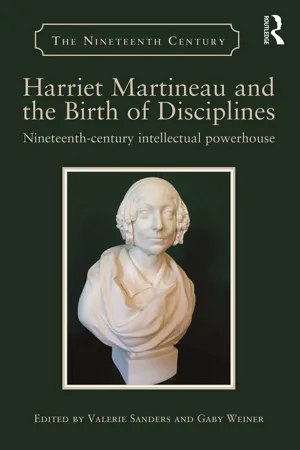
Harriet Martineau and the Birth of Disciplines
Nineteenth-century intellectual powerhouse
- 248 pages
- English
- ePUB (mobile friendly)
- Available on iOS & Android
eBook - ePub
Harriet Martineau and the Birth of Disciplines
Nineteenth-century intellectual powerhouse
About this book
One of the foremost writers of her time, Harriet Martineau established her reputation by writing a hugely successful series of fictional tales on political economy whose wide readership included the young Queen Victoria. She went on to write fiction and nonfiction; books, articles and pamphlets; popular travel books and more insightful analyses. Martineau wrote in the middle decades of the nineteenth century, at a time when new disciplines and areas of knowledge were being established. Bringing together scholars of literature, history, economics and sociology, this volume demonstrates the scope of Martineau's writing and its importance to nineteenth-century politics and culture. Reflecting Martineau's prodigious achievements, the essays explore her influence on the emerging fields of sociology, history, education, science, economics, childhood, the status of women, disability studies, journalism, travel writing, life writing and letter writing. As a woman contesting Victorian patriarchal relations, Martineau was controversial in her own lifetime and has still not received the recognition that is due her. This wide-ranging collection confirms her place as one of the leading intellectuals, cultural theorists and commentators of the nineteenth century.
Part I
Foundational characteristics
1 Mapping the intellectual self
Harriet Martineau’s Autobiography and the role of life writing in defining disciplines
Harriet Martineau’s Autobiography (1877) has been celebrated as radically transforming the autobiographical genre, most particularly in regard to the nineteenth-century female autobiography. The self-shaping that autobiographical writing involves, alongside the agency of the author to narrate their own tale, provides a powerful space for articulating individual and social identity. Most critics have read the Autobiography as a continuation of Martineau’s conviction that it was her duty to teach the nation, as well as further evidence of her desire to maintain control over her public persona. Linda Peterson, in her introduction to the Autobiography, emphasises Martineau’s deliberate self-shaping, from her ‘interdicting the publication of her letters and asking friends to burn private correspondence’, to writing her own obituary in the third person, arguing that she ‘in effect prevented others from shaping her life story, and thus … maintained the power to tell it her own way.’1 Similarly, Lucy Bending writes that Martineau’s Autobiography came out of her ‘desire to put forward her own case, to represent herself in a way that was not inflected by the interpretations of others whose desire for Martineau to be what they expected her to be was at times overwhelming,’2 while Jill Ker Conway observes that ‘Martineau, a woman who had become one of the leading educators of her society on social and economic matters … wanted the world to know how she had become such a phenomenon.’3
It is within this context of Martineau as a social and cultural phenomenon, and her desire to control the expression of the nature of her impact, that this chapter is positioned. I argue that her impact as a public intellectual is mapped autobiographically through her intricate engagement across a variety of academic disciplines and through her formal learning and scholarly work, as well as her encounters with leading figures of those intellectual fields. Valerie Sanders humorously recounts that ‘George Eliot was filled with a renewed sense of horror at the indignities of self-exposure’ upon reading Martineau’s Autobiography;4 but most importantly, Sanders remarks on Martineau’s deliberate move away from a conventional feminine autobiography, which even shied away from using the generic term, to the more masculine approach of presenting ‘a history of [her] life and opinions.’5 Indeed, Sanders suggests that Martineau was the ‘only female autobiographer of the nineteenth century to give anything like “her own intellectual history”.’6 Ironically playing on the knowledge that female autobiographers who ‘emphasised the pleasant and entertaining aspects of their lives … got a better press’,7 Martineau facilitates this feminine mode to some degree in the way she discusses her encounters with intellectual figures, ultimately subverting the private, social setting by transforming it into an interdisciplinary space of ideas.
Martineau’s position within the context of female autobiography has received a great deal of critical discussion, with some scholars accentuating the feminine qualities of her work, such as Conway drawing out the way in which the opening chapters focus on Martineau’s inner life and religious turmoil, ‘religious sensibility’ being a conventional feature of female memoirs,8 while others, like Sidonie Smith, have argued that Martineau wrote her autobiography in a ‘manly’ manner: ‘Harriet Martineau … assumes the role of the “manly” woman, appropriating the prerogatives and privileges of male selfhood.’9 Conway circumvents some of the masculinisation of Martineau by claiming it was the fact that she was seemingly on her deathbed that allowed her to ‘throw away many concerns about privacy and modesty’, yet by Conway’s own admission, Martineau had been ‘one of the leading educators of her society on social and economic matters’, and so it seems unlikely that she would have felt constrained to speak because of her gender.10 Indeed, as Sanders points out, the women ‘who were bold enough to call their work “autobiography” were generally women who had already flouted convention, and drawn attention to themselves by their participation in controversial campaigns’, for which Martineau was famed.11
Other assessments have been more willing to embrace the hybrid nature of Martineau’s style in terms of gendering. Sanders observes that Martineau ‘may have written more self-consciously as a woman in some parts of the book than in others’, but ‘[b]y the end… . Men and women have been subsumed into a mystical conception of “Man”.’12 This melding of gender aligns with Peterson’s observation that Martineau was deliberately confronting ‘a dominant male tradition’ by ‘insist[ing] upon gender-free patterns of human development’, and suggesting that women ‘should adopt universal patterns of interpretation, systems that apply to all humankind.’13 It is in this reference to human development – one might say, human intellectual development – that Martineau’s autobiography fuses as a critique both of the genre of female life writing and the ways in which education and learning are conceived within her Victorian society. David Amigoni draws on Peterson’s observations on the hybridity of female autobiography to suggest that its ‘generic instability and hybridity’ should be considered ‘the basis for exploring the “diversity of forms” ’ inherent in life writing.14 This ‘diversity of forms’ resonates powerfully with the way in which Martineau engages intellectually with the world around her, and is reflected in her hybrid (both in terms of gender and intellectual disciplines) literary productions.
Martineau’s resistance to external definition has made her notoriously difficult to categorise as a writer. As Alexis Easley states later in this volume, Martineau’s unwillingness to ‘tie herself down to another multi-volume history writing project’ reflects her deliberate attempts to defy categorisation. However, the unfortunate result of this defiance is that for much of the twentieth century Martineau was defined as a ‘miscellaneous’ writer, thus ‘trivialising her achievement in multiple fields of discourse, including her important work as a historian.’15 This chapter therefore examines the Autobiography as Martineau’s intellectual self-shaping, and thus her statement of the role her decades of intellectual productivity had in forming not just her own understanding of intellectual disciplines, but also the role of the disciplines in the fabric of British cultural heritage. I begin by looking at the role of interdisciplinarity in Martineau’s narrative. The conversations between disciplines are fundamental to her accounts of her personal intellectual development. The categorising and re-categorising of the disciplines enables her to construct her identity on her own terms, but within the legitimisation of those established disciplines. I go on to examine the layering of Martineau’s categorisation techniques, from mapping, to hierarchies and disciplinary evolution along the lines of Comtean positivism, to, again, a hybrid approach that encompasses these maps and structures with the narrative of life writing. This section then flows into the more specific focus on the foundation of, not just theology, but theological modes, in Martineau’s intellectual rationalisation. While engaging in the traditionally female mode of religious exploration, Martineau goes further in revealing how the theological method of apologetics influenced the organisation of her intellectual space. It then follows that Martineau’s personal intellectual development is broadened into the national narrative, as autobiography is viewed as historical material. For Martineau, however, this material is produced consciously, as she deliberately seeks to take an active role in continuing to shape Britain’s intellectual culture after her death.
While engaging with Martineau’s personal life, it is significant that her account only reveals the personal insofar as it furthers the understanding of her intellectual progress. Conway suggests that as a genre, autobiography brings together discrete disciplines, providing access to questions of history, psychology, literary criticism and philosophy.16 In this vein, Harriet Martineau, as an interdisciplinary writer (as many nineteenth-century public intellectuals were), uses her Autobiography to tease apart the disciplinary threads, providing a canvas for their interconnections and progress. Her map reflects the influence of Auguste Comte’s positivist approach to the scientific disciplines, but extends this structure to incorporate the humanities as well, authenticating them by bringing them underneath the scientific banner. As Easley has argued, Martineau thus reasserts herself into the broader narrative of national progress.17 Between the boundaries of self and self-construction, Martineau’s Autobiography seeks to establish the intellectual disciplines necessary to Britain’s intellectual development, facilitating Martineau’s own life narrative to model the pathway of progress.
Autobiography and intellectual development
Interdisciplinarity is enjoying a resurgence of currency, yet it is often framed as an innovation of scholarship. Thomas Scheff argues for ‘researchers to become generalists after their initial training in a discipline or subdiscipline’, for ‘the most physical science progress has been made when separate disciplines or subdisciplines have combined.’18 He bases his argument on the conviction that where the physical sciences have learnt to become interdisciplinary, the social sciences and humanities are lagging behind. However, the establishment of discrete divisions, or at least the segregation of scholars to particular specialisations, is relatively new: Harriet Martineau, like most nineteenth-century public intellectuals, was what Scheff would describe as a generalist, engaging across fields, bringing them into conversation with each other in order to speak to the social, political and economic issues that concerned her. Thus the researchers promoting interdisciplinarity are returning to a scholarly openness that was indicative of Victorian intellectual engagement.
The division of academic or intellectual disciplines creates a myth of order and organisation. In reality, however, disciplines are most relevant and active when flowing in and out of one another, entering into conversation. Discrete disciplines, therefore, standing alone, are inherently unstable in a way that reflects Bending’s assessment of Martineau’s Autobiography, referring to the ‘profound instability of many of Martineau’s own terms of description, as she puts forward what initially seems to be a consistent position.’19 In looking at the connections Martineau makes between the development of intellectual disciplines and her personal life story, it is important to acknowledge that ...
Table of contents
- Cover Page
- Half Title page
- Harriet Martineau and the Birth of Disciplines
- Title Page
- Copyright Page
- Contents
- Figures
- List of Contributors
- Acknowledgements
- Introduction The disciplines and Harriet Martineau
- Foundational characteristics
- Contribution to disciplines
- Contribution to fields of knowledge
- Selective bibliography
- Index
Trusted by 375,005 students
Access to over 1.5 million titles for a fair monthly price.
Study more efficiently using our study tools.
Frequently asked questions
Yes, you can cancel anytime from the Subscription tab in your account settings on the Perlego website. Your subscription will stay active until the end of your current billing period. Learn how to cancel your subscription
No, books cannot be downloaded as external files, such as PDFs, for use outside of Perlego. However, you can download books within the Perlego app for offline reading on mobile or tablet. Learn how to download books offline
Perlego offers two plans: Essential and Complete
- Essential is ideal for learners and professionals who enjoy exploring a wide range of subjects. Access the Essential Library with 800,000+ trusted titles and best-sellers across business, personal growth, and the humanities. Includes unlimited reading time and Standard Read Aloud voice.
- Complete: Perfect for advanced learners and researchers needing full, unrestricted access. Unlock 1.5M+ books across hundreds of subjects, including academic and specialized titles. The Complete Plan also includes advanced features like Premium Read Aloud and Research Assistant.
We are an online textbook subscription service, where you can get access to an entire online library for less than the price of a single book per month. With over 1.5 million books across 990+ topics, we’ve got you covered! Learn about our mission
Look out for the read-aloud symbol on your next book to see if you can listen to it. The read-aloud tool reads text aloud for you, highlighting the text as it is being read. You can pause it, speed it up and slow it down. Learn more about Read Aloud
Yes! You can use the Perlego app on both iOS and Android devices to read anytime, anywhere — even offline. Perfect for commutes or when you’re on the go.
Please note we cannot support devices running on iOS 13 and Android 7 or earlier. Learn more about using the app
Please note we cannot support devices running on iOS 13 and Android 7 or earlier. Learn more about using the app
Yes, you can access Harriet Martineau and the Birth of Disciplines by Valerie Sanders,Gaby Weiner in PDF and/or ePUB format, as well as other popular books in History & World History. We have over 1.5 million books available in our catalogue for you to explore.