- 220 pages
- English
- ePUB (mobile friendly)
- Available on iOS & Android
eBook - ePub
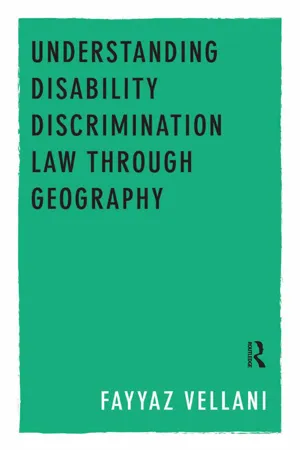
Understanding Disability Discrimination Law through Geography
About this book
Examining the UK Disability Discrimination Act (DDA) in comparison to its counterparts in the USA and Australia, this book focuses on how it is being interpreted and acted upon in the context of higher education, a key area of national attention in the UK. It also evaluates this law in the context of the larger project of civil rights legislation and demonstrates that geography can be used to explain law and legal arguments by highlighting their subjectivity and by emphasizing the importance of place, specificity and context. While providing in-depth analysis of the effectiveness and scope of this significant legislation this book demonstrates the importance of geography in the application of law. It provides insights into the broader workings of UK anti-discrimination law, which are particularly relevant given the scrutiny of the Equality and Human Rights Commission and the concerns about the effectiveness of legal tools in fighting discrimination. Finally, this book critiques liberal notions of legal subjectivity and medical definitions of disability which is topical given the current attention given to debates about identity politics.
Concepts in Disability Law
Chapter 1
Law and Liberal Legalism
(1.0) Introduction
This book investigates the role and importance of law and legal frameworks in seeking to secure accessible environments for disabled people. The research for the book was primarily conducted in England and Wales with some comparative research done in Australia and the USA, examining the responses of service providers to legal requirements to be more inclusive of disabled people. In particular, universities represent a category of service providers which is particularly interesting because access to higher education entails not only physical access, but also access to power structures which determine the experiences of disabled students. Larger questions of how socio-institutional frameworks and cultural assumptions about disability materially influence disabled people can be viewed in the context of inclusiveness at universities.
The objective of this book, then, is to explore the scope of the Disability Discrimination Act (DDA) 1995, in redressing the marginal status of disabled people in England and Wales.1 How far is this legislation transforming, or how far will it be able to transform, disabled peoples’ lives? Liberalism has dominated western legal systems and so, to answer this question I examine liberal conceptions of law and critiques of these conceptions (Blomley, 2000). The chapter is divided as follows: (1.1) The scope of law and legal discourses, (1.2) The roots of liberalism: utilitarianism, (1.3) Liberalism, law and the legal subject, (1.4) Epistemologies of law, (1.5) The scope of law in overturning discrimination, and (1.6) Space, place and specificity: a critical legal geographical approach. In (1.7) I conclude the chapter.
(1.1) The Scope of Law and Legal Discourses
Over the past forty years, there has been a considerable rise in the number and activity of new social movements and protest groups in the UK,2 USA, Australia and elsewhere (Young, 1990). One of the goals of such groups, including women, people of colour, gays and lesbians, and disabled people, has been the pursuit of legislation which seeks to overturn discrimination (Blomley et al., 2001; Gooding, 1994; Handley, 2001; Young, 1990). These groups have used the language of rights to redress their marginalisation, with much of the inspiration arising in the wake of the American civil rights movement (Gooding, 1994). However, as many argue, this approach alone, without other measures to counteract cultural assumptions and norms in everyday life, for example, will not suffice in improving the lives of disabled people (Handley, 2001; Young, 1990). Critical legal theorists, feminists, anti-racists and disabled scholar argue that the law – in its current Western, liberal forms – has limited capacity to change people’s lives (Clark, 2001; Razack, 1991; hooks, 2003). The extent and scope of these capacities are scrutinised in this chapter.
These arguments are manifold, but rest primarily on one question. While the law itself is a complex tool which shapes and governs peoples’ lives, can legislation reach areas of human interaction such as cultural biases, prejudices and norms, as well as the broader framework of values in western liberal democracies (Gooding, 1994; Young, 1990)?3 For example, disabled activists have lobbied for, and have been successful in obtaining, CRL in European and North American countries (Campbell and Oliver, 1996). Some theorists argue that this legislation alone is not enough to change disabled peoples’ lives, as it cannot transform wider systemic disadvantages faced by them (Oliver and Barnes, 1998). For example, Gooding (1994), Oliver and Barnes (1998), and Stiker (2000) argue that antidiscrimination legislation (ADL) does not fundamentally call into question, or seek to alter, wider socio-legal and economic systems in which peoples’ value to society – in basic terms – is primarily measured through economic output and productivity.4 Others question whether ADL will be able to permeate into people’s everyday interactions with each other, where subtle forms of prejudice are encountered (Gooding, 1994; Young, 1990).
There have also been critiques of the ontological basis for ADL, beyond the limitations of its liberal legal values. Specifically, the DDA is premised on the medical model of disability, rather than the social one, and as demonstrated in later chapters, the use of the medical model has material consequences for disabled people (Gooding, 1994; Oliver and Barnes, 1998; Young, 1990). Moreover, the DDA is premised on the idea that disability is primarily an individual phenomenon, rooted in the impairment of specific individuals. Conversely, in a social model of disability, society is seen to disable those with impairments by building barriers impeding their full access to social life, thus removing the stigma from the individual (Barnes et al., 2002; Oliver and Barnes, 1998).
In the UK DDA, and its Australian counterpart, also called the DDA, for example, the onus is on individual disabled people to pursue their legal cases where they feel they have been discriminated against, rather than a proactive approach in which discrimination is broadly discouraged at the societal level5 (Handley, 2001; Roulstone, 2003). A proactive approach, for example, would aim to influence the behaviour of organisations and institutions so that they are more inclusive of disabled people, rather than simply attempting to accommodate disabled people within existing social structures (Barnes et al., 1999). Such an approach would more closely resemble civil rights legislation (CRL) such as the Americans with Disabilities Act (ADA) but this law too, has its limitations, as will become clear later in the book. Some theorists would prefer a legislative approach where the law seeks to discourage discrimination before it happens, rather than after the fact, a more overt goal of CRL than of ADL (Barnes et al., 2002; Barnes et al., 1999).
CRL, at the very least, has been symbolically significant for disabled people and has established a legal framework for a more egalitarian distribution of opportunities and resources within the existing socio-economic system (Gooding, 1994; Oliver and Barnes, 1998; Young, 1990). For example, the Americans with Disabilities Act (ADA) has been successful in increasing access to the built environment in the United States of America (USA).6 There has also been more employment of disabled people in the USA since this legislation was enacted in 1990 (Gooding, 1994).
These may be seen as either positive or negative developments, depending on one’s point of view (Bellamy, 2000; Ramsay, 1997). Some argue that the ADA has not called into question able-bodied peoples’ fundamental attitudes about disability, and that it does not recognise the intrinsic value of disabled people, but rather makes them adapt to able-bodied labour markets and built environments (Gewirtz, 1997; Hahn, 2001). Others argue that law alone cannot change fundamental attitudes, and that much more is required for these attitudinal shifts (Young, 1990). This chapter evaluates the efficacy of ADL and CRL in changing disabled people’s lives, and does not necessarily to draw conclusions about the wider socio-political projects within which they are embedded. In order to evaluate this legislation, and unearth its values and assumptions, I turn to the origins of western liberal philosophies: utilitarianism.
(1.2) The Roots of Liberalism: Utilitarianism
In developing critiques of liberalism, it is important to examine the origins of its current manifestations. Contemporary legal thought has been significantly influenced by utilitarianism (Clark, 2001; Pue, 1990). Utilitarianism originated in England as a philosophical inquiry into the workings of government and the feudal economic theories which existed prior to the industrial revolution of 1750 to 1830 (Dent, 1993; Mill, 1859). Utilitarians advocated a series of political, social, and economic reforms based on the principles of liberalism and the need for more efficient and responsive government (Fitzpatrick and Hunt, 1987; Handley, 2001; Ward, 1998).
Utilitarianism originated as the study of law based on simple rules and assumptions about human nature and the motivations behind human behaviour (Dent, 1993). Mill (1859), in his book On Liberty – the classic utilitarian treatise – applied post-Enlightenment scientific and rational methods to ethics and politics. The philosophy of utilitarianism was based on the principle of utility, or the ability to please as many individuals as possible, thereby achieving the greatest good for the greatest number of people (Mill, 1859). As Dent (1993:7) notes:
Utility, or the Greatest Happiness Principle, holds that actions are right in proportion as they tend to promote happiness, wrong as they tend to produce the reverse of happiness. By happiness is intended pleasure, and the absence of pain; by unhappiness, pain, and the privation of pleasure… pleasure, and freedom from pain, are the only things desirable as ends.
Utilitarians theorised that human behaviour is guided by the desire to avoid as much pain and seek as much pleasure as possible (Dent, 1993; Handley, 2001; Ward, 1998). The utility of any action, therefore, would depend upon the minimisation of pain and maximisation of pleasure resulting from it (ibid.). The role of government, in this view, is to achieve utility using a simple pleasure-pain scale to evaluate actions, with the most favourable actions giving the most pleasure to the largest number of individuals (Dent, 1993). Utilitarian reforms had significant impacts on social policy and practice from the mid 1800s onwards – including better conditions for the working classes in England and the United States – and utilitarianism came to be viewed as a pillar of democracy (Fitzpatrick and Hunt, 1998).
Contemporary western democracies have legal systems premised on utilitarian notions that law, by improving the lives of individuals, improves the whole of society (Birch, 1998; Dearlove and Saunders, 2000). For example, in the socioeconomic realm, citizens who self-actualise to their highest economic potential accrue benefits personally through wealth creation, and pass on these benefits through taxation, and via consumer spending, which creates jobs and opportunities for others (Young, 1990). Therefore, one of the predominant aims of human life in contemporary liberal capitalist contexts is economic self-actualisation (Stiker, 2000; Ward, 1998).
In liberal economic theory, all that is needed to create maximum utility for all individuals is a level playing field, an oft-used metaphor for the competitive nature of capitalist market economies (Rose, 1987; Young, 1990). However, the presumption of a level playing field ignores broader systemic inequalities which may impede certain groups, such as disabled people, from equally participating in social and economic life (Gooding, 1994; Razack, 1991; Young, 1990). The existence of a playing field, i.e. the labour market, does not necessarily signify equality or a society which is truly inclusive (Fitzpatrick and Hunt, 1987; Gleeson, 1999). For example, Gleeson (1999:38) describes Marx’s critiques of capitalist exploitation and neglect of disabled people as follows:
For Marx, the suffering ‘pauper’ – that spectral other which haunted the Victorian bourgeois imagination – was testimony to capitalism’s oppression and exploitation of the physically vulnerable. His pauper was a polymorph whose many forms included vagabonds, criminals, and prostitutes – the ‘lumpenproletariat’ – together with those in the proletariat who had failed in the competition to sell labour powers. For the latter, Marx clearly recognised physical infirmity as a principal cause of unsaleable labour power.
Given this history of exclusion of disabled people from labour markets, many argue that liberalism’s focus on self-fulfilment via individual choice ignores social attitudes and structures which may impede disadvantaged members of society from asserting their agency (Gooding, 1994; Young 1990). Some critical legal scholars, such as Blomley and Clark (1990:13), claim that “the individualist obsession of legal liberalism offers only a “thin” – even barren – model of social life.” At the same time, they warn against a wholesale dismissal of liberalism, noting that some of its values, such as the legal promise of equality and justice, are laudable (ibid.). As Blomley and Clark (1990:14) note:
It is vital at this point, however, to note that scepticism toward liberalism need not imply a simple-minded rejection. Although the legal critique can appear irreverent, it is also clear that certain principles of legal liberalism are regarded as viable and as normatively valuable. Thus, the legal promise of equality and justice – albeit partial – contained within the concept of the rule of law,” has been applauded by some radicals ... similarly, the appeal of liberalism to tolerance, autonomy..is undoubtedly appealing.
As noted earlier, this book and chapter do not provide polemical accounts of the DDA, but instead seek to understand how disabled people experience law and legal processes. The next section highlights how those experiences have been ensconced in particular liberal conceptions of human beings in relation to each other, and the law.
(1.3) Liberalism, Law and the Legal Subject
Critical legal theorists and writers from other disciplines have argued that liberal values limit the ability of the law to redress social inequality because in liberalism, law is construed as being abstract, neutral and removed from society (Blomley et al., 2001; Clark, 2001; Pue, 1990; Ramsay, 1997; Razack, 1998; Young, 1990). Moreover, because law is defined as an autonomous field of inquiry, liberals see it as being ‘objective’ and sufficient unto itself, as something which stands abstractly apart from the ‘subjective’ and ‘particular’ nature of society (Clark, 2001; Pue, 1990). This view can limit the ability of law to redress social inequality because in societies which exhibit systematic inequality, an insistence on the rule of law can serve to legitimate those inequalities (Fitzpatrick and Hunt, 1987; Minow, 1991; Razack, 1998; Razack, 1991). For example, feminists have argued that while law claims a neutral stance, it has traditionally favoured men, because the liberal legal subject has historically been conceived of as male (Ramsay, 1997). The next section examines various terms and concepts associated with law in liberal societies and consider what different theorists have to say about them.
(1.4) Epistemologies of Law
Four paradigms through which legal theorists view the law are positivism, realism, instrumentalism, and legal formalism. Positivism assumes institutional structures as given rather than bringing them under normative evaluation (Young, 1990). For example, a positivist view of discrimination against disabled people would remedy the problem by making discrimination illegal (Razack, 1998). When positivism is applied to law, law is assumed to be capable of responding to society’s needs and solving its problems (Gooding, 1994). Critics argue that a positivist view of law ignores larger social structures, and/or other factors which are not directly within the realm or scope of law, or cannot be addressed in such straightforward terms (Blomley, 1994; Minow, 1991; Ramsay, 1997).
Blomley (2000), Clark (2001) and Roulstone (2003) argue that a positivist approach to the law would imply that the law is straightforward and ‘natural’.7 In Pue’s (1990:570) words, for lawyers, positivism is the view that “the law is not mysterious to those who are trained to look for it.” Realism, on the other hand, is a concern for fact or reality and a rejection of the impractical and visionary (Clark, 2001). Altman (1990:152) calls a realist view of law “rule scepticism.” Legal realism posits that the law, in asserting itself as neutral and unbiased, is legislated, enacted and enforced by people, who, regardless of their attempts at justice, will deliver and interpret these laws in varying ways, depending upon their own understandings (Clark, 2001). A realist view of law thus rejects law’s positivist claims to value-neutrality as it suggests that the law only exists as interpreted through the people in charge of it, and can claim no moral absolution or justice which is completely consistent in its treatment of all legal subjects (Pue, 1990). A realist view of the law would acknowledge, for example, that the personal biases of judges do affect the legal decisions in court cases (Bagguley, 1990; Pue, 1990).
Instrumentalism, according to Blomley (2000:10), is the view that law is “an autonomous instrument with which an activist legislator can bring about (or prevent) social and economic change.” An instrumentalist view of law assumes that ‘society,’ as an entity separate from ‘the law’ has various needs, and that ‘the law’ responds to these needs and ‘acts upon’ society to achieve the desired results (Blomley, 2000). According to Blomley (2000), this view ignores the organic nature of the relationships between law and society. For example, an...
Table of contents
- Cover Page
- Half-Title Page
- Dedication
- Title Page
- Copyright Page
- Table of Contents
- List of Figures and Tables
- Introduction
- Part I Concepts in Disability Law
- Part II Implementation
- Part III Conclusions
- Epilogue: The Equality Act [2010]
- Bibliography
- Index
Trusted by 375,005 students
Access to over 1.5 million titles for a fair monthly price.
Study more efficiently using our study tools.
Frequently asked questions
Yes, you can cancel anytime from the Subscription tab in your account settings on the Perlego website. Your subscription will stay active until the end of your current billing period. Learn how to cancel your subscription
No, books cannot be downloaded as external files, such as PDFs, for use outside of Perlego. However, you can download books within the Perlego app for offline reading on mobile or tablet. Learn how to download books offline
Perlego offers two plans: Essential and Complete
- Essential is ideal for learners and professionals who enjoy exploring a wide range of subjects. Access the Essential Library with 800,000+ trusted titles and best-sellers across business, personal growth, and the humanities. Includes unlimited reading time and Standard Read Aloud voice.
- Complete: Perfect for advanced learners and researchers needing full, unrestricted access. Unlock 1.5M+ books across hundreds of subjects, including academic and specialized titles. The Complete Plan also includes advanced features like Premium Read Aloud and Research Assistant.
We are an online textbook subscription service, where you can get access to an entire online library for less than the price of a single book per month. With over 1.5 million books across 990+ topics, we’ve got you covered! Learn about our mission
Look out for the read-aloud symbol on your next book to see if you can listen to it. The read-aloud tool reads text aloud for you, highlighting the text as it is being read. You can pause it, speed it up and slow it down. Learn more about Read Aloud
Yes! You can use the Perlego app on both iOS and Android devices to read anytime, anywhere — even offline. Perfect for commutes or when you’re on the go.
Please note we cannot support devices running on iOS 13 and Android 7 or earlier. Learn more about using the app
Please note we cannot support devices running on iOS 13 and Android 7 or earlier. Learn more about using the app
Yes, you can access Understanding Disability Discrimination Law through Geography by Fayyaz Vellani in PDF and/or ePUB format, as well as other popular books in Physical Sciences & Geography. We have over 1.5 million books available in our catalogue for you to explore.