eBook - ePub
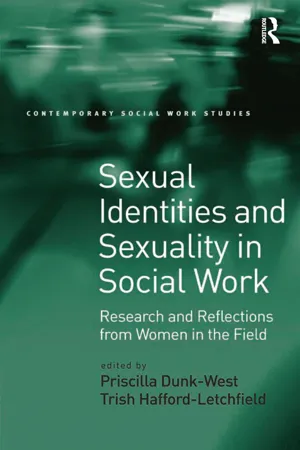
Sexual Identities and Sexuality in Social Work
Research and Reflections from Women in the Field
- 210 pages
- English
- ePUB (mobile friendly)
- Available on iOS & Android
eBook - ePub
Sexual Identities and Sexuality in Social Work
Research and Reflections from Women in the Field
About this book
Sexuality and sexual identity have been relatively marginalized areas in both social work education and practice. However, changes in policy and legislation in the UK and other countries over the past decade have brought discussions of sexuality into the mainstream public service agenda. In social work and social care, gay and lesbian citizenship rights have been explicitly recognised. In the fields of adoption and fostering new regulations and guidance have helped improve and develop practice around assessment and intervention. It remains the case, however, that sex is often perceived as a problem area within social work and social care, discussed only in relation to sexually diverse communities or in the realm of dysfunction or pathology. This collection aims to generate a more proactive and challenging discussion of sexuality and sexual identity in social work. Its starting point is that sexuality is an essential aspect of individual identity, that users must be able to express their sexuality, and that it is essential for social workers to be able to respond and discuss sexual issues appropriately. The contributions are informed by feminist research, considering, in particular, the experiences of women working in and using social care services since the 1990s. In addition to a consideration of the wider policy, legislative and service providers' perspectives, the book includes reflective accounts as well as research-led contributions, offering a comprehensive and balanced account of this important field, which aims to inform both theory and practice.
Information
Chapter 1
Sexuality and Women in Care Organizations: Negotiating Boundaries within a Gendered Cultural Script
Introduction
Mainstream research, education and practice in management and organizations in social work have not been strong on gender and sexuality and any specific analysis is far from being explicit and well established. This chapter therefore takes a closer look at the contradictory and paradoxical nature of gendered selves and sexual identities in those public sector organizations delivering care services. Research into gender issues in care organizations has historically been influenced by the feminist movement and by a number of critical studies on social issues where gender as a biological fixed entity has been analysed for its social, historical, economic and political constructions (Dominelli 2002, Orme 1998, White 2006). Most of this has focussed on service user perspectives and their experiences and the nature of relationships between social workers and service users. Despite these theoretical developments, gender and gender powered relations within social care organizations themselves have been less of a concern. This is despite the fact that gender and sexuality issues remain defining features in most social care organizations: for example in gendered patterns of hierarchy; occupational segregation; the predominance of heterosexuality; harassment and discrimination and in the questioning of work-life balance, particularly in relation to family responsibilities. These are in turn defined by and instrumental in reproducing social relations of age, class, disability, culture and ethnicity.
Similarly, major changes in the United Kingdom legislative framework to promote the rights of lesbians and gay men have challenged and continue to challenge long-standing heteronormative and heterosexist frames of reference in both social work practice and professional education and the way these are organized. Numerous developments in legislation and rights to promote sexuality within particular areas such as employment, crime, civil partnership and family law have gone some way to transforming the everyday lives and experiences of lesbian, gay and bisexual people (Cocker and Hafford-Letchfield 2010). However, in the absence of any current systematic approach to addressing sexuality issues in social work, there are implications for its increased visibility and the complexity of managing identities within the current dynamic and changing social environment in which care organizations operate.
Theoretically, a move towards more pluralist approaches within the post structuralist and post modernist turns has also given rise to the intersection of gender and sexuality with other multiple social divisions and differences. Those ‘third wave’ feminists have critically questioned the notion of coherent identities and view freedom as resistance to categorization or identity (Mann and Huffman 2004). Evolving discourses frame and determine social knowledge and our subsequent understanding of power as well as about the concentration of power in relation to the nature of personal identity and organizational life. These continue to carry gendered meanings and reinforce gender inequalities (Foucault 1977, Broadbridge and Hearn 2008). Globalization and individualization, together with increasingly individualized consumer cultures within modernization of care services (Clarke 2004) and more recently the UK governments ‘transformation’ agenda (Department of Health 2008) have demanded continuous innovation and performance improvement in all aspects of social care. Within this context we face a particularly complex and contradictory picture of what progress is actually being made towards gender and sexual equality.
This chapter will argue that whilst a number of gains have been achieved, if left critically unexamined, sexism, heterosexism and gender biases will continue as more subtle practices embedded within social work’s core processes and activities. This requires increased reflexivity in order to negotiate boundaries within such an institutionalized cultural script (Martin 2003). By reviewing some of the literature and research on gender and sexuality within organizations in social work and social care, this chapter intends to elaborate on the range of ways that gender and sexuality are enacted, sustained and generated across the structures and practices of organizational life. It reviews some of the broader key discourses when thinking about the relationships between gender, sexuality and organizations within social care. Some tentative recommendations will be made about what women themselves can do, what care organizations can do and how current discursive practice in relation to gender and sexuality within the organization might be deconstructed and challenged.
Gender, sexuality and social work – a brief historical perspective
The meaning of gender and sexuality in social work has changed over time and is by its very nature, politically and socially constructed. A number of debates and movements arising from feminist activism from the 1970s have supported women’s rights both in the workplace and in service provision giving rise to positive responses through legislation, social policy, human resource developments and service delivery (Dominelli and McLeod 1989). Public concern and recognition of issues such as sexual harassment, sexual abuse and examination of opportunities for women in relation to promoting fairness in career progression and in exercising their rights are examples of evidence of positive responses to these issues (White 2006).
Orme (2009:69–71), who has contributed extensively to the literature in this area, identifies three strands of feminist social work informed by and responsive to developments in feminist thinking. Firstly she highlights the synergies between feminism and social work based on shared values where the latter has used categories such as race, gender and class to legitimize action against oppression. Feminist social work has strived to work with women to raise consciousness but also considers subjectivity of the individual, their sense of self and ways of understanding their relationship within the world. The ethos of this relationship enables women to utilize their strengths and abilities as both a resource and means of exercising their rights (Hanmer and Statham 1999). For example, increased levels of awareness and developments in responses to domestic violence over the last decade are largely due to the determined efforts of women’s organizations forcing domestic violence from the margin to the mainstream (Blyth 2005). The subsequent emergence of multi-agency domestic violence fora has encouraged professionals from different disciplines not to think in boxes but to understand the overlap between different forms of oppression. These have proved essential not just in understanding safeguarding implications within family social work but in making connections with other types of abuse in vulnerable adults (Department of Health 2000). Secondly, Orme refers to ‘prescriptions for practice with women’ by utilizing commonalities and differences to build a basis for which relationships can be built between women workers and service users. One critique of this approach is the potential homogenization of the category of ‘woman’. The sustainability of this position is questionable on the basis that it does not fully acknowledge the presence of power. How it is grounded in the realities of practice particularly for providers of state services within a statutory context is also questionable (Hale 1984, White 2006). Thirdly, Orme cites the importance of understanding gender dimensions of social work by adopting feminist theory to explore the impact of gender oppression on men and social work such as in the work done by Cree (2001).
Correll et al. (2007:1) define gender as:
an institutionalized system of practices for constituting people as two different categories (men and women), and organizing relations of inequality based on this difference.
This definition captures several key features of contemporary views on gender. Gender is seen as a categorization process which starts on the basis of classification and differentiation and then applied to persons, activities, behaviours, jobs, tasks, objects and so on (Mathieu 2009).
In short there are many complications in conceptualizing gender and defining what it is. Whilst the nature of women’s experiences and gender issues have been explored in much greater depth within a number of social science disciplines, the significance of gender and sexuality within many areas of social care have not. For example the implications for women within significant user groups such as older people (Maynard et al. 2008) and people with learning disabilities (Scior 2003) in all their diverse contexts remain relatively or at least inconsistently unexplored as care environments have developed. There has been some bringing together of issues in relation to gender and sexuality, for example, Brown and Cocker (2010) tell us that:
The second wave of the women’s movement … brought together lesbian and feminist political discourses. It was within this area that much of the radical thinking about social work and feminism as well as social work with lesbians and gay men took place (Brown and Cocker 2011:8).
The rise of lesbian and gay political influences through activists and organizations within the UK Socialist movement, its Local Authorities, Councillors and Unions up to the 1980s had advanced the nature of much public sector thinking compared with later hostilities emanating from later Conservative Governments. Social work in the 1980s was one of the professions at the forefront of arguing for lesbian and gay equality as demonstrated through social work’s involvement within trade union as well as labour and community activism (Brown 1998). However, looking at the changed landscape of social work from the 1990s towards the end of the first decade of the 21st century, many of its challenges lie in being compliant with legislative and policy requirements. The trend towards increased managerialism; bureau-professional regimes within specific configurations of structures, cultures, relationships and processes of organizational co-ordination (Clarke and Newman 1997) served to dampen the organizational base from which the women’s movement and its supporters had operated. Substantial growth in legislation, policy and practice guidance and proceduralization has standardized many areas of social work practice in which organizational compliance has become a crucial and valued quality (Harlow 2004). More recent moves towards personalization and self-directed care (Department of Health 2008a) have been critiqued for the potential to take service users further away from any analysis of their structural, community and personal circumstances (Ferguson 2007). Any in-depth analysis of the causes of social problems, or service users’ own narratives of their situation have become secondary to procedures, resource allocation and measurement of ‘outcomes’ (Hafford-Letchfield 2010). The individualization of service provision can further lead to the undermining of collective service provision (Ferguson, 2007). Hudson, writing more than two decades ago, still captures the issues relevant to contemporary social work’s organizational structures and their influence.
In reality, the structure and control of social work reflects and reinforces broader social processes of male domination in our society. Feminism’s central emphasis on women participating in the decisions affecting them (as consumers and as workers) and on creating decision-making structures which are non-hierarchical, very directly confronts the masculine organizational principles of social work agencies (Hudson 1985:640–641).
What does organisational theory tell us?
Organizations are embodied in their social contexts being both social places of organizing and social structuring of social relations. Their interrelationships are historically dynamic (Hearn and Parkin 2001). Classical theory and scientific management carry implicit and sometimes explicit conceptualizations of gender and sexuality where managerial practices spell out detailed statements on the way one is assumed to manage or be managed. Weberarian concepts of the bureaucratic organization (Weber 1947) tend to emphasize rationality or instrumentality rather than emotions whereas in practice, bureaucracies are often intensely emotional. The human relations school has been interpreted by Hearn and Parkin (2001) as an attempt by men not just to reorganize social relationships in organizations but to incorporate gendered and sexual relations in to organizational analysis. This is presented in an agendered and asexual way by using neutral language. Hearn and Parkin go as far to suggest that human relations theory has been used to legitimate increased managerial surveillance and control of workers, particularly women’s emotional and even sexual lives.
Likewise the bringing of psychoanalytic insights from individual to group and organizational dynamics, such as those enshrined in the theoretical conceptions of the UK Tavistock Institute, has addressed the unconscious preoccupations of members of groups and organizations. These include unconscious sexual preoccupations and have contributed significantly to the government of subjectivity and social life (Hearn and Parkin 2001).
All of these theories have, albeit in different ways, contributed to the establishment of the system as the prime paradigm for the analysis of organizations. According to Hearn and Parkin (who have written extensively in the area of gender, sexuality and violence in organizations), the system can be used to obscure gender and sexuality. In another sense, it can also be used to perpetuate or justify the maintenance roles of women in lower organizational positions. Whichever way one looks at it, Hearn and Parkin suggest that organizational theories and analysis are more frequently concerned with human relations that express interpersonal and emotional relationships between its members rather than those social structural relations of power and dominance. Therefore the notion of organizational structure as an objective, empirical and genderless reality is itself a gendered notion. The range of empirical studies outlined in the unique text ‘The Sexuality of Organizations’ (Hearn et al. 1989) for example, highlights these interconnections of sexuality and power in organizations and the pervasiveness of the power of men, particularly heterosexual men.
Connecting gender and sexuality in social work organizations
There are gendered processes in sexuality, including the dominance of various forms of sexuality over others. On the face of it, sex and sexuality might appear to have little to do with social care management and organizations. One might even argue that the current bureaucratic and managerialist organization is predominantly viewed as sexless, emanating from its rational and objective character. Sexuality can also be understood as both a foundation of gender and a focused aspect of gender relations. A growing body of research however has promulgated theories on how heterosexuality is seen as the primary means by which both people and organizations are gendered and as a mechanism through which power is exercised within the organizational context (Gutek 1989, Brown 1995, Halford and Leonard 2001, Hicks 2008). By exploring aspects of communication, career development, self-presentation and relationships within organizations, a heterosexualised version of sexuality inflects organizational life at all levels with gendered consequences. Most organizations and managements reproduce dominant heterosexual norms, ideology and practices. One of the consequences of which is to render gay and lesbian issues ‘problematic’ where gay men and lesbian women are forced to ‘manage’ their sexuality in organizations, choosing whether to come out and how to manage this out identity (which is more than a one off event) or more commonly to hide their identity. Research commissioned by Stonewall in 2008 revealed the tensions and contradictions which exist for lesbian women at work. It suggested that often lesbian women think their gender is more of a barrier to success at work than their sexual orientation. Therefore, if they can hide the fact that they’re gay, some feel it best to do just that. As one participant said, ‘putting your hand up twice’ can be difficult (Miles not dated:2). Participants felt that role models and openly gay women made a crucial difference to the confidence and profile of lesbians and bisexual women in the workplace, and wanted to see organizations involve them more in the development and its initiatives:
As a woman you’ve already got one strike against you in terms of a diversity box that you check. As a lesbian that’s the second one as well. If you’re an ethnic minority lesbian then you’ve got three. As a woman and as an ethnic minority you can’t hide that, but there’s no reason to foreground the fact you’re gay as well. People feel that it’s hard enough (quoted research participant in Miles, not dated:7).
Like monitoring established in other areas of diversity, effective monitoring of sexual orientation can be an important tool for employers to measure performance and make improvements to the working environment. This however is not an exercise that can succeed in isolation. It highlights differences between groups, such as minority status or staff from particular teams or grades, in terms of productivity, satisfaction and progression (Stonewall not dated).
Indeed (hetero)sexual arrangements in private domains generally provide the base infrastructure for organizations and management, principally through women’s associated unpaid reproductive labour (Broadbridge and Hearn 2008). One might think that there would tend to be more sensitivity or at least tolerance within social work environments to these complexities. Whilst legislative changes may have, in turn, transformed the current context for social work practice with lesbians and gay men, challenges for practice remain as this will only ‘be as e...
Table of contents
- Cover
- Half Title
- Title Page
- Copyright Page
- Table of Contents
- Notes on Contributors
- Preface
- Acknowledgements
- Introduction: Sexualities and Sexual Identities in Social Work
- 1 Sexuality and Women in Care Organizations: Negotiating Boundaries within a Gendered Cultural Script
- 2 ‘A Chance to Cut is a Chance to Cure’: Self-harm and Self-protection – A Gay Perspective
- 3 Researching Sexuality and Ageing
- 4 Reflecting on Sexual Health and Young Women’s Sexuality: Business or Pleasure?
- 5 Growing up with a Lesbian or Gay Parent: Young People’s Perspectives
- 6 Have you Heard? … Reflections on the Kerr/Haslam Inquiry
- 7 The Assessment of Lesbian and Gay Prospective Foster Carers: Twenty Years of Practice and What has Changed?
- 8 What is Personal? Reflecting on Heterosexuality
- 9 Sexuality before Ability? The Assessment of Lesbians as Adopters
- 10 Identity, Emotion Work and Reflective Practice: Dealing with Sexuality, Race and Religion in the Classroom
- 11 Everyday Sexuality and Identity: De-differentiating the Sexual Self in Social Work
- Index
Trusted by 375,005 students
Access to over 1.5 million titles for a fair monthly price.
Study more efficiently using our study tools.
Frequently asked questions
Yes, you can cancel anytime from the Subscription tab in your account settings on the Perlego website. Your subscription will stay active until the end of your current billing period. Learn how to cancel your subscription
No, books cannot be downloaded as external files, such as PDFs, for use outside of Perlego. However, you can download books within the Perlego app for offline reading on mobile or tablet. Learn how to download books offline
Perlego offers two plans: Essential and Complete
- Essential is ideal for learners and professionals who enjoy exploring a wide range of subjects. Access the Essential Library with 800,000+ trusted titles and best-sellers across business, personal growth, and the humanities. Includes unlimited reading time and Standard Read Aloud voice.
- Complete: Perfect for advanced learners and researchers needing full, unrestricted access. Unlock 1.5M+ books across hundreds of subjects, including academic and specialized titles. The Complete Plan also includes advanced features like Premium Read Aloud and Research Assistant.
We are an online textbook subscription service, where you can get access to an entire online library for less than the price of a single book per month. With over 1.5 million books across 990+ topics, we’ve got you covered! Learn about our mission
Look out for the read-aloud symbol on your next book to see if you can listen to it. The read-aloud tool reads text aloud for you, highlighting the text as it is being read. You can pause it, speed it up and slow it down. Learn more about Read Aloud
Yes! You can use the Perlego app on both iOS and Android devices to read anytime, anywhere — even offline. Perfect for commutes or when you’re on the go.
Please note we cannot support devices running on iOS 13 and Android 7 or earlier. Learn more about using the app
Please note we cannot support devices running on iOS 13 and Android 7 or earlier. Learn more about using the app
Yes, you can access Sexual Identities and Sexuality in Social Work by Priscilla Dunk-West, Trish Hafford-Letchfield in PDF and/or ePUB format, as well as other popular books in Social Sciences & Social Work. We have over 1.5 million books available in our catalogue for you to explore.