- 374 pages
- English
- ePUB (mobile friendly)
- Available on iOS & Android
eBook - ePub
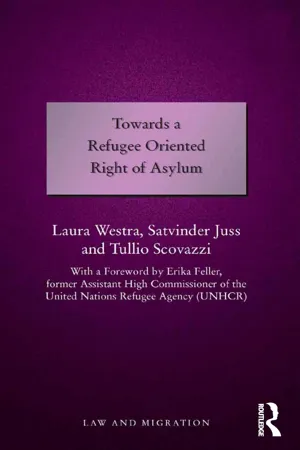
Towards a Refugee Oriented Right of Asylum
About this book
This volume explores the factors that give rise to the number of people seeking asylum and examines the barriers they currently and will continue to face. Divided into three parts, the authors first explore the causality that generates displacement, examining climate change, illegal conflicts and the deprivation of natural resources. They argue that all of these problems either originate from human agency directly, or are strongly influenced by human activities, particularly those of wealthy countries in the North West. The study goes on to discuss how migrants are received and the problems they face on arrival, and concludes with confronting the fate and the status of asylum seekers after arrival, and the walls, both virtual and material, that they encounter. The authors propose ways of approaching the situation, beyond the present language and the limited interpretations of the Convention on the Status of Refugees. Written by leading experts in environmental ethics, asylum law, and international law, the book will be essential reading for those working in these and related areas.
Information
Proximate and Distant Causality Affecting Asylum Seekers and Internally Displaced Persons
Chapter 1
The Limitations of the Present International Instruments for the Protection of Refugees
Of thirty ways to escape danger, running away is best.
(Old Chinese Proverb)
With these words, Essam El Hinnawi starts his 1985 monograph on the topic of environmental refugees. His starting point is the 1972 Stockholm Conference (Stockholm Declaration of the United Nations Conference for the Human Environment 1972; El Hinnawi 1985); he adds, in his discussion, the concept of ‘Ecodevelopment’ coined in this document. Like this concept, which has in recent times morphed into the watered down notion of ‘sustainable development’, the definition of refugee is not totally ‘fixed’, according to El Hinnawi. He says:
… environmental refugees are defined as those people who have been forced to leave their traditional habitat, temporarily or permanently, because of a marked environmental disruption (natural or triggered by people) that jeopardizes their existence and/or seriously affected the quality of their life (El Hinnawi 1985: 4).
By adding, ‘In a broad sense, all displaced people can be described as environmental refugees’, El Hinnawi places environmental refugees in a category that he views as primary or foundational, rather than simply viewing them as ‘displaced peoples’ instead. These are not accepted as legitimate refuge seekers, according to the 1951 Convention on Refugees (CSR), but rather as IDPs, internally displaced persons, not qualified to claim refugee status.
El Hinnawi’s argument is both correct and appropriate. In turn, he defines ‘environmental disruption’ as:
… any physical, chemical and/or biological changes in the ecosystem (or the source base) that render it, temporarily or permanently unsuitable to support human life (El Hinnawi 1985: 4).
This is the aspect of the issues confronting environmental refugees that is at the heart of this work: when the resource base, the integrity of the lands where a community resides, is destroyed, indeed it can no longer support human life. That has been the argument proposed by my work since 1994 (Westra 1997; Westra 1998; Pimentel, Westra and Noss 2000; Soskolne, Westra et al. 2007; Westra 2006; Westra 2007). If ecological integrity is central to human health and survival, as well as to the normal functioning of ecosystems, then its absence represents an attack on both health and survival, as well as ecosystem function.
We are all affected in various measure, as I have argued, but the poor and those who live on the land are indeed the most vulnerable. Whether the flight that ensues is temporary or permanent, for most of these refugees, it is indeed the dangerous circumstances in which they find themselves that defines their status, even when the circumstances are the result of conflicts or other non-environmental situations. But their numbers are often great, and their relocation poses immense problems even in their country of origin. Large migrations, an increasingly common situation today, may well do great damage to the area to which they relocate (El Hinnawi 1985: 5).
The magnitude of the problem cannot be overstated. A Christian Aid Report predicts that, ‘given current trends 1 billion people will be forced from their homes between now and 2050’ (Christian Aid Report 2007), adding:
Stranded within their countries and largely ignored by the media, they are the world’s forgotten people. The numbered include,
• 50 million people displaced by conflict and extreme human rights abuse. This assumes a rate of displacement of roughly 1 million people a year, which is conservative;
• 50 million people displaced by natural disasters. Again this conservatively assumes that around 1 million people will be displaced this way every year;
• 645 million people displaced by development projects such as dams and mines (at the current rate of 15 million a year);
• 250 million people permanently displaced by climate change related phenomena, such as floods, droughts, famines and hurricanes;
• 5 million people will flee their own countries and will be accepted as refugees (Christian Aid Report 2007: 6).
Already in 1994, the ‘Almeria Statement on Desertification and Migration’ estimated that ‘the number of migrants in the world, already at very high levels, nonetheless continues to increase by about 3 million each year’ (International Symposium on Desertification and Migration 1994). Norman Myers alerted the world to this emerging crisis already in 1993 (Myers 1993), and in 2005 he ‘revised his estimate’ (McAdam 2007: 1), suggesting up to 200 million as a possible refugee number (Myers 2005).
However, Sir Nicholas Stern viewed that figure as ‘conservative’ and Myers has since once again revised his estimate (Stern 2007). The daunting numbers of ecological refugees, that is, the IDPs that comprise climate and other environmental refugees, as well as those displaced by economic oppression and toxic exposures engendered by ‘development’ and other industrial projects, are grave enough to warrant a thorough re-examination and discussion of present international law.
The main problem with these large migrations lies in the definition of refugee with its strict limits, according to the Convention Relating to the Status of Refugees (adopted 28 July 1951; into force 22 April 1954):
Article 1. Definition of the Term ‘Refugee’
The term ‘refugee shall apply to any person who:
(1) …
(2) As a result of events occurring before 1 January 1951 and owing to well-founded fear of being persecuted for reasons of race, religion, nationality, membership of a particular social group or political opinion, is outside the country of his nationality and is unable or, owing to such fear, is unwilling to avail himself of the protection of that country; or who, not having a nationality and being outside the country of his former habitual residence as a result of such events, is unable or, owing to such fear, is unwilling to return to it.
The well-founded fear that is the basis of any refugee’s claim appears to be a single individual’s sentiment, although, as we shall argue below, it may be viewed from several perspectives, even to apply to whole affected groups, and the Jewish people of Nazi Germany were precisely such a group. Thus, the original intent of these definitions is directed at the plight of single individuals, rather than large migrating groups. But, as El Hinnawi argues, environmental disasters, whether wholly natural (such as earthquakes, droughts and tropical cyclones), partly natural, that is such that human activities play a significant role in the severity of resulting disasters (such as floods, tsunamis, hurricanes of particular strength), or even those where human activities play a major role, such as melting ice and permafrost in the Artic, raising sea levels elsewhere, are such that invariably large numbers are affected.
All of these disasters affect disproportionately the poorest people in the world, as they have no infrastructure or social services to protect them, or to mitigate the effects of environmental disasters (Pogge 2008). In addition, land degradation and desertification also render various regions in the South uninhabitable, as does deforestation, and such phenomena generate a mass exodus from the affected region (Goodland 2008: 219–44). Hence it is easy to understand why other countries and their governments, beyond the areas where the disasters occur, are not eager to open their doors, but content themselves with sending aid, at best. This ‘aid’ is often inappropriate, insufficient and hard to distribute to those most at risk (El Hinnawi 1985: 23–30).
Often environmental refugees simply attempt to migrate to a different area in their own country, perhaps to the cities. But these are both unprepared and unwilling to receive them and to support their many needs:
The End of the Line
When environmental refugees migrate to urban areas, they expect a ‘rosy’ quality of life. But soon they find themselves in slums and squatter settlements. In such areas they are usually deprived of access to the basic facilities of drinking water and waste disposal. They are frequently forced to use open water for washing, cleaning and the disposal of waste in unhygienic ways; to break open municipal water mains; to use public places such as open ground to relieve themselves; and to live in makeshift shelters surrounded by accumulating domestic waste (El Hinnawi 1985: 31).
Equally unacceptable are the so-called ‘environmental disasters’ such as Bhopal, Seveso, 3-Mile Island or Chernobyl (Westra 2007: chs 1–2; El Hinnawi 1985: 35–6). The industrial operations we take for granted everywhere in developed countries and the developing world result in increasingly visible public health hazards that are not limited to the occasional spill, malfunction or other ‘accident’. In contrast, they render the conditions of life around their location hazardous for all, but impossible for those who live a traditional lifestyle on the land, as is the case particularly for isolated communities and Indigenous peoples everywhere (Westra 2007: chs 1–2).
Hence in this work we will analyse the impact of these realities exacerbated by globalization and climate change, as well as the proliferation of industrial chemicals. In this regard we will consider the CSR and other regulatory regimes regarding Internally Displaced Persons (IDPs), as well as other international instruments regarding human rights and humanitarian law. Our goal will be to discover whether it is possible to find a legal avenue to mitigate the suffering of these millions of people, starting with the special plight of Aboriginal peoples.
Internally Displaced Persons in International Law
UNDP, in collaboration with IOM, UNICEF and the World Bank, is preparing a handbook on integrating migration into national development strategies. On behalf of the European Commission with other United Nations agencies and IOM, UNDP is managing a programme on knowledge-sharing related to migration and development (UNGA 2008: 11).
The potentially hopeful presence of the International Organization for Migration (IOM) and Global Forum, devoted to the same issue, lose their relevance when one considers the main focus of the documents referred to: ‘development’ or, essentially, trade:
The IOM seeks to engage expatriate communities as partners for development, including through the transfer of knowledge and skills (UNGA 2008: 13).
Clearly, the drafters do not have in mind the starving millions of IDPs and refugees in Sub-Saharan Africa, their deep poverty and the burden of disease; nor do they consider that today’s large migrations are, for the most part, the result of trade and ‘development’, both pursued without any concern for sustainability (Soskolne, Westra et al. 2007) or the connections between environment, human rights and health (Gostin 2008).
The basic difference between ‘migration’ and ‘forced migrations’ is clearly recognized in the work of the Refugee Studies Centre at the University of Oxford, together with UNEP, as well researched and analysed in Issue 31 of Forced Migration Review (2008). Achim Steiner, the UN Under-Secretary General and Executive Director (UNEP), says,
Human migration, forced or otherwise will undoubtedly be one of the most significant consequences of environmental degradation and climate change in decades to come (Forced Migration Review 2008: 4).
Steiner acknowledges that ‘unsustainable human development’, together with the rising sea level and the ‘loss of coastal wetlands’, contributes significantly to the millions who will be fleeing by 2080. Rather than focusing on trade advantages, the challenges to human security policies are grave, and ‘environmental migrants’ are recognized now as a separate category, whose numbers have not been acknowledged in law yet, but they are constantly increasing because of ‘longer term environmental degradation’, which aggravates the situation created by the impact of sudden disasters:
Environmental migrants are understood to be those individuals, communities and societies who choose, or are forced to migrate as a result of damaging environmental and climatic factors (Morton, Bancour and Laczko 2008: 5).
Climate change impacts will follow three separate avenues: (1) ‘the effects of warming and drying’ will significantly disturb ecosystem services; (2) the increasing presence of catastrophic weather events such as floods or heavy precipitation, will ‘generate mass displacement’; and (3) ‘sea level rise’ will permanently destroy the traditional territories of millions (Morton, Bancour and Laczko 2008: 6). The ongoing development of all these concurrent events, demands ‘proactive intervention’ (Morton, Bancour and Laczko 2008: 6); it also requires the organizational and institutionalization of several areas of research, with a view to promote readiness for mitigation and assistance.1 These organizations do not have binding force to impose the conclusions they might reach about the necessity of aid and assistance to migrants, let alone the power to be truly ‘proactive’, in the sense of being able to proscribe the hazardous and negligent human activities that produce ‘overwhelming negative’ impacts on peoples and environments, and which, in turn, generate mass environmental and climate migrations.
To sum up, the primary responsibility for IDPs rests with their territorial state because of the principles of sovereignty and non-intervention. However, as Goodwin-Gill and McAdam add:
… the governing principles of sovereignty and non intervention stand potentially in opposition to often governing principles of international organization, including the commitment to human rights and to international cooperation in the resolution of humanitarian problems (Goodwin-Gill and McAdam 2007: 33).
The major problem is that ‘neither the UNHCR nor any other UN agency has any legal authority “to protect” persons within their own country’ (Goodwin-Gill and McAdam 2007: 34; UNGA 2005). Hence the protection of IDPs – although a ‘broad consensus’ exists in principle on the need to protect (Goodwin-Gill and McAdam 2007: 48) – remains unsolved, at least at the international level. The question on the ground remains almost exclusively regional...
Table of contents
- Cover Page
- Half-Title Page
- Title Page
- Copyright Page
- Table of Contents
- Foreword by Erika Feller
- Acknowledgements
- Introduction to the Question of Asylum Seekers: ‘Se Non Ora, Quando?’
- Part I: Proximate and Distant Causality Affecting Asylum Seekers and Internally Displaced Persons
- Part II: Present Challenges, Legal Regimes and Jurisprudence
- Part III: The Case for the Support of Asylum Seekers
- Epilogue
- Appendix 1: The 1951 Convention and 1967 Protocol Relating to the Status of Refugees
- Appendix 2: Other Relevant Instruments
- Index
Trusted by 375,005 students
Access to over 1.5 million titles for a fair monthly price.
Study more efficiently using our study tools.
Frequently asked questions
Yes, you can cancel anytime from the Subscription tab in your account settings on the Perlego website. Your subscription will stay active until the end of your current billing period. Learn how to cancel your subscription
No, books cannot be downloaded as external files, such as PDFs, for use outside of Perlego. However, you can download books within the Perlego app for offline reading on mobile or tablet. Learn how to download books offline
Perlego offers two plans: Essential and Complete
- Essential is ideal for learners and professionals who enjoy exploring a wide range of subjects. Access the Essential Library with 800,000+ trusted titles and best-sellers across business, personal growth, and the humanities. Includes unlimited reading time and Standard Read Aloud voice.
- Complete: Perfect for advanced learners and researchers needing full, unrestricted access. Unlock 1.5M+ books across hundreds of subjects, including academic and specialized titles. The Complete Plan also includes advanced features like Premium Read Aloud and Research Assistant.
We are an online textbook subscription service, where you can get access to an entire online library for less than the price of a single book per month. With over 1.5 million books across 990+ topics, we’ve got you covered! Learn about our mission
Look out for the read-aloud symbol on your next book to see if you can listen to it. The read-aloud tool reads text aloud for you, highlighting the text as it is being read. You can pause it, speed it up and slow it down. Learn more about Read Aloud
Yes! You can use the Perlego app on both iOS and Android devices to read anytime, anywhere — even offline. Perfect for commutes or when you’re on the go.
Please note we cannot support devices running on iOS 13 and Android 7 or earlier. Learn more about using the app
Please note we cannot support devices running on iOS 13 and Android 7 or earlier. Learn more about using the app
Yes, you can access Towards a Refugee Oriented Right of Asylum by Laura Westra,Satvinder Juss in PDF and/or ePUB format, as well as other popular books in Social Sciences & Law Theory & Practice. We have over 1.5 million books available in our catalogue for you to explore.