- 212 pages
- English
- ePUB (mobile friendly)
- Available on iOS & Android
eBook - ePub
About this book
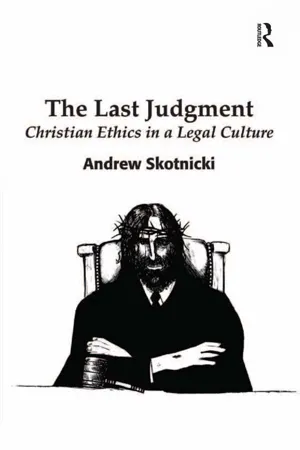
In a culture obsessed with law, judgment, and violence, this book challenges Christians to remember that Jesus urged his followers to judge no one, bring harm upon no one, and follow no law save the law of altruistic love. It traces Christian history first to show that Christians of an earlier age took very seriously the gospel injunctions against punitive legal judgment and then how the advent of formal legal codes and philosophical dualism undermined that perspective to create a division between a private Christian spirituality and a public morality of order and legally sanctioned violence. This historical approach is accompanied by an argument that the recovery of a Christian ethic based upon unconditional love and forgiveness cannot be accomplished without the renewal of a Christian spirituality that mirrors the contemplative spirituality of Jesus.
Information
Chapter 1 Law and Judgment in the Hebrew Scriptures
DOI: 10.4324/9781315556352-2
A thesis that argues that law and judgment, in all but the most restricted circumstances, are improper ideas for Christians must find its principal warrant in the biblical text and, since it provides so much of the basis for the Christian experience, the Hebrew Bible. Gunther Bornkamm has remarked that the Bible is not only the most popular book ever written, it is also the most misunderstood.1
Cognizant of that proviso, I will contend that there is a continuum of interpretation regarding the divine law in these paradigmatic texts. At one end, there exists a particular, austere and legal approach to creation and God’s role within it; on the other, a unified, relational, and contemplative one.2 The latter worldview lays the groundwork for the argument that will be sustained throughout the book concerning law and judgment. Here, one’s love of God and God’s creation, and one’s silent contemplation of the divine mystery, provide the horizon wherein law is interpreted and judgments are rendered. The law is sacred but must be viewed in light of a deity who speaks to the attentive heart in a language that supersedes the literal language of the Torah, especially the promise that its obedient servants will prosper (Job 29: 12–17; 31: 5–40; Mal 3: 14–15). It is in this framework, reminiscent of the theology in the Book of Job, that Jesus approached the law.3 In contrast, there exists a far more literal Deuteronomic view that the laws revealed in the Torah are a manifestation of God’s inscrutable and unsearchable ways and are unconditionally binding regardless of circumstance or human disposition, unless amended by God Himself.4
Whatever variations of interpretation may be summoned by the range of opinion presented above, the people of ancient Israel understood law within the context of a covenant, implying a relationship between God and the people whom God chose to bear witness to a gracious and loving plan for the redemption of humankind (Isa 2: 2–4). The rules emanating from this covenant are thus deeply bound to the historical events that form the story of the Jewish people. Yet, in this long and hallowed history, God shows a willingness to reshape both the form and content of laws since they comprise a charter for the preservation and flourishing of life as it is conditioned by unfolding events, not simply a set of rigid, ahistorical mandates (Dt 30: 15–16). In parallel fashion, punishment, while often severe, cannot be separated either from the covenantal promise of restoration or from an unfailing love that makes good out of the human propensity to do evil and seeks to foster a humble serenity rather than rebellion in the face of life’s painful limitations.
It is thus not my intention to comb the Hebrew Scriptures in order to find proof texts for a sharply drawn antinomian argument. Such a task would, first of all, be impossible in describing a faith whose character is defined so poignantly by its relation to law. Besides, as we will see and as many readers already know, the early Christian community was hardly of a single mind with regard to locating the place of law and judgment in an ethic faithful to Christ. And even among the most fervent antinomians, the Torah could not be rejected as both a religious and moral guide. Christians were incapable of ignoring the divine origin of the Pentateuch without at the same time setting themselves on heretical turf, as both Manichaeans and followers of Marcion were to reveal.5 In whatever way early Christians approached the subject, law was in some form still an expression of God’s justice and sovereignty. This was the common belief of their Jewish ancestors, not to mention all the peoples of the Ancient Near East whose influence on Hebrew legal formulations was significant.6
This chapter will first depict the traditional position that law, as imparted in the context of the Covenant, provides the only path God provides for the attainment of human and spiritual flourishing. As such, its provisions, as discerned within the tradition, are unconditionally binding. It will then develop the idea that law, despite its honorable place in the narrative of Judaism, is authoritative only within a deeper context of a contemplative and loving stance before God and creation. Finally, the implications of these two views for the punishment of lawbreakers will be discussed.
The Divine Origin of Law
For the Greeks, law was sacred. It expressed the structures of a permanent natural order, and in Plato that sense of divinity applied to the laws enacted by the community.7 The same can be said for the people of Israel. The creation accounts reveal a belief that God has instilled laws into the very fabric of life. The Psalms announce that this soundless moral message of God extends from one end of the universe to the other (Ps 19: 4–6). Implied law can be found throughout Genesis: after Adam and Eve disobey God’s command they hide and feel shame (Gen 3: 7–11); Cain, after killing Abel, laments that his sin is too great to be pardoned and that he can no longer endure the presence of God (Gen 4: 13–14); and Abraham is commended for his righteousness and obedience to the divine will even though the law had as yet not been proclaimed (Gen 26: 5).8
The word for judgment found throughout the Hebrew Scriptures, mishpat, coincides with what might be considered not an extraneous pattern of normative human behavior but a natural one.9 Among its various meanings, including the case to be heard before a court and the judgment rendered, mishpat implies a “measured, balanced relatedness … to the whole of life.”10 This understanding also reveals a theological affirmation of the harmony between divine and human life as well as between divine and human judgment when the fundamental laws of the Creator’s universe are honored.11
Furthermore, the law is revealed to the ancient Hebrews in the context of their own liberation from slavery. A free as opposed to an enslaved people are the subjects of law; it is the gift given to a community capable of voluntary assent to its provisions to enable them to maintain their freedom against the impulses and political decisions that led to their enslavement in the first place.12
Law, therefore, must always be understood not simply in a social but also in a literary framework. Each of the commandments given to Moses on Sinai, for example, is related to a story emanating from the experience of the people of Israel.13 This is not simply a charming stylistic device. The formative story of a people, not coercive force, is what provides law with the sacred character it so often possesses. A legal code always has a world-creating dimension. It carries the aspirations of a particular people a...
Table of contents
- Cover Page
- Half-Title Page
- Dedication Page
- Title Page
- Copyright Page
- Table Of Contents
- Acknowledgments
- Prologue
- Introduction: Crime, Harm, and the Cultural Landscape
- 1 Law and Judgment in the Hebrew Scriptures
- 2 Law and Judgment in the New Testament
- 3 Law and Judgment in the Early Christian Community
- 4 Law and Judgment Prior to the Enlightenment
- 5 Twilight of the Gods: Rights, Reason, and Disenchantment
- 6 Law and Judgment in Modern Society
- 7 How Should Christians Think About Law and Judgment?
- Bibliography
- Index
Trusted by 375,005 students
Access to over 1.5 million titles for a fair monthly price.
Study more efficiently using our study tools.
Frequently asked questions
Yes, you can cancel anytime from the Subscription tab in your account settings on the Perlego website. Your subscription will stay active until the end of your current billing period. Learn how to cancel your subscription
No, books cannot be downloaded as external files, such as PDFs, for use outside of Perlego. However, you can download books within the Perlego app for offline reading on mobile or tablet. Learn how to download books offline
Perlego offers two plans: Essential and Complete
- Essential is ideal for learners and professionals who enjoy exploring a wide range of subjects. Access the Essential Library with 800,000+ trusted titles and best-sellers across business, personal growth, and the humanities. Includes unlimited reading time and Standard Read Aloud voice.
- Complete: Perfect for advanced learners and researchers needing full, unrestricted access. Unlock 1.5M+ books across hundreds of subjects, including academic and specialized titles. The Complete Plan also includes advanced features like Premium Read Aloud and Research Assistant.
We are an online textbook subscription service, where you can get access to an entire online library for less than the price of a single book per month. With over 1.5 million books across 990+ topics, we’ve got you covered! Learn about our mission
Look out for the read-aloud symbol on your next book to see if you can listen to it. The read-aloud tool reads text aloud for you, highlighting the text as it is being read. You can pause it, speed it up and slow it down. Learn more about Read Aloud
Yes! You can use the Perlego app on both iOS and Android devices to read anytime, anywhere — even offline. Perfect for commutes or when you’re on the go.
Please note we cannot support devices running on iOS 13 and Android 7 or earlier. Learn more about using the app
Please note we cannot support devices running on iOS 13 and Android 7 or earlier. Learn more about using the app
Yes, you can access The Last Judgment by Andrew Skotnicki in PDF and/or ePUB format, as well as other popular books in Theology & Religion & Ethics & Religion. We have over 1.5 million books available in our catalogue for you to explore.