eBook - ePub
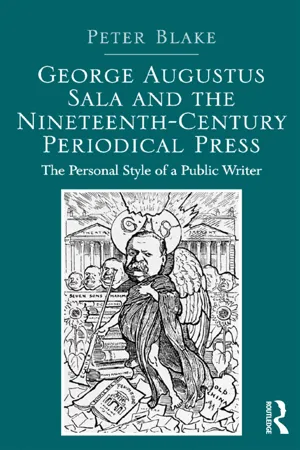
George Augustus Sala and the Nineteenth-Century Periodical Press
The Personal Style of a Public Writer
- 296 pages
- English
- ePUB (mobile friendly)
- Available on iOS & Android
eBook - ePub
George Augustus Sala and the Nineteenth-Century Periodical Press
The Personal Style of a Public Writer
About this book
In his study of the journalist George Augustus Sala, Peter Blake discusses the way Sala's personal style, along with his innovations in form, influenced the New Journalism at the end of the nineteenth century. Blake places Sala at the centre of nineteenth-century newspapers and periodicals and examines his prolific contributions to newspapers and periodicals in the context of contemporary debates and issues surrounding his work. Sala's journalistic style, Blake argues, was a product of the very different mediums in which he worked, whether it was the visual arts, bohemian journalism, novels, pornographic plays, or travel writing. Harkening back to a time when journalism and fiction were closely connected, Blake's book not only expands our understanding of one of the more prominent and interesting journalists and personalities of the nineteenth century, but also sheds light on prominent nineteenth-century writers and artists such as Charles Dickens, Mathew Arnold, William Powell Frith, Henry Vizetelly, and Mary Elizabeth Braddon.
Information
Chapter 1
A Visual Apprenticeship
In 1834 at the age of six, George Augustus Sala went temporarily blind. His nurse had inadvertently left the doors and windows of the cottage in Edgware he was residing in wide open. Sala had just suffered from an attack of the measles and in his autobiography, written 62 years later, he states that he still believed it was the result of this sudden exposure to the elements that led to ‘a horrible attack of inflammation. I turned purple, I lost my hearing, and some time afterwards, I lost my sight.’1 In fact Sala had suffered from encephalomyelitis, an inflammatory condition of the brain resulting from a reaction to the measles virus. Encephalomyelitis can lead to blindness and deafness and, looking back on the event, Sala was obviously deeply physically scarred by the ordeal. Aside from all the unconventional treatments he was subjected to (having his eyes rubbed with ‘golden ointment’, his ears pierced and his head shaved), he also overheard his mother’s maid refer to him as ‘that miserable little object.’2 Sala recalls that ‘the contumelious expression of the lady’s maid cut into my heart as though with a sharp knife.’3 But it was the disorienting mental effect that loss of sight must have had on the young boy’s perception of the world around him that would be the most important product of this unfortunate incident.
Blindness in whatever form must have been especially uncomfortable in an early Victorian culture that was just beginning to live in what Jean-Louis Comolli has described as ‘a sort of frenzy of the visible’ due to the increasing ‘social multiplication of images.’4 What Comolli specifically had in mind was the growth in access to visual information which the illustrated press and photography brought with them. It could also be argued that Sala’s temporary blindness was to be a considerable influence on his relationship with modernity. His ‘personal’ style of writing and his early experiments in illustration all became elements of a modernity that was to reach its culmination in the power of the press during the second half of the nineteenth century. Paul de Man defines modernity as involving ‘a freshness of perception that results from a slate wiped clear.’5 De Man believes that ‘the human figures that epitomise modernity are defined by experiences such as childhood or convalescence.’6 This point is reinforced by John Ruskin who was endeavouring in the 1850s to define the capacities of a new kind of observer: ‘The whole technical power of painting depends on our recovery of what may be called the innocence of the eye; that is to say, of a sort of childish perception of these flat stains of colour, merely as such, without consciousness of what they signify, – as a blind man would see them if suddenly gifted with sight.’7 What we can endeavour to trace is how Sala’s long, dark ordeal without sight created within him a freshness of perception which in turn led to a more modern way of looking at the world once the blindness had been lifted.
Throughout the misery of his loss of sight he found sweet relief in the sound of his sister Augusta’s voice reading to him from the Bible as well as fairy tales, history books, travel books, biographies and extracts from the newspapers. It is a poignant image, that of the man later to be dubbed ‘king of the Journalists’, being first introduced to the power of the press by his older sister while he sat blindly and impotently by. Sala himself called these two blind years ‘sightless and profitable’. Profitable because ‘during those dark twenty-four months I learned, thanks to a loving sister who was always reading to me and telling me stories, the greater part of that which was long afterwards to be useful to me as a journalist.’8 But the image also provides us with an insight into the gestation of Sala’s love affair with the press, a love affair that would soon embrace the new visual culture that would transform it.
When his sight was finally restored nearly two years later, albeit leaving one eye forever a ‘duffer’, the first task he set himself was to learn the art of writing. This was achieved by assiduously studying the ‘columns of the Times newspaper.’9 At the same time his father’s solicitor presented him with a folio edition of the Universal Penman, Engraved by George Bickham, Printed for the Author, and Sent to the Subscribers if Living within the Bills of Mortality (1733). In his illuminating essay, ‘Shared Lines: Pen and Pencil as Trace’, Gerard Curtis notes that the same George Bickham was responsible for a series of books that by stressing the importance of penmanship and repetitive exercises enabled the student to flourish in calligraphy, and by extension in the devising of pictures and drawing of animals. This educational training ‘stressed … the aesthetics of a written graphic line that easily flowed between text and image.’10 Sala informs us that he used to sit on a little low stool with the Universal Penman propped up against another book while he copied ‘not only the different styles of handwriting, but also … the emblematic sculptures at the top of the pages … like swans, like eagles with outspread wings, like the waves of the sea, like ships in full sail, and like festoons of flowers.’11 Sala’s education was thus mirroring the growing importance taking place between writing and drawing or the verbal and the visual in the first half of the nineteenth century.
Pen and Pencil
The importance of these two mediums was being ‘constantly reinforced in the Victorian city environment.’12 The streets, particularly the streets of the metropolis, which were to be Sala’s playground, were being turned ‘quite literally into environments to be read’, with advertising hoardings, billstickers, signwriting, window displays and ‘spectacular promotions.’13 Mass production used visual means to circulate ideas and to stimulate desire, while in the pages of the press the dissemination of engraved and photographic images was being made possible because of the reduced costs of printing technologies. Curtis notes that ‘the partnership of the textual and the pictorial line, begun in The Penny Magazine (first edition March 1832), culminated in the Illustrated London News (first edition 1841), one of the great cultural achievements of the Victorian period.’14 Kate Flint notes how periodicals like The Penny Magazine and the ILN ‘relied as much, if not more, on images as on words in their representation of the world.’15 Meanwhile, book illustration was reaching a new level of sophistication especially in the works of Charles Dickens and William Thackeray, and Flint notes that the pictorial images did not merely mirror the text but ‘provided an interpretative gloss.’16 Dickens was notoriously fastidious in his desire to find the best artists possible to deliver representations of his novels, while Thackeray, as an illustrator of his own works, saw the relationship between image and text as a self-conscious dialogue. Judith L. Fisher notes that this is emphasised in the subtitle to Vanity Fair (1847); ‘Pen and Pencil Sketches of English Society.’17
What all this visual stimulus amounted to in terms of the press and book production was an ideological struggle between pen and pencil, the verbal and the visual; a struggle that ultimately culminated in the subordination of image to text. Text and image had come to be seen as compatible, and indeed necessary, in the first half of the nineteenth century. George Cruikshank’s illustration of himself and William Hone, illustrator and writer, sitting at the same table creating their particular brand of art in perfect equality was an example of this . So too was Cruikshank’s title-page for the monthly parts of Dickens’s Sketches by Boz (1837), depicting Dickens and Cruikshank, writer and illustrator, rising above the crowds in a hot-air balloon viewing all things together and comprehensively. (See Figure 1.1.)
But by the second half of the century book and periodical illustration was not the creative and imaginative force it had been. The focus changed from excitement and sensation to elevation and improvement. Illustrators themselves felt that the imaginative as well as physical contributions they brought to novels were being neglected, and this culminated in Cruikshank’s polemical attacks on Dickens and W.H. Ainsworth.18 In the twentieth century, book illustration had come to be viewed as being as outmoded as the fiction it attempted to illustrate. The pictorial had largely given way to the photographic, and although large swathes of the press clamoured for engraved images, most of these images were derived from photographs. In his autobiography, the artist William Powell Frith relates how on its appearance photography became known as the ‘foe-to-graphic’ art and how it destroyed ‘line and all other styles of engraving as effectually as it has put a stop to lithography.’19 The more ‘respectable’ publications continued to consider the embellishment of their pages with these engravings as vulgar and ‘low-brow’. In terms of visual art the rise of the Pre-Raphaelites had introduced a keener appreciation to the detail of nature and the vividness of colour, and by their engravings for illustrated editions of poems, books and periodicals had given the art of engraving a new found respectability. But this was offset by the (ironically) incredible popularity of William Powell Frith and his photographic, social panoramas whose dense narrative content placed more importance on ‘reading’ the painting than appreciating its poetic visuality.
What I want to display in this chapter is the way that Sala’s early career mirrored this battle between the pen and the pencil. Sala’s immersion into the world of engraving and other visual forms throughout the 1840s meant that he was directly involved in a new form of print that was becoming what Andrew King and John Plunkett describe as ‘emblematic of the modern.’20 But as public taste changed and the pictorial became less sensational and more improving, and thus subordinate to the textual, Sala turned his back on scene painting, murals and engraving, and embra...
Table of contents
- Cover Page
- Title Page
- Copyright Page
- Contents
- List of Figures
- Acknowledgements
- Introduction
- 1 A Visual Apprenticeship
- 2 Tales of Two Cities: Part 1 – London
- 3 Tales of Two Cities: Part 2 – Paris
- 4 Interlude – A Russian Digression
- 5 Novelist and Man of Letters
- 6 ‘There really is a world outside Fleet Street’: Completing the Journalistic Education: Sala as Special Correspondent
- 7 ‘The flogging to be efficacious must be severe’: Sala and Flagellant Pornography
- Conclusion
- Bibliography
- Index
Trusted by 375,005 students
Access to over 1.5 million titles for a fair monthly price.
Study more efficiently using our study tools.
Frequently asked questions
Yes, you can cancel anytime from the Subscription tab in your account settings on the Perlego website. Your subscription will stay active until the end of your current billing period. Learn how to cancel your subscription
No, books cannot be downloaded as external files, such as PDFs, for use outside of Perlego. However, you can download books within the Perlego app for offline reading on mobile or tablet. Learn how to download books offline
Perlego offers two plans: Essential and Complete
- Essential is ideal for learners and professionals who enjoy exploring a wide range of subjects. Access the Essential Library with 800,000+ trusted titles and best-sellers across business, personal growth, and the humanities. Includes unlimited reading time and Standard Read Aloud voice.
- Complete: Perfect for advanced learners and researchers needing full, unrestricted access. Unlock 1.5M+ books across hundreds of subjects, including academic and specialized titles. The Complete Plan also includes advanced features like Premium Read Aloud and Research Assistant.
We are an online textbook subscription service, where you can get access to an entire online library for less than the price of a single book per month. With over 1.5 million books across 990+ topics, we’ve got you covered! Learn about our mission
Look out for the read-aloud symbol on your next book to see if you can listen to it. The read-aloud tool reads text aloud for you, highlighting the text as it is being read. You can pause it, speed it up and slow it down. Learn more about Read Aloud
Yes! You can use the Perlego app on both iOS and Android devices to read anytime, anywhere — even offline. Perfect for commutes or when you’re on the go.
Please note we cannot support devices running on iOS 13 and Android 7 or earlier. Learn more about using the app
Please note we cannot support devices running on iOS 13 and Android 7 or earlier. Learn more about using the app
Yes, you can access George Augustus Sala and the Nineteenth-Century Periodical Press by Peter Blake in PDF and/or ePUB format, as well as other popular books in Literatura & Industria de medios y comunicaciones. We have over 1.5 million books available in our catalogue for you to explore.