- 268 pages
- English
- ePUB (mobile friendly)
- Available on iOS & Android
eBook - ePub
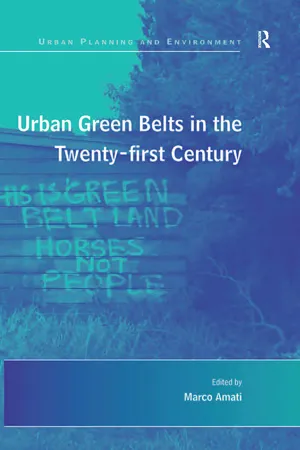
Urban Green Belts in the Twenty-first Century
About this book
Planners internationally have employed green belts to contain the explosive sprawl of cities as varied as Tokyo, Vienna and Melbourne during the twentieth century. As yet, no collection has gathered these experiences together to consider their contribution to planning. Juxtaposing examples of green belt implementation worldwide, this book adds to understanding of how green belts can be effected in theory and how practitioners have adapted them in practice. The book provides a typology of green belt implementation and reform, enabling planners to grasp why these policies are employed and whether they are relevant to twenty-first century planning.
Information
CHAPTER 1
Green Belts: A Twentieth-century Planning Experiment
The general public creates an outcry if any attempt is made to invade this green belt and that is something we want to get into planning – the creation of public interest. We want to get them to know something of our work and support us in our activities (Abercrombie, 1948, 13)
The implementation of green belts in many countries can be regarded as one of the most internationally famous attempts to control urban growth. Green belts have ringed major cities to prevent them sprawling. Planners have used them to separate satellite ‘new towns’ from the urban core, safeguarding land for recreation, agriculture and forestry. Green belts have also provided sites for more utilitarian uses such as salvage yards, incinerators and quarries. In some places, areas of the green belt have suffered through illegal dumping or through neglect.
The popularity of green belts among planners during the twentieth century is due to the alignment of their attributes with some of the assumptions that underpinned modernist planning. These assumptions were that strict divisions between different land-uses could be unproblematically drawn, and that planners’ actions could be justified by normative conventions and a search for universal truths.
As planners began to grapple with the messy realities of urban growth during the twentieth century, green belts gave them a tool to realise a normative geography that a city has natural limits, that urban and rural areas should be separated and that settlements should be balanced and evenly-spaced. Green belts were used as part of a project to construct a universal planning canon, being employed regardless of the contingencies that affect urban growth in different cities around the world. They also contributed to the construction of planning as a discipline, as the open space they preserved could be linked directly to a who’s who of famous UK planners such as Patrick Abercrombie and Raymond Unwin (Gault, 1981).
Planning has changed considerably since the early post-WWII period when practitioners attempted to physically realise the ideas of high modernism (Taylor, 1998). As planners seek to direct the growth of cities towards sustainable patterns of land-use, how likely is it that they will continue to see a green belt policy as a useful tool for managing urban growth? Planners are no longer the all-powerful experts that they once were, nor can they rely on a consensus politics that will support such bold measures. The impact that green belts have on market processes sits uncomfortably with the neo-liberal strategies to deregulate government invoked in many countries during the latter part of the twentieth century (Evans, 2003; Healey, 1997, 15). Furthermore, a number of well-known alternatives to a green belt exist allowing planners to opt, for example for a green wedge, a greenway or a greenweb.
Despite these forces of change, green belts can be found next to fourteen cities in the UK, where they have remained a central plank of national planning policy for more than fifty years. Planners have successfully enforced green belts despite sustained periods of high development pressure particularly in the South-East of England. Green belts have garnered broad political support throughout successive changes of government, including the Thatcherite deregulation of the 1980s. Yet, as contributions to a recent special issue of Journal of Environmental Planning and Management and an article by Sir Peter Hall have discussed, the UK’s green belts are by no means sacrosanct and a debate currently rages on their future in relation to housing and the urban fringe (Amati, 2007; Gunn, 2007; Gallent, 2007; Lloyd, 2007; Hall, 2007).
This book is concerned with attempts to reform the green belt as a reflection of the shifts away from modernist planning thought. Although it may contribute to the UK’s green belt debate, the book’s focus steers deliberately away from the large body of research that already exists on the UK, and towards work by international scholars and practitioners. The aim of bringing these works together is to use green belts as a lens through which to view the changes in planning during the twentieth century. At the same time, each of the following chapters contributes to the question of whether green belts remain a relevant or useful concept for the twenty-first century.
Any book that makes the green belt its central theme but fails to mention how the concept was developed and disseminated would be remiss and leave the reader unaware of its importance. Therefore, the aim of the present chapter is to unpack the reasons for the widespread implementation and popularity of the green belt among planners. Central to this history is that of UK planning and how it influenced other countries. It is argued that the popularity of green belts among planners internationally peaked from the early 1950s to the 1970s when the ideas of high modernism seemed practicable. At the same time, the green belt concept was transmitted to, or borrowed by, other countries. In some cases diffusion occurred along colonial channels, where attempts were being made to integrate elements of UK planning into indigenous systems. In New Zealand for example, Abercrombie’s Greater London Plan 1944 was widely read and it was common for planners to train in the UK or at least take Town Planning Institute (later Royal Town Planning Institute) exams until 1958.
In the following a brief sketch of the historical development of the green belt in the UK is provided, describing how pre-WWII planners invoked the green belt as a way of achieving the normative goals associated with preserving the landscape. A great deal of research already exists in this area (for example, Thomas, 1963; Sheail, 1981; Elson, 1986; Cherry, 1996; Matless, 1998), and the intention is not to repeat this work but to use it to unpack how Raymond Unwin and Patrick Abercrombie, two of the most internationally reknown planners, used the green belt to entrench preservationist values into the planning system. Secondly, it is shown how the success of the green belt was deliberately associated with the growing discipline of Planning. Thirdly, I focus on two aspects of modernist planning, the concealment of normative goals behind rational justifications and the search for a universal planning discipline, and discuss the extent to which the implementation of the green belt mapped onto these. Finally, I introduce the book’s structure as a reflection of the changes that have taken place in planning since the early post-WWII period and summarise how each of the contributions fit into this.
The Pre-WWII Green Belt
The simple idea of surrounding an urban area with a band of undeveloped land has a variety of nineteenth century origins but first gained prominence through its association with the Garden Cities concept. To think of green belts is to think inescapably of Ebenezer Howard and his work To-morrow: a peaceful path to real reform (1898).
Despite the importance of the green belt in the UK’s planning history, the origins of the term and its application have been diverse (Freestone, 2002). A number of similar schemes, such as parklands, parkways and greenways, flourished during the early twentieth century, spreading internationally via conferences, exhibitions and international lecture tours (Ward, 2002, 79). Each of these schemes have their individual histories and have shaped the development of different cities at various times.
While the green belt was one of several policies that planners in different countries could choose from, it was strongly supported in the UK by an active group of ‘preservationists’. Preservationists sought to impose a normative model of settlement on the landscape, what Matless (1998) terms a ‘morality of settlement’, and to use the landscape to constitute citizens (Parker, 2006; Reeder, 2006, 60). Preservationists normatively asserted that a town should be clearly a town, and a village a village. They saw the adoption of green belts as a way of imposing an urban-rural polarity on an in-between landscape of urban fringe suburbs and ribbon development (Matless, 1998, 32).
The ideas of preservationists were woven into the UK’s planning system during the pre-WWII period by a broad array of actors. The highly distinguished planner Patrick Abercrombie, writing about the Council for the Preservation of Rural England (CPRE), one of the most active preservationist groups that he co-founded in 1926, mentions:
the local authorities, the owners, the farmers, the inhabitants; the users of the country, the ramblers, the campers, the motorists; the preservationists of the commons and footpaths, wild flowers, fauna, ancient buildings, trees, etc.; the National Trust; the women’s institutes, the rural community councils, the architects, surveyors, engineers and town planners; the garden cities, housing and town-planning propaganda associations (Abercrombie, 1959, 228)
These were all to be coordinated, from however divergent angles, to achieve the common goal of preserving the countryside’s existing beauty. Although these groups would have had disparate concerns, their support for the work of the CPRE is a reflection of the broad appeal of the preservationist cause.
Preservationist concerns also constituted the discourse of the influential London Society (Beaufoy, 1997), and were voiced by prominent politicians such as William Bull, Lord Meath, Neville Chamberlain and Herbert Morrison (Reeder, 2006, 58). They included the geographer, Lawrence Dudley Stamp, whose pioneering land-use survey of Britain contributed to the 1947 Town and Country Planning Act. Preservationists were able to count among their ranks, not only Patrick Abercrombie, but also planners such as Raymond Unwin and F. J. Osborn who all had enormous influence on the development of the UK’s planning system.
Unwin, in particular, was a keen advocate for separating town and country deriding, in his widely read Town Planning in Practice ‘that irregular fringe of half-developed suburb, and half-spoiled country which forms such a hideous and depressing girdle around modern growing towns …’ (Unwin, 1909, 156). The irony is that this could be used to describe London’s present-day green belt.
As Unwin and Abercrombie’s career and influence developed they were able to project their preservationist ideals onto the planning system through the implementation of a green belt. In 1929 Unwin became the chief planner of the Greater London Regional Planning Committee and published his First report proposing a ‘green girdle’ for the enjoyment of Londoners to compensate for the deficiency of open spaces. The implementation of his plan was prevented by a government financial crisis in 1931 (Miller, 1991, 189–209), and it was only in 1935 that the green belt could be finally implemented with the help of a London County Council scheme to buy land and the cooperation of an array of actors that shared preservationist concerns (Amati and Yokohari, 2007; Reeder, 2006, 64–5). Abercrombie wrote the enormously influential County of London Plan 1943 and the Greater London Plan 1944) which were published to national and international acclaim (Forshaw and Abercrombie, 1943; Abercrombie, 1945). Both of these contained sections on the green belt and directly influenced central government thinking at a time when UK planning legislation was undergoing momentous changes as development rights were being nationalised through the 1947 Town and Country Planning Act (Garside, 2006).
The popularity of the green belt in the UK is demonstrated by its eventual integration into central government planning policy. Abercrombie’s work in the 1940s influenced Duncan Sandys the Minister with responsibility for planning. He issued a Circular calling on all local planning authorities, county councils in England and Wales to consider submitting plans for a green belt in 1955 (Ministry of Housing and Local Government, 1955).
The implementation of the green belt in the UK can be seen as a fifty year struggle during which the popularity and fame of the concept steadily increased in line with its proponents’ careers. Once the popularity of the green belt peaked it remained high for the first 20 years of the post-WWII period. The following explores the reasons for this popularity in greater depth.
Connecting the Success of the Green Belt to Planning
The incorporation of the green belt into the UK’s central government policy as well as the support it gained from well-known planners inspired what Ward (2000) terms as the ‘undiluted’ borrowing of the concept by a number of cities during the post-WWII period. The following sections describe why the borrowing of the green belt was so wholesale. Firstly, UK planners trumpeted the success of the green belt to further the planning project. Secondly, the normative values articulated during the pre-WWII period and certain aspects of modernist, early post-WWII planning aided the implementation of the green belt.
By the mid-1950s the green belt could justifiably be called part of an international planning language. The ideas behind the green belt would have been recognisable from the pre-WWII attempts to preserve the existing greenery around other European cities such as Frankfurt, Berlin and Vienna (Ward, 2002, 84; Kühn and Gailing; Breiling and Ruland, this volume). The US federal government had employed a variant of the concept to build its three ‘greenbelt towns’ during the 1930s depression (Arnold, 1971). The use of green belts to separate satellite towns was a part of Communist Party policy for St Petersburg during the early 1930s (Anan’ich and Kobak, 2006). But it was through the propagandising work of British planners in the post-WWII period that the green belt concept was deliberately and rapidly spread.
During the 1940s to 1970s, UK planning was being held up as an example and UK planners were in demand. For example, Patrick Abercrombie toured Australia in 1948 on a month long visit sponsored by the British Council which also sponsored a Town Planning in Britain Exhibition that travelled to both Australia and New Zealand. Abercrombie also travelled to Hong Kong in 1947 advising on the planning of the city (Tang et al., 2007). F. J. Osborn travelled extensively acting as an international propagandist for the Garden Cities movement during the 1950s, 60s and 70s (Whittick, 1987).
In many cities green belts were attempted at this time. The New Zealand and Australian cities of Wellington, Christchurch, Brisbane, Melbourne and Sydney drew their inspiration for their green belts from the UK but also from earlier schemes such as Colonel Light’s Adelaide Parklands (Amati, 2006; Low Choy and Gleeson, 1998; Freestone, 1992; Miller and Amati; Buxton and Goodman; Garnaut, this volume). Cities in East Asia such as Hong Kong and Tokyo both implemented their own versions of the green belt drawing on Abercrombie’s work (Tang, 2007; Amati and Parker, 2007; Watanabe et al., this volume). Ottawa’s green belt while being based originally on the work of F. L. Olmsted, also drew on Abercrombie’s Greater London Plan 1944 (Gordon and Scott, this volume).
The green belt was seen by planners as an achievement to be assiduously promoted – as the quotation from Patrick Abercrombie’s 1948 speech at the University of Melbourne shows at the beginning of this chapter. The planning theorist Lewis Keeble, whose Principles and practice of town and country planning was standard reading throughout the English-speaking world during the 1950s and 1960s (Taylor, 1998), also saw the green belt as a way of furthering the aims of planning as a discipline:
It is therefore desirable that great and persistent efforts should be made to publicise the achievements of Planning. These include the following: – The establishment and maintenance of Green Belts around the great cities; the overall success of these is far greater than the detailed local failures which have sometimes occurred (Keeble, 1961a, 90–91)
In other words, Keeble hoped that the green belts would carry the cause of planning forward, being, as Desmond Heap stated in his 1955 presidential address to the Town Planning Institute, its ‘very raison d’être’. The Town and Country Planning Association, celebrating the UK government’s incorporation of the green belt into national policy, were able to pronounce that ‘one great nation has officially adopted one of the major principles of the garden city idea formulated by Sir Ebenezer Howard in 1898’ (Elson, 1986, 14–15). F. J. Osborn was similarly delighted by the popularity of the green belt among the public: ‘The sudden almost universal acceptance of the policy of dispersal, green belts and new towns is the most heartening thing that has happened in the history of planning’ (quoted in Whittick, 1987, 91). In the late 1950s, B. J. Collins writing in the Town Planning Review could note a number of ‘healthy signs’: ‘The salutary cry goes up in tones of horror, “This is Green Belt.” It is a cause in which each authority and numberless individuals have made sacrifices for the sake of the future, and many of them now feel deeply opposed to any compromise’ (Collins, 1957).
The satisfaction that these planners derived from succeeding to get green belts designated was linked to their concerns to further the planning project. The green belt provided a useful example, for planners to show what their discipline could achieve nationally and internationally
Green Belt as a Modernist Planning Policy
The early post-WWII period also saw the green belt being employed alongside modernist planning tools. This period can be characterised as one of ‘middle modernism’ because planners were forced to reach compromises with both the practicalities of implement...
Table of contents
- Cover Page
- Dedication
- Title Page
- Copyright Page
- Contents
- Figures
- Tables
- Notes on contributors
- Preface
- Acknowledgements
- 1 Green Belts: A Twentieth-century Planning Experiment
- I The Coalition of the Un-willing: Landowners and the Green Belt
- II Falling Out of Favour: Deregulation and Green Belts
- III Re-forming Greenery: From Green Belts to Green Nets
- IV Works in Progress: Patching Together a Flexible Green Belt
- Index
Trusted by 375,005 students
Access to over 1.5 million titles for a fair monthly price.
Study more efficiently using our study tools.
Frequently asked questions
Yes, you can cancel anytime from the Subscription tab in your account settings on the Perlego website. Your subscription will stay active until the end of your current billing period. Learn how to cancel your subscription
No, books cannot be downloaded as external files, such as PDFs, for use outside of Perlego. However, you can download books within the Perlego app for offline reading on mobile or tablet. Learn how to download books offline
Perlego offers two plans: Essential and Complete
- Essential is ideal for learners and professionals who enjoy exploring a wide range of subjects. Access the Essential Library with 800,000+ trusted titles and best-sellers across business, personal growth, and the humanities. Includes unlimited reading time and Standard Read Aloud voice.
- Complete: Perfect for advanced learners and researchers needing full, unrestricted access. Unlock 1.5M+ books across hundreds of subjects, including academic and specialized titles. The Complete Plan also includes advanced features like Premium Read Aloud and Research Assistant.
We are an online textbook subscription service, where you can get access to an entire online library for less than the price of a single book per month. With over 1.5 million books across 990+ topics, we’ve got you covered! Learn about our mission
Look out for the read-aloud symbol on your next book to see if you can listen to it. The read-aloud tool reads text aloud for you, highlighting the text as it is being read. You can pause it, speed it up and slow it down. Learn more about Read Aloud
Yes! You can use the Perlego app on both iOS and Android devices to read anytime, anywhere — even offline. Perfect for commutes or when you’re on the go.
Please note we cannot support devices running on iOS 13 and Android 7 or earlier. Learn more about using the app
Please note we cannot support devices running on iOS 13 and Android 7 or earlier. Learn more about using the app
Yes, you can access Urban Green Belts in the Twenty-first Century by Marco Amati in PDF and/or ePUB format, as well as other popular books in Politics & International Relations & Local & Regional Planning Public Policy. We have over 1.5 million books available in our catalogue for you to explore.