1.1.1 Definition
The clause is the smallest independent expressive unit in Chinese grammar. We will elaborate on this definition in the following subsections.
1 The expressive nature of the clause
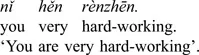
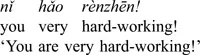
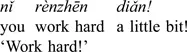
By expressive we mean that it expresses an idea and imparts an intention. Specifically, it may realise a statement, an exclamation, a request, or a question. An intention is not necessarily a statement, although it may be related to it. For example, statements may be expressed indirectly in some cases:
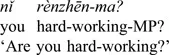
The basic elements of the four clauses are nǐ and rènzhēn, although the intentions are different. (1) is a statement, (2) an exclamation, (3) a request, and (4) a question. (1) is the direct realisation of a statement, while (2) conveys the exclamation via the statement. (3) is not a statement, although it is related to such statements as nǐ bú gòu rènzhēn (‘You are not hard-working enough’.) and nǐ shì yīnggāi rènzhēnde (‘You should be hard-working’.). Similarly, (4) is not a statement either, although it implies, or is indirectly associated with, such statements as nǐ kě’néng shì bú rènzhēnde (‘It may be the case that you are not hard-working’.).
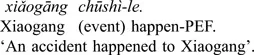
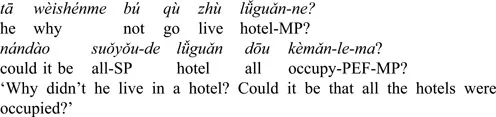
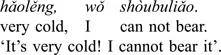
In questions or exclamations that are realised by a single question, a mood particle, or an exclamatory mood particle, there may be a statement implied, thus an association exists between them. For example,
(5) is an interrogative consisting of an exclamatory particle alone. In some specific contexts, it may be associated with the statement xiǎngbúdào huì yǒu zhèzhǒngshì (‘I had not expected there should be such a thing’.). Similarly, (6) is an exclamatory clause realised by an exclamatory particle. One may imagine a typical context where it is associated with the statement nǐ zhè shì chīxīnwàngxiǎng (‘You are expecting too much!’).
2 The independent nature of the clause
By independent we mean that it is not included in any other clause. In other words, those units that are included in a clause are not clauses themselves. For example,
(7) is a clause; it occurs independently. This clause is included in the clause dà’niáng zǎojiù zhīdào … (‘Auntie knew much earlier that …’) in (8), functioning as the object of zhīdào. Thus it is not a clause. The following are two other examples:
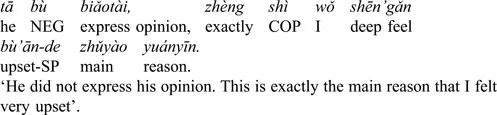
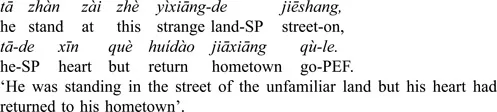
(9) is a complex sentence consisting of two clauses; they are different clauses within the same complex sentence, but they are not included in each other; that is, they are independent clauses. In (10), these two clauses are included in the clause pattern X zhèngshì Y de zhǔyàoyuányīn (‘X is exactly the main reason for Y’.); they serve as the subject and attribute in the clause. They are not independent clauses.
3 The clause as the smallest expressive unit
There are three types of expressive units: clauses, complex sentences, and sentence groups. The clause is the smallest among them. Complex sentences and sentence groups are composed of at least two clauses. For example,
(11) is a complex sentence and (12) is a sentence group, each containing two clauses.
4 The clause as sentence
The clause is a kind of sentence; it carries a specific mood. For example, clauses (1) – (4) are in the declarative, exclamatory, imperative, and interrogative mood, respectively. When two or more clauses configure with each other to form a complex sentence/sentence group, the clauses all have their own moods. For example,
They are all complex sentences; each consists of two clauses, and the two clauses within each are in different moods. The mood configurations are ‘declarative + interrogative’, ‘declarative + imperative’, and ‘exclamatory + declarative’, respectively.