- 234 pages
- English
- ePUB (mobile friendly)
- Available on iOS & Android
eBook - ePub
Valuing Historic Environments
About this book
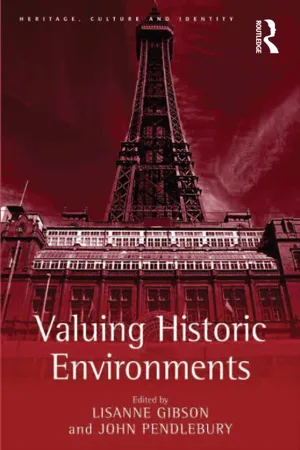
This volume brings together an interdisciplinary team of leading scholars to discuss frameworks of value in relation to the preservation of historic environments. Starting from the premise that heritage values are culturally and historically constructed, the book examines the effects of pluralist frameworks of value on how preservation is conceived. It questions the social and economic consequences of constructions of value and how to balance a responsive, democratic conception of heritage with the pressure to deliver on social and economic objectives. It also describes the practicalities of managing the uncertainty and fluidity of the widely varying conceptions of heritage.
PART I
Values and Heritage Stewardship
Chapter 1
Patrons, Populists, Apologists: Crises in Museum Stewardship
Museums today are more popular and at the same time more beset than ever. They are popular because increasingly visited by mass audiences, who widely regard them as trustworthy sources about everything from pterodactyls to Picassos. They are beleaguered because fast-changing views of their proper functions lumber them with multiple and ever more incompatible missions. Public approbation lends museums high visibility, while intensifying their burdens and risks.
Here I sketch the dilemmas faced by repositories of natural and cultural heritage in becoming embattled and politicized arenas of conflict. As traditional acquisition norms of purchase and pillage give way to moral and legal demands for restitution and repatriation, many museums are hard put to retain their holdings, let alone to add to them. At the same time, views about how, when and even if museums should display their wares are in flux. Past triumphalism gives way to stress on remorse and recrimination; the primacy once accorded perdurable material relics is now accorded to function and performance; elite patronage yields to dumbed-down populism; ideals of objectivity and universality are discarded for partisan engagement.
Museums are not the only heritage realm undergoing crisis. Indeed, heritage as a whole is in a perpetual state of emergency. Stewards in every realm are beset by manifold challenges: how to ensure a valued past’s survival, how to fund its conservation and maintenance, how to validate its authenticity, how to secure its proper role in public memory. Perils of the moment make heritage managers more reactive than proactive; they respond when things look parlous. In so doing they mirror public awareness and concern. Nothing arouses affection for a legacy so much as the threat of its loss. Things of which most people were little aware suddenly become precious when destruction or despoliation is imminent. Few in the heritage community gave much thought to Mostar’s bridge, Afghanistan’s cliff-face Buddhas or Baghdad’s museum until they were bombed, defaced and looted.
Yet museums especially exemplify the purposes and attendant problems of our collective heritage. More than any other institution, they epitomize what we value not as commercial commodity – although museums dote on what used to be commodities – but as locales in which to be edified, charmed, delighted, amazed, awed, challenged. Admittedly, such terms equally evoke other arenas – circuses, funfairs, theatres, sport stadiums. But museums differ from all of these in that entertainment is not their primary function. Much public pressure is nowadays exerted to make it so. Museums that fail to oblige populist demands are denounced as old-fashioned, fuddy-duddy, unresponsive, elitist.
Old Museum Missions and Stereotypes
Things were ever thus. Every era is lumbered with once-trendy museums that then became white elephants – obsolete embarrassments, politically incorrect sitting ducks for iconoclasts. They are in unending trouble. ‘Museums anywhere, everywhere, are a problem’, declared heritage guru Freeman Tilden twenty years ago. In the light of ‘widespread public resistance to museums of any kind’, he went on, ‘it has even been suggested that the name museum be changed to something else’.1
Part of this opprobrium stemmed from the pre-modern European collecting urge that begat Wunderkammerer, those omnium gatherums whose bric-a-brac influence still persisted. Tilden had toured countless ‘historical-society museums that left me dazed and dizzy, … a letter from Napoleon to Josephine reposing beside a stuffed albino squirrel … a fireman’s hat just above a first edition of James Fenimore Cooper, and both of these in front of a Revolutionary musket … Each article displayed was … possibly a treasure, but the whole set-up was inchoate’.2
Yet cabinets of curiosities, the private collections of rich and powerful men, were by then the exception. They had been largely transformed into or replaced by nineteenth-century public museums, serving as sanctuaries for relics of past times and other cultures, at once exotic, instructive and, as vestiges of outworn folk doomed to extinction, pathetic. The great Western museums came into existence as showcases of imperial booty, taken by force or theft or derisory purchase from colonized and subjugated peoples the world over. As adjuncts of national and imperial chauvinism, the public acquisition of global heritage justified looting and spoliation in the name of civilized progress. Termed ‘the finest legacy of the Enlightenment’,3 the modern universal museum was a temple of knowledge and beauty intended to inspire patriotic reverence and wholesome reflection.
Moral pedagogy was the canonical museum role. The mission of their collections was to teach a wider public to emulate their betters. The likenesses of admired exemplars in the National Portrait Gallery would inspire ‘mental exertion, noble actions and good conduct’, was Prime Minister Lord Palmerston’s 1856 dictum inscribed above the portal.4 Viewing the artefacts of other cultures would make British Museum visitors more thoughtful, more benign, more truly British.
Like the temples of worship they were often built to resemble, these secular cathedrals aimed to inculcate civic ideals among the untutored masses, but only to hoi polloi able and ready to shed uncouth ways. ‘The first function of a Museum is to give example of perfect order and perfect elegance to the disorderly and rude populace’, wrote that arbiter of taste John Ruskin in 1880. But the populace should pay for the privilege of self-improvement. There should be ‘small entrance fees, that the rooms not be encumbered by the idle, or disgraced by the disreputable. You must not make your Museum a refuge against rain or ennui, nor let into perfectly well-furnished and even … palatial rooms the utterly squalid and ill-bred portion of the people’.5 Museums epitomized decorum and civility – the antithesis of Bateman’s Boy, jailed for life for breathing on the glass.6 Museum treasures were sacred icons, not to be touched, let alone doubted or derided.
Small wonder that to their critics museums were akin to mausoleums. In 1856 the British Museum stifled Nathaniel Hawthorne.
Crushed to see so much, I wandered from hall to hall with a heavy and weary heart, wishing that the Elgin Marbles and the frieze of the Parthenon were all burnt into lime … and that the mummies had all turned to dust … that all the material relics of so many successive ages had disappeared with the generations that produced them.
Misguided veneration of antiquity, in his view, blinded viewers from seeing ‘for rubbish what is really rubbish; and under this head might be reckoned almost everything … at the British Museum’.7
Half a century later, ‘museum’ became Italian Futurists’ prime term of abuse. Everything wrong with modern Italy came from its fetish of museums, their useless, filthy, retrograde holdings the major impediment to modern progress. Italy was a ‘country of the dead’, its people dozing over the glory of their ancestors, Rome and Venice mired in mouldy relics, Florence a cemetery kept up for tourists besotted with the antiquarian rubbish. In seeking to rid Italy of ‘its smelly gangrene of professors, archaeologists, ciceroni and antiquarians’, Filippo Tommaso Marinetti delighted in the ‘growing nausea for the antique, for the worm-eaten and moss-grown. … For too long has Italy been a dealer in second-hand clothes. We mean to free her from the numberless museums that cover her like so many graveyards’.8
Anti-museum stereotypes continue to proliferate. The museum as mortuary, as site of death and entombment, starred in Dan Brown’s best-selling Da Vinci Code.9 Yet the word most commonly linked with museums is ‘boring’. Modern Londoners are said to see the British Museum as ‘dusty, irrelevant and dull, … the place of boring school trips’.10 It is also stupefying in its immensity. ‘Teenagers looking for ancient artefacts have to face an expedition almost as fraught as Indiana Jones’s adventures in the Temple of Doom’.11 In New York’s Metropolitan Museum of Art, a fleet-footed guide promises to deliver the top dozen masterpieces in under an hour. The champion of ‘the six-minute Louvre’ sprints past the Venus de Milo, the Winged Victory of Samothrace, the Mona Lisa, exulting that ‘there isn’t a museum in the world that can keep me inside for very long’.12
New Strengths and Obligations
Today’s museums signally refute these denigratory stereotypes. Museums are more popular, more numerous, more visited, more extolled, more trusted than ever. They are prime stimulants of domestic pride and foreign tourism; they are founts of group identity; they become envoys of diplomacy. And they are seen as the most trustworthy source of public instruction; the public at large has greater faith in museums than in any other supplier of knowledge. In a 1994–1995 survey, 20,000 European 15-year-olds ranked museums and sites most reliable for understanding the past – above documents and printed sources, much higher than TV documentaries.13 Across the Atlantic the story is the same: 1,500 American interviewees considered museums the most honest and unbiased source of information about the past, more trustworthy even than accounts by grandparents and by eyewitnesses to historic events.14
What makes museums so trusted? They provide unparalleled intimacy and involvement with the past, in apparently unmediated immediacy. In museums we go at our own pace, with our own chosen companions; we are not required to look here rather than there, or constrained to view things in any set sequence; we are not told what to think but left to make up our own minds. Unlike students immured in a classroom or imbibing oldsters’ tales of yore, museum-goers feel they make of the past what they themselves decide, based on evidence that is seemingly uncontrived and objective.15
Intrinsic materiality also lends verisimilitude to museum displays. Visitors trust what is there because they see it with their own eyes; seeing is believing, things don’t lie, as is customarily said. Imaginations are carried back to when the bones were living creatures and the artefacts were fashioned, without the distortions patent in movies and television.16 Moreover, museum exhibits are felt to reflect a consensus of many views, not just one, as with a particular schoolteacher or an authored textbook. The collaborative museum chorus of manifold voices, all the more authoritative by dint of their anonymity, lends displays added credibility.17
Public approbation in great measure reflects the extraordinary transformations museums have undergone in recent decades. Victorian credos are now stood on their heads. Populism dethrones patronage. Populist taste more and more decides what is to be acquired and shapes its display – motorcycles at the Guggenheim, hip-hop ephemera at the Brooklyn Museum of Art, 1950s’ fashion at the Victoria and Albert. Vox populi makes the take at the gate the prime criterion of museum survival, confirming Andy Warhol’s ‘ canny prediction that all museums will become department stores, and vice versa’.18 Ancient relics give way to retro nostalgia, contemplation to performance, display cases to interactive engagement; several art museums encourage visitors to add their own labels to paintings and sculpture.19
At the conceptual artist Rudolf Stingel’s retrospective in Chicago and New York, viewers were invited to have a go at gallery walls with pens, credit cards, fingernails, or whatever; the resultant ‘populist, manic, talking-in-tongues wallpaper’ was said to make ‘the Metropolitan Museum’s Temple of Dendur, incised by a couple of centuries of tourist comments, look positively virginal’.20 Media hypes blockbuster exhibits; what is permanent is musty and often politically incorrect. Display features more and more objects from the present and the very recent past, a time near enough to the present for visitors to identify with. A 2006 British Museum show on the modern Middle East foregrounded ‘works that directly address the issues that exercise us all’, wrote the museum’s director: ‘political and religious turmoil, violence, displacement, exile, the struggle for liberties of all kinds’.21
Allied with interac...
Table of contents
- Cover Page
- Half Title page
- Series page
- Title Page
- Copyright Page
- Contents
- Figures
- Tables
- List of Contributors
- Acknowledgements
- Introduction Valuing Historic Environments
- I Values and Heritage Stewardship
- II Cultural Landscapes
- III The Heritage of Housing
- Index
Trusted by 375,005 students
Access to over 1.5 million titles for a fair monthly price.
Study more efficiently using our study tools.
Frequently asked questions
Yes, you can cancel anytime from the Subscription tab in your account settings on the Perlego website. Your subscription will stay active until the end of your current billing period. Learn how to cancel your subscription
No, books cannot be downloaded as external files, such as PDFs, for use outside of Perlego. However, you can download books within the Perlego app for offline reading on mobile or tablet. Learn how to download books offline
Perlego offers two plans: Essential and Complete
- Essential is ideal for learners and professionals who enjoy exploring a wide range of subjects. Access the Essential Library with 800,000+ trusted titles and best-sellers across business, personal growth, and the humanities. Includes unlimited reading time and Standard Read Aloud voice.
- Complete: Perfect for advanced learners and researchers needing full, unrestricted access. Unlock 1.5M+ books across hundreds of subjects, including academic and specialized titles. The Complete Plan also includes advanced features like Premium Read Aloud and Research Assistant.
We are an online textbook subscription service, where you can get access to an entire online library for less than the price of a single book per month. With over 1.5 million books across 990+ topics, we’ve got you covered! Learn about our mission
Look out for the read-aloud symbol on your next book to see if you can listen to it. The read-aloud tool reads text aloud for you, highlighting the text as it is being read. You can pause it, speed it up and slow it down. Learn more about Read Aloud
Yes! You can use the Perlego app on both iOS and Android devices to read anytime, anywhere — even offline. Perfect for commutes or when you’re on the go.
Please note we cannot support devices running on iOS 13 and Android 7 or earlier. Learn more about using the app
Please note we cannot support devices running on iOS 13 and Android 7 or earlier. Learn more about using the app
Yes, you can access Valuing Historic Environments by Lisanne Gibson,John Pendlebury, Lisanne Gibson in PDF and/or ePUB format, as well as other popular books in Physical Sciences & Geography. We have over 1.5 million books available in our catalogue for you to explore.