Applying ecocritical theory to the work of Victorian writers, this collection explores what a diversity of ecocritical approaches can offer students and scholars of Victorian literature, at the same time that it critiques the general effectiveness of ecocritical theory. Interdisciplinary in their approach, the essays take up questions related to the nonhuman, botany, landscape, evolutionary science, and religion. The contributors cast a wide net in terms of genre, analyzing novels, poetry, periodical works, botanical literature, life-writing, and essays. Focusing on a wide range of canonical and noncanonical writers, including Charles Dickens, the Brontes, John Ruskin, Christina Rossetti, Jane Webb Loudon, Anna Sewell, and Richard Jefferies, Victorian Writers and the Environment demonstrates the ways in which nineteenth-century authors engaged not only with humans' interaction with the environment during the Victorian period, but also how some authors anticipated more recent attitudes toward the environment.
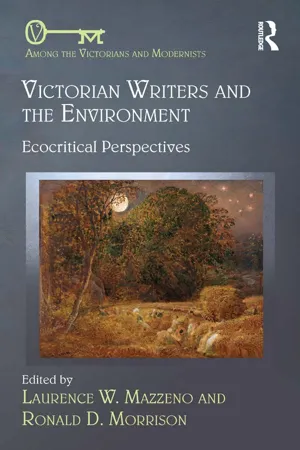
eBook - ePub
Victorian Writers and the Environment
Ecocritical Perspectives
- 260 pages
- English
- ePUB (mobile friendly)
- Available on iOS & Android
eBook - ePub
Victorian Writers and the Environment
Ecocritical Perspectives
About this book
Information
1 Reading nature
John Ruskin, environment, and the ecological impulse
Since its beginnings ecology has been strongly characterized by its multiple nature. Its scientific insights produce critiques of environmental policy, resource management, and social organization, and for many ecological actors engagement with nature involves a combination of scientific, social, aesthetic, and spiritual approaches. Ecological science invites political action, as well as questions about lifestyle choices and social organization. Ecology destabilizes customary disciplinary and cultural boundaries, and inclines towards advocating a holistic attitude to every subject. All of the modern features of ecology reflect the conditions of its genesis in the mid-nineteenth century, as well, of course, of all that followed. Rather than being merely an offshoot of evolutionary science, early ecology represented the coming together of Darwinism and many other strands of thought, including anatomical science, Romanticism, transcendentalism, human geography, religion, and politics. Ecology is marked by a wider nineteenth-century tendency to draw together often disparate and sometimes conflicting ideas. I will be exploring a particular instance of the nineteenth-century roots of ecology in the work of John Ruskin. Although he ultimately rejected evolutionary theory and the implications of materialist science, his nature writings participated in nascent ecological thinking, and his approach represented many of the contradictions and opportunities that define ecology.
Like many others of his generation, Ruskin was caught between two conceptualizations of environment—one based on eighteenth-century and evangelical notions of a hierarchical nature, the other informed by both Romantic and scientific claims about the interdependence of environment. Ruskin’s ambivalent perspective generated a powerful method of reading natural phenomena that foregrounded their dynamism and their embeddedness within larger systems, and anticipated the ambitious multivalence of ecological thought. Beginning with examples from the 1840s and 1850s of Ruskin’s extraordinarily acute nature-reading, I will underline his insistence that observers pay close attention to nature; that the environment represents a precious resource; and that environmental engagement offers opportunities for self-improvement and collapses the distance between observer and observed by revealing what they share. While his nature-reading techniques were profoundly indebted to scriptural hermeneutics, his insistence on close scrutiny led him to discern the systematic connections of nature and to reach for explanations of environment that bore distinctive ecological markers. Acknowledging, scrutinizing, and embracing an environment made up of endless connections and characterized by infinite variety led him to query the place of humanity within this newly conceived realm. By turn, it led him at times to challenge (but ultimately never to reject or overturn) those hierarchical and anthropocentric readings of nature that he inherited from Evangelicalism. Like ecology, Ruskin’s approach to nature was complex, multiple, and in a state of productive tension.
Having explored Ruskin’s nature-reading methods and the ways this led him to think of nature as a helpful system, I will turn to the manner in which he directed this towards nature conservancy. Ruskin’s activities in the 1870s are significant not merely as indicators of his environmentalist credentials but also for the manner in which they deployed the nature-reading processes established early in his career. Uniquely gifted in reading the signs of a healthy environment, Ruskin was also unusually sensitive in discerning environmental breakdown, partly because of his attentiveness to nature and partly because, as a religious thinker, the stakes could not have been higher. Focusing closely on his observations of moments in which the various “bodies” of nature begin to lose their ecological order, I will demonstrate that Ruskin’s environmental consciousness was informed both by evangelical hermeneutics and materialist science. Committed to the preservation of divine nature, and to the salvational possibilities of environmental stewardship, Ruskin’s vision of nature-as-system also carried unmistakable ecological markers.
An ecological model of nature emerged distinctively around mid-century in the work of Ernst Haeckel, George Perkins Marsh, and others who drew upon Darwin’s notion of the “economy of nature,” a vision of nature as a complex whole made up of dynamic, interactive parts in various states of competition, co-operation, and co-dependence.1 Ecology was influenced by nineteenth-century biology, anatomy, natural history, geology, and organic chemistry, but its multiple roots can also be traced to Romanticism, transcendentalism, human geography, and to emerging disquiet about intensive exploitation of resources. Its genesis belongs in a process of scientific and cultural change taking place throughout the century. Conceptualizing nature as a complex continuum made up of dynamic, interactive elements, ecologists immediately promoted environmental and social programs, arguing that lessons about natural systems provide powerful arguments for better management of the planet. Ecology represents a holistic way of seeing that pays close attention to microcosmic and macrocosmic elements of natural systems, and valorizes the dynamic connectedness of heterogeneous phenomena—that which Ruskin perceived as early as 1843 when he notes that “there is indeed in nature variety in all things” (3: 368) and that “the truths of nature are one eternal change—one infinite variety” (3: 145).2 Ecologists attempt to reject anthropocentric assumptions, rooted in western philosophy, that subordinate environment to humanity, insisting instead that priority be placed upon environmental systems. Intensely programmatic, ecology engages in wider debates about resource management that go beyond normally constituted boundaries of scientific discourse. Ecologists simultaneously operate at scientific, social, and cultural levels; and elaborate a holistic view of human activity that includes political economy, creative practices, and epistemology. Philosophies predicated on linearity, hierarchy, and division are often rejected in favor of inclusive, organic modes of inquiry. As I hope to demonstrate, Ruskin’s characteristic approach to nature-reading placed him close to many of the emerging features of ecological thought that I have so far described.
Ruskin’s nature-reading began in youthful scientific articles and The Poetry of Architecture (1837–1838), but emerged most powerfully in Modern Painters (5 vols., 1843–1860), a work whose fame was in no small part due to its author’s reputation as a “word-painter” whose descriptions of nature were uniquely vivid. His ability to transcribe visual experience into textual form, enabling readers to feel that they saw with Ruskin, relied on being both a gifted reader and writer of nature. Modern Painters was at once a defense of J. M. W. Turner and a call for landscape artists to engage intensively with environment in order to observe and describe its various “truths.”3 For Ruskin, this meant science and the arts working in harmony. In “The Moral of Landscape,” a chapter from Modern Painters III (1856), he spoke impatiently of Wordsworth’s anxieties about scientific investigation of nature. “The chief narrowness of Wordsworth’s mind,” he complained, was that “he could not understand that to break a rock with a hammer in search of crystal may sometimes be an act not disgraceful to human nature” or that “to dissect a flower may sometimes be as proper as to dream over it” (5: 359). Deeply indebted to Wordsworth, and Romanticism, Ruskin nonetheless believed that poetic engagement was insufficient, and that “a curiously balanced condition of the powers of mind is necessary to induce full admiration of any natural scene” (5: 357). While many were incapable of achieving this rare balance, a true observer combined the reading techniques of the artist, poet, botanist, engineer, and divine. Each of these specialists, he argued, could perceive in a natural object only a single, distorting aspect—its aesthetic qualities, poetic connotations, taxonomic status, structural function, or role in God’s creation. Only in individuals like Turner were “these perceptions and trains of ideas” presented in “a mingled and perfect harmony” (5: 358) that embraced the multiple aspects of natural phenomena. Building this proto-ecological model of engagement, Ruskin called on readers to particularly observe what he termed the “Vital Beauty” and “leading lines” of nature: by noting the ways in which the functional life history of an organism or inorganic matter were inscribed in their forms, Ruskin invited readers to engage sympathetically with them, and to recognize their locatedness within environmental networks.
In Modern Painters II (1846), he attempted to divide natural beauty into two aesthetic categories:
By the term Beauty, then, properly are signified two things. First, that external quality of bodies already so often spoken of, and which, whether it occur in a stone, flower, beast, or in man, is absolutely identical, which, as I have already asserted, may be shown to be in some sort typical of the Divine attributes, and which therefore I shall, for distinction’s sake, call Typical Beauty: and, secondarily, the appearance of felicitous fulfilment of function in living things, more especially of the joyful and right exertion of perfect life in man; and this kind of beauty I shall call Vital Beauty.
(4: 64)
Vital Beauty was among the most significant tools in Ruskin’s nature-reading methodology. It cannot be understood in isolation from its conceptual twin, Typical Beauty, which he located in environmental features that revealed divine order and intention. Typical Beauty echoed the evangelical Bible study methods with which Ruskin was so familiar. Just as scriptural hermeneutics suggested that Old Testament figures and events were divine types because they prefigured Christ, so Ruskin’s six natural types symbolized aspects of divine purpose as revealed through environment. While Ruskin’s principal aim in Modern Painters was indeed to declare “the perfectness and eternal beauty of the work of God,” narrowly contextualized religious readings of his work often deflect attention from the manner in which Ruskin’s preoccupation with the intricate material workings of environment distanced him from evangelical concerns about the snares of postlapsarian creation. Engagement with Vital Beauty, defined as “the appearance of felicitous fulfilment of function in living things” and of their “joyful and right exertion of perfect life,” was not merely a matter of producing a “homiletic register” in which “each species has its own assigned function to perform, and its own particular sermon or message from God to convey” (Finley 205). While Ruskin argued that “there is not any organic creature, but in its history and habits it shall exemplify or illustrate to us some moral excellence or deficiency” (4: 156), he found it difficult to share the certainty of fellow Christians about the unique and separate role of Homo sapiens in creation. Understanding natural sermons made it necessary to “not only love all creatures well, but esteem them” (4: 100). Doing so involved deep sympathy with the lived experience and physical being of the natural form under observation, an engagement that tended in practice to draw human subject and natural object together by acknowledgement of their shared experience of life. Pursuing the various communions of sympathy that Vital Beauty opened up led Ruskin to re-evaluate what it meant to be creative, and to see humans, animals, rocks, paintings, buildings, and societies as sacred participants in cooperative “building,” each seeking a helpful place in nature’s wider “circles of vitality” (16: 378).
Vital Beauty moved Ruskin beyond familiar sermons in stones, inviting readers to sympathetically identify with environment: our place in creation is re-imagined when we recognize or believe that everything in nature feels with us the pleasures of “felicitous fulfilment of function” (4: 64) in joyful exertions. In a study of Ruskin, design, and much else besides, Lars Spuybroek suggests that sympathy indicates “deep-rooted engagement between us and things,” a “relationship with caring,” and “an immediate seeing-feeling-thinking relationship” (146, 171) which extends beyond organic life. Building on Ruskin’s Vital Beauty, Spuybroek argues that this “reciprocity between us and things” is “not something extra, added on top of our relations with things and with each other,” but “at the core of those relations” (146, 173–4). Sympathy must not be confused with empathy: we sympathize when we are able to enter into another’s mode of existence, even when that existence is repulsive to us. Spuybroek draws on Henri Bergson’s example of solitary wasps that paralyze caterpillars, arguing that they experience sympathy because their success “requires a form of knowledge between intelligence and instinct” (163). Describing Vital Beauty in individuals of a species, Ruskin counseled readers that we are not “called to pronounce upon worthiness of occupation or dignity of disposition” because “the animal’s position and duty” is fixed by its divine design. The task instead is “to determine how far it worthily executes its office; whether, if scorpion, it hath poison enough, or if tiger, strength enough, or if dove, innocence enough, to sustain rightly its place in creation” (4: 101). To do this, we must sympathetically enter their lived experience, and in order to do so, we must be mindful of organic functionality.
The concept of sympathy was familiar in an age of Romantic poetry and nature tourism, but it was also through contact with nineteenth-century materialist anatomy, natural science, and geology that Ruskin predicated his version on proto-ecological concepts of interpenetration, cooperation, and the function-form relationship. As an exemplar of Vital Beauty, Ruskin drew attention to “a slender, pensive, fragile flower” poking out of “lines and gradations of unsullied snow” in an Alpine spring. The bloom of Soldanella alpina “shudders over the icy cleft … partly dying of very fatigue after its hard won victory” (4: 146) in piercing the snow. While “the dead ice and the idle clouds” evoke “very pure and high typical beauty,” the Soldanella offered “a totally different impression of loveliness” in which “there is now uttered to us a call for sympathy” for its heroic efforts, and “an image of moral purpose and achievement, which, however unconscious or senseless the creature may indeed be that so seems to call, cannot be heard without affection, nor contemplated without worship” (4: 147). Vital Beauty occurs when we recognize effort and energy as something familiar: founding this concept on what we share with other parts of nature, and inviting identification with humble organisms routinely regarded as “unconscious or senseless” (4: 89), Ruskin complicated anthropocentric divisions underlying Evangelicalism, just as the sentence above fails to quite clarify whether the object of worship is God or flower. We “look upon those as most lovely which are most happy” because “the pleasure afforded by every organic form is in proportion to its appearance of healthy vital energy” (4: 90, 92). Subject and object draw closer in a moment of recognition of one another’s common experience of pleasure and energy. Ruskin hoped that by receiving “the utmost of pleasure from the happiness of all things” (4: 90), the observer would begin to conceive the wider environmental systems within which humanity was embedded.
Vital Beauty led Ruskin to ever-closer studies of environment and to insights that were reliant on the intensity of his gaze. His reading process involved tracing stories that stressed interconnectedness and dynamic process. In The Elements of Drawing (1857), a volume of art instruction, Ruskin told students “I have directed your attention early to foliage” because “its modes of growth present simple examples of the importance of leading or governing lines.” In these leading lines, the artist accesses “a kind of vital truth to the rendering of every natural form … because these chief lines are ...
Table of contents
- Cover
- Half Title
- Title Page
- Copyright Page
- Table of Contents
- Acknowledgments
- Introduction: Practical ecocriticism and the Victorian text
- 1 Reading nature: John Ruskin, environment, and the ecological impulse
- 2 Between “bounded field” and “brooding star”: a study of Tennyson’s topography
- 3 Celebration and longing: Robert Browning and the nonhuman world
- 4 “Truth to nature”: the pleasures and dangers of the environment in Christina Rossetti’s poetry
- 5 The zoocentric ecology of Hardy’s poetic consciousness
- 6 Early Dickens and ecocriticism: the social novelist and the nonhuman
- 7 Bleak intra-actions: Dickens, turbulence, material ecology
- 8 Dark nature: a critical return to Brontë country
- 9 Anna Sewell’s Black Beauty: reframing the pastoral tradition
- 10 The environmental politics and aesthetics of Rider Haggard’s King Solomon’s Mines: capital, mourning, and desire
- 11 Jane Loudon’s wildflowers, popular science, and the Victorian culture of knowledge
- 12 Falling in love with seaweeds: the seaside environments of George Eliot and G. H. Lewes
- 13 Agriculture and ecology in Richard Jefferies’s Hodge and His Masters
- 14 Edward Carpenter, Henry Salt, and the animal limits of Victorian environments
- Sources for further study
- Editors and Contributors
- Index
Trusted by 375,005 students
Access to over 1.5 million titles for a fair monthly price.
Study more efficiently using our study tools.
Frequently asked questions
Yes, you can cancel anytime from the Subscription tab in your account settings on the Perlego website. Your subscription will stay active until the end of your current billing period. Learn how to cancel your subscription
No, books cannot be downloaded as external files, such as PDFs, for use outside of Perlego. However, you can download books within the Perlego app for offline reading on mobile or tablet. Learn how to download books offline
Perlego offers two plans: Essential and Complete
- Essential is ideal for learners and professionals who enjoy exploring a wide range of subjects. Access the Essential Library with 800,000+ trusted titles and best-sellers across business, personal growth, and the humanities. Includes unlimited reading time and Standard Read Aloud voice.
- Complete: Perfect for advanced learners and researchers needing full, unrestricted access. Unlock 1.5M+ books across hundreds of subjects, including academic and specialized titles. The Complete Plan also includes advanced features like Premium Read Aloud and Research Assistant.
We are an online textbook subscription service, where you can get access to an entire online library for less than the price of a single book per month. With over 1.5 million books across 990+ topics, we’ve got you covered! Learn about our mission
Look out for the read-aloud symbol on your next book to see if you can listen to it. The read-aloud tool reads text aloud for you, highlighting the text as it is being read. You can pause it, speed it up and slow it down. Learn more about Read Aloud
Yes! You can use the Perlego app on both iOS and Android devices to read anytime, anywhere — even offline. Perfect for commutes or when you’re on the go.
Please note we cannot support devices running on iOS 13 and Android 7 or earlier. Learn more about using the app
Please note we cannot support devices running on iOS 13 and Android 7 or earlier. Learn more about using the app
Yes, you can access Victorian Writers and the Environment by Laurence W. Mazzeno,Ronald D. Morrison in PDF and/or ePUB format, as well as other popular books in Literature & Literary Criticism. We have over 1.5 million books available in our catalogue for you to explore.