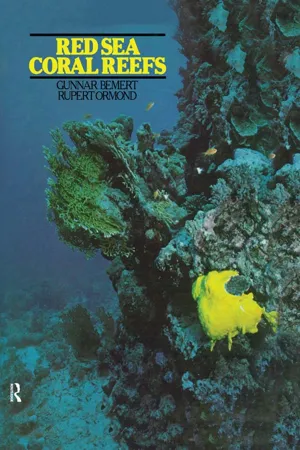
First published in 1981. The Red Sea is a distinctive and unique tropical sea, and the only enclosed coral sea in the world. This book are the impressions and images from the author who has been a professional diver and photographer since 1975. working on the
east coast of the Red Sea. He shares his exciting and fantastic times in Saudi Arabia, maligning that the Red Sea remains an unparalleled source of surprises, entertainment, and beauty.
- 256 pages
- English
- ePUB (mobile friendly)
- Available on iOS & Android
eBook - ePub
Red Sea Coral Reefs
About this book
Information
1 The Red Sea

The Red Sea runs, a narrow strip of deepest blue, for 1,500 miles between Africa and Arabia. At its head lie the twin gulfs of Suez and Aqaba, while its southern end joins through Bab-el-Mandab, the gate of tears, with the Indian Ocean. On either side lie arid lands, desert and semi-desert, where few animals appear to flourish; but framing the Red Sea, basking in its shallow waters, spread thousands of untouched coral reefs, oases of teeming life, close to the dry and thirsty land. This book is about these reefs, and this chapter about the sea in which they grow.
The Red Sea is of course not really red, but rather many magnificent shades of blue. The name is the same not only in different European languages, but also in Arabic – El Bahar Ahmer. But how the Red Sea came to be known as such has long been forgotten. There are various theories: that dust carried out to sea by sandstorms might make the sea look red – but dust quickly sinks; that the name comes from the rosy sunsets – although in fact the sunsets are frequently less spectacular than those in more cloudy parts of the world. It has been suggested the name might arise from the not uncommon occasions when so-called ‘red tides’ occur. Red tides are phenomena which have been observed throughout most of the tropics. The surface of the sea is scattered with large patches or windrows of a dense orange-red scum; this is usually due to a sudden bloom or outbreak of one of a few species of phytoplankton (microscopic planktonic plants) which contain a reddish pigment. In the Red Sea local or more extensive outbreaks of a planktonic plant called Oscillatoria erythraeum may occur for a week or two every few years. However, perhaps the best clue to the most likely explanation for the name of the Red Sea comes from the Arabic name for the neighbouring Mediterranean, which is El Bahar Abiad, the White Sea. There are no white tides or white sunsets here, but the coastline from afar often does appear white because of the limestone cliffs along the shore. Similarly, in light scattered through the dust and sand of desert and semi-desert, the coastline of the Red Sea appears cloaked in vermilion and orange.
GEOGRAPHY AND OCEANOGRAPHY
The Red Sea is a spear-shaped body of water reaching a maximum depth of 2,359 metres. It extends for 1,932 kilometres north and south, and at the widest point the distance east and west across its waters is only 306 kilometres. On either side, beyond the shoreline, are desert and semi-desert. In the central and southern parts this forms a well-defined coastal plain, twenty to forty kilometres wide, and known for example in Saudi Arabia as the tihama. Beyond this rise rugged and barren mountains, which become higher to the south with massive peaks of over 3,000 metres in both Yemen and Ethiopia.
The sea itself has a narrow coastal shelf zone with a depth of 100–500 metres. Beyond this the sea bed falls rapidly to a main trough at a depth of 600–1,000 metres or more. Within this again is a deeper central or axial trough which is more than twenty kilometres wide, but which reaches depths of 2,000 metres or more. The deepest parts form a series of fairly well-defined hollows or deeps, the best known of which are the Atlantis II deep (2,167 metres) and the Discovery deep (2,190 metres). These deeps have recently aroused considerable interest because the water within them is very warm (up to 55°C), very salty (up to eight times that of normal sea water), and contains very high concentrates of various metals, especially iron and manganese.
The axial trough reappears within the Gulf of Aqaba, which, despite its narrow dimensions, reaches depths of over 1,800 metres. By contrast the Gulf of Suez nowhere exceeds 90 metres in depth. The Red Sea and Gulf of Aqaba are in fact part of a large rift system in the earth’s crust which extends north to include the Jordan Valley and the Dead Sea, and south into the East African Rift Valley. The whole rift is now understood to have been formed by the movement apart of two major tectonic plates, those which constitute the African and Arabian continents.
This movement, which is still continuing, is believed to have originated about 70 million years ago. The new basin at first became connected with the Mediterranean, a link which was broken and re-established several times during geological history. Subsequently, about 10 million years ago, the Red Sea became connected with both the Mediterranean and the Indian Ocean. But later, probably during the lowering of sea-level during the ice ages, half a million years ago, the Red Sea became completely isolated again. The Red Sea finally became linked to the Indian Ocean only about 300,000 years ago, and even now this link is not a very secure one, since the water over the sill at Bab-el-Mandab, the southern entrance to the sea, is little more than a hundred metres deep. It seems that during this last isolation of the Red Sea it must have dried up sufficently for the previous fauna to have been destroyed, for the present animals are all of Indian Ocean origin.

2 The Red Sea, red in the light of the setting sun. By day the fiery sun renders the surrounding lands harsh and inhospitable; but it also warms the sea and provides the light energy in which coral reefs thrive.

3 The coral gardens of the Red Sea, second to none for colour of coral growth and density of fish life.
The main oceanographical feature of the Red Sea is its high salinity – up to 41 parts per thousand at the north end, compared to 35 parts per thousand in the open oceans. This higher salinity is a consequence both of the hot climate and the absence of any river adding fresh water to the sea. The surface sea temperatures range, according to the time of year, from approximately 20° to 26°C in the northern part, and from 25° to 31°C in the central and southern parts. The temperature gradually falls with increasing depth to about 700 metres, beyond which it is remarkably constant at about 21.5°C; by comparison in other seas the temperature falls to only a few degrees centigrade.
The normal tides are small and occur on a semidiurnal (twice a day) basis, with the whole sea oscillating around a nodal point approximately at the latitude of Port Sudan. The peak tides, at the northern and southern ends, are of about half a metre, while in the centre there is virtually no daily tide. There are, however, throughout the Red Sea, seasonal variations in water level over a longer period, so that in summer the mean water level in the centre of the Red Sea is nearly a metre lower than it is in winter. In addition the water level at the northern end of the Red Sea is over half a metre lower than it is at the entrance.
These seasonal tides, and the pattern of prevailing winds and currents, are all influenced by the change between summer and winter monsoons in the Indian Ocean. During the summer northerly winds prevail through the whole Red Sea, the main surface current generated by these winds is to the south, and water is driven out of the Red Sea, thus lowering its level. During winter the prevailing winds are still northerly in the northern half, but in the southern part are from the south, and these winds generate a northerly current, thus bringing water back into the Red Sea again. The essential pattern of circulation within the Red Sea is completed by a deeper countercurrent moving in the opposite direction to the surface waters. The seasonal pattern of winds has also had, as we shall see, some impact on the area’s history.
HISTORY
The geography of the Red Sea has always been the main feature forcing much of a fateful past upon the peoples whose lands lie along its coasts. For the Red Sea forms both wedge and link between Jazirat al Arab, the Arabian Peninsula, and the great African continent whose western shoreline is divided amongst the nations of Egypt, Sudan, Ethiopia, Djibouti and Somalia.
This strategic geographical position has assured the Red Sea of a continuing role in the fortunes and misfortunes of the Middle East, an area which has itself always been both land bridge and barrier between Europe and the Far East. Perhaps no area of earth has been so long or so hotly contested, either in the name of religion, or for a claim to its booty or for control over its trade routes.
In olden days the sailing ships from India and China used to ride the north-eastern monsoons across the Arabian Sea each February, passing via Aden to unload at Jeddah, the designated port of the Holy City of Mecca, and, in even earlier days, at Yanbu, port city of Medina. On the west side of the sea also cargoes from the Orient were unloaded at such ancient ports as Suakin. The almost constant northerly winds at higher latitudes made it difficult for such ships to press closer to the centres of population around the Mediterranean. Then, on a regular schedule, these ships would return to the Indian Ocean in August or September, as weather permitted, often laden with a cargo of Arabian horses or African ivory. The transhipment of goods from the Far East continued by land to the eastern Mediterranean countries or via the Nile to Egypt, and beyond, by sea again, to Europe. The caravans made their arduous overland journeys plagued by bandits, accidents, disease and thirst until the coming of steamships and the building of the Suez Canal dispensed with the need for this kind of travel.
Along with frankincense, myrrh, silk and pepper travelled the books and the lighter baggage of ideas. Travellers brought their science, philosophy, medicine, languages, political and religious thought with them. Even in the pre-Islamic ‘Age of Ignorance’ the merchants and rulers of the area remained informed of events and innovations in the rest of the world by way of the gossip exchanged in the bazaars and around the campfires of the caravans. The famed hospitality of Arab homes attracted many a weary wanderer with tales to tell for his supper.
Thus it was perhaps no mere chance that at this crossroads of ideas and beliefs the religion of Islam was revealed to and proclaimed by the Prophet Mohamed. Mohamed was born in Mecca, early in the seventh century, and while still an orphaned boy he found work on the caravans, as did many of the Hedjazis in his day. The Meccan idol worshippers, rich and comfortable through their trade and pagan pilgrimages, were not amused when the now forty-year-old Mohamed began to preach, in the name of Allah, the Oneness of God. Thus, in AD 628, he was forced to flee the persecution of his fellow Meccans, and he made his way to Medina: an event which marks the start of the Anno Hegira and the Islamic calendar. At the same time the Prophet sent some of his followers across the Red Sea to seek refuge in the Christian Kingdom of Ethiopia, where other ‘People of the Book’ received them. In Medina the Prophet built Islam’s first mosque, and it was there that God’s revelations were collected and organised to become the Holy Book, the Koran.
The first pilgrimage took place in AD 629 when many of Mohamed’s faithful returned to Mecca and gathered to pray at the Ka’ba, towards which all Muslims turn to say their prescribed prayers. By the time the Prophet died, Islam had become a militant state as well as an established religion, and the succeeding Caliphs carried its banner onwards.
The early Muslim conquests included Byzantium, Persia, Egypt, Iraq and Syria. Naval victories for the Arabs included the occupation of Cyprus in 655. Within a hundred years of the death of the Prophet, the Islamic Empire stretched from Gibraltar to India. Absorbing peoples, cultures and languages, the Muslims translated Greek texts, refined medicine, advanced alchemy, astronomy, mathematics, geography, architecture, law and literature.
After the initial peak of the Arabian-based empire came Crusaders, Mongols and Turkish Ottomans, battling to secure the caravan routes and the Red Sea ports through which passed the trade to the Orient. The fortunes of the Red Sea ports fluctuated with accidents of history. When in 1453 Constantinople first fell to the Turks, this closed the alternative overland route to China, thus handing a monopoly to the Arabs and Egyptians controlling the Red Sea. But within a century the Ottomans had conquered Egypt and the Arabian coast and were themselves promoting the area. Thus, by 1560, half a million pounds of spices were reaching Alexandria via the Red Sea each year.
In the 1600s, however, the development by the Dutch and English of Vasco da Gama’s route around the African cape to the Far East spelt disaster for the Red Sea trade. The increasing development in Europe of superior ships and technology initiated the expansion of European control and influence, which brought European galleons to the Red Sea, and eventually colonialism to the African shore. But just as Red Sea trade had so swiftly declined, so it was revived, at a stroke, by the opening, in 1869, of the Suez Canal.
While the political power of the Islamic empire fluctuated and became divided, the spread of Islam seems scarcely to have been checked. The Red Sea, which divides Arabia from Africa, also joins them, and by this route, up until the present day, numerous Arab tribes have migrated to the African continent in search of greener pastures, carrying language and religion with them, and spreading both among the African peoples. Today there are approximately 750 million Muslims spread over the globe. And as once the Red Sea stimulated the birth and spread of Islam, so in later years her waters carried millions of pilgrims on the return journey to the Islamic motherland.
In ages past Western needs were for silk, spices, incense and coffee, and the political and military means necessary to assure a steady supply of these goods. Today the need is for oil, as energy-hungry Western nations look east once more. Huge superships now make the journey to and from Arabia itself, replacing the wooden ships and camel caravans that once plied this route with different cargoes. And as the powerful nations manoeuvre for control of this new trade, the Red Sea may find itself still to be of the greatest strategic importance.
RESEARCH AND EXPLORATION
Only at a late stage in its history, of course, did the scientific study of the Red Sea begin, and only now is the knowledge gained being applied to man’s benefit. The first attempt at a systematic investigation of the Red Sea’s marine life was that of the Danish expedition of 1761–67, led by the extraordinary Peter Forsskål, a pupil of the great biologist Linnaeus. A large part of the fauna of the Red Sea, and thus incidentally of the Indian and Pacific Oceans, was first described and named by Forsskål. But of the six scientists who set out on the expedition, five of the...
Table of contents
- Cover
- Half Title
- Title Page
- Copyright Page
- Table of Contents
- Dedication
- Preface
- Acknowledgments
- 1 The Red Sea: Its geography and history
- 2 The Coral Gardens: The coral reefs of the Red Sea
- 3 The Coral Animal: Corals and soft corals, sea-fans and sea-anemones
- 4 All Creatures Great: Larger invertebrates – starfishes, sea-urchins, crabs, etc.
- 5 All Creatures Small: Smaller invertebrates – seashells, sea-slugs, worms and sponges
- 6 The Diversity of Fishes: A guide to the families of coral fish
- 7 Private Lives: Details in the behaviour of some Red Sea animals
- 8 Danger!: Dangers on the reef – sharks and venomous animals
- 9 Doing It Yourself: Diving in the Red Sea, and underwater photography
- Bibliography
- Appendix: Technical details to illustrations
- Index
Trusted by 375,005 students
Access to over 1.5 million titles for a fair monthly price.
Study more efficiently using our study tools.
Frequently asked questions
Yes, you can cancel anytime from the Subscription tab in your account settings on the Perlego website. Your subscription will stay active until the end of your current billing period. Learn how to cancel your subscription
No, books cannot be downloaded as external files, such as PDFs, for use outside of Perlego. However, you can download books within the Perlego app for offline reading on mobile or tablet. Learn how to download books offline
Perlego offers two plans: Essential and Complete
- Essential is ideal for learners and professionals who enjoy exploring a wide range of subjects. Access the Essential Library with 800,000+ trusted titles and best-sellers across business, personal growth, and the humanities. Includes unlimited reading time and Standard Read Aloud voice.
- Complete: Perfect for advanced learners and researchers needing full, unrestricted access. Unlock 1.5M+ books across hundreds of subjects, including academic and specialized titles. The Complete Plan also includes advanced features like Premium Read Aloud and Research Assistant.
We are an online textbook subscription service, where you can get access to an entire online library for less than the price of a single book per month. With over 1.5 million books across 990+ topics, we’ve got you covered! Learn about our mission
Look out for the read-aloud symbol on your next book to see if you can listen to it. The read-aloud tool reads text aloud for you, highlighting the text as it is being read. You can pause it, speed it up and slow it down. Learn more about Read Aloud
Yes! You can use the Perlego app on both iOS and Android devices to read anytime, anywhere — even offline. Perfect for commutes or when you’re on the go.
Please note we cannot support devices running on iOS 13 and Android 7 or earlier. Learn more about using the app
Please note we cannot support devices running on iOS 13 and Android 7 or earlier. Learn more about using the app
Yes, you can access Red Sea Coral Reefs by Bemert,Gunnar Bemert,Rupert Ormond in PDF and/or ePUB format, as well as other popular books in Scienze sociali & Antropologia. We have over 1.5 million books available in our catalogue for you to explore.