- 258 pages
- English
- ePUB (mobile friendly)
- Available on iOS & Android
eBook - ePub
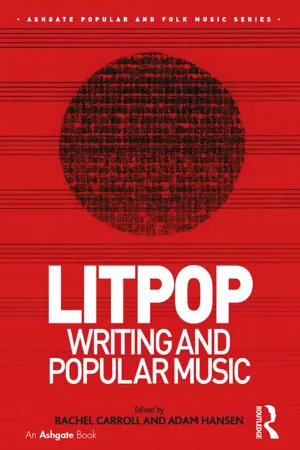
Litpop: Writing and Popular Music
About this book
Bringing together exciting new interdisciplinary work from emerging and established scholars in the UK and beyond, Litpop addresses the question: how has writing past and present been influenced by popular music, and vice versa? Contributions explore how various forms of writing have had a crucial role to play in making popular music what it is, and how popular music informs 'literary' writing in diverse ways. The collection features musicologists, literary critics, experts in cultural studies, and creative writers, organised in three themed sections. 'Making Litpop' explores how hybrids of writing and popular music have been created by musicians and authors. 'Thinking Litpop' considers what critical or intellectual frameworks help us to understand these hybrid cultural forms. Finally, 'Consuming Litpop' examines how writers deal with music's influence, how musicians engage with literary texts, and how audiences of music and writing understand their own role in making 'Litpop' happen. Discussing a range of genres and periods of writing and popular music, this unique collection identifies, theorizes, and problematises connections between different forms of expression, making a vital contribution to popular musicology, and literary and cultural studies.
Information
Making Litpop
Chapter 1
‘A Burlesque of Art’: Three Men in a Boat, Music Hall and the Imperial Mimicry of the Victorian Urban Explorer
In his autobiography, My Life and Times (1926), Jerome K. Jerome reflects on the unfavourable light in which critics regarded him. To read the reviews of his novel Three Men in a Boat (1889) ‘one might have imagined’, writes Jerome, ‘that the British Empire was in danger’.1 Despite this, however, his comedic tale of three friends, Harris, George, and the narrator J., who take a boating trip up the river Thames, was incredibly popular with the reading public, and by far his most successful work. It was perhaps this mass popularity that prompted the periodical Punch to dub Jerome, ‘’Arry K. ’Arry’.2 Derived from Harry, but with a dropped aitch affecting a cockney accent, ’Arry was a derogatory term for members of the lower middle classes who, as office clerks and shop workers, had enough disposable income and holiday time to pursue leisure activities that had normally been the preserve of higher echelons of the class structure. The ’Arry was, as Peter Bailey puts it, ‘established in the language as a shorthand for the stereotype cockney swell, and indeed in general for the working man as a lout on the spree’.3 Punch, critical of the Three Men’s alcohol consumption and use of slang, regarded Jerome as being indicative of this type of lower-middle-class vulgarity.4
The Three Men, finding they are becoming unhealthy in the city, decide that the only remedy is the sort of rational recreation that was held by reformers to be beneficial.5 It has been noted before that the structure of Three Men in a Boat mimics that of an imperial upriver journey.6 This is signposted when the Three Men, waiting for a cab to set off on their trip, attract the attention of a group of young boys, one of whom shouts out that, judging by the excessive amount of luggage our heroes have, they are clearly ‘a-going to find Stanley’.7 Stanley is, of course, Henry Morton Stanley, whose account of his search to find the missionary Dr David Livingstone was published as How I Found Livingstone in 1872. Upon close comparison with How I Found Livingstone, the extent of the parodic references to imperial adventure tropes within Three Men in a Boat becomes evident: time is spent on the planning and packing process; we see them stop regularly to camp; there is a constant risk of attack from the river bank; they attract crowds; they face mock battles and threats from local landowners; they worry about drinking water and the risk of disease; and they detail the use of tinned food. They enact a knowing appropriation of an imperial narrative. However, when they have just begun the return leg of their journey, the Three Men abandon it in favour of a cheap French restaurant in London, and a night at the well-known music hall, the Alhambra.
It is this association with the culture of the music hall which provides a focus through which the imperial parody of Three Men in a Boat must be viewed in order to fully explicate its significance. The familiarity of the Three Men with the popular songs of the halls suggests an affirmation of a lower-middle-class culture often suspected of, aptly enough, lowness. In turn, the interpretive versatility of the popular comic song of the music halls suggests how Jerome’s humour, which, as V.S. Pritchett notes, is ‘pure music hall’, should be read.8 In this light, Three Men in a Boat uses popular music to knowingly interrogate the implied imperial masculine standards implicit in its mock epic allusions, and contemporary social movements which drew on its exploratory rhetoric.
The Music Hall and Domestic Exploration
The contemporary disdain for the London ’Arry and his popular music is rather earnestly displayed in an 1892 article by the poet George Barlow in the Contemporary Review. In it Barlow laments the conversion of the Shaftsbury Avenue Opera House into a music hall, his belief being that it would now ‘resound to the laughter of countless ’Arries and their giggling sweethearts over a burlesque of art as vulgar and detestable as it is possible to the soul of man to conceive’.9 Importantly, Barlow saw this mass approval of low theatrical art as implicitly linked to national decline, bemoaning ‘the English nation, who in their steady progress towards complete democracy are becoming every day more and more Americanised, more and more gross and material in their aims and aspirations, less and less heroic and therefore less and less artistic’.10 Indeed, this perceived trend is even given colonial and military significance, due to the comments of an ‘ill-natured Frenchman’ who ‘was lately overheard to remark, in reference to this ill-omened and sudden transformation: “The English descend from Parnassus as quickly as they did from the heights of Majuba Hill!”’.11 This passage connects the fate of the Shaftsbury Avenue Opera House with a prominent British military defeat at the hands of the Boers in 1881; both are sources of gloating for malicious foreigners. Yet this connection implies that the popularity of the music hall is given wider social significance, tantamount to a self-sabotaging of national interests.
The halls are presented as the antithesis of imperial heroism, and this same connection would later be applied by opponents of tableaux vivants displays, models posing in muslin and skin-coloured tights to simulate nudity, at the Palace Theatre of Varieties in 1893. In 1894 a letter printed in the Woman’s Signal, the newspaper of the Woman’s Christian Temperance Union, opined that ‘the surest sign of a great empire’s ruin is the want of veneration for noble womanhood’; this was a view reiterated by Lady Henry Somerset, leader of the Union and firm opponent of the tableaux vivants.12 In these protestations we are presented with a late-Victorian capacity for a ready connection to be drawn between fitness on the theatrical stage and on the world stage. This imperialisation of the anxieties surrounding the theatre is reinforced by contemporary examples of a far more domestic type of exploration.
In the early 1880s, Frederick Charrington, a Methodist missionary in the East End of London, campaigned in what became known as the ‘Battle of the Music Halls’.13 Charrington identified the halls as being centres of alcoholism and prostitution, the two main causes, as he saw it, of social decline in London. Conspicuously, the Alhambra, in which the Three Men seek refuge, although one of the more upmarket music halls, was found on Leicester Square, one of the main centres of prostitution at the time.14 What is more, in 1886, Charrington set up a ‘mission to the fallen’ at the Alhambra, as well as other West End halls.15 That the Three Men should go here situates them in this context of potential social and sexual corruption. Barlow expresses similar concerns over this sexualised perception of the music halls, pointing the finger at ‘the bourgeois’ who visit the halls to ‘witness the revolting gambols of unsexed women’.16 Indeed, the women on stage seem to be a particular source of concern, with Barlow fretting about ‘the gyrations of the creatress of “Ta-ra-ra-boom-de-ay”’, just as purity movements feared the sexualisation of the tableaux vivants.17
Charrington’s protesting had mixed success, but he was representative of a much larger social purity movement. Initially started by campaigns to repeal the Contagious Diseases Acts of the 1870s and defend the civil liberties of prostitutes, by 1885 this movement had transformed into the more conservative and authoritarian National Vigilance Association, which sought to ‘raise the standards of social morality in general by repressing sexuality and promoting chastity … a comprehensive attack on ‘obscenities’ in society, arts and entertainment’.18 Music halls were seen as just the sort of corrupting influence that needed stopping. As far as Jerome’s critics were concerned, his Three Men mark themselves out as examples of the same vulgar bourgeois that Barlow found so distasteful.19 By exchanging the river for the Alhambra, and so comically rejecting Stanley’s imperial tropes, the Three Men align themselves with Barlow’s unruly ’Arries.
A factor in the formation of the National Vigilance Association was the publishing, in 1885, of ‘The Maiden Tribute of Modern Babylon’, a series of articles, in the Pall Mall Gazette, in which the editor W.T. Stead researched and uncovered the business of child prostitution in London. During the course of his investigations he even encounters Frederick Charrington, who wastes no time in giving an account of the seduction of a young girl by the proprietor of, unsurprisingly, a music hall. After allowing her to sing for one night, we are told that he ‘drugged her, seduced her and communicated to her a foul and loathsome disease’ that left her ‘literally rotting on some straw in an outhouse’.20 Performance leads to putrescence, and the story is framed as if it is a well-established pathway. Casting London as the Minoan maze of Greek mythology, Stead aims to portray a city that readers were unaware of: dark, foreign, bestial, pestilent, and in as much need of missionaries as Africa. ‘The Maiden Tribute’ is just one of a tradition of writings which use the vocabulary of exploration to deal with issues of urban social reform.
A subsequent example of this type of writing was William Booth’s In Darkest England, and the Way Out 21 in which he details plans to solve the problem of poverty and ill health in London with a system of rural farm colonies, designed on a colonial model, and strategic emigration. With its references to ‘tribes’, ‘denizens’, ‘campaigns’ and ‘darkest depths’, it is the epitome of imperial social reform as exploration writing; both London’s malady and the cure are described and plotted through a colonial framework. Of course, Booth’s book takes its name from Stanley’s In Darkest Africa, 22 which was published only months before. Inevitably, Booth’s concern would also express itself by way of an opposition to the music halls, with 1894 seeing him lead an anti-music hall campaign with Salvation Army marches through the West End.23 Yet, in Three Men in a Boat, the music hall, in sharp contrast to its role in these urban exploration texts, is itself cast as a source of salvation.
The Music Hall of Three Men in a Boat
While on the way to Runnymede, J. recounts a previous occasion when, attempting and failing to find a particular lock, he became lost on the river, which, as night falls, becomes so ‘...
Table of contents
- Cover Page
- Title Page
- Copyright Page
- Contents
- General Editor’s Preface
- Notes on Contributors
- Acknowledgements
- INTRODUCTION
- PART I: MAKING LITPOP
- PART II: THINKING LITPOP
- PART III: CONSUMING LITPOP
- Index
Trusted by 375,005 students
Access to over 1.5 million titles for a fair monthly price.
Study more efficiently using our study tools.
Frequently asked questions
Yes, you can cancel anytime from the Subscription tab in your account settings on the Perlego website. Your subscription will stay active until the end of your current billing period. Learn how to cancel your subscription
No, books cannot be downloaded as external files, such as PDFs, for use outside of Perlego. However, you can download books within the Perlego app for offline reading on mobile or tablet. Learn how to download books offline
Perlego offers two plans: Essential and Complete
- Essential is ideal for learners and professionals who enjoy exploring a wide range of subjects. Access the Essential Library with 800,000+ trusted titles and best-sellers across business, personal growth, and the humanities. Includes unlimited reading time and Standard Read Aloud voice.
- Complete: Perfect for advanced learners and researchers needing full, unrestricted access. Unlock 1.5M+ books across hundreds of subjects, including academic and specialized titles. The Complete Plan also includes advanced features like Premium Read Aloud and Research Assistant.
We are an online textbook subscription service, where you can get access to an entire online library for less than the price of a single book per month. With over 1.5 million books across 990+ topics, we’ve got you covered! Learn about our mission
Look out for the read-aloud symbol on your next book to see if you can listen to it. The read-aloud tool reads text aloud for you, highlighting the text as it is being read. You can pause it, speed it up and slow it down. Learn more about Read Aloud
Yes! You can use the Perlego app on both iOS and Android devices to read anytime, anywhere — even offline. Perfect for commutes or when you’re on the go.
Please note we cannot support devices running on iOS 13 and Android 7 or earlier. Learn more about using the app
Please note we cannot support devices running on iOS 13 and Android 7 or earlier. Learn more about using the app
Yes, you can access Litpop: Writing and Popular Music by Rachel Carroll,Adam Hansen in PDF and/or ePUB format, as well as other popular books in Media & Performing Arts & Music. We have over 1.5 million books available in our catalogue for you to explore.