eBook - ePub
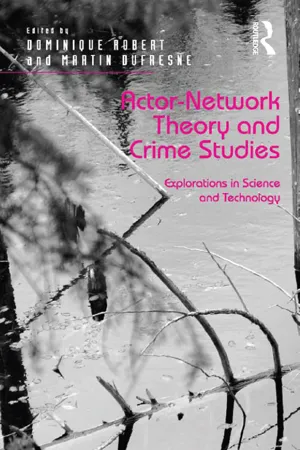
Actor-Network Theory and Crime Studies
Explorations in Science and Technology
- 160 pages
- English
- ePUB (mobile friendly)
- Available on iOS & Android
eBook - ePub
Actor-Network Theory and Crime Studies
Explorations in Science and Technology
About this book
Developed by Bruno Latour and his collaborators, actor-network theory (ANT) offers crimes studies a worthy intellectual challenge. It requires us to take the performativity turn, consider the role of objects in our analysis and conceptualize all actants (human and non-human) as relational beings. Thus power is not the property of one party, but rather it is an effect of the relationships among actants. This innovative collection provides a series of empirical and theoretical contributions that shows: ¢ The importance of conceptualizing and analyzing technologies as crucial actants in crime and crime control. ¢ The many facets of ANT: its various uses, its theoretical blending with other approaches, its methodological implications for the field. ¢ The fruitfulness of ANT for studying technologies and crime studies: its potential and limitations for understanding the world and revamping crime studies research goals. Students, academics and policy-makers will benefit from reading this collection in order to explore criminology-related topics in a different way.
Information
Chapter 1
Situational Crime Prevention in Nightlife Spaces: An ANT Examination of PAD Dogs and Doorwork
Introduction
In recent years, urban nightlife has undergone significant changes, creating an imperative for crime prevention activities in nightlife spaces. With the aim of developing the service sector economy, many cities have made changes to hospitality and entertainment by increasing the number of alcohol licenses and extending opening hours (Chatterton and Hollands 2003). This tendency has been seen in a number of countries, including Denmark (Demant and Krarup 2013), Australia (Lindsay 2005), and the UK (Bellis and Huges 2011). The associated development of a “night-time economy” has transformed many inner-city areas into spaces associated with entertainment focused around alcohol sales and consumption (Jayne, Valentine, and Holloway 2008). This has resulted in an increase in young people’s use of urban spaces for leisure and entertainment, as well as increases in violence in nightlife areas (Graham and Homel 2008). Recreational illicit drug use has also come to be associated with nightlife venues, alongside changes in the position of illicit drugs in young people’s leisure time and the mainstreaming and commercialization of electronic dance music scenes (Measham and Moore 2009). Graham and Homel (2008) emphasize how the combination of large numbers of young adults who are under the influence of alcohol and engaging in social and sexual competition in permissive, escapist environments can create increased risks of violence and aggression. As such, nightlife spaces are often presented as environments that present risks in terms of crime and deviant behaviour (Graham 2009). The contradictory nature of these associations – leisure, entertainment, intoxication, crime, and disorder – has led scholars to denote nightlife spaces as “contested” spaces (Chatterton and Hollands 2003, Demant and Landolt 2014, Hobbs et al. 2003). The tensions and ambiguities now inherent in nightlife spaces have become a particular challenge for crime prevention.
It is within these changes in the night-time economy and nightlife spaces that situational crime prevention (SCP) has become relevant. The regulation of urban nightlife precincts and spaces has become a matter for both public and private policing, with many of these efforts falling under the banner of situational crime prevention (Centre for Problem-Oriented Policing 2013). SCP can be defined as a range of preventative measures, including defensible space architecture, target-hardening, and neighborhood watch, that are designed to reduce opportunities for, and increase the risks associated with, committing specific crimes (Clarke 1983: 225). SCP tends to employ rational choice and opportunity theories in order to understand the relationships between situations, offenders, and offenses (for example, Newman, Clarke, and Shoham 1997). In this chapter, we propose that Actor-Network Theory (ANT) can be a fruitful supplement to the analysis of situations, crimes, and prevention strategies beyond SCP’s theoretical roots, examining specifically the use of SCP strategies targeting illicit drugs and violence in nightlife spaces.
In this chapter we present a brief introduction to SCP and ANT, followed by ANT analyses of two crime prevention strategies: Passive Alert Detection (PAD) dogs at music festivals (Case I) and “doorwork” (Case II) at licensed venues. The first case examines the use of PAD, or sniffer, dogs to assist police in detecting illicit drugs at music festivals in Australia, whereby police display law enforcement as a strategy to prevent illicit drug use and possession. The case extends the analysis of nightlife spaces into the daytime and rather different venues, recognizing festivals as sites of leisure pursuits commonly associated with nightlife. The case examines how the use of PAD dogs at festival entrances influences police, young people, drug use, and the entrance space, such that the agencies and actions of each are transformed. The analysis also highlights the lasting effects of such prevention strategies beyond drug use prevention. The second case focuses on the bodily and spatial transformations produced in doorwork undertaken by security and undercover police at a nightclub in Copenhagen, Denmark, based on an empirical study of complaint letters and e-mails from expelled clubbers. The case explores the enactment of “wrong” bodies, illuminating the effects of drug use- and violence-prevention strategy on clubbers and club spaces.
Situational Crime Prevention (SCP)
A wide and diverse array of strategies fall under the banner of SCP, including concealing, removing, and “hardening” targets; controlling access to facilities; strengthening natural and formal surveillance; sign-posting instructions; and so on (Centre for Problem-Oriented Policing 2013). These strategies represent a shift away from a focus on offender criminality and delinquency, or factors disposing people or groups toward criminal activity, in favor of an approach that brings together disposition and opportunity – the person and the setting – in theorizing crime (Clarke 1997). However, there is a tension within SCP between a move away from the offender, with a sustained focus on settings, environments, and situations, and the maintenance of an offender focus, with an emphasis on rational choice (Cornish and Clarke 1986) and opportunity (or routine activity) (Cohen and Felson 1979) theories of offending. SCP have tended to remain focused on how individuals assess targets and opportunities presented within situations, assuming that offenders (who are seen as motivated toward crime prior to entering the situation) make cost-benefit calculations based on the characteristics of situations (Cornish and Clarke 1987). An offense is therefore seen as the result of an individual decision to commit a crime, and it is this decision that SCP aims to influence. These theoretical underpinnings lead to SCP strategies that aim to structure choices toward crime prevention by increasing the perceived difficulty and risks of crime, removing excuses, and reducing its anticipated rewards (Centre for Problem-Oriented Policing 2013, Clarke 1997). These are seen to be malleable features of situations in which potential offenders come into particular spaces that present or deny opportunities for criminal acts. SCP seeks to reduce such opportunities and thus reduce the incidence of particular types of crime in particular places.
The situation in SCP is conceived of as a motivated offender coming into contact with a target in a particular space, leading to crime in that instance. The situation tends to be conceived of in relation to a specific space and the targets or opportunities it presents for a specific form of crime. Despite this focus on particular spaces and their relationship with particular crimes, there is a limited theoretical focus in SCP on the role of space in crime and prevention. SCP tends to focus on what is in the space (target objects or people, for example) and the physical layout and design of an area (as in crime prevention through environmental design, see for example Clarke n.d.). Similarly, SCP demonstrates a particular focus on the ways in which humans and non-humans come together in situations, with non-human actors such as objects (for example, steering locks, signs, street lights) and spaces (for example, off-street parking, street closures) being routinely employed as measures to influence offending behaviour. However, SCP engages limited resources for theorizing the ways in which this collecting of humans and non-humans generates or inhibits crime other than structuring people’s choices.
An argument often made against SCP is the assertion that strategies in particular places tend to result in the displacement of crime to other targets, times, places, or types of crime (Clarke 1983). This is related to the notion within traditional criminology that offenders will stay motivated to offend, and targets will remain elsewhere (Cornish and Clarke 1987). Proponents of SCP have attempted to address this criticism by arguing that displacement is not inevitable, using rational choice theory to suggest that “offenders respond selectively to characteristics of particular offenses – in particular, to their opportunities, costs, and benefits – in deciding whether or not to displace their attentions elsewhere” (Cornish and Clarke 1987: 934). Thus, SCP falls back on the notion of individual offenders’ rational choices and the choice-structuring properties of situations when addressing displacement.
This brief introduction to SCP, its approaches and theoretical underpinnings demonstrates its focus on situations as collections of humans and non-humans in spaces, presenting or limiting opportunities for human criminal action. However, it also demonstrates the lack of a theoretical understanding of the process by which this assembling generates situations, crime, prevention, and displacement beyond the offender-focused rational choice and routine activity theories. We propose in this chapter that ANT’s focus on the way heterogeneous actors come together to produce action (Latour 2005) is an alternative way to examine this process, which can provide further nuance to the analysis of crime and prevention.
Actor-Network Theory (ANT)
Rather than attempting to summarize the central tenets of the whole field of ANT scholarship (see Law 2009, Mol 2010), we here present the key ANT concepts that have informed our case analyses below and our discussion of SCP. In particular we address the generation of action by heterogeneous (human and non-human) collectives rather than individual actors; the relational enactment of abilities and attributes, and the multiple effects of these enactments; and transformations generated across time and space.
One of the most well known features of ANT approaches is the inclusion of non-humans alongside humans, whereby an assumed distinction between them is removed and they are treated similarly in the analysis (Latour 2005). ANT recognizes that humans and non-humans co-constitute one another, and that “any course of action will rarely consist of human-to-human connections … or of object-to-object connections, but will probably zigzag from one to the other” (Latour 2005: 75). A course of action will usually involve a range of heterogeneous actors acting in concert, with action being brought about collectively rather than being attributable to individual things or people. Similarly, both humans and non-humans can be actors or actants, that is, they can act, have an effect or make a difference to a state of affairs. Each actor is both active and acted upon, its own capacities being generated, enabled, constrained, or otherwise mediated by those around it (Latour 2005). ANT is thus a relational approach, whereby all actors come to be what they are, with the capacities that they have, through their associations with other actors in the relational network (Latour 2005, Law 2009, Mol 2010). This means that no actor can be singled out as the sole actor at work in any given action; there are no individuals. Actors cannot be seperated from the effects that others have on them or the relations in which they are able to have an effect – to act – on others.
The relational focus of of ANT leads to another of its central tenets, that of enactment. In ANT, actors are not seen to have stable and essential properties that pre-exist their relations; they gain attributes and abilities through their relations with others (Latour 2005). Actors and realities are enacted into being in relational networks. Thus, in their encounters with others, actors are transformed, gaining new properties and agencies and losing others. One result of this is that things can be enacted into reality multiply as they are involved in multiple simultaneous, but not necessarily related, networks (Law 2009). Therefore, things can come to have multiple characteristics and multiple effects; this will be seen in relation to SCP strategies below as they come to be enacted in multiple relational networks.
One final element of ANT that we raise here is the way in which transformations can originate from, and have effects on, other times and places. According to Latour (2005: 166) situations are always molded by actors from different times and places. Actors don’t have to be in close proximity to affect one another; actions can be carried out at a distance. As such, an ANT analysis moves beyond the boundaries of the immediate encounter to examine how immediately present actors have transformative effects that extend outwards in time and place, and the way in which they have been transformed by actors from other times and places. In accounting for the action of distant actors, however, one (the ANT researcher) must demonstrate how, and using what vehicles, the effects of these actors are transported across times and locations (Latour 2005). This enables ANT analysis to examine the action of absent actors as well as the transformations that SCP strategies can effect beyond their immediate time and place of implementation.
These ANT principles demonstrate a departure from SCP’s theoretical approach while maintaining its interest in how situations involving heterogeneous actors generate particular kinds of action. Through the cases below, we demonstrate the ways in which ANT analysis extends SCP beyond its traditional analyses by examining two SCP strategies.
Case I: Passive Alert Detection (PAD) Sniffer Dogs at Music Festivals
Police patrols with Passive Alert Detection (PAD), or sniffer, dogs have become a common presence at large-scale summer music festivals attended by young people in Melbourne. The data for this case are drawn from ethnographic research undertaken as part of an ongoing doctoral study of young people’s illicit drug use in Melbourne, Australia. This analysis uses ANT to examine how this SCP strategy brings together young people, police, drugs, and festival spaces such that each is transformed, but not always in ways that prevent drug use.
The Collective Production of Police Abilities
According to ANT, police attributes and abilities do not exist independently of situations of crime prevention activity. This section explores how police and their capacities for preventative action are enacted within the relations of the situation and in concert with a number of other human and non-human actors.
During the period of fieldwork for this study, it was common to see police patrolling nightlife precincts and music festival sites. However, as police officers are unable to detect the presence of illicit drugs on a person without a particular reason to search them, police alone pose little threat to festival patrons carrying illicit drugs providing they are not acting suspiciously. Police alone are therefore not particularly effective in deterring people from use, as they pose little threat of detection. In line with the rational choice perspective of SCP, in order to prevent illicit drug use, police seek to increase the perceived risk of carrying illicit drugs by improving their search and detection abilities and thus the risk of detection and legal action. This is done at music festivals through the enrollment of three particular actors: PAD dogs, entrance spaces, and the media.
PAD dogs have heightened and trained abilities to detect some substances through smell and to indicate the presence of illicit drugs to a police officer. This ability then enables police to identify people who may be in possession of illicit drugs, and is used as reasonable grounds to search someone on suspicion of drug possession (NSW Ombudsman 2006). However, these particular abilities are not inherently useful for crime prevention purposes. In order to use these new abilities to detect drug possession, they must be brought into action in the festival space. To enter a music festival, all attendees must pass the entrance gate to the venue, which involves the crowd being funneled through security for bag and ticket checks. This makes the entrance space a point of high crowd flow and density, particularly at certain times of the day. The layout of the space enables police with PAD dogs to “sniff” a high volume of people in a short space of time, and it limits the ability of patrons to avoid the police, as they have no option but to pass the gate if they wish to enter the festival. For the young people in this study, this made the festival entrance become a highly concerning situation. The space was transformed into a key point of contact between them and police, creating a risky or dangerous space because of the possible impact that police detection could have on a festival attendee’s life.
Even in the festival entrance space, however, it was impossible for PAD dogs to sniff all entering patrons because of the person-to-dog ratio and the size of these spaces. Therefore it remained relatively uncommon for people to actually be sniffed or come into close proximity with a PAD dog. None of the participants had stories of being stopped or searched, and none personally knew anyone who had been caught in possession of drugs by police with PAD dogs. How, then, did the police with PAD dogs come to concern young people carrying drugs?
There were two particular ways in which police used and extended their relational networks in order to generate concern among young people beyond close encounters with PAD dogs. Firstly, police used the high crowd flow through entrance spaces as a way to enhance the visibility of their efforts. They conducted public searches of patrons identified by PAD dogs in front of large crowds of people waiting in line to enter the festival or exiting crowded trains during peak entrance times. As a result, sightings of PAD dogs and their use were common, even if being sniffed was not. This reinforced the possibility of detection as well as the possibility of public humiliation, which the young people also feared.
Secondly, police enrolled the news media (online news, newspapers, television) to spread the word of PAD dog use. In the days before festivals, reports warned that there would be PAD dogs at the entrance (for example, Dmytryshchak 2013). Reports documenting the number of arrests made with PAD dogs and the drugs seized also followed nearly all of the major music festivals in the summer period of the fieldwork (for example, Ainsworth 2012, Toy and Rolfe 2012). In these media reports, police sought to strengthen the discourse of PAD dog effectiveness and were quoted saying that “some people chose to [bring drugs] and they’ve been caught” (Toy and Rolfe 2012), and that people should “expect to be caught” if carrying illicit drugs (Ainsworth 2012). This wide media coverage meant that young people were aware that arrests were made even if they didn’t know of anyone personally who had been arrested.
These strategies increased the visibility of police PAD dog operations and thus transported their effects beyond their immediate presence, widening their sphere of influence. Because of this, often the actual presence or absence of PAD dogs was less important for influencing young people’s actions with regard to drug use than the possibility that the dogs would be there. In these ways, police were able to increase their ability to act in ways that produced uncertainty and fear in young people by enrolling other actors into the situation. However, in the following section, we see that while their efforts did transform festival spaces and young people’s actions, they were not necessarily effective in preventing drug use and possession.
Making Young People Act
The situation created at festival entrance spaces by the addition of police with PAD dogs generated a number of transformations in the young people who had to move through that space. Young people in possession of illicit drugs became identifiable criminals with more limited abilities to protect themselves from police intervention. This put them in a position of having to resist the effo...
Table of contents
- Cover Page
- Title Page
- Copyright Page
- Contents
- Notes on Contributors
- Preface
- Introduction: Thinking through Networks, Reaching for Objects and Witnessing Facticity
- 1 Situational Crime Prevention in Nightlife Spaces: An ANT Examination of PAD Dogs and Doorwork
- 2 Actor Network Theory and CCTV Development
- 3 How Does a Gene in a Scientific Journal Affect My Future Behavior?
- 4 Making Crime Messy
- 5 Seeing Crime: ANT, Feminism and Images of Violence Against Women
- 6 Translating Critical Scholarship Out of the Academy: ANT, Deconstruction and Public Criminology
- 7 Can Electricity Soothe the Savage Breast? What Tasers Do to the Police Use of Force
- 8 The Relevance of Actor-Network Theory (ANT) for Research on the Use of Genetic Analysis for Identification in Criminal Justice
- 9 The Factishes of DNA Identification: How a Scientist Speaks about His Craft to Politicians
- Index
Trusted by 375,005 students
Access to over 1.5 million titles for a fair monthly price.
Study more efficiently using our study tools.
Frequently asked questions
Yes, you can cancel anytime from the Subscription tab in your account settings on the Perlego website. Your subscription will stay active until the end of your current billing period. Learn how to cancel your subscription
No, books cannot be downloaded as external files, such as PDFs, for use outside of Perlego. However, you can download books within the Perlego app for offline reading on mobile or tablet. Learn how to download books offline
Perlego offers two plans: Essential and Complete
- Essential is ideal for learners and professionals who enjoy exploring a wide range of subjects. Access the Essential Library with 800,000+ trusted titles and best-sellers across business, personal growth, and the humanities. Includes unlimited reading time and Standard Read Aloud voice.
- Complete: Perfect for advanced learners and researchers needing full, unrestricted access. Unlock 1.5M+ books across hundreds of subjects, including academic and specialized titles. The Complete Plan also includes advanced features like Premium Read Aloud and Research Assistant.
We are an online textbook subscription service, where you can get access to an entire online library for less than the price of a single book per month. With over 1.5 million books across 990+ topics, we’ve got you covered! Learn about our mission
Look out for the read-aloud symbol on your next book to see if you can listen to it. The read-aloud tool reads text aloud for you, highlighting the text as it is being read. You can pause it, speed it up and slow it down. Learn more about Read Aloud
Yes! You can use the Perlego app on both iOS and Android devices to read anytime, anywhere — even offline. Perfect for commutes or when you’re on the go.
Please note we cannot support devices running on iOS 13 and Android 7 or earlier. Learn more about using the app
Please note we cannot support devices running on iOS 13 and Android 7 or earlier. Learn more about using the app
Yes, you can access Actor-Network Theory and Crime Studies by Dominique Robert,Martin Dufresne in PDF and/or ePUB format, as well as other popular books in Social Sciences & Criminology. We have over 1.5 million books available in our catalogue for you to explore.