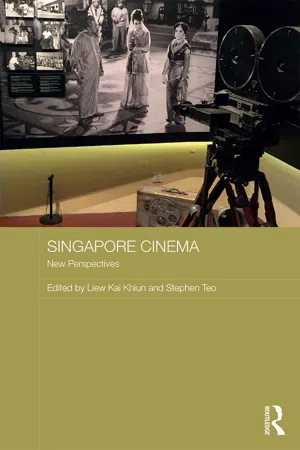
This book outlines and discusses the very wide range of cinema which is to be found in Singapore. Although Singapore cinema is a relatively small industry, and relatively new, it has nevertheless made an impact, and continues to develop in interesting ways. The book shows that although Singapore cinema is often seen as part of diasporic Chinese cinema, it is in fact much more than this, with strong connections to Malay cinema and the cinemas of other Southeast Asian nations. Moreover, the themes and subjects covered by Singapore cinema are very wide, ranging from conformity to the regime and Singapore's national outlook, with undesirable subjects overlooked or erased, to the sympathetic depiction of minorities and an outlook which is at odds with the official outlook. The book will be useful to readers coming new to the subject and wanting a concise overview, while at the same time the book puts forward many new research findings and much new thinking.
- 194 pages
- English
- ePUB (mobile friendly)
- Available on iOS & Android
eBook - ePub
About this book
Information
Part I
Cine-pasts
1 Malay cinema’s legacy of cultural materialism
P. Ramlee as historical mentor
Malay cinema in Singapore
For more than twenty years in its fifty years as an independent nation, Singapore did not have a film industry. The best that one could say about this lack is that it was a transitional phase in which a dormant Singapore cinema was waiting for the right moment to rise up. This occurred in the 1990s, beginning with an outburst of short films (Harvey 2007, 266–8), and with long feature film productions by mid-decade (Eric Khoo’s Mee Pok Man, released in 1995, is generally seen to be the milestone). Historically, Singapore had a film industry focussed on the production of Malay-language films. Singapore functioned as the Mecca of Malay film production. The first Malay talkie Leila Majnun was filmed in Singapore in 1933 (Uhde and Uhde 2000, 3). However, an industry did not flourish until after the Second World War. Two production studios, Cathay-Keris and Shaw Brothers’ Malay Film Productions, dominated the entire feature film production of Singapore at the time. Over 200 Malay films were produced in total. Its heyday extended from the 1950s to at least the mid-1960s. This coincided with the period when Singapore’s political destiny was very much connected with the independence movement in Malaya and the emerging nation state of Malaysia with which Singapore merged in 1963.
Thus, Malay cinema was an ethnic cinema that had aspirations to become a national cinema. However, Singapore separated from Malaysia in 1965 to become an independent nation, thus throwing Malay cinema’s nationalist narrative askew. Though Malay films continued to be produced in Singapore until 1972, the industry was already fading by the end of the 1960s. Economic costs and union problems contributed to the eventual demise of the industry. Malay films appeared outdated when contrasted with the modern offerings of Hollywood and Hong Kong, which dominated the market for film entertainment. More importantly, it no longer seemed credible for the newly independent country with a Chinese majority population to maintain a film industry producing Malay-language films. Although Malay was recognised as the national language of Singapore, it was not much used in daily life by the majority of Singaporeans, and senior commentators still find it necessary to exhort Singaporeans to learn and speak the national language (Mahbubani 2014). Arguably, had Singapore remained in Malaysia, it might have continued to function as the base of Malay film production. Malay films gave Singapore an identity when it was still an integral part of the Malay world. When Malay film production ceased, it lost not just an identity, but a whole industry.
The disappearance of Malay cinema meant that, for a long time, Singapore existed as a nation without a national cinema. However, a Singapore cinema did eventually emerge and it grew with a separate identity from the historical Malay cinema which had given Singapore a prior cinematic identity. With the growth of new Singapore cinema, a question arises: how should one appraise Malay cinema? Philip Cheah has said that the cinema in Singapore had “always been dogged by a struggle for national identity” (Cheah 2001, 157), by which he might have actually referred to Malay cinema as a fitting example of the quandary. Does it really belong to Singapore? Or does it more appropriately belong to the Malaysian national context? This kind of quandary over ownership has been addressed by other scholars, notably Alfian Bin Sa’at, who goes on to say that the Malay cinema’s studio era remains essentially “peripheral to the consciousness of not only Singaporean audiences, but filmmakers as well” (Alfian 2012, 36). Malay cinema was an ethnic cinema whose narratives “were characterised by an increasingly communalistic Malay ethnic-cum-racial exclusivism” (Kahn 2006, 128). This communalism was at variance with the new national ethos of Singapore under the leadership of the People’s Action Party (PAP), which sought to create a multicultural, multiracial society. Malay cinema therefore poses a historical paradox in the Singapore context.
Malay cinema has, however, bequeathed an undeniable heritage to Singapore cinema. This heritage has been recognised by historians, and perhaps by the public. Most commentators point to P. Ramlee as the single most representative figure of Malay cinema. The films of P. Ramlee constitute practically the Malay cinema’s golden age, cherished by all the races of Malaysia and Singapore. They are artefacts of the Malay imagination, typified by the sublime Ali Baba Bujang Lapok (1961), which epitomised Malay cinema as social practice as well as leisure practice. At the same time, Malay films elucidated the aspirations of the Malays and their social conditions as well as the urge for nationalism. Joel Kahn sees “images and representations of Malay-ness” in P. Ramlee’s films “that have their origin in the conservative discourse of Malay nationalism” (Kahn 2006, 128). Timothy Barnard (2006) considers Malay films as a marginalised form of “literature” in which to read the contexts of its times. He “reads” the texts of P. Ramlee’s Penarek Becha (The Trishaw Man, 1956) and Labu dan Labi (Labu and Labi, 1962) as sources “for gaining a better understanding of the vibrant social and cultural currents of the 1950s and 1960s in a Malaya that faced modernization and decolonization” (Barnard 2006, 167). Syed Muhd Khairudin Aljunied (2006) views Malay films as an alternative historical and archival source providing “an illuminating insight into the social history of the Malays” (Khairudin 2006, 115). He analyses Seniman Bujang Lapok (The Nitwit Movie Stars, 1961) as a “study of Malays in Singapore during the post-war years” (Khairudin 2006, 116). For Khairudin, the film showcases the Malay community’s concern for “having to maintain traditional Malay values whilst at the same time, keeping up with the coming of modernity” (Khairudin 2006, 117). This reaction to modernity is echoed by Malaysian critic Hassan Muthalib, who declares that P. Ramlee “extolled traditional Malay culture and values, believing that they were not at odds with living in the city with all its modernity” (Hassan 2013, 59).
Many of P. Ramlee’s films are now valued for their primary social content as much as for their enduring capacity to entertain. Khoo Gaik Cheng had inferred that Malay cinema is nowhere near a radical form and practice of cinema (like Third Cinema), and that it has “a long history … as entertainment” (Khoo 2006, 98). According to Hassan Muthalib, one of the outstanding features of Malay films was “that there were absolutely no expressions of anti-colonial sentiments whether openly or subtly” (Hassan 2013, 52). Malay films are probably best seen as falling into that which Khoo has called the “grey area between unqualified assimilation and remembrance” (Khoo 2006, 99). Though Khoo does not elaborate on the grey area, I take it to mean that Malay films are highly suggestive of a communal vision of life and a faintly nostalgic style of living because Malays have assimilated themselves to modernity. A film such as Seniman Bujang Lapok may actually be exemplary of this grey area. The film thrives on the entertaining performances of the three principal actors – Aziz Sattar, S. Shamsuddin, and P. Ramlee – as bachelors trying to rise above their stations. The narrative, such as it is, unfolds on a very loose and relaxed structure relying mostly on situation comedy, slapstick, song interludes and melodramatic exuberance.
The structure is influenced by a kind of multi-media theatre, bangsawan, the traditional home of Malay performers who were later employed in the film industry. Barnard claims that bangsawan actors were responsible for “developing the techniques, traditions and ideas that would dominate the glory days of Malay filmmaking in Singapore in the 1950s and 1960s” (Barnard 2010, 57). It is not difficult to see that the actors in Seniman Bujang Lapok evoke these very same bangsawan practices. The actors are essentially playing themselves, as untrained actors seeking employment in the Malay Film Productions studio. They follow the director’s instructions and fit into the system of film production and performance. Thus, it shows the Malays adjusting themselves to the modernity of the cinema. They do so in the only way they would know how – through their familiarity with bangsawan performances. Thus, bangsawan implicitly engenders the remembrance of Malay tradition. Meanwhile, they carry on with their ramshackle lives in the kampong (the Malay word for village), determined to make something of themselves as actors so that they can marry the women they court in the kampong and become men of substance.
The unassuming narrative structure and the threadbare production standards contribute to the movie’s charm. The austerity of the production conveys the innocence of a style and standard of living among the Malays that has now expired (at least in Singapore). The film opens with touristy shots of urban Singapore in the early 1960s. The camera follows an advertising truck carrying a huge poster of a Malay film cruising around the city streets. It then goes into the kampong showing the three Malay protagonists of the title still ensconced in a rural setting, providing a contrast with the metropolitan views of the city seen earlier, and indirectly reminding viewers that Malays are traditionally associated with the kampong and its rural lifestyle.
The kampong is a potent symbol of remembrance to Singaporeans today. Politicians constantly invoke the kampong “spirit” by reminding Singaporeans of a time in which a communal spirit united the various communities. There is no doubt that the film’s significance for a scholar such as Khairudin lies in this remembrance conjuring a contrast of lifestyles. He analyses the protagonists’ journey into the city to become movie stars as a way of earning a living, overcoming their backwardness and engaging with the “challenge of modernity that Malay society was grappling with in the 1950s and 1960s” (Khairudin 2006, 120). Hence, the protagonists are assimilated into the system (that of the film industry and, indirectly, of society), allowing them to confront the modernity impacting their lives.
This chapter will draw on P. Ramlee’s films to illustrate principles of intrinsic social values and norms that are transparent in the films themselves. These values and norms guided the Malays as they assimilated into modern society and determined the pattern of behaviour that I will postulate here as cultural materialism, and which I will go on to address in relation to the films of P. Ramlee. In effect, P. Ramlee depicts a culture of materialism showing the Malays going about the business of assimilating into modern living, wherein materialistic needs are always primary concerns. In this process of presenting a culture of materialism, the remembrance of a traditional lifestyle (the kampong spirit) is often evoked, thus becoming a factor in the affective behaviour of cultural materialism. It may serve as a counter-response to the culture of materialism. Cultural materialism may be misinterpreted to imply a crass or corrupting form of behaviour but the keyword is on the cultural implying that materialism, while it may be inherently corrupting, is moderated and arbitrated by ethical values popularised within the Malay community. These values are in turn mediated by the interventions of the creative talents of P. Ramlee, such that they become part of the cinematic and cultural language of Malay cinema. The films themselves are treated as classic texts of cultural materialism.
In its application to Malay cinema, cultural materialism reflects Malay society’s concern over poverty and social marginalisation. In the films of P. Ramlee, such a concern is expressed in harmony with the materialistic instincts of Singapore as a rising nation within the geopolitical context of the Cold War throughout the 1950s and 1960s. This was exactly the period in which the Malay film industry thrived in Singapore. Materialistic values were offered as the most effective way to combat communism, which threatened the security of both Malaysia and Singapore at the time. Singapore grew as a port city, a financial centre, and a place in which multinational corporations could do business and find a base for manufacturing. Malay cinema developed in tandem with this political environment that cherished materialism.
At the same time, the materialism evident in the films of P. Ramlee is in complete harmony with the commercialism of the Shaw Brothers-owned Malay Film Productions studio in Jalan Ampas (and later the Merdeka Film Studio in Kuala Lumpur where P. Ramlee was also employed and spent his last years). Kahn notes that the Shaw Brothers ensured the films “were commercially viable” and that they “would play to local audiences” (Kahn 2006, 128–9). In the local milieu, the materialism portrayed would have been informed by cultural features and attributes of the larger community of Singapore and Malaysia. The films often followed the plotlines and conventions of storytelling found in Chinese and Indian films. Interestingly, though Chinese and Indian characters are not usually featured, whenever they appeared, such characters are usually pawnbrokers, businessmen or towkays in the case of the Chinese, and moneylenders (or ceti) in the case of the Indians. Thus, their roles illustrate nothing more than the tendency of cultural materialism prevalent in the community.
Given the pre-eminence of music in P. Ramlee’s films, we might note that music plays a role as an indicator of cultural materialism. Nightclubs are a commonplace setting in P. Ramlee’s films. Here, culture, in the form of song and dance, and business are interlinked; and the lifestyle that revolves around the nightclub is the very manifestation of cultural materialism. The nightclub becomes a hub for a more liberal form of cultural materialism in the Malay cinema of that period, a sign of the easy and unforced Malay assimilation into Western modernity. Sex and drink are acceptable practices of this setting, startling now in view of the rise of Islamic fundamentalism in Malaysia and the imposition of Sharia law. The nightclub, clearly a symbol of cultural materialism incompatible with the spirit of Islamic values, must be understood as a symptom of the Malay aspiration towards modernity. It is not the only symbol of cultural materialism, but it is perhaps a key symbol complementing other symbols that seem more natural to the Malays, for example, the kampong.
In Malay cinema, cultural materialism is custom-made to fit and adapt to the Malay sense of religious and cultural propriety. In this way, there is a certain sense that materialism itself is tempered by the spiritual qualities of Malay tradition and the ethical norms regulating the lifestyles of Malays. The kampong spirit is definitely significant to the cultural materialism of the Malays, and the kampong is as much a cultural setting as the nightclub. Kahn tells us that “normal kampong life is the very definition of Malay virtue” (Kahn 2001, 103). A ramification of this statement would suggest that the nightclub, so ubiquitous in the Malay cinema of P. Ramlee, would be the very definition of Malay vice. The Malays have been so overwhelmingly identified with the kampong that the nightclub assumes strength of symbolism for its commercialism and the materialism that the Malays aspire to. Hence, the nightclub is primarily noteworthy for generating a greater sense of urbane materialism and integrating the Malays into a multicultural hub of materialism in a way that a kampong could not. Because materialism is universal in Singapore, Malay cinema’s display of cultural materialism shows the influences of Western modernity as well as other Asian (particularly Chinese) forms of cultural materialism.
It is not the purpose of this chapter to spotlight the ethnographic or social history of the Malay community and its concern over the collision of modernity with tradition. It seeks instead to denote Malay cinema’s kinship with the present Singapore cinema to which it is normally thought as having no connection at all. Younger generations of Singaporeans do not usually make the link between present Singapore films and the past cinema of the Malay film industry. Yet we may detect a link between the past and the present through the films of P. Ramlee and the present-day films of Jack Neo, for example. This is a proposition that I will explore in another chapter. Neo can be regarded as the modern P. Ramlee. In fact, we can see P. Ramlee as the cultural mentor of Neo. The link between them transcends the historical paradox that is at the heart of Malay cinema’s relationship to Singapore. Alfian Bin Sa’at has asserted that there are “traces” of the Malay cinematic heritage that can be found in contemporary Singapore cinema (Alfian 2012, 36). I concur with him although what Alfian considers “traces” differs quite radically from my interpretation of the same. Alfian refers to the connection between Singapore and the Malayan hinterland as an abiding vestige of the Malay cinema and points to a sense of nostalgia in which Singapore, as the metropolitan centre, looks keenly at the Malay hinterland as “a repository of certain conservative cultural and moral values in contradistinction to the chaotic liberal relativi...
Table of contents
- Cover
- Half Title
- Title Page
- Copyright Page
- Dedication
- Table of Contents
- List of figures
- Foreword
- Acknowledgements
- Contributors
- Introduction
- PART I Cine-pasts
- PART II Cine-citizenry
- PART III Cine-cityscapes
- Index
Trusted by 375,005 students
Access to over 1.5 million titles for a fair monthly price.
Study more efficiently using our study tools.
Frequently asked questions
Yes, you can cancel anytime from the Subscription tab in your account settings on the Perlego website. Your subscription will stay active until the end of your current billing period. Learn how to cancel your subscription
No, books cannot be downloaded as external files, such as PDFs, for use outside of Perlego. However, you can download books within the Perlego app for offline reading on mobile or tablet. Learn how to download books offline
Perlego offers two plans: Essential and Complete
- Essential is ideal for learners and professionals who enjoy exploring a wide range of subjects. Access the Essential Library with 800,000+ trusted titles and best-sellers across business, personal growth, and the humanities. Includes unlimited reading time and Standard Read Aloud voice.
- Complete: Perfect for advanced learners and researchers needing full, unrestricted access. Unlock 1.5M+ books across hundreds of subjects, including academic and specialized titles. The Complete Plan also includes advanced features like Premium Read Aloud and Research Assistant.
We are an online textbook subscription service, where you can get access to an entire online library for less than the price of a single book per month. With over 1.5 million books across 990+ topics, we’ve got you covered! Learn about our mission
Look out for the read-aloud symbol on your next book to see if you can listen to it. The read-aloud tool reads text aloud for you, highlighting the text as it is being read. You can pause it, speed it up and slow it down. Learn more about Read Aloud
Yes! You can use the Perlego app on both iOS and Android devices to read anytime, anywhere — even offline. Perfect for commutes or when you’re on the go.
Please note we cannot support devices running on iOS 13 and Android 7 or earlier. Learn more about using the app
Please note we cannot support devices running on iOS 13 and Android 7 or earlier. Learn more about using the app
Yes, you can access Singapore Cinema by Kai Khiun Liew, Stephen Teo, Kai Khiun Liew,Stephen Teo in PDF and/or ePUB format, as well as other popular books in Social Sciences & Ethnic Studies. We have over 1.5 million books available in our catalogue for you to explore.