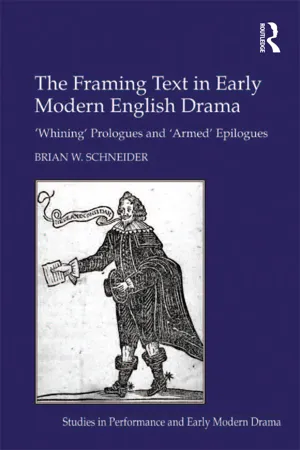
eBook - ePub
The Framing Text in Early Modern English Drama
'Whining' Prologues and 'Armed' Epilogues
- 330 pages
- English
- ePUB (mobile friendly)
- Available on iOS & Android
eBook - ePub
The Framing Text in Early Modern English Drama
'Whining' Prologues and 'Armed' Epilogues
About this book
Though individual prologues and epilogues have been treated in depth, very little scholarship has been published on early modern framing texts as a whole. The Framing Text in Early Modern English Drama fills a gap in the literature by examining the origins of these texts, and investigating their growing importance and influence in the theatre of the period. This topic-led discussion of prologues and epilogues deals with the origins of these texts, the difficulty of definition, and the way in which many prologues and epilogues appear to interact on such subjects as the composition of the theatre audience and the perceived place of women in such an audience. Author Brian Schneider also examines the reasons for, and the evidence leading to, the apparently sudden burgeoning of these texts after the Restoration, when prologues and epilogues grace nearly all the dramas of the time and become a virtual cottage industry of their own. The second section-a comprehensive list of prologues and epilogues-details play titles, playwrights, theatres and theatre companies, first performance and the earliest edition in which the framing text(s) appears. It quotes the first line of the prologue and/or epilogue and uses the printer's signature to denote the page on which the texts can be found. Further information is provided in notes appended to the relevant entry. A final section deals with 'free-floating' and 'free-standing' framing texts that appear in verse collections, manuscripts, and other publications and to which no play can be positively ascribed. Combining original analysis with carefully compiled, comprehensive reference data, The Framing Text in Early Modern English Drama provides a genuinely new angle on the drama of early modern England.
Information
Chapter 1
Matters of Definition
Our Author’s unprovided, and doth vow,
What e’re I say must stand for Prologue now.1
Prologues of old the Learn’d in Language say;
Were merely Introductions to the Play,
Spoken by Gods, or Ghosts, or Men who knew
Whate’er was previous to the scenes in view.2
The end of Epilogues, is to Inquire
The censure of the play or to desire
Pardon for what amisse.3
Introduction
Early modern drama consistently displays its own theatricality, attempting among many other topics to come to terms with the importance of the playwright, the functions of the audience and the contribution of the actor.4 The spectator is drawn into the theatrical experience by direct address in prologues, epilogues and inductions, by references in the texts themselves and soliloquies spoken directly to the audience; or kept at a distance, when the play retreats into its own dramatic reality. Theatrical space itself is often referred to and there is the reiterated ironic refrain that, if what the audience is seeing was indeed a play, it would not be believed. The very nature of drama comes under close and repeated scrutiny, and attempts are made to define and depict what Marston, in the prologue to The Dutch Courtesan (1604), felicitously calls ‘Best art’.5 Though not the only debate carried out in the play texts themselves, the so-called ‘War of the Theatres’, or Poetamachia,6 is perhaps the most obvious and the most self-conscious example of playwrights discussing not only what drama is, but what it both should and should not be.7 Other playwrights were also exercised about the matter: John Ford comments succinctly in the prologue to The Lovers’ Melancholy (c. 1628): ‘To tell ye, gentlemen, in what true sense / The writer, actors, or the audience / Should mould their judgements for a play, might draw / Truth into rules, but we have no such law.’8
Many prologues and epilogues concern themselves with major elements of the discussions about the nature of drama, which continued throughout the period. The playwrights took advantage of the extra-theatrical dimension that these framing texts afforded and used them, often in highly original ways, to enunciate their diverse ideas on referentiality, theatricality, audience participation and expectation and authorial competence. The comfortable notion that many prologues and epilogues are only peripheral texts concerned mainly with soliciting audience approval and applause, anticipating criticism or giving plot summaries does not, in a significant number of cases, bear close scrutiny. Plays like Satiromastix and Poetaster (both appearing in 1601) achieve a new dimension when set against each other, intertextually and thematically, to exemplify skirmishes in the ‘War of the Theatres’; prologues and epilogues appear to interact similarly, displaying not simply repetitions of audience address, but also genuine and sophisticated engagement with notions of drama and of playgoers’ requirements. Prologues and epilogues, examined separately from the dramas they frame, often appear to be feeding off each other, but not in any facile way – regular playgoers (or readers) might well discern an ongoing debate about the nature of the theatrical presentation before them. Three aspects of this debate are particularly apposite – the uncertain nature of prologues and epilogues themselves; the playwrights’ view of, and response to, the reasons why contemporary audiences attended the theatre; and the growing importance of women as spectators and as influences on the reception of the plays being staged. Early modern prologues and epilogues are actively concerned with defining their own texts, their audiences and the female constituent of those audiences.
Framing Texts: Uncertainty, Speculation and Experiment
It might appear relatively simple, at first glance, to gather together the prologues and epilogues of early modern drama, to examine their content and make reasonable and reasoned judgments concerning their function and importance to the overall dramatic experience of a contemporary audience. Many of these texts are made up of similar ingredients – the direct address to the audience, the pleas for silence and applause, the faux modesty, the attack on critics, exposition and explanation, among others. The way ought to be clear to determine any new elements that were added to the manner in which prologues and epilogues were presented during the period and to produce a definitive, or at least working, description of what constitutes a prologue and epilogue.
In fact, and at every turn, prologues and epilogues raise problems regarding definition, authorship, performance, purpose and effect; they resist categorization and even when they occasionally anatomize themselves, they only tell a partial story. A speech bearing all the marks described above as belonging to a prologue or epilogue may not be identified as such on the printed page, while some of the texts so identified may lack virtually all the criteria one might include in an effort to pin down a satisfactory definition. Some plays have more than one prologue and/or epilogue; others sport different framing texts at different points in their production and printing histories. Can we rightly call certain speeches prologues and epilogues, which are not so identified in the published edition? Or call those texts prologues, which are announced as such on the printed page but are, in fact, scenes of dialogue that in other printed works might be termed Inductions or given some other title? Perhaps it would be better to ignore the designations given by printed editions to framing speeches and instead identify the function of such texts in the whole theatrical experience, so that we can nominate them as prologues and epilogues, or as Prefaces, Inductions or Choruses.9 The separation is not clear-cut: There are introductory scenes which either include or discuss prologues;10 a few prologues and epilogues are shared by more than one speaker; and some Choruses appear to deliver texts which are, in all but name, prologues or epilogues. Some prologues of the period were preceded by Dumb Shows, and epilogues were often followed by other stage business or by jigs. One or two prologues and epilogues are interrupted before they begin properly or while they are in full flow. Other framing texts are delivered by someone from the cast of the play who remains in character, changes from character to Prologist or Epilogist, or slips in and out of his or her role while delivering the text. The problem arises as to whether all the texts so delivered can be called prologues and epilogues. If so, then finding a working definition of prologues and epilogues becomes more vexed.
This diversity of approach to the framing text is partly a reflection of a similar diversity of audience and venue. Performances at Court often prompted new prologues and epilogues, usually directed at the monarch. It is also arguable that certain types of framing texts would be composed for the different kinds of audiences frequenting open air and private playhouses, for the plays put on by boy actors, or for closet dramas. When there were widely divergent expectations from a play at one theatre as opposed to another, then the prologue and epilogue would reflect those expectations. This occurs in James Shirley’s The Doubtful Heir (1638): ‘All that the Prologue comes for, is to say, / Our Author did not calculate his Play, / For this Meridian’.11 The prologue continues to negotiate a careful path, explaining why the play should actually have been presented at the Blackfriars but at the same time not insulting the audience at the Globe, before whom the play is actually being performed: ‘This Play, meant for your persons, not the place’ (my emphasis).
The Royal Slave (1636) by William Cartwright is a good example of occasion causing alterations to the framing texts. The play was, according to the title page, ‘Presented to the King and Queene by the Students of Christ-Church in Oxford. August 30. 1636’.12 A short prologue to their Majesties was delivered by a Mage, while another character from the play, Cratander, presented a 24-line epilogue. A further performance, before a university audience only, was framed by new, more light-hearted speeches: the prologue was delivered by a jocular Priest (‘After our Rites done to the King, we doe / Think some Devotion’s to be paid to you’) and the epilogue by another character, this time Arsamnes, who begins: ‘Thus cited to a second night, wee’ve / Ventur’d our Errours to your weighing Eare’.13 The royal pair saw the play again, this time at Hampton Court, and once more a new prologue and epilogue were provided, though this time the printed version gives no indication as to who delivered the speeches. The prologue on this occasion suggests that the very presence of royalty makes the play fresh again: ‘Things twice seene loose; but when a King or Queene / Commands a second sight, they’re then first seene’.14 In each of these cases the response of the audience to the play might vary because of the form, content and attitude of the prologue and epilogue, while the presence of the monarch in itself means that the framing texts may change to display due deference and elicit royal approval.
Framing texts may, therefore, due to occasion, venue and audience, work on the audience in different ways, without reference to the play itself, concerning themselves much more with extra-dramatic considerations. This still leaves the problem of defining prologues and epilogues in a satisfactory way, even within a broad framework.15 The ‘standard’ prologue might be described as one that gains the audience’s attention and silence, introduces the play and more or less humbly asks for the spectator’s approval, or at least tolerance, for the author’s shortcomings or the play’s perceived imperfections. The ‘standard’ epilogue cou...
Table of contents
- Cover Page
- Title Page
- Copyright Page
- Contents
- Acknowledgements
- Preamble
- Introduction: Matters of Viewpoint
- 1 Matters of Definition
- 2 ‘Prologos’ to Prologue in Classical Drama
- 3 Epilogue Origins and Medieval Framing Texts
- 4 ‘Sit, see and hear’: Prologues, Epilogues and the Dichotomized Audience
- 5 ‘Take your places, ladies’: Prologues, Epilogues and the Female Spectator
- 6 The Framing Text – Matters of Custom
- Conclusion: Identifying the Framing Text
- Appendix 1: The Prologues and Epilogues of Early Modern English Drama to 1660
- Appendix 2: Miscellaneous Prologues and Epilogues
- Works Cited
- Index
Trusted by 375,005 students
Access to over 1.5 million titles for a fair monthly price.
Study more efficiently using our study tools.
Frequently asked questions
Yes, you can cancel anytime from the Subscription tab in your account settings on the Perlego website. Your subscription will stay active until the end of your current billing period. Learn how to cancel your subscription
No, books cannot be downloaded as external files, such as PDFs, for use outside of Perlego. However, you can download books within the Perlego app for offline reading on mobile or tablet. Learn how to download books offline
Perlego offers two plans: Essential and Complete
- Essential is ideal for learners and professionals who enjoy exploring a wide range of subjects. Access the Essential Library with 800,000+ trusted titles and best-sellers across business, personal growth, and the humanities. Includes unlimited reading time and Standard Read Aloud voice.
- Complete: Perfect for advanced learners and researchers needing full, unrestricted access. Unlock 1.5M+ books across hundreds of subjects, including academic and specialized titles. The Complete Plan also includes advanced features like Premium Read Aloud and Research Assistant.
We are an online textbook subscription service, where you can get access to an entire online library for less than the price of a single book per month. With over 1.5 million books across 990+ topics, we’ve got you covered! Learn about our mission
Look out for the read-aloud symbol on your next book to see if you can listen to it. The read-aloud tool reads text aloud for you, highlighting the text as it is being read. You can pause it, speed it up and slow it down. Learn more about Read Aloud
Yes! You can use the Perlego app on both iOS and Android devices to read anytime, anywhere — even offline. Perfect for commutes or when you’re on the go.
Please note we cannot support devices running on iOS 13 and Android 7 or earlier. Learn more about using the app
Please note we cannot support devices running on iOS 13 and Android 7 or earlier. Learn more about using the app
Yes, you can access The Framing Text in Early Modern English Drama by Brian W. Schneider in PDF and/or ePUB format, as well as other popular books in Literature & Literary Criticism. We have over 1.5 million books available in our catalogue for you to explore.