Although there are human geographers who have previously written on matters of media and communication, and those in media and communication studies who have previously written on geographical issues, this is the first book-length dialogue in which experienced theorists and researchers from these different fields address each other directly and engage in conversation across traditional academic boundaries. The result is a compelling discussion, with the authors setting out statements of their positions before responding to the arguments made by others.
One significant aspect of this discussion is a spirited debate about the sort of interdisciplinary area that might emerge as a focus for future work. Does the already-established idea of communication geography offer the best way forward? If so, what would applied or critical forms of communication geography be concerned to do? Could communication geography benefit from the sorts of conjunctural analysis that have been developed in contemporary cultural studies? Might a further way forward be to imagine an interdisciplinary field of everyday-life studies, which would draw critically on non-representational theories of practice and movement?
Readers of Communications/Media/Geographies are invited to join the debate, thinking through such questions for themselves, and the themes that are explored in this book (for example, of space, place, meaning, power, and ethics) will be of interest not only to academics in human geography and in media and communication studies, but also to a wider range of scholars from across the humanities and social sciences.
This chapter explores avenues for the development of communication geography under the dual banners of sustainability and justice—two of the key pragmatic objectives we can work towards if we leverage the theories and constructs of communication geography. By directing attention to the practical and intellectual benefits of bringing together studies in geography and communication this chapter moves beyond earlier research which surveyed the relevant epistemological and ontological terrain (Adams, 2009, 2011; Adams and Jansson, 2012). This previous work sorted existing research into four quadrants—communication-in-place, place-in-communication, communication-in-space, and space-in-communication—offering a simple map for engaging with existing research in geography and communication theory as well as organizing ties to cognate disciplines. The goal in this chapter is to see how the pragmatic objectives of sustainability and justice can be situated within this taxonomy, engaging constructively with what Hulme (2008a: 6) calls the “fragility and transience of environmental discourses.” I start with a brief glance back at my research thus far. I move from there to consider geographical scale and its role in shaping what we know, or can reasonably expect to know, about the consequences of our actions. This leads to a reflection on the notion of ethical consumption and more broadly on how justice and sustainability depend on communications in and around the act of consumption.
Excursions and Incursions
My thesis and dissertation were inspired by the works of Marshall McLuhan but shaped by influences at the University of Wisconsin-Madison, including Bob Sack and Yi-Fu Tuan in the Department of Geography and John Fiske in Communication Arts. Both the thesis and the dissertation addressed communication, moving into the topic in complementary ways. The thesis focused on a single medium, television, with attention to television’s worldviews as well as the social and spatial connections it sustained. The dissertation compared three different social movements with attention to the dynamics set up by protesters via many different media as they reached out to distant audiences and those audiences formed an ephemeral community capable of influencing targeted policy-makers. The core arguments from the thesis and the dissertation were published as research articles (Adams, 1992, 1996). In very different ways, these first studies explored the idea that the contents and the contexts of mediated communication must be considered in tandem. It was not just a matter of what television said, but also how it said (and showed) things. It was not just what protesters said, but how they appropriated various media to get their points of view across. My subsequent research searched for interesting configurations of the medium and the message, including a pair of complementary studies exploring the internet in terms of space and place metaphors (Adams, 1997), and as a set of contexts for social interaction each with a distinct topology (Adams, 1998).
During this period I grappled with the relation between the medium and the message (Was the medium the message as McLuhan thought, or separate from the message as semioticians like Barthes and Eco thought?) and I responded by moving across the grain of this debate, looking for ways to reconceptualize the human agent. I wanted to think of people not merely as perceivers who encounter media and messages, but also as actors, integrally rooted in modes of action and sensation made possible by a host of media. The actor I saw when I looked through the dual lenses of medium and message was an extensible self.
I submit that something is gained by understanding “person” as a dynamic entity which combines: A) a body rooted in a particular place at any given time, bounded in knowledge gathering by the range of unaided sensory perception and, in action, by the range of the unaided voice and grasp; and B) any number of fluctuating, dendritic, extensions which actively engage with social and natural phenomena, at varying distances. (Adams, 1995: 269)
A decade of rumination on this extensible self led to a book that explored the way personhood involves the development and maintenance of dynamic connections through space and time, such that from moment to moment we are, in some sense, in or at multiple remote locations (Adams 2005). I argued that society has developed not merely the technological means of supporting extensible selves, but also the institutional, attitudinal, and emotional preconditions for living in an essentially boundless way, with blurry and fluctuating lines between here and there, self and not-self.
I found, in addition, that from the point of view of the geographical agent it made little sense to frame communication research exclusively around either message or medium, content or context. The notion of a boundless or extensible self—person as “amoeba”—depended on being in place and in space, in a conventional sense, but also on simultaneously occupying the topological spaces and places of communication infrastructure and institutions (media contexts) and the metaphorical spaces and places of discourses and texts (media contents). I argued that this fluctuation in the self’s ability to sense and act was limited in part by coupling constraints and capability constraints experienced by the body (Hägerstrand, 1970) but that the self is also extended in space and time, moment to moment, through both interpersonal and mass media. I showed that this was equally true of unskilled laborers, office-workers, managers, and professors (Adams, 1999, 2000). It was also true of immigrants whose communications occupied a space of mediated connection that linked two different countries, what Rina Ghose and I called a “bridgespace” (Adams and Ghose, 2003).
There is, then, a complicated shape-shifting that defined what it meant to be a person (rather than merely human). In a departure from critical theory’s effort to critique power relations, I suggested that the extensible self must depend on actions of distant and unknown others. By way of a complement to studies of borders, boundaries, and the ineluctably embodied nature of the self, I argued that self is dependent on others—both known and unknown, necessitating a sort of training in areas of love, trust, and altruism. While a portion of this training is achieved through formal education, the rest is instilled through popular culture, religious institutions, families, and other social institutions. The purpose of such training is often to solidify state power and class privilege, but I rejected a wholesale Marxist or Althusserian critique of ideology, noting that training in extensibility provides people “with tools to overcome their biases and to construct a just society” (Adams, 2005: 68).
In 2001 I had one of the more striking research experiences of my career. I received a Fulbright Fellowship that allowed me to move with my family to Montreal for the fall semester. I planned to study the worldviews of the residents of Quebec and the extent to which these reflected different scales of identity—North American, Canadian, Quebecker/Québécois, and Montrealer/Montréalais. This was a huge project, and one that had me randomly buying music CDs, reading popular novels, subscribing to several newspapers, recording television news, and watching movies. The flailing continued through August and the first week of September, then two planes smashed into the World Trade Center towers and my project found a focus. I immersed myself in the Canadian media and watched a moment in history through the eyes of Quebec’s Anglophones and Francophones, with particular attention to the contrasting discourses of the two language communities. Rather than merely considering the dialectic between medium and message I considered the ways in which two parallel media-message systems, one circulating French responses, the other carrying English responses, in separate venues to different communities, demonstrated strongly contrasting worldviews (Adams, 2004).
This study suggested to me that there were interesting stories to be found if I could again study a key event, this time looking at a range of different media. That impulse was answered with my second monograph, Atlantic Reverberations (Adams, 2007) which witnessed the 2004 US presidential campaign through the lenses of several media. Working in France this time rather than Quebec, I found that newspapers, television, and the internet told different stories about the race to the White House by George W. Bush and John Kerry, revealing multiple dimensions of this campaign as it was constructed by the French, and thereby also highlighting the affordances of different media. International news flows between the US and France thereby reconstructed two national identities—French and American.
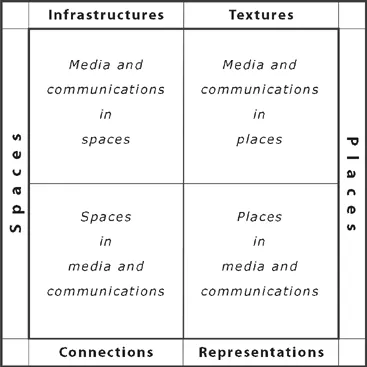
What remained to be answered was how all of this fit together, so in a few years I turned to the task of sorting out the kinds of spaces and places that form the habitats of boundless, amoebic selves. At this point I arrived at the quadrant diagram (Adams, 2009, 2010). To briefly summarize this diagram (">Fig. 1.1), it identifies four distinct and complementary ways in which media and communication are geographical: (a) media-and-communications-in-places, meaning the places of media use and consumption as they are inflected by a particular combination and arrangement of communication opportunities and limitations, (b) places-in-media-and-communications, meaning mediated representations of particular or generic places, whether verbal, visual, or multisensory, (c) media-and-communications-in-spaces, the geographical arrangement and physical distribution of communication infrastructure across the landscape and between multiple locations, and (d) spaces-in-media-and-communications, the functional social contexts—spaces of interaction, inclusion and exclusion, proximity and distance—that are created by social networking activities. I found that this combination, which will be simplified throughout the chapter by using “communication” in place of “media-and-communication” provides a comprehensive engagement with the geographical elements of communication that arise in connection with a particular medium, situation, or event. It also provides a means of exploring communication relative to pragmatic goals and objectives. This is the direction I will take in this chapter.
Figure 1.1The Quadrant Diagram Showing Various Ways in which Media and Communication Become Geographical
Source: After Adams, 2009.
Towards Applied Communication Geography
As an illustration of these four perspectives on communication we can consider a single event, the meltdown of the Fukushima Daiichi I nuclear power plant on March 11, 2011 following the Tōhoku earthquake and tsunami. An interest in communication-in-place would direct us to look at the communications that took place within the plant and in the immediate vicinity of the plant as the crisis unfolded. We could ask questions about how these communications increased or decreased the risks of environmental contamination and loss of human life. It is in the nature of communication-in-place to be ephemeral; many such communications are lost. Researchers may have to rely on communications about communications, like the comment from one of the so-called Fukushima 50, the employees who remained on-site to help mitigate the disaster, who stated bluntly: “[T]elling people to go back into dangerous areas was tough” (McCurry, 2013). Communication-in-place also includes daily discussions that occurred among people living just outside the evacuation zone, shadowed as they were by environmental crisis, and the subsequent discourses underlying the massive 17-point drop in public trust of the Japanese government (Edelman, 2012).
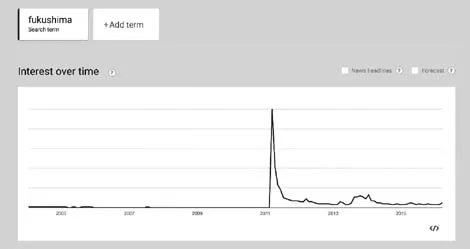
An interest in place-in-communication might incline us to follow the image of this nuclear meltdown as it circulated around the globe. Examining the first 100 images returned by a Google image search for the term “Fukushima” in summer of 2014, one sees the destroyed power plant, sick and mutated animals, mutant fruits and vegetables, maps of the radiation plume, people in radiation suits, and cartoons making light of the disaster. All 100 images are related in some way to the power plant or the meltdown. None merely depicts the Fukushima Prefecture. Like Chernobyl, the place name is now primarily a name for the disaster. We could interpret such images as indications of what Fukushima means as a place image at this point. Alternatively we could chart the meteoric rise in Fukushima as a search term following the disaster (">Fig. 1.2). Either of these constitutes place-in-communication.
Figure 1.2Google Trends Diagram of the Evolving Popularity of Searches for the Term “Fukushima”
Source: http://www.google.com/trends/explore#q=fukushima&cmpt=q. Accessed July 2, 2014.
An interest in communication-in-space would point, in contrast, to the material and technical networks of infrastructure and information that carried communications of the event at various points in its evolution. We might note that risk mitigation necessitates a flexible and robust system for sharing time-sensitive information. It might involve planning for backup power in the case of a power outage, so people can charge their cell phones. It might also involve promoting the use of special Twitter hashtags specifically for emergency use to help people exchange information and avoid confusion in a crisis (Acar and Muraki, 2011: 400). In any case the interest here is on links to and from the focal place.
Finally, an interest in space-in-communication would point in the direction of the non-Euclidean topologies that have emerged as people have created and maintained various Fukushima-related communication links. The space defined by such links does not mirror the space of communication infrastructure. Instead, it draws together a particular constellation of people, texts, and other resources linked by codes and internet protocols. For example, the Fukushima Diary (http://fukushima-diary.com/) is a blog created by Mochizuki Iori which links to many other online resources: a Facebook page, foreign and local news sources, photos showing skin ailments, YouTube videos of unusual weather phenomena, a site providing radioactivity measurements for Japanese sewage, and so on. These links form an online neighborhood for Iori’s site, a space where proximity is a function of links (not geographical proximity) and one can move from site to site by returning to the Fukushima Diary which serves as the main node for all of these links. This is a space in the sense that it enables and constrains activity and does so in a way that is shared by a number of users.
One of my key arguments in this chapter is that it is vitally important to consider all of these various aspects of communication geography en route to any response to environmental risk. Another is that communication involves more than just information dissemination. In the case of Fukushima, the “real problem” in the opinion of a reporter for Nature, “was not a lack of information, but a lack of communication” (Pacchioli, 2013). How are these things different? In the words of the Tokyo bureau chief for TheNew York Times, “there was an information dump. I guess the government had had enough criticism. They just threw crates and crates of numbers at us with no explanation” (ibid.). The lack of communication was not solved by inundating people with information. Amory Lovins, from the Rocky Mountain Institute, identified several interrelated communication problems (2011: 1–2):
Japan’s more rigid bureaucratic structures, reluctance to send bad news upwards, need to save face, weak development of policy alternatives, eagerness to preserve nuclear power’s public acceptance (indoctrinated since childhood), and politically fragile government, along with [the power company] TEPCO’s very hierarchical management culture, a...
Table of contents
Cover
Half Title
Title Page
Copyright Page
Table of Contents
List of Figures
Preface
Introduction
Part I Positions
Part II Reflections
Index
Trusted by 375,005 students
Access to over 1.5 million titles for a fair monthly price.
Study more efficiently using our study tools.
Frequently asked questions
Yes, you can cancel anytime from the Subscription tab in your account settings on the Perlego website. Your subscription will stay active until the end of your current billing period. Learn how to cancel your subscription
No, books cannot be downloaded as external files, such as PDFs, for use outside of Perlego. However, you can download books within the Perlego app for offline reading on mobile or tablet. Learn how to download books offline
Perlego offers two plans: Essential and Complete
Essential is ideal for learners and professionals who enjoy exploring a wide range of subjects. Access the Essential Library with 800,000+ trusted titles and best-sellers across business, personal growth, and the humanities. Includes unlimited reading time and Standard Read Aloud voice.
Complete: Perfect for advanced learners and researchers needing full, unrestricted access. Unlock 1.5M+ books across hundreds of subjects, including academic and specialized titles. The Complete Plan also includes advanced features like Premium Read Aloud and Research Assistant.
Both plans are available with monthly, semester, or annual billing cycles.
We are an online textbook subscription service, where you can get access to an entire online library for less than the price of a single book per month. With over 1.5 million books across 990+ topics, we’ve got you covered! Learn about our mission
Look out for the read-aloud symbol on your next book to see if you can listen to it. The read-aloud tool reads text aloud for you, highlighting the text as it is being read. You can pause it, speed it up and slow it down. Learn more about Read Aloud
Yes! You can use the Perlego app on both iOS and Android devices to read anytime, anywhere — even offline. Perfect for commutes or when you’re on the go. Please note we cannot support devices running on iOS 13 and Android 7 or earlier. Learn more about using the app
Yes, you can access Communications/Media/Geographies by Paul C. Adams,Julie Cupples,Kevin Glynn,André Jansson,Shaun Moores in PDF and/or ePUB format, as well as other popular books in Social Sciences & Geography. We have over 1.5 million books available in our catalogue for you to explore.