eBook - ePub
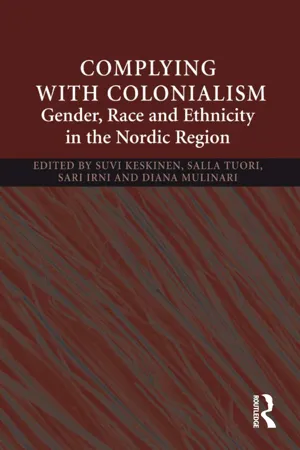
Complying With Colonialism
Gender, Race and Ethnicity in the Nordic Region
- 288 pages
- English
- ePUB (mobile friendly)
- Available on iOS & Android
eBook - ePub
Complying With Colonialism
Gender, Race and Ethnicity in the Nordic Region
About this book
Complying with Colonialism presents a complex analysis of the habitual weak regard attributed to the colonial ties of Nordic Countries. It introduces the concept of 'colonial complicity' to explain the diversity through which northern European countries continue to take part in (post)colonial processes. The volume combines a new perspective on the analysis of Europe and colonialism, whilst offering new insights for feminist and postcolonial studies by examining how gender equality is linked to 'European values', thus often European superiority. With an international team of experts ranging from various disciplinary backgrounds, this volume will appeal not only to academics and scholars within postcolonial sociology, social theory, cultural studies, ethnicity, gender and feminist thought, but also cultural geographers, and those working in the fields of welfare, politics and International Relations. Policy makers and governmental researchers will also find this to be an invaluable source.
Information
Chapter 1
Introduction: Postcolonialism and the Nordic Models of Welfare and Gender
Theoretical debates within postcolonial theory have largely been concerned with the cultures and societies of former colonies (see, for example: Said 1993; Bhabha 1994; Spivak 1988). This collection examines colonial histories and mentalities that shape gendered and racialised power relations in European countries; countries which represent themselves as outsiders in relation to colonial power relations. This book offers analyses of the ways in which present-day Nordic countries (Sweden, Norway, Denmark and Finland in particular) are marked, both culturally and economically, by colonial relations; a fact which has material, political and ethical consequences. The colonial ties of these countries are usually regarded as weak and their international relations are seen to be characterised by development aid, peace building and cooperation, rather than colonialism or imperialism. The region is often described as a cluster of nations where welfare, democracy, and more recently economic competitiveness are seen to be highly developed. Instead of taking this idealised image for granted, the authors of this book critically examine the Nordic colonial past, as well as the policies and practices and national imaginaries of present Nordic welfare states.
This book develops the concept of colonial complicity (see Vuorela in this book) to highlight the manifold ways in which North-European countries have taken, and continue to take, part in (post)colonial processes. The lure of an enterprise as powerful and authoritative as the Western civilising project, attracts even those who never belonged to its centre or were its main agents. Nations, groups and individual subjects are drawn by the promise of power to adopt the discourses, imaginaries and material benefits connected to this project. The Nordic countries see themselves as part of the Western world, drawing their value systems from the Enlightenment, and showing themselves to be willing to defend these values sometimes even more forcefully than the former colonial centres. The recent cartoon affair in Denmark and Sweden is evidence of this willingness. In 2005 the Danish newspaper Jyllands-Posten published cartoons of Prophet Mohammed as a terrorist with reference to ‘freedom of speech’ leading to large demonstrations and boycotts in many Muslim communities and countries. Colonial complicity refers to processes in which (post)colonial imaginaries, practices and products are made to be part of what is understood as the ‘national’ and ‘traditional’ culture of the Nordic countries. For example, a number of Finnish citizens have recently signed petitions and engaged themselves in campaigns to save liquorice wrappers (and other products with racist images), introduced during the colonial period all over Europe, because these wrappers are seen as part of traditional Finnish culture (see Rossi in this book). This example also shows that the idea that the country was an outsider to the colonial project makes it possible to claim that in the Nordic/Finnish context such images and products are not racist.
The concept of colonial complicity also includes the idea of multiple power relations in motion within societies and between nations in a postcolonial context. Although the Nordic countries participate in the key political and economic organisations of the West (such as the OECD and the European Union), the Nordic countries are also subjected to the rules of these organisations and the powerful forces within them. The transnational enterprises that occupy a leading role in global capitalist economies are not bound to nation-based loyalties, but move their production between different continents, according to where they can maximise profit (see Mulinari and Räthzler in this book). The concept of colonial complicity seeks to capture the political ambiguities and changing power relations within the Nordic region. However, the applicability of the concept is not restricted to the analysis of the Nordic region, but provides a basis for postcolonial studies of other regions with a similarly uncertain relationship to the colonial project.
This shifting position in relation to the colonial project has also had an effect on the critique of colonialism and neo-colonial ties in the Nordic countries. These countries never went through a clear period of critique of colonialism and its presence in everyday environments and encounters, as did the colonial centres in the aftermath of the dismantling of the empires. Anti-racist and anti-imperialist movements, and academic commentary on issues of race and colonialism, have been part of the Nordic societies since the 1970s, yet these countries have managed to retain an image of themselves as untouched by colonial legacies.
This book aims to deepen the understanding of European colonial past and present eras. It broadens the perspective of former colonizing and colonised nations by focusing on the often invisible participants in the (post)colonial order. The book also raises the question of the relationship between postsocialism and postcolonialism. Since the fall of the socialist system at the beginning of 1990s and the intensified economic, political and scientific cooperation across the former ‘iron curtain’, many feminist researchers from Central and Eastern Europe have pointed out similarities in the ways in which the ‘Third World’ and the ‘Second World’ are constructed by the ‘First World’. In much the same way as the Orient and Africa were constructed as the ‘other’ by the Europeans of the colonial period, Eastern and Central Europe have now been represented as the underdeveloped and dependent opposite of Western Europe. These othering processes are supported by the economic and political domination, as well as the discursive power, of the Western countries (Regulska 1998; Slavova 2006). Women from postsocialist countries have, in particular, been confronted with images of themselves as sexualised, and engaged in prostitution (see Sverdljuk in this book). Postcolonial analyses in the Nordic and other European contexts should therefore also look at the intra-European histories of racism, as part of the racialised and colonial order of things (see Griffin and Braidotti 2002).
We seek to rethink the relationship between colonial centres and margins to include diversified and shifting positions within this global order. One example of this is the colonial complicity of the Nordic countries described earlier. Another example is the complex position of the postsocialist countries in Central and East Europe. On the one hand, they are constructed as the ‘other’ of the developed and wealthy Western European nations, but on the other hand many of them are now member states in the European Union. Thus they take part in the economic and political power that the EU commands, especially towards non-European nations and people. The postsocialist countries also make visible the multiplicity of colonial ties and histories in the European region. For example the colonial layers of Bosnia include the influences of the Ottoman Empire, the Soviet Union, Western Europe and Middle Eastern countries (see Huttunen in this book).
This collection brings together recent postcolonial feminist research in the Nordic countries. The authors investigate both the nature of race formations and the extent of racial discrimination in these countries, where social, economic and gender equality is inscribed in a particular welfare state model, and also in specific ways of negotiating class conflicts, popular struggle and political resistance. The essays show how changes over time and the interwoven strands of ‘race’, class, gender and sexuality serve to create specific patterns of disadvantages and privileges. The collection allows for a critical discussion of the Nordic models and current integration and diversity policies, thereby demonstrating the places these countries take in the postcolonial order.
Rethinking ‘Nordic’ and ‘gender’ in Nordic gender studies
Postcolonial Nordic feminism is a theoretical and political endeavour that has emerged in the last twenty years to explore, emphasise and challenge the links between racism(s) and gender discrimination within the Nordic welfare states (especially Sweden, Finland, Norway and Denmark). This research field evolves from the collective efforts that have been inspired by pioneering work in black feminist thought which challenges the framework that for many years has dominated Nordic gender studies and Nordic feminist theory. In this framework, ‘race’ or ethnicity has been seen as a marginal issue, and mainly relevant to studies conducted on ‘others’. Central to postcolonial Nordic feminist arguments is the claim that the denial of gendered racisms as a central principle of social organisation in Western democracies in general, and in the Nordic countries in particular, leads to a distorted analysis of the (diversified) meaning of gender.
This theoretical approach investigates the fractures in Nordic whiteness discourses where the construction of (exclusive) national identities is built upon a notion of belonging grounded in ‘race’/ethnicity, and where distinctions, such as the one between ‘the nation’ and ‘the immigrants’, are systematically created and reinforced. Building on these insights this collection explores ways of thinking about the relationship between the welfare state and its gendered and racialised ‘others’.
Postcolonial Nordic feminism has become possible since a growing number of feminists with migrant backgrounds, particularly in Sweden, have challenged both the exclusion of gender analysis from antiracist postcolonial studies, and the monolithic narrative of gender evolving in Nordic gender studies. Far from being a mainstream perspective it has, however, become an important critical voice in Nordic studies on race and gender relations. Postcolonial feminism in the Nordic context has emerged from critical dialogues with anti-racist, postcolonial and queer scholarship and it owes a considerable conceptual debt to the field of Race critical theory as well. This scholarship explores the complex ways in which varied forms of racism(s) are interwoven with social inequalities and exclusions.
The efforts to deepen the understanding of racism (Omi and Winant 1986; Gilroy 2004) alongside theoretical debates on the concept of racialisation (Miles 1989; Murji and Solomos 2005) are at the heart of the Nordic postcolonial feminist understanding of the interaction between nation-states, labour needs and migration processes. The notion of racialisation refers to the process of differentiating people and stabilising these differences, as well as legitimating power relations based on these racialised differences. The use of the notion of racialisation in this sense acknowledges the connection between racism in the form of historical racial biology, which has legitimised colonialism and the extermination of minorities, and the contemporary cultural racism that marginalises in particular those who have migrated from outside of Europe to the Nordic countries (Molina 2004, 95).
During the past decades some of the most important contributions to the analysis of the category of ‘race’ came from writers within the field of feminism. Maxine Baca Zinn and Bonnie Thornton Dill (1996) assert that, since the late seventies, women of colour, speaking simultaneously ‘within and against’ both women’s liberation and antiracist movements, challenged the hegemony of feminist theory constructed primarily around the lives of white middle-class women. These critics argued that continuity with old paradigms could be traced in both the themes and explanations provided by feminist researchers exploring the lives of migrant and ‘Third World women’. Largely in response to these criticisms, work that links gender to other forms of domination has increased since then (see for example: Anzaldúa 1991; Ware 1992; Brah 1996; Alexander and Mohanty 1997; Ahmed et al 2004; Lewis 2000).
Postcolonial Nordic feminism draws from an intersectional perspective (de los Reyes and Mulinari 2005; de los Reyes et al 2002). The notion of intersectionality was introduced into gender studies to make it possible to explore the connections between distinct axes of power, as well as to expand earlier analyses in which gender was the only focus. With the help of this perspective, feminist researchers have repeatedly shown how gender, class and ‘race’ or ethnicity are mutually constituting, coming alive in and through one another.
In critical dialogue with other postcolonial and queer feminist researchers, we work to expand understandings of the diverse ways in which the Nordic welfare states and their institutions construct families, gender(s) and nationhood. For example, the concept of subordinated inclusion developed by Mulinari and Neergaard (2004) grasps the specific position of migrants within Nordic welfare systems, where formal citizenship rights go hand in hand with ethnic discrimination in all spheres of social and political life. Nordic postcolonial feminists have also problematised the complex ways in which the discourses on nationhood and belonging, along with the welfare systems, create specific categories of people, such as ‘the immigrants’. In this book we use the term welfare state nationalism to refer to the kind of nationalism typical for the Nordic countries.
Several Nordic postcolonial feminists have suggested that the notion of gender equality is at the core of the discourse on nationhood, and is central to defining who belongs to the nation and who does not (see for example Bredström 2003; de los Reyes et al 2002). These researchers argue that the discourses on gender equality are closely linked with ideas of ‘bad patriarchies’ located in distant places and in racialised bodies. These discourses of nationhood and belonging serve to marginalise and exclude (or alternatively, to subordinate and regulate) ‘others’. This can be seen, for example, in the increased criminalisation of racialised men, and the homogenisation of highly diverse groups of racialised women into particular kinds of subjects – those not belonging to the nation. Several policies based on the notion of ‘risk groups’ have been developed recently, specifically targeting ‘migrant families’ based on assumed cultural differences (see Larsen, Keskinen and Tuori in this book) The culturalist discourse constructs ‘immigrants’ as an undifferentiated whole in terms of assumed uniform cultural traits that distinguish the ‘West’ from the ‘Rest’. These policies not only increase the criminalisation of racialised men but silence issues of poverty, institutional racism and political exclusion.
Postcolonial feminist intellectuals have criticised the hegemonic trends within Nordic gender and ethnicity research; especially the (colonial) desire to know the ‘other’. The concept of cultural difference is often used to name, describe and research the ways in which those who are not European, white and heterosexual, are different. The desire to understand the ‘other’ reinforces the assumption that ‘race’ is one kind of minority experience, the kind of thing researchers ‘find’ or ‘study’ in the field. This longing to know may lead to the dangerous Christian desire to save the ‘other’ from the assumed cultural restrictions of patriarchal family forms and religious fundamentalism. Another consequence of reifying culture is that feminists (carrying privileged forms of femininity) tend to re-read highly politicised forms of ethnic mobilisation that include patriarchal constraints, as ‘traditional’ cultural forms. In Sweden in particular, postcolonial researchers have systematically resisted the development of an academic field for the study of ‘migrant women’, their ‘culture’ and ‘social problems’, which would be guided by the interests of policy making and political bureaucracy.
Exploring Nordic welfare-states from a postcolonial perspective
Feminist researchers in the Nordic countries and in Europe more generally, have made central contributions to the understanding of the relations between welfare and gender which are relevant to our project. They have pointed out the limitations of welfare models that take the male breadwinner as the norm, and have argued for the need to develop alternative models (Sainsbury 1996; Lister et al 2007). While these alternative models have illuminated the gendered nature of social policies, as well as the tensions between social policies and the gendered lives of citizens, their focus is mainly on one dimension of differentiation, namely gender. Such a focus does not, in our view, provide a broad enough basis for understanding the ways in which cultural notions of normality and (national and ethnic) belonging are embedded in social policies targeting families and households.
A number of recent studies in the field of social policy have highlighted the significance of ‘race’, as well as the central role that welfare states and their institutions play in the creation and reproduction of specific categories of people (Lewis 2000). As researchers within postcolonial and cultural studies have argued, social policies are also policies about the creation and regulation of specific populations. Colonial politics of exclusion, Stoler (1997) suggests, were based in the construction of legal classifications which designated who was ‘white’, who was ‘native’, who was a citizen, who could become a citizen, which children were legitimate and which were not. These kinds of classifications are at the core of the policies of Nordic welfare states (Helén and Jauho 2003), although this fact is rarely acknowledged.
Welfare state policies are not simply created and implemented, but they are both constituted by and constitutive of intersecting and unequal relations that affect the construction of (welfare) subjects (Fink, Lewis and Clarke 2001). This understanding of the nation and national belonging as a cultural and social formation always in the act of becoming (Billig 1995) puts the connections between certain (subordinated, stigmatised, excluded) femininities and masculinitie...
Table of contents
- Cover Page
- Title Page
- Copyright Page
- Contents
- List of Contributors
- Acknowledgements
- 1 Introduction: Postcolonialism and the Nordic Models of Welfare and Gender
- PART 1: POSTCOLONIAL HISTORIES/POSTCOLONIAL PRESENTS
- PART 2: WELFARE STATE AND ITS ‘OTHERS’
- PART 3: DOING NATION AND GENDER: THE CIVILISING MISSION ‘AT HOME’
- Index
Trusted by 375,005 students
Access to over 1.5 million titles for a fair monthly price.
Study more efficiently using our study tools.
Frequently asked questions
Yes, you can cancel anytime from the Subscription tab in your account settings on the Perlego website. Your subscription will stay active until the end of your current billing period. Learn how to cancel your subscription
No, books cannot be downloaded as external files, such as PDFs, for use outside of Perlego. However, you can download books within the Perlego app for offline reading on mobile or tablet. Learn how to download books offline
Perlego offers two plans: Essential and Complete
- Essential is ideal for learners and professionals who enjoy exploring a wide range of subjects. Access the Essential Library with 800,000+ trusted titles and best-sellers across business, personal growth, and the humanities. Includes unlimited reading time and Standard Read Aloud voice.
- Complete: Perfect for advanced learners and researchers needing full, unrestricted access. Unlock 1.5M+ books across hundreds of subjects, including academic and specialized titles. The Complete Plan also includes advanced features like Premium Read Aloud and Research Assistant.
We are an online textbook subscription service, where you can get access to an entire online library for less than the price of a single book per month. With over 1.5 million books across 990+ topics, we’ve got you covered! Learn about our mission
Look out for the read-aloud symbol on your next book to see if you can listen to it. The read-aloud tool reads text aloud for you, highlighting the text as it is being read. You can pause it, speed it up and slow it down. Learn more about Read Aloud
Yes! You can use the Perlego app on both iOS and Android devices to read anytime, anywhere — even offline. Perfect for commutes or when you’re on the go.
Please note we cannot support devices running on iOS 13 and Android 7 or earlier. Learn more about using the app
Please note we cannot support devices running on iOS 13 and Android 7 or earlier. Learn more about using the app
Yes, you can access Complying With Colonialism by Suvi Keskinen, Salla Tuori, Sara Irni, Diana Mulinari, Suvi Keskinen,Salla Tuori,Sara Irni,Diana Mulinari in PDF and/or ePUB format, as well as other popular books in Social Sciences & Anthropology. We have over 1.5 million books available in our catalogue for you to explore.