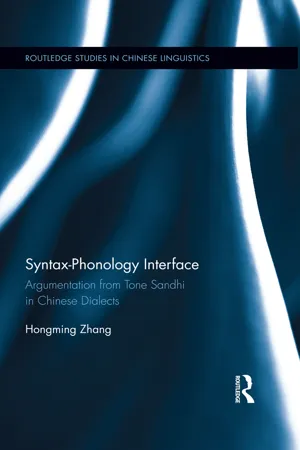
Syntax-Phonology Interface
Argumentation from Tone Sandhi in Chinese Dialects
- 234 pages
- English
- ePUB (mobile friendly)
- Available on iOS & Android
About this book
This book centers on theoretical issues of phonology-syntax interface based on tone sandhi in Chinese dialects. It uses patterns in tone sandhi to study how speech should be divided into domains of various sizes or levels.
Tone sandhi refers to tonal changes that occur to a sequence of adjacent syllables or words. The size of this sequence (or the domain) is determined by various factors, in particular the syntactic structure of the words and the original tones of the words. Chinese dialects offer a rich body of data on tone sandhi, and hence great evidence for examining the phonology-syntax interface, and for examining the resulting levels of domains (the prosodic hierarchy).
Syntax-Phonology Interface: Argumentation from Tone Sandhi in Chinese Dialects is an extremely valuable text for graduate students and scholars in the fields of linguistics and Chinese.
Frequently asked questions
- Essential is ideal for learners and professionals who enjoy exploring a wide range of subjects. Access the Essential Library with 800,000+ trusted titles and best-sellers across business, personal growth, and the humanities. Includes unlimited reading time and Standard Read Aloud voice.
- Complete: Perfect for advanced learners and researchers needing full, unrestricted access. Unlock 1.4M+ books across hundreds of subjects, including academic and specialized titles. The Complete Plan also includes advanced features like Premium Read Aloud and Research Assistant.
Please note we cannot support devices running on iOS 13 and Android 7 or earlier. Learn more about using the app.
Information
Table of contents
- Cover
- Title
- Copyright
- Dedication
- Contents
- Abbreviations
- Acknowledgments
- Introduction
- 1 Theoretical issues of syntax-phonology interface
- 2 Functional relations in tone sandhi
- 3 The c-command condition in phonology
- 4 Some issues in Mandarin interface studies
- 5 Function words and rhythmic effect
- 6 Theoretical discussions
- 7 Concluding remarks
- Bibliography
- Author index
- Language index
- Subject index