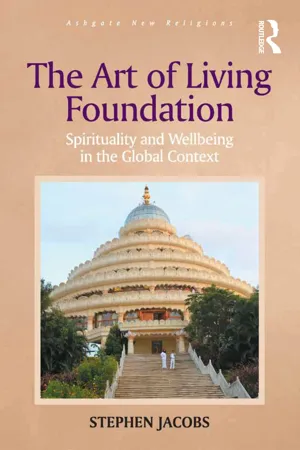
eBook - ePub
The Art of Living Foundation
Spirituality and Wellbeing in the Global Context
- 250 pages
- English
- ePUB (mobile friendly)
- Available on iOS & Android
eBook - ePub
About this book
The Hindu-derived meditation movement, The Art of Living (AOL), founded in 1981 by Sri Sri Ravi Shankar in Bangalore, has grown into a global organization which claims presence in more than 150 countries. Stephen Jacobs presents the first comprehensive study of AOL as an important transnational movement and an alternative global spirituality. Exploring the nature and characteristics of spirituality in the contemporary global context, Jacobs considers whether alternative spiritualities are primarily concerned with individual wellbeing and can simply be regarded as another consumer product. The book concludes that involvement in movements such as AOL is not necessarily narcissistic but can foster a sense of community and inspire altruistic activity.
Information
Chapter 1
Locating Art of Living
There are a number of intersecting trajectories that inform the context for the development of groups such as Art of Living (AOL). In this chapter I trace the convergence of Eastern and Western cultural discourses that are facilitated by the intensification of encounters that begin with colonial expansion. These encounters have continued through the processes of globalisation (discussed more fully in Chapter 5). Encounters between East and West are not merely political and/or economic, but also cultural. There have also been various developments within distinct cultures, such as the development of psychology in the West, which have facilitated cultural conversations, appropriations and syncretisms. Before looking at these cultural developments and encounters, there are two important provisos to the contextual discussion.
First, neither East nor West is a homogeneous entity. Edward Said in his seminal text Orientalism (1991) suggested that the discourse which proposes the bifurcation of the world into the Orient and Occident can be considered an imaginary geography that is primarily concerned with relationships of power. As Benedict Anderson (1991) identified in his important work on nationalism, the imagination is a powerful cultural and political force. Colin Campbell (2007, p. 5) also observed that the term ‘the West has widespread popular currency’.1 Consequently if there is an imagined ‘West’ there is also an imagined East. This imagined East is represented in a variety of ways, but most importantly for our understanding of AOL, the East is imagined as the source of a perennial wisdom by some in the West to critique various aspects of modernity. In particular as AOL’s origins are in India, I will be focusing on the encounters between India and the West. However, it is important to note that China, Japan and Tibet have also played a significant place in the romantic imagination of the West. For example the Beats looked towards the Zen traditions, and Timothy Leary used the Tibetan Book of the Dead to provide a framework for understanding the effects of psychedelic drugs.
Second, this account is both selective and necessarily brief. For example, while I discuss Swami Vivekananda, who is an important re-interpreter of Hindu traditions at the end of the nineteenth century, this discussion only touches on certain aspects of his life and teaching that are pertinent to our understanding of AOL. There are numerous other re-interpreters of Indian traditions, particularly at the end of the nineteenth century and early part of the twentieth century, such as Sri Aurobindo, whom I do not discuss but are also important in rearticulating aspects of the Hindu traditions, and therefore important contributors to the context for understanding AOL. Similarly, I am equally selective in my discussion of groups and individuals who are significant in the development of what Nikolas Rose (1998) has termed ‘the psy disciplines’ and their significance for the development of the Human Potential Movement. My argument is that these trajectories gained a critical momentum, and therefore influenced the overall cultural milieu out of which AOL emerged in the early 1980s. Furthermore these trajectories, like the ripples caused by throwing several pebbles into a pond, interacted with each other in complex ways.
Secularisation and Spirituality
One of the significant trajectories in understanding the context for the popularity of AOL is what Christopher Partridge has called ‘the re-enchantment of the West’. This seems to contradict the idea that in a post-Enlightenment world, religion and quasi-religious ideas no longer have any significance. Partridge (2004, p. 44) emphasises that this re-enchantment is ‘not2 a return to previous ways of being religious, but rather new ways of being religious’. Commentators like Partridge and Heelas argue that religion in the postmodern world is not decreasing in significance, but manifests in very different forms from what might be called traditional church religiousness. However, other commentators, particularly Steve Bruce, argue that religion in all of its forms is becoming largely irrelevant, and therefore we should describe the Western world, not as re-enchanted, but disenchanted.
The perceived diminishing significance of religion is generally referred to as secularisation. The empirical and quantitative evidence of church attendance in England is unambiguous, and seems to support the secularisation thesis. Although it is methodologically problematic to gather precise quantitative data it seems clear that there has been an inexorable decline in church attendance over the last 150 years in England. Although figures are contested it is generally estimated that about 40 per cent of the population attended church in 1851 and this had fallen to about 6.3 per cent in 2005 (Warner 2010, p. 11). In their analysis in 2000 of the 25 churches and chapels of Kendal, a small town in northern England, Paul Heelas and Linda Woodhead (2005, p. 35) estimated 7.9 per cent of the population attended what they have called ‘the congregational domain’. Even in the USA, which is often reported as being still a very religious nation, there is evidence that despite claims that church attendance has remained fairly consistent, actual attendance at churches has declined. Hadaway, Marler and Chaves (1993, p. 750) suggest that while approximately 40 per cent of Americans claim to attend church, the actual attendance rate is less than half of this. They suggest that the actual attendance rate for American churches has steadily declined since World War Two. Warner (2010, p. 76) suggests that in both the UK and US context ‘there has been well over a century of sustained decline for the institutional providers of religion’.
This statistical data combined with the hegemony of a positivist paradigm and Nietzsche’s assertion that ‘God is dead. God remains dead. And we have killed him’ (cited in Warner 2010, p. 21) led many commentators to suggest that as the processes of modernisation progressed religion would become increasingly anachronistic and disappear entirely from the public sphere, the attenuation of institutional forms of religiousness, and in the long term the evaporation of religious ideas from individual minds (see Brown 2001 and Bruce 2002). Callum Brown (2001, p. 2) in his persuasive thesis suggests that it is not simply a story of the decline of the church in Britain, but ‘the end of Christianity as a means by which men and women, as individuals construct their identity’. This classical secularisation thesis posits a sort of zero sum relationship between religion and the forces of secularisation.
Most commentators now accept that religiousness and the ways in which people express their religiousness are highly adaptive and fluid. Consequently, religion will never disappear, but has been transformed in the global postmodern context. The first critical reflections of the zero sum thesis have suggested that whilst religion has been increasingly banished from the public sphere it still remains an important aspect of the private sphere. So for example David Martin (cited in Flanagan and Jupp 1999, p. 19) suggests that secularisation is about religious institutions and not about religion per se. Bryan Wilson (1982, p. 149), suggests that by secularisation he means ‘that process by which religious institutions, actions, and consciousness lose their social significance’. Grace Davie (1994), in her seminal book Religion in Britain, argues that there is both clear evidence of a decline in the involvement of individuals in institutional forms of religion and also evidence – produced by groups such as the Alister Hardy Religious Research Centre – that many people still believe in some sort of non-empirical reality. Consequently Davie maintains that the best way to characterise contemporary religiousness – at least in the UK – is as ‘belief without belonging’. However, particularly in the post 9/11 world, religion has once again become a visible presence in the public domain.3 Even prior to 9/11 the sociologist of religion Peter Berger (1999, p. 2), reassessing some of his earlier work, asserted that ‘the assumption that we live in a secularised world is false. The world today is as furiously religious as it ever was’. As we shall see Sri Sri Ravi Shankar advocates a place for spirituality and religion in the public sphere. Furthermore neither religion nor spirituality is necessarily as individualised or purely private in the way that is envisaged by Grace Davie’s thesis. There is clearly a sense of belonging amongst participants in AOL.
Spirituality
Academic, media and popular discourses seem to suggest that religiousness has bifurcated into two main avenues that can be broadly identified as the fundamentalist and the spiritual. The rise of so-called fundamentalism4 does not concern us here. However, the concept of spirituality has become a prominent trope in the discourses about the nature of religion in a global context. Both Sri Sri Ravi Shankar and active participants frequently refer to AOL as being about spirituality. One of the most often quoted aphorisms of Sri Sri Ravi Shankar is that ‘religion is like the banana skin and spirituality is the banana. People have thrown away the banana and are holding onto the skin’ (Sri Sri Ravi Shankar 1999, p. 3). The distinction between religion and spirituality is a common theme in the discourse of the baby boomer and subsequent generations, and is frequently understood in terms of different perceptions of authority, value and authenticity. Discourses of spirituality suggest that the ultimate source of authority, value and authenticity is located in the individual subjective experience, whereas religious discourses perceive the ultimate source of authority, value and authenticity residing in a separate transcendent reality, often mediated through an external institutional authority. The prevalence of this discourse of spirituality amongst the baby boomer generation indicates a paradigm shift ‘from a world in which beliefs held believers to one in which believers hold beliefs’ (Roof 1999, p. 42).
Paul Heelas and Linda Woodhead (2005, p. 3) characterise this paradigm shift from religion to spirituality as ‘a turn away from “life-as” (life as lived as a dutiful wife, father, husband, strong leader, self-made man, etc.) to “subjective-life” (life lived in deep connection with the unique experiences of my self-in-relation)’. Many active participants suggest that it is the subjective experiential aspect which is fundamental to their continued involvement with AOL. For example a part time volunteer teacher indicated that the practices of AOL created within her a ‘feeling of stillness inside’. A participant on an Art of Silence Course indicated that his involvement with AOL provided ‘experiences, which cannot be expressed in words’ and that it gave him ‘peace of mind’ (personal conversations August 2013). This does suggest that spirituality can be understood as a peculiarly individual phenomenon in comparison to more traditional forms of religiousness. However, there is also a strong collective aspect to AOL, that manifests in a variety of ways, particularly through a congregational type gathering known as satsang, which are not only organised on the ashram in Bangalore, but are also regular events arranged by local groups around the world.
Although Sri Sri Ravi Shankar suggests that religion is like ‘the banana skin’ he does not suggest that religion as such should be rejected. In an interview for The International Peace Congress in November 2006 he observed:5
Every religious tradition has three aspects: they have symbols, practices and values. So if you focus more on the value, you will find that all of the religions have the same values like compassion honesty, love, caring, prayer.
It is these underlying values that constitute spirituality, and it is this focus on the underlying spiritual values that has the capacity to unify people. So later on in this interview Sri Sri Ravi Shankar indicates that ‘spirituality is something that brings people together. It unites you in the experiences, the deep experiences of yourself.’ Consequently the deep underlying values of religion are clearly commensurate with the subjective experiences, such as inner stillness and peace of mind, affirmed by AOL participants.
The diversity of religions as expressed through different symbols and practices should be a cause for celebration, and not conflict, as these differences are rooted in common values. This unity in difference is articulated in the AOL characterisation of humanity as ‘a one world family’. Consequently the significance of the boundaries between religions becomes attenuated. AOL discourse suggests that, as it taps directly into these core values, it is possible to be simultaneously a Christian, Hindu, Muslim or even atheist and at the same time deeply committed to AOL. One can have both the fruit and the banana skin. It is also possible to remain true to, for example, one’s Christian identity and at the same time relate to singing Hindu devotional songs. This implies that one can also have a bite from other people’s bananas without fundamentally compromising your core values.
Spirituality is a notoriously vague signifier. It is perhaps this vagueness that constitutes the allure of spirituality. The concept of spirituality is more open to an individual interpretation and is less contingent upon any external authority than institutional forms of religion. Spirituality tends to be perceived as being less bound by creed, canonical texts and hierarchical structures than religion. The ultimate validating principle of spirituality is frequently couched in terms of personal experience and individual transformation. Consequently, many forms of spirituality prioritise technique over doctrine. This is certainly the case in AOL. Almost every active member of AOL I spoke to referred to having powerful experiences when practising the techniques of AOL. Every active participant that I spoke to also indicated that they felt that their lives had somehow been transformed through their involvement with AOL.
The Subjective Turn
Spirituality is often linked to what has been called the subjective turn and is understood in terms of turning to one’s own subjective experience as a source of validation. Disillusionment with external sources of authority is an integral element of this subjective turn. ‘The goal is not to defer to a higher authority, but to have the courage to become one’s own authority’ (Heelas and Woodhead 2005, p. 4). However, groups such as AOL do not seem to be consistent with this rejection of external authority that characterises the subjective turn. Active participants in AOL clearly regard Sri Sri Ravi Shankar as the source of authoritative knowledge. In other words there seems to be a tension between the internal experiential validation of AOL and the role attributed to Sri Sri Ravi Shankar as a source of wisdom and authority.
Zygmunt Bauman (2000, p. 31) has suggested that the emphasis on the individual and the disillusionment with external modes of authority has entailed ‘transforming human identity from a “given” into a “task”’. This task of establishing a meaningful identity is made even more problematic, as it has to be accomplished in the context of what Peter Berger et al. (1974) have characterised as the pluralisation of life-worlds. Life-worlds are the perceived systems of meaning, which are ‘social in origin and maintenance’ and which provide a sense of order and stability (Berger et al. 1974, p. 62). The encounter with a plurality of life-worlds relativises these, and thereby undermines the plausibility of any particular meaning system associated with a specific life-world. This relativisation of life-worlds and the undermining of the plausibility of meaning systems has entailed that modern consciousness can be best characterised in terms of ‘a deepening condition of homelessness’ (Berger et al. 1974, p. 76). The transformation of identity construction from a given to a task and the pluralisation of life-worlds has produced what Ulrich Beck and Elisabeth Beck-Gernsheim (2001, p. 7) have termed ‘a tyranny of possibilities’. This tyranny of possibilities has been accompanied by a growing disillusionment with more traditional institutions and ideologies, which had in the past provided plausible structures of meaning. Zygmunt Bauman (2000, p. 2) describes this tyranny of possibilities and concomitant disillusionment with traditional structures of meaning as ‘liquid modernity’ – a context where ‘cultures become fluid and like fluids nothing keeps its shape and everything is prone to change’. For some this constant state of flux is deeply unsettling and this has engendered ‘its own nostalgias – nostalgias, that is, for a condition of “being at home” in society, with oneself and, ultimately, in the universe’ (Berger et al. 1974, p. 77).
This nostalgia for finding a home has provided a context for what Roof (1999, p. 9) has called an ‘effusive quest culture’. Bauman (2000, p. 21), drawing on the work of Erich Fromm, observes that there is a tendency to fear freedom and ‘the compulsive quest for certainty takes off, the desperate search for solutions able to eliminate the awareness of doubt begins, anything is welcome that promises to assume the responsibility for certainty’. This quest for certainty has in turn created a context for what Beck and Beck-Gernsheim (2001, p. 7) have identified as ‘a market for answer factories’. AOL can be understood as both a therapeutic solution, enabling the individual to feel better about themselves, and an answer factory which provides participants with a stable meaning system for the construction of identity in the context of liquid modernity. This raises the question of why AOL is an effective ‘answer factory’ to the existential anxiety of the homeless mind in the context of liquid modernity. I suggest that there are three interrelated reasons that account for the success of AOL, which I term therapeutic solutions, escaping the cage of disbelief and symbolic resource.
Therapeutic Solutions
Therapeutic solutions is a generic term that can be applied to a gamut of techniques intended to produce a subjective sense of well-being. Philip Rieff (1966) has argued for what he has called the ‘triumph of the therapeutic’, which he suggests is a major cultural shift. In this new emerging cultural context ‘psychological man’ has superseded ‘religious man’, and ‘“I believe”, the cry of the ascetic, lost precedence to “one feels”, the caveat of the therapeutic’ (Rieff 1966, p. 22). Eva Ilouz (2008, p. 9) argues that ‘the therapeutic discourse has mustered an enormous cultural resonance because it has been acted within and through the main institutions of modernity’. In other words therapeutic discourses have become hegemonic, and are therefore recognisable and perceived as meaningful. Assertions such as Art of Living teaches ‘effective practical techniques for emotional and physical wellbeing’ (AOLF 2013a...
Table of contents
- Cover
- Title Page
- Copyright Page
- Contents
- Acknowledgements
- Introduction
- 1 Locating Art of Living
- 2 Sri Sri Ravi Shankar and a Brief History of Art of Living
- 3 Beliefs and Practices
- 4 On Whose Authority?
- 5 A One World Family
- Conclusion
- Bibliography
- Index
Trusted by 375,005 students
Access to over 1.5 million titles for a fair monthly price.
Study more efficiently using our study tools.
Frequently asked questions
Yes, you can cancel anytime from the Subscription tab in your account settings on the Perlego website. Your subscription will stay active until the end of your current billing period. Learn how to cancel your subscription
No, books cannot be downloaded as external files, such as PDFs, for use outside of Perlego. However, you can download books within the Perlego app for offline reading on mobile or tablet. Learn how to download books offline
We are an online textbook subscription service, where you can get access to an entire online library for less than the price of a single book per month. With over 1.5 million books across 990+ topics, we’ve got you covered! Learn about our mission
Look out for the read-aloud symbol on your next book to see if you can listen to it. The read-aloud tool reads text aloud for you, highlighting the text as it is being read. You can pause it, speed it up and slow it down. Learn more about Read Aloud
Yes! You can use the Perlego app on both iOS and Android devices to read anytime, anywhere — even offline. Perfect for commutes or when you’re on the go.
Please note we cannot support devices running on iOS 13 and Android 7 or earlier. Learn more about using the app
Please note we cannot support devices running on iOS 13 and Android 7 or earlier. Learn more about using the app
Yes, you can access The Art of Living Foundation by Stephen Jacobs in PDF and/or ePUB format, as well as other popular books in Theology & Religion & Religion. We have over 1.5 million books available in our catalogue for you to explore.