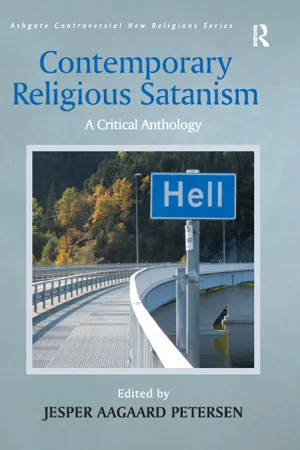
- 290 pages
- English
- ePUB (mobile friendly)
- Available on iOS & Android
eBook - ePub
About this book
The Church of Satan was founded by Anton LaVey on April 30, 1966. In his hands, Satan became a provocative symbol for indulgence, vital existence, natural wisdom and the human being's true animal nature. At present, religious Satanism exists primarily as a decentralized subculture with a strong internet presence within a larger Satanic milieu in Western culture. Though most are inspired by LaVey, the majority of contemporary Satanists are not members of the Church of Satan. The various expressions of modern Satanism all navigate in today's detraditionalized religious market through the creative appropriation of popular culture, philosophy, literature and religion. The concrete solutions are varied; but they all understand the power of transgression allying oneself with a most powerful symbol of resistance, namely Satan. Thus, contemporary religious Satanism could be understood as a complex negotiation of atheism, secularism, esotericism and self: A "self-religion" in the modern age. Despite the fascinating nature of religious Satanism, it has attracted little scholarship until relatively recently. This book brings together a group of international scholars to produce the first serious book-length study of religious Satanism, presenting a collection that will have wide appeal to specialists and non-specialists alike. The first part contains broader studies of influential groups and important aspects of the Satanic milieu, especially regarding historical developments, the construction of tradition and issues of legitimacy. The second part narrows the view to regional variations, especially with studies on Northern and Eastern Europe. The third part consists of primary documents selected for their representational and informational value.
Information
Chapter 1
Introduction: Embracing Satan1
The harmony of soul and body – how much that is! We in our madness have separated the two, and have invented a realism that is vulgar, an ideality that is void.
Oscar Wilde: The Picture of Dorian Gray, 1908 (1890) (pp. 19–20)
This is not a book about Satanic ritual abuse. It is not even a book about the Satanic Panic spanning the eighties and nineties – even though that moral panic still affects us both locally and globally. No children or animals were harmed during the research for this volume and no pacts, orgies or blood rituals performed. So what is it about?
This is a book about contemporary religious Satanism. Let me explain these concepts in turn. The subject is contemporary or modern in the sense that Satanism manifests itself in loose collectivities around the same time that counter-cultural, proto-New Age, eastern and human potential movements bloom in the West – the sixties and early seventies. As with all these related phenomena, Satanism draws upon reinterpretations of self-contained, complex, and much older traditions and various elements of rejected knowledge within the “cultic milieu” of the West (Campbell 1972); thus it is a sub-stream within that milieu, a dark or sinister bricolage within western “occulture” (Partridge 2004, 2005).
It is religious in the sense that contemporary Satanism is a substantial and functional equivalent to religion in the classical sense. Substantially, some groups within the sub-stream are easily identifiable as religions, with doctrine, practice, community and organization (Lincoln 2003: chapter 1); others are more on the mystical, spiritual or philosophical side, a loose network or carnal brotherhood of like or very un-like minds (Campbell 1978). Both provide for the same functions, such as meaning, community and identity, for their adherents. Correspondingly, most formulations could be understood through the category of “self-religion” or “Life spirituality” as explored by Paul Heelas:
In sum, New Age spiritualities of life are all about realizing one’s inner, true life. Such spiritualities are (albeit to varying degrees) detraditionalized …. Ultimately, life can only be experienced through one’s own inner-directed life. One has to be able to live one’s life, express one’s own life, experience the wisdom inherent in one’s life. Traditions, with their supra-self, externally sustained frames of reference and injunction, can have little or no role to play. (Heelas 2002: 362)
Although modern Satanism is very different from New Age spirituality on many accounts, the basic focus on socialization as repression of an essential nature and the transformation or self-realization through detraditionalized techniques are comparable (Partridge 2004: 81; see Asbjørn Dyrendal’s contribution in the present volume for an illuminating discussion).2
As such, contemporary religious Satanism spans the field from full-blown religion with tradition, rituals, communitarian ethos and hierarchy to austere, individualistic philosophy, a “humanism with horns” (Dyrendal 2007: 25), “atheistic, skeptical Epicurea[nism]” (e.g. Gilmore 1999 and Walls 2007), “atheistic, self-centric philosophy” with “a-theology” or “cult of opposition” (Partridge 2005: 222–23) or even “an un-religion” (e.g. Crabtree 2002, Paradise 2007: 150). Anton LaVey, the most significant spokesperson of the substream, has described his interpretation of Satanism (which of course is Satanism as such) as “Ayn Rand with trappings” (Klein 1970: 20, Fritscher 2004 [1973]: 181). To paraphrase Stephen Flowers, Satanism comprises immanent, materialistic as well as transcendent, idealistic views of the Self (Flowers 1997: 5), and, one could add, atheistic and theistic views of Satan. However, most if not all, contemporary groups link Satan and self explicitly and interpret Satan as a symbol, archetype or force of nature. As mentioned above, they are markedly detraditionalized and thus supportive of the sacralization of the self and secular trends of modern society. They manifest epistemological individualism (Partridge 2004: 32–33) and syncretism or eclecticism (Campbell 1972, Partridge 2004, Hammer 2001a, 2001b) that is symptomatical of self-religion and the ideology of seekership in the cultic milieu. I will return to that shortly.
Finally, contemporary religious Satanism is satanic in the sense that all groups and individuals relate to the figure of Satan, as mentioned above, as a force, model, symbol or expression of self. In this sense and that alone modern Satanism could be called a “cult of opposition” (Partridge 2004: 222) that “ … cannot be understood apart from the Christian culture that provided the context for their foundation …” (La Fontaine 1999: 81). As James R. Lewis remarks, Satan has “become an ambivalent symbol” in the West as he has come to “embody some very attractive attributes” (Lewis 2003: 107) through a re-reading of the Christian tradition: He is associated with sex, pride, non-conformity, rebellion and individualism. But it is a very large misunderstanding to stop here, with the anti-Christian, inversionist sentiments of the substream. As will be discussed in greater length in the section on the “how” of Satanism below, certain historical processes of reinterpretation have freed the concept of Satan from a theological and Christian context, driven by a complex wave of romantic and modernist interests. Modern Satanism is better understood as post-Christian and as part of the Left-Hand Path traditions (see Kennet Granholm’s chapter in the present volume for a critical assessment).
As should be clear by now, most formulations of satanic discourse and practice have a positive as well as a negative side. The positive side is the self-religious, focusing on empowerment, self-realization, actualization, assertion or development, whether it manifests itself as a rational self-interest, gnosis, or development of natural potentials. Satan has attractive attributes and is symbolically equated with the self. However, as could be seen with Paul Heelas’ definition above, this project cannot be understood apart from a negative distancing or even destructive attitude towards external authorities, a subversion of established traditions and herd mentality. The self project is a project of non-conformity. But this element of non-conformity and de-conditioning is not tied to Christianity alone; it is a general opposition to all traditional and modern institutions of authority. Christianity is understood as the prime example of a totalitarian, oppressive moral force – other enemies are capitalist society’s dictum of consumerism and passive entertainment; “liberal” society’s “universal” human rights and bland equality; puritanical morals of sexual repression; the wellfare state; and the blind obedience and irrationality of the herd in all religions (Flowers 1997: 195f). Satan is the Adversary or ultimate rebel and is thus symbolically a stance one takes in the pursuit of self interest and self development. All in all, the Satan of Satanism is heavily detraditionalized and, while nominally tied to Christianity, cannot be understood in a strictly Christian sense. Thus modern Satanism is not a Christian sect, inverted Christianity or a Christian hermeneutics.3
My argument is parallel to the position taken by the anonymous author of the Wikipedia entry on “Satanism”
Common misuse of the word generally refers to “the worship of Satan or the practice of ritual magic.” However, by the actual adherents, the suffix -ism is often used suggesting the definition as an act or practice (e.g. the word heroism), as opposed to the oft-assumed definition as the doctrine or philosophy behind an act or practice.” (Wikipedia, “Satanism”)
While I would not disband substantive definitions of Satanism, I would certainly expand the world-view-analysis with its’ focus on belief in Satan and resulting practices, an inherently theological and psychological approach, with a discoursive approach, where the declaration “I am a Satanist” is a speech-act (Austin 1962), a declaration of intent: Satanism is thus also the act of declaring and practicing an adversarial stance. This is a much more dynamic conception of ideology, where the concrete practices influence the system of beliefs and practices while also being influenced by the same system.4
Let us now examine these elements in greater depth. After some preliminary remarks on the satanic milieu, groups within it and the cohesiveness of the field, I will examine the “what”, the substantial side of modern Satanism through a typology and discussion of common traits in discourse, practice and imagery, focused on the elements found attractive in formulations of satanic positions by important spokespersons. Then I will turn to the “how”, the performative and constructive side, to illustrate the divergence and complexities within the field. These positions are of course intertwined and only separated analytically. Finally, I will briefly address the “why”, the functional side of Satanism and its appeal in western societies, and conclude with a summary of the chapters and primary material found between the covers.
Drawing Boundaries
As stated above, modern Satanism can be conceived as a part of the cultic milieu proposed by Colin Campbell in his seminal article The Cult, the Cultic Milieu and Secularization (Campbell 1972). As such, Satanism is a bundle of ideas and practices related to other ideas and practices in the “cultural underground of society” (ibid.: 122). This heterogenous, but single “assortment of cultural items” (ibid.) is held together by common traits, mainly deviance, syncretism, overlapping communication structures and the ideology of seekership (ibid.: 122–24). The point is that new religious movements continuously crystallize from this cultural field. It works as both the substantive and functional context for group evolution – it is the cultic milieu and not the individual groups that are permanent (ibid.: 122).5
The cultic milieu is a “fuzzy category” (Taylor 1995: 38ff; Saler 2000: 202f). Its’ contents are arranged according to the Wittgensteinian notion of family resemblance in order to have the necessary cohesion (not coherence or consistence) without losing its’ heterogeneous character. Nevertheless some streams are closer related than others, as some concepts, practices and influential formulations work as magnets, making clusters of related items, and these could be categorized as the broad currents of a very complex field of rejected knowledge and communication. Campbell himself describes “cultic culture” as “falling in the property space bounded by a religion-science axis and an instrumental-expressive orientation axis, taking for granted the prior criterion of societal deviancy” (Campbell 1972: 124) and proceeds to mention four important streams: Two religious, namely mysticism and “pre-Christian pagan traditions”, and two pseudo-scientific, namely deviant science and underground technology (ibid.: 124–126). In a similar vein, Christopher Partridge isolates four such streams when discussing the contemporary spiritual climate of the West – The Western Mystery/Esoteric tradition, the alternative or paranormal, the New Age and the contemporary Pagan “occulture” – and includes Satanism in the fourth category (Partridge 2004: 71–84).
I would propose to isolate a “Satanic milieu”, an important discourse, sub-field, current or reservoir alongside for example the neo-Pagan, UFO related, New Age, Theosophical and Western Esoteric currents, as modern Satanism in its divergent forms is sufficiently distinctive to warrant this accentuation. The satanic milieu is in itself a polythetic category with fuzzy borders, and could be conceived of as a cult-producing substance of key terms and practices as well as the reservoir of ideas uniting the broad movement of modern Satanism, mirroring the larger cultic milieu in a fractal sense. Thus the satanic milieu is a trend in popular culture (Baddeley 2000, Dyrendal 2005, 2008, forthcoming), a collective style and identity within satanic neo-tribes (Lowney 1995, Hermonen 2002) and the reference points of the satanic subcultures that crystallize around distinct interpretations or manifestations of Satanism today (Dyrendal 2004, Petersen 2005).6 Even though few modern, self-professed Satanists feel as a part of a grand movement or clearly definable subculture (and some even attack the very notion of community implied in these words), I would certainly state that from a historical and sociological point of view, they do belong to a diffuse “occultural” movement and, in the case of organized Satanists, belong to subcultures within it with common identity, history (both emic and etic), symbols, aesthetics, interpretations and practices; in short: Identity, commitment, consistent distinctiveness and autonomy.7
Nevertheless, it is important to differentiate between specific individuals, tangible groups and the movement as a whole. These positions are angles or approaches of analysis, as are the delimitations I have made above. As such, etic categorization should not ignore the very pertinent assessments on the emic level. The same aber dabei could be stated with regard to sources: Are we looking at movement texts (Hammer 2001b: 37), online material (Petersen 2007), popular culture (Dyrendal 2008) or qualitative analysis of specific groups and individuals, and what are their relations with each other?
Consequently, we should not fall into the trap of reifying our analytical concepts so as to envision modern Satanism as a self-contained tradition “out there” with an inherent essence; one would do well to work along the same lines as Wouter Hanegraaff when he explicates Western Esotericism:
… an emphasis on the complexity of western culture as a pluralistic field of competing religious and ideological identities, and on western esotericism as an analytical concept (not a descriptive category) which brings that situation into focus by systematically highlighting religious and cultural dimensions that have traditionally been marginalized as “other.” (Hanegraaff 2007: 109)
In this sense, we participate in a closure of the satanic milieu itself, as we should understand it as a contested space that is given a temporary coherence, substance and community through discoursive battles. These battles are fought with actors from within and from without: “Othering” from the mainstream (or cognitive majority), as when childcare workers or influential Christian groups define “Satanism” to de-legitimize it or academic scholars try to legitimize it, “Othering” from within when one group de-legitimizes another or the milieu as a whole, and the creative use of tradition and “alterity” to legitimize oneself within (Hjelm 2007. See also the contributions of Graham Harvey, James R. Lewis and Maxwell Davies in the present volume). I will return to these issues in “the how of Satanism” below; presently I will discuss a basic typology and some elements that do seem to be widespread in the milieu across discoursive boundaries.
The “What” of Satanism
Three broad categories or ideal types can be discerned within the satanic milieu: Rationalist, Esoteric and Reactive paradigmatically conform Satanism (Schmidt 2003 [1992]: 11ff, Dyrend...
Table of contents
- Cover
- Half Title
- Title Page
- Copyright Page
- Table of Contents
- Notes on Contributors
- Acknowledgements
- 1 Introduction: Embracing Satan
- PART I Broader Studies: History, Tradition, Legitimacy
- PART II REGIONAL STUDIES
- PART III PRIMARY DOCUMENTS
- Index
Trusted by 375,005 students
Access to over 1.5 million titles for a fair monthly price.
Study more efficiently using our study tools.
Frequently asked questions
Yes, you can cancel anytime from the Subscription tab in your account settings on the Perlego website. Your subscription will stay active until the end of your current billing period. Learn how to cancel your subscription
No, books cannot be downloaded as external files, such as PDFs, for use outside of Perlego. However, you can download books within the Perlego app for offline reading on mobile or tablet. Learn how to download books offline
Perlego offers two plans: Essential and Complete
- Essential is ideal for learners and professionals who enjoy exploring a wide range of subjects. Access the Essential Library with 800,000+ trusted titles and best-sellers across business, personal growth, and the humanities. Includes unlimited reading time and Standard Read Aloud voice.
- Complete: Perfect for advanced learners and researchers needing full, unrestricted access. Unlock 1.5M+ books across hundreds of subjects, including academic and specialized titles. The Complete Plan also includes advanced features like Premium Read Aloud and Research Assistant.
We are an online textbook subscription service, where you can get access to an entire online library for less than the price of a single book per month. With over 1.5 million books across 990+ topics, we’ve got you covered! Learn about our mission
Look out for the read-aloud symbol on your next book to see if you can listen to it. The read-aloud tool reads text aloud for you, highlighting the text as it is being read. You can pause it, speed it up and slow it down. Learn more about Read Aloud
Yes! You can use the Perlego app on both iOS and Android devices to read anytime, anywhere — even offline. Perfect for commutes or when you’re on the go.
Please note we cannot support devices running on iOS 13 and Android 7 or earlier. Learn more about using the app
Please note we cannot support devices running on iOS 13 and Android 7 or earlier. Learn more about using the app
Yes, you can access Contemporary Religious Satanism by Jesper Aagaard Petersen in PDF and/or ePUB format, as well as other popular books in Theology & Religion & Religion. We have over 1.5 million books available in our catalogue for you to explore.