Pictorial representation is one of the core questions in aesthetics and philosophy of art. What is a picture? How do pictures represent things? This collection of specially commissioned chapters examines the influential thesis that the core of pictorial representation is not resemblance but 'seeing-in', in particular as found in the work of Richard Wollheim.
We can see a passing cloud as a rabbit, but we also see a rabbit in the clouds. 'Seeing-in' is an imaginative act of the kind employed by Leonardo's pupils when he told them to see what they could - for example, battle scenes - in a wall of cracked plaster. This collection examines the idea of 'seeing-in' as it appears primarily in the work of Wollheim but also its origins in the work of Wittgenstein. An international roster of contributors examine topics such as the contrast between seeing-in and seeing-as; whether or in what sense Wollheim can be thought of as borrowing from Wittgenstein; the idea that all perception is conceptual or propositional; the metaphor of figure and ground and its relation to the notion of 'two-foldedness'; the importance in art of emotion and the imagination.
Wollheim, Wittgenstein and Pictorial Representation: Seeing-as and Seeing-in is essential reading for students and scholars of aesthetics and philosophy of art, and also of interest to those in related subjects such as philosophy of mind and art theory.
A thought always contains something which reaches beyond the particular case, through which this comes to consciousness as falling under a generality.
(Frege, 17 Kernsätze, Kernsatz 4)
That the sun has risen is not an object which sends out rays which arrive in my eyes; is not a visible thing like the sun itself.
(Frege, 1918: 61)
Between 1946 and 1949 Wittgenstein produced a number of manuscripts which included discussion of seeing-as and what he called ‘seeing aspects’ – among a host of other elements in mental life (see especially 1980a, 1980b, 1982a, 1982b, 1953: IIxi). Neither is remotely the main topic. Nor is there one, conceived as some specifiable part of mental life. Nor is this discussion organised into some connected whole. Rather, it is woven through discussion of other things. No view, or account, of seeing-as is offered or endorsed. These manuscripts read more like daybooks than monographs; daily jottings, over an extended period, of daily (perhaps nocturnal) occurrences of ideas or worries. Wittgenstein himself characterises his aim as follows:
The genealogy of psychological phenomena: I am aiming, not for exactness, but for surveyability.
(RPP I §895 (158))
Here I will refer to these texts simply as ‘the daybooks’. One main focus will be on a particular sort of surveyability which emerges.
Despite their sketchy character, the daybooks contain important lessons. Focus on seeing-as is one way to extract them. One main lesson is how accounts of mental life must, and can, respect the essential publicity of thought – the requirement that, as Frege put it, any thought must be graspable as the same by different thinkers. A related second lesson brings out disjunctivism’s point and worth, particularly in re perception. Not that Wittgenstein was a disjunctivist. But he suggests what is in fact a good reason for being one.
The Tractatus' speedy collapse
Seeing-as, of one sort, is something on which the Tractatus had confidently, but surely wrongly, pronounced. That misplaced confidence is one by-product of a misplaced confidence in its general account of representation, one which, in 1929, Wittgenstein himself came to see would not do. His project of working out what would do – the rest of his career – brought him, for one thing, closer to Frege, thus to appreciate the depth and importance of what I will call ‘Frege’s challenge’. The Tractatus treatment of seeing-as is a good point of entrée to all this. Discussing the Necker cube, it says this:
To perceive a complex means to perceive that its constituents are combined in such-and-such way.
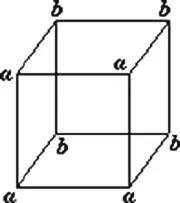
This perhaps explains that the figure can be seen in two ways as a cube; and all similar phenomena. For we really see two different facts.
(5.5423)
This cannot be right. First, one might, notoriously, see that the Necker contains elements (lines, for example) organised thus and so, while being unable to see them as so arranged. Seeing a Necker one recognises it immediately as a Necker. Knowing his Neckers, he sees immediately that the lines are arranged so as to form an image of a cube oriented such-and-such way. Or seeing the lines and knowing his geometry, or his drawing, well enough, he knows that there must be such a cube depiction present. But today he simply cannot make that depiction come into view for him. Second, conversely, one may see the Necker’s depiction of one of its cubes – call this the A-cube – but miss the fact that the lines in the depiction are organised in some specified way. He may, for example, see the A-cube in a blur, or, while seeing the A-cube, miss a bit of organisation at the back. (He might, say, fail a quiz on this.) Or he might simply be benighted in re the organisation of a cube.
Suppose there is a plastic cube – perhaps a recipe box – on the kitchen counter. One might see it without yet recognising it as a cube. One might take it for a half-cube, or recognise it as some sort of rhomboid, without yet quite seeing what sort, etc. – just as one might see a pig snuffling beneath an oak, locating a truffle, while taking it for an aardvark locating ants, or not knowing what sort of animal it might be. Recognising the box as a cube, or as a recipe box, recognising the pig as a pig, what it is doing as snuffling, or truffle-hunting, and so on, are not perceptual accomplishments, or not of the sort that seeing may be, but rather exercises of capacities of thought, ones to judge correctly when it is, or when it would be, for example, a pig that one faces.
True, ‘see-as’ has a non-perceptual use, just as ‘see’ does (in ‘see that’). Pia may, for example, see battery power as the future of urban transportation, as she may see that the battery power in her all-electric has run out. So Pia thinks. What she thus thinks has no visual features. Seeing battery power as Pia does is not a visual experience. There is no way what she thus sees looks. Seeing the Necker as a depiction of the A-cube rather than as one of the B-cube, or as neither, is having a visual experience of a certain sort. Such is not to be understood in terms of awareness-that.
Verbs such as ‘see’ and ‘look’, which may be used to speak of visual experiencing, seem pretty regularly to have other uses on which they speak, not of that, but rather of ways of standing in thought towards things. Seeing that this year will be a vintage one for port, or that it is the end of an era, or that the fix is in – even seeing that the T-bones now lie on Pia’s new white carpet – are not visual phenomena. Similarly, while for Pia to look like her mother may be for the two to share visual features (quite abstract ones, perhaps, considering Pia’s still girlish mien), for it to look as though Pia’s mother is coming to dinner, or even as though it is Pia’s mother coming down the street, is for there to be things for one, or relevantly informed ones, to think. (Contrast here it looking as though Pia’s mother is approaching with it looking (just) as though she were approaching.)
‘See-that’ speaks of awareness, but not visual awareness – even if visual awareness may sometimes be what makes what one thus realises recognisable. (Sid might also see that the Wildschwein is in Pia’s tulips again by the dismayed look on her face, or by his watch, which tells him it is Wildschwein time.) As Frege notes, that the Wildschwein is in the garden is neither in the garden nor outside the gate. It neither takes long to happen, nor is it momentary. It does not happen. It has no location. Accordingly, it forms no images on retinas. It cannot be an object of sight, nor of sensory awareness, as the Wildschwein trampling the tulips can be.
Seeing the A-cube may enable one to see that the lines of the Necker are organised in such-and-such way (though there is no guarantee that it will). Seeing that the lines are organised in that way may help one to see it as a depiction of the A-cube (or to see that depiction in it). But each is a fundamentally different form, or notion, of awareness. The first makes one aware, the second registers what is thus on offer. As each serves a very different function, so, too, each takes a very different sort of object. For good reason, neither entails the other.
How could Tractarian Wittgenstein have missed this difference? Perhaps because the Tractatus account of representing-as erases it. That account begins the work:
The world is everything that is the case.
The world is the totality of facts, not of things.
The world is determined by the facts, and by these being all the facts.
(1–1.11)
What is the case, for example, is that Pia is walking a pig on a leash. The world, we are told, is all of that. It is made up of whatever is so. (What, then, might one represent as being thus and so?) The world is, so far, a notion open to be filled in in various ways. But it is plausibly at least that of which we judge in judging either truly or falsely – in judging, that is, that things are thus and so, which makes what we judge and what we judge of at least (perhaps only) superficially the same. Sid judges that Pia is walking a pig on a leash, and that very same thing (that she is leading a pig on a leash) is so (or again not so). One judges that in being all that is the case, the world is, inter alia, this, or perhaps of something in the world that it is that very thing, that Pia is walking, etc.
The world, we are told, is everything that is the case. But it is also (one would have thought) everything one judges to be thus and so in judging something to be the case. One smells a regress. Are we at the bottom of the garden path? Have we, to borrow Austin’s image, just nutmegged our own defender, to dribble up smartly before our own goal? It would seem, anyway, that something is already badly wrong. For one thing, as Frege points out, that such-and-such – what is the case – is something invisible, not a possible object of perceptual awareness, whereas we had all hoped that what we judge of might, at least sometimes, be something which we see. But perhaps more needs to be said as to why that such-and-such must be invisible. Perhaps there is only a seeming issue here. In any case, that suggestion that there is just one thing, or category of thing, which is both what we represent as such-and-such when we represent the world as a certain way and what we represent it as, or the representation of it as that, is quite deliberate. For it serves an essential function in the Tractatus story of what representing is.
That story of representing begins in section 2 as follows:
We make ourselves pictures of the facts.
(2.1)
The picture is a model of reality.
(2.12)
The elements in the picture correspond to the objects.
(2.13)
The elements of the picture stand in, in the picture, for the objects.
(2.131, my italics)
The picture consists in the fact that its elements are combined with one another in a determinate way.
(2.14)
That the elements in the picture relate to each other in a certain manner and way represents it as being so that the things so relate to one another.
(2.15)
To represent things as being a certain way is thus to depict them in a certain way, on the above model of depiction. A given way for representing things as being is such a depiction.
It is thus clear enough what representing truly must be:
What the picture represents is its sense.
(2.221)
Its truth or falsity consists in the agreement, or disagreement, of its sense with reality.
(2.222)
In the picture, stand-ins for – representatives of – given objects (whatever these are) are structured in a given way. Such representatives are elements in the picture. In it they relate to each other in given ways. If the picture is true (depicts truly), then what those stand-ins stand in for also so relate.
Wittgenstein seems to have forgotten here that very elementary point which Frege puts as follows: ‘Clearly one would not call a picture true if an intention did not attach to it’ (1918: 59). One need not take Frege’s term ‘intention’ (‘Absicht’) au pied de la lettre. The point is that, for example, visible arrangements of elements in a depiction of something, if they represent things as any way at all, do so only on a particular understanding which, if that is what they do, they bear. Lichtenstein’s Three Views of Rouen Cathedral is not to be understood as depicting things as such that in Rouen everything, sky included, is, or looks as if, coloured in three-colour-dots fashion, though some identical arrangement of dots on canvas might have been understood in this way. (One point stressed by Wittgenstein after the watershed of 1929 is that any picture admits of interpretation.)
Bracketing this last point, the Tractatus now quite properly notes that if such is what truth is to be, a condition is thereby imposed on relevant depictings: the structure they give to their elements must be a structure which could occur in what they represent. For which, those depictings and what they depict must both belong to the same category of things, a category of things so structurable.
In order to be a picture, a fact must have something in common with what it depicts.
(2.16)
There must be something identical in order for the one to be a picture of the other at all.
(2.161)
The idea that the depiction and the depicted are to share a structure must be an idea which at least makes sense: both depiction and depicted must be so structurable. But it is just this condition which cannot be satisfied by representing-as. Here is a short account of why.
Generality
Let grammar be our guide. Suppose that something, A, is, or was, or can be represented as being, B. For example, Sid may represent Pia (to himself, say) as (then) walking her pig in Jezus-Eik. Then something, A, is represented as (being) something; something, B, is what A is thus represented as being. B is then a particular way for something (such as A) to be; A is a particular thing liable to be that way. In such representing A is related to B in a particular way. What way?
For a start, for A to be as thus represented is for it, in being as it is, to be the way in question. As one may also put it, A’s being as it is is then a particular case of something being that way, of a thing (being) B – for example, of a thing being such as to be walking a pig in Jezus-Eik. In A we thus find a case of something being a way (B) for something to be. In those two italicised ideas a crucial distinction lies. To begin with the second, a way for something to be is at least a way there might have been for things to be even if things had not been just as they are. If walking a pig in Jezus-Eik is something Pia might intelligibly do, or be thought to do, then it is something she might achieve, or count as achieving, in many ways. It being Jezus-Eik in which she walked her pig, she chose her dress carefully. In Jezus-Eik one does not want to appear a frump – as she did not. But suppose her sense of irony had failed her: she donned a dirndl. Things would then have been dif...
Table of contents
Cover Page
Half-Title Page
Title Page
Copyright Page
Table Of Contents
List of figures
Notes on contributors
Acknowledgements
Introduction
Part I Wittgenstein and seeing-as
Part II Difficulties with Wollheim's borrowing from Wittgenstein
Part III Benefits from Wollheim's borrowing from Wittgenstein
Part IV Rescuing Wollheim's account without the support of Wittgenstein
Part VI Magination and emotion in Wollheim's account of pictorial experience
Index
Trusted by 375,005 students
Access to over 1.5 million titles for a fair monthly price.
Study more efficiently using our study tools.
Frequently asked questions
Yes, you can cancel anytime from the Subscription tab in your account settings on the Perlego website. Your subscription will stay active until the end of your current billing period. Learn how to cancel your subscription
No, books cannot be downloaded as external files, such as PDFs, for use outside of Perlego. However, you can download books within the Perlego app for offline reading on mobile or tablet. Learn how to download books offline
Perlego offers two plans: Essential and Complete
Essential is ideal for learners and professionals who enjoy exploring a wide range of subjects. Access the Essential Library with 800,000+ trusted titles and best-sellers across business, personal growth, and the humanities. Includes unlimited reading time and Standard Read Aloud voice.
Complete: Perfect for advanced learners and researchers needing full, unrestricted access. Unlock 1.5M+ books across hundreds of subjects, including academic and specialized titles. The Complete Plan also includes advanced features like Premium Read Aloud and Research Assistant.
Both plans are available with monthly, semester, or annual billing cycles.
We are an online textbook subscription service, where you can get access to an entire online library for less than the price of a single book per month. With over 1.5 million books across 990+ topics, we’ve got you covered! Learn about our mission
Look out for the read-aloud symbol on your next book to see if you can listen to it. The read-aloud tool reads text aloud for you, highlighting the text as it is being read. You can pause it, speed it up and slow it down. Learn more about Read Aloud
Yes! You can use the Perlego app on both iOS and Android devices to read anytime, anywhere — even offline. Perfect for commutes or when you’re on the go. Please note we cannot support devices running on iOS 13 and Android 7 or earlier. Learn more about using the app
Yes, you can access Wollheim, Wittgenstein, and Pictorial Representation by Gary Kemp,Gabriele Mras,Gabriele M Mras in PDF and/or ePUB format, as well as other popular books in Philosophy & Philosophy History & Theory. We have over 1.5 million books available in our catalogue for you to explore.