- 262 pages
- English
- ePUB (mobile friendly)
- Available on iOS & Android
eBook - ePub
About this book
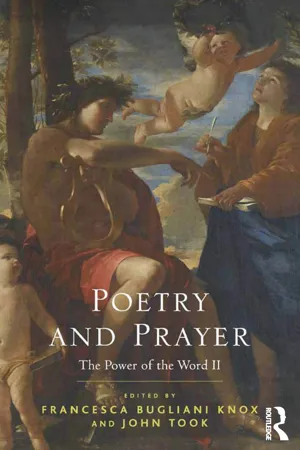
Interdisciplinary and ecumenical in scope, Poetry and Prayer offers theoretical discussion on the profound connection between poetic inspiration and prayer as well as reflection on the work of individual writers and the traditions within which they stand. An international range of established and new scholars in literary studies and theology offer unique contributions to the neglected study of poetry in relation to prayer. Part I addresses the relationship of prayer and poetry. Parts II and III consider these and related ideas from the point of view of their implementation in a range of different authors and traditions, offering case studies from, for example, the Bible, Dante, Shakespeare and Herbert, as well as twentieth-century poets such as Thomas Merton, Denise Levertov, W.H. Auden and R.S. Thomas.
Information
Theoretical Perspectives
Chapter 1
Poetry and Prayer: A Survey of Some Twentieth-Century Studies
This chapter is devoted to one aspect of the relationships between faith, religion, theology and spirituality on the one hand and literature on the other, namely, the relationship between poetry and prayer. This relationship in the last century has attracted the attention of theologians and literary scholars and critics, both Christian and non-Christian. There is, of course, an obvious connection between the two. Some prayers have the form of poems, and some poems are prayers. At the end of the twentieth century, a study by an American biblical scholar, L. William Countryman, argued that the English lyric poem offers a very suitable vehicle for the expression of personal spirituality. This chapter, however, is not concerned with the poetic or religious qualities of particular poems or prayers, nor with religious poetics. It is a survey of a few of the more significant theoretical studies of the relationship between the two activities of Christian prayer and the making and reading of poetry. In the 1920s, Prière et poésie by the French scholar and writer Henri Bremond caused some controversy in both Catholic and literary circles.1 Bremond claimed that poetry is ‘pure’ in so far as it moves in the direction, not of music, but of prayer. He argued that the psychological mechanisms operative in mystical experience are the same, but on a ‘lower’ level, as those of poetic experience, so that a poet is, as it were, a kind of mystic manqué. Later in the century, the book Poetry and Prayer (1967) by William T. Noon, an American Jesuit Professor of English Literature, offered a critical response to Bremond’s claims and an alternative view of this relationship from the point of view of a scholar and critic of modern literature. It was in the 1960s, too, that the eminent German Jesuit philosopher and theologian Karl Rahner published some short essays on poetry viewed from a theological perspective. Towards the end of the century, we can also see a theological interest in poetry and its relation to prayer reappearing in the work of the Irish theologian Enda McDonagh, in particular in his book The Gracing of Society (1989). A recent rekindling of scholarly interest in the religious imagination and in connections between theology and literature and the fact that the topic of poetry and prayer has not received very much scholarly attention in the last forty years suggest that there may be some value in drawing attention once more to these twentieth-century contributions.
Henri Bremond (1865–1933): Prayer and Poetry
Historians have identified two debates about mystical phenomena taking place in France in the late nineteenth and early twentieth centuries. Psychologists argued over whether mystical experience is evidence of pathological mental conditions or ‘potentially positive and healthy, while not denying the possibility of pathology’ (Talar 184). At the same time, Catholic theologians and writers on spirituality fought over two issues: (1) whether the ‘graces’ of contemplative prayer are normal later stages of spiritual growth or supplementary and exceptional, and (2) the nature of mystical experience and of the knowledge it involves (Talar 186–8). Bremond was aware of the often bitter confrontations between these different schools of thought as well as of contemporary debates about la poésie pure (Talar 187).2
Early on in Poetry and Prayer, Bremond claims to have neither the leisure nor the competence to write a ‘real book on the essence of poetry’. Instead he offers ‘a short discourse made up of necessarily dogmatic and abstract formulas’ (4), no more than ‘a rough sketch’, the work of ‘an amateur, a simple inquirer’, who is also ‘in a hurry’ (6). His work is a psychological study, an investigation into the psychological structures and mechanisms that are involved in poetic and mystical experience, with a view to demonstrating ‘analogies of form and communities of mechanism’ between poetic and mystical experience (116–17). To that end he explores the resemblances and differences between poetic and mystical experience. His central claim is that poetic experience is of the same order of knowledge as mystical experience: ‘poetic experience is an experience of the mystical order’ (81), in spite of the fact that there is also ‘an abyss of difference’ between them (85).
Bremond’s method is different from that of others who have written on the subject of the relationship between prayer and poetry. They used an understanding of poetic experience to shed light on mystical experience, while he chose the reverse, to allow the mystical to shed light on the poetic: ‘It is not Shelley’s experience that helps me to know better the experience of John of the Cross, but conversely it is the experience of the saint which makes a little less obscure the mystery of the experience of the poet’ (Bremond, Prayer and Poetry 84). Bremond gave two reasons for this approach. First, mystical and poetic experiences employ the same psychological mechanisms and therefore belong to the same order of ‘real’ knowledge, a form of knowledge which is ‘not immediately conceptual, but unitive’. Secondly, ‘mystical experience is the highest degree and the supreme development here below of all real knowledge; indeed the most perfect kind of real knowledge’ because of its supernatural character and ‘because it alone sets in movement the whole psychological mechanism, all the springs which actuate real knowledge’ (188).
The Experience of the Poet and of Readers of Poetry
Bremond’s starting point is the idea that there is something intangible, a mystery, in poetry (Prayer and Poetry 2). The true characteristics of poetry are to be found in Romanticism, which was ‘a conscious and reasoned reaction against the rationalistic aesthetic of the eighteenth century and the senile humanism which had prepared the road for that aesthetic’ (55). The Romantics understood the ‘mysterious experience which lies at the root of … masterpieces (of poetry): the interior principle, the poetic gift and invisible springs of action which that gift sets in motion’ (56). And this experience needs to be distinguished from other intellectual activities which go with it. In Bremond’s version, the secret of poetry’s magic lies in inspiration in the traditional sense of a visitation by an external power.3 However, great poets are not the only people who have an experience which at a certain degree of intensity produces masterpieces. Readers who read the poets ‘poetically’ also ‘resemble them and share in their gift, in their poetic state’ (3). To read poetry is to ‘interpret the poet’s experience by repeating it afresh’. Between poet and reader there is an ‘interchange of psychical currents’ (4).
Psychology: The Soul and the Self
Bremond’s basic thesis about the relationship between poetic and mystical experience in his book hinges on his concepts of the soul and the self and his argument for the presence in humans of two different ways of knowing which correspondingly give rise to two distinct kinds of knowledge. When discussing the soul, he makes use of traditional concepts of the ‘powers of the soul’, in particular intellect (or intelligence) and will, and the ‘spatial’ metaphors for the soul beloved of the mystics. According to this way of thinking, the soul has, as it were, both a ‘surface’ and a ‘centre’ or ‘depth’ (sometimes also called the ‘apex’). The intelligence, the ordinary instrument for attaining and working with concepts and images, operates, in Bremond’s scheme, on the surface of the soul (Prayer and Poetry 102). As for the centre, Bremond follows the mystics in seeing this as the site of another very different kind of knowledge. This knowledge or awareness, more obscure and unclear, less well-defined than intellectual conceptual knowledge, is variously described as an ‘apprehension’, an ‘intuition’, a ‘touch’. This apprehension brings a direct contact with the ‘real’, in contrast with the intellect, which deals with concepts and images (103). And it is this second kind of awareness which is common to both poetic and mystical experience.
Bremond also links this image of the soul and its activities with Paul Claudel’s parable of animus and anima. For Bremond, animus indicates ‘surface self’, ‘rational knowledge’; anima, ‘deep self’, ‘mystical or poetic knowledge’ (108–9). Animus is the agent of ordinary everyday human activities both good and bad (123–4); anima, on the other hand, is the self of the centre of the soul: ‘the self which endures, image and temple of God, the self of all inspirations, the hearth whereon all true poetry and heroism are set alight.’ Anima is what Scripture, Augustine and Pascal call the ‘heart’ (124–5).
The Operation of Grace
Another key to Bremond’s understanding of mystical and poetic experience lies in the traditional Thomist theology of the operation of divine grace in humans. Grace, the Spirit of God ‘indwelling’ the human soul, does not bypass natural human psychological processes and structures of knowing and acting, but raises them to a different ‘supernatural’ level and ‘perfects’ them. So in graced mystical experience, human capacities of knowing and loving are raised to a new level of knowledge and love of God, which is a foretaste of the Beatific Vision to be completed in heaven. Bremond quotes another Jesuit theologian, Joseph de Guibert, a specialist in what at the time was known as ascetical and mystical theology: ‘The supernatural character of our interior life does not necessarily modify the psychological design of that life; where it does modify it, it does not do so by violently introducing completely foreign elements, but by helping, completing, transforming, elevating the constitution of our natural psychic activity’ (quoted in Bremond, Prayer and Poetry 84–5). There is therefore continuity or commonality between the experience of poet and reader on the one hand, and that of the mystic on the other, because the same psychological structures and processes are in operation in each.
Poetic Inspiration
Moments of inspiration are those in which writers and poets are made into mystics. Between such moments, trying to write is a matter of ‘high fever of meditation and research’, of many ideas, but one cannot express them; ‘in short, an intense fatiguing activity, but without result’ (Bremond, Prayer and Poetry 91–2). When inspiration comes, however, ‘the spark shoots out, and there is great peace’ (92). One idea or feeling or image remains (92). This is like the ‘simple prayer’ of the mystics described by Père Grou, ‘in which the mind has no other object before it than a confused and general view of God, the heart has no other feeling than a sweet and peaceful tasting of God, which nourishes it without effort, as milk feeds children’ (quoted in Bremond, Prayer and Poetry 92).
This experience is that form of awareness or apprehension which takes place in the centre or depths of the soul. It is best expressed, not by saying that we ‘comprehend’ something, but rather that we ‘feel’, ‘touch’, or better ‘possess’ it (93). Bremond maintains that the object which inspiration presents us with is not an idea, which he describes as ‘clear, inanimate, and hollow’, but ‘the reality itself which that idea was at one and the same moment showing to us and hiding from us’ (93). In this kind of inspiration, ‘a foreign presence besieges me, enfolds me, penetrates me – in a word, possesses me’ at the centre of the soul (94), to produce an experience analogous to that of ‘an external intervention which stimulates vital acts’ in the higher mystical states (104).
The two modes of knowing that Bremond describes are mutually interdependent. The centre apprehends or possesses ‘the real’; the intellect, on the surface, conceptualizes and discusses it: the intellect could not work with it, if it had not first been apprehended (145–6).
Differences between Poetic and Mystical Experience
It is in his discussion of the differences between these two experiences that Bremond makes most use of the ‘higher mystical states’ to cast light on poetic experience. For his definition of mystical experience properly so called, he relies on the work of theologians Augustin Poulain, Joseph Maréchal and Léonce de Grandmaison, all of whom see the essential characteristic of mystical experience as a direct apprehension or feeling of the presence of God (Prayer and Poetry 133–4). And he draws on Grandmaison to list the essential features of such an experience. They include:
• a sense of entering, in answer to a call, into immediate contact, without images or discourse, but not without light, with an infinite goodness;
• this quasi-experimental perception of God is ineffable; the least inadequate means of describing it are those borrowed from the operations of the senses: taste, savour, sight, touch; and
• the resulting knowledge, an illumination in depth, is no less unique, and at the same time it has a powerful ‘affective tone’; it is an immediate ‘imposed’ evidence, rather than dry, abstract knowledge (136–7).
Again, Bremond insists that there is no question of positing that the poet’s ‘dim light’ and the ‘sun’ of the Christian contemplative are identical. One is a ‘profane and after all, a fairly common experience’, the other ‘wholly supernatural and one not granted to all Christians, even to those who are very devout’ (137). However, for Bremond, poetic experience is none the less a gift of God, ‘a grace, an activity essentially directed towards prayer’ (138). But even if it were ‘completely profane, worldly, frivolous even’, it would still be a real knowledge distinct from notional knowledge (138). Poetic knowledge unites the poet, ‘not directly, to the sovereign reality, God – that is the exclusive privilege of mystical knowledge – but to all the created real and underneath the created reality, indirectly to God himself’ (138).
Bremond insists, too, that possession of anima, and therefore of a capacity for this knowledge, is not the exclusive privilege of poet and mystic. There is a hierarchy of states: the highest are the mystical; then higher poetical states, then the lower poetical states, that is to say, the experience of thousands of poets which never find expression and of true readers of poetry (196–7).
The Miracle of Poetry
The crucial differences between poet and mystic, for Bremond, lie in their natures, and in particular in the fact that poets have both ‘an invincible need’ to communicate the poetic experience to others and a certain gift which enables them to do this successfully (Prayer and Poetry 156). By contrast, the illumination that mystics receive in contemplation does not of itself give them the means of communicating the experience to others (157). Poets’ purpose in exercising this gift is to provoke in others an experience similar to their own. When this happens, ‘the poet’s anima stimulates this deeper self of the reader, elevates it and associates it with the poet’s own experience’ (160). The ability to find words capable of this communication is the mark which sets poets apart from mystics and ‘the run of men’ (160).
The Poet and the Mystic
Poetic and mystical experience, then, are alike in that they belong to the same order of knowledge and use the same psychological mechanisms. They differ, however, in a number of important ways.
First, as we have already seen, the poet feels a compulsion to rush to communicate the experience to others and has the ability to do so. Secondly, Bremond states, towards the end of his book, ‘I have already insinuated, I will now say expressly, that God does not give himself immediately to the poet. Whence comes the fundamental difference between the poetic and mystical experience’ (Prayer and Poetry 177).4 Later in the book he puts the distinction between p...
Table of contents
- Cover Page
- Half-Title Page
- Dedication
- Title Page
- Copyright Page
- Table Of Contents
- Notes on Contributors
- Preface and Acknowledgements
- Introduction
- Part I Theoretical perspectives
- Part II Case studies
- Part III Case Studies: The Twentieth Century
- Index
Trusted by 375,005 students
Access to over 1.5 million titles for a fair monthly price.
Study more efficiently using our study tools.
Frequently asked questions
Yes, you can cancel anytime from the Subscription tab in your account settings on the Perlego website. Your subscription will stay active until the end of your current billing period. Learn how to cancel your subscription
No, books cannot be downloaded as external files, such as PDFs, for use outside of Perlego. However, you can download books within the Perlego app for offline reading on mobile or tablet. Learn how to download books offline
Perlego offers two plans: Essential and Complete
- Essential is ideal for learners and professionals who enjoy exploring a wide range of subjects. Access the Essential Library with 800,000+ trusted titles and best-sellers across business, personal growth, and the humanities. Includes unlimited reading time and Standard Read Aloud voice.
- Complete: Perfect for advanced learners and researchers needing full, unrestricted access. Unlock 1.5M+ books across hundreds of subjects, including academic and specialized titles. The Complete Plan also includes advanced features like Premium Read Aloud and Research Assistant.
We are an online textbook subscription service, where you can get access to an entire online library for less than the price of a single book per month. With over 1.5 million books across 990+ topics, we’ve got you covered! Learn about our mission
Look out for the read-aloud symbol on your next book to see if you can listen to it. The read-aloud tool reads text aloud for you, highlighting the text as it is being read. You can pause it, speed it up and slow it down. Learn more about Read Aloud
Yes! You can use the Perlego app on both iOS and Android devices to read anytime, anywhere — even offline. Perfect for commutes or when you’re on the go.
Please note we cannot support devices running on iOS 13 and Android 7 or earlier. Learn more about using the app
Please note we cannot support devices running on iOS 13 and Android 7 or earlier. Learn more about using the app
Yes, you can access Poetry and Prayer by Francesca Bugliani Knox,John Took in PDF and/or ePUB format, as well as other popular books in Theology & Religion & Religion. We have over 1.5 million books available in our catalogue for you to explore.