eBook - ePub
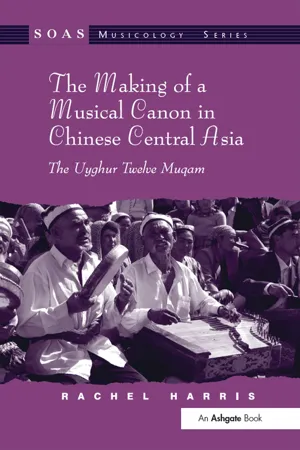
The Making of a Musical Canon in Chinese Central Asia: The Uyghur Twelve Muqam
- 176 pages
- English
- ePUB (mobile friendly)
- Available on iOS & Android
eBook - ePub
The Making of a Musical Canon in Chinese Central Asia: The Uyghur Twelve Muqam
About this book
Throughout the course of the twentieth century, as newly formed nations sought ways to develop and formalise their national identity and acquire a range of identifiable national assets, we find new musical canons springing up across the world. But these canons are not arbitrary collections of works imposed on the public by the authorities. Rather they acquire deep resonance and meaning, both as national symbols and as musical repertoires imbued with aesthetic value. This book traces the formation of one such musical canon: the Twelve Muqam, a set of musical suites linked to the Uyghurs, who are one of China's minority nationalities, and culturally Central Asian Muslims. The book draws on Uyghur and Chinese language publications; interviews with musicians and musicologists; field, archive and commercial recordings, and aims towards an understanding of the Twelve Muqam as musical repertoire, juxtaposed with an understanding of the Twelve Muqam as a field of discourse. The book brings together several years' work in this field, but its core arises from a research project under the auspices of the AHRC Centre for Music Performance and Dance.
Chapter 1
An Overview of Uyghur Music
Uyghur music embraces several distinct regional styles, product of the geography and complex history of the region, whose oasis kingdoms, separated by mountains and deserts, have been subject through the course of history to rule by many different local and outside forces. Each of the region’s oasis towns has to this day maintained its own distinctive sound and repertoire, but they are linked by a common language and overarching culture, maintained by constant communication through trade and movement of peoples. Musically there is much to link these local traditions, in terms of instruments, genres, styles and contexts.1
The most prestigious and well-known genre of Uyghur music is the muqam, which includes several regional traditions of large-scale suites of sung, instrumental and dance music. With the exception of this recognised genre, Uyghur musicologists follow the contemporary Chinese model for the classification of their musical traditions. Thus they recognise several forms of narrative song (encompassing sung epic tales dastan, the popular tradition of qoshaq, theatrical skits läpär, äytshish and the religious mäddhi namä). The popular local song suites sänäm are classified as dance music, while instrumental music covers the traditional and widespread naghra–sunay drum-and-shawm bands plus the modern professional solo repertoire. The large and diverse repertoire of folk songs runs from the popular song suites sung mainly for dancing, to the chants of the religious mendicants and female village ritualists. Contrary to the common perception of Islam in the West as hostile to music, amongst the Uyghurs many traditional musical contexts are linked to the religion. Today traditional genres compete with a lively pop music industry and the music of the professional, state-sponsored troupes, but again there is a great deal of overlap between these categories.
A brief view of history
The history of this region is contested, as I noted briefly in the introduction, with Chinese histories typically depicting the Uyghur Turks as arriving in 840 CE only after the collapse of their kingdom on the Orghun River in today’s Mongolia. Uyghur scholars, however, point to a longer history of Turkic presence in the Xinjiang region and the intermingling of its inhabitants over the course of centuries, and uniformly regard the pre-9th-century music of the region as the direct heritage of the contemporary Uyghurs.
Chinese sources are rich in references to the early music of this region, termed the ‘Western Region’ (xiyu). Dynastic annals record that a musician from the oasis kingdom of Kösän (Qiuci), named Suzup, travelled to the court of the Chinese emperor Wudi in AD 567 in the entourage of a Turki princess, and introduced the theory of seven modes and five tones to China. The music of the early kingdoms of the Western Region was well-known by China’s elite during the Tang and Song dynasties (7th–10th centuries). Musicians from these kingdoms performed in the imperial court, and through the court gradually introduced their new instruments and repertoires into wider Chinese musical practice. The popularity of the music of the Western Region in elite Chinese circles can be seen from the frequent references in the Chinese poetry of that era. Scholars believe that the famed Tang Daqu suites of the imperial court, which were later adopted by the Japanese court, have their roots in the 5th-century great suites (chong küy) of the Western Region.2
The historical flow of music has largely moved from west to east. While Chinese histories record the influence of the Western Region on central China, Uyghur music has historically absorbed much influence from the regions of Central Asia to the west, arriving along the famed Silk Road. Islam and Islamic culture spread gradually through the region, reaching Kashgar as early as the 10th century, and taking hold in Qumul to the east only in the 16th century. Uyghurs regard the Qarakhan Khanate of Kashgar (founded in the 10th century) as an important age for the development of their music as it marked the beginning of close contact with the wider Islamic world. During the ensuing centuries many of the key aspects of the contemporary music culture were absorbed: instruments like the kettle drum-and-shawm bands (naghra-sunay) which are believed to have played the Qarakhan kings into battle, and the concepts and structures of maqām. The Chagatay era (14th–16th centuries) is also regarded as an important period for cultural and musical development in Central Asia as a whole, and many of the lyrics of the Twelve Muqam are accredited to the poet–musicians of this era. An important source on the music of this period is the History of Musicians (Tarikhi Musiqiyun), written by Mulla Ismatulla Mojizi in 1854–55. This book provides the source material for contemporary knowledge of music at the court of the 16th-century Yärkänd Khanate, which is today widely regarded as the golden age of Uyghur music, and especially the Twelve Muqam.3
Muqam
The Uyghur muqam repertoires consist of large-scale suites consisting of sung poetry, stories, dance tunes and instrumental sections. Some of the lyrics of the muqam are drawn from the major Central Asian poets Nawayi, Mäshräp, Fuzuli, Belili and Zelili.4 Much of this body of poetry is linked to Sufi imagery and ideals. Other sections of the muqam lyrics are drawn from folk poetry, especially the popular tale of the lovers Ghärip and Sänäm. Muqam are typically performed by a small ensemble of singers, led by the lead singer muqamchi, accompanied by plucked or bowed lutes and dap frame drum, but they may also be played in instrumental form by kettle drum-and-shawm (naghra-sunay) bands. Playing muqam is not reserved to an exclusive group of professional musicians; historically they were performed in folk contexts as well as in the courts of local kings, and today they cross rural and urban, professional and popular boundaries. Men and women (though the latter still rarely play muqam in folk contexts), professionals and religious mendicants may practise this tradition, and playing muqam is sometimes referred to in terms of a spiritual, even physical need. Listening to muqam, particularly the opening muqäddimä sections of the Twelve Muqam, is often said to serve a religious and meditative function, especially in the context of Xinjiang’s great religious festivals, while the lighter pieces towards the end of the suites are commonly used to accompany dancing. Contemporary scholars refer to four distinct regional genres: the Twelve Muqam of the Kashgar-Yärkänd region, the Turpan Muqam, the Qumul Muqam, and the Dolan Muqam.
The Twelve Muqam each consist of a suite of sung and instrumental pieces, classically accompanied on the bowed lute satar and dap frame drum, with accompanying voices. The names of the Twelve Muqam are drawn from Arabic and Persian.
Table 1.1 Names of the Twelve Muqam according to the 2002 recordings5
Rak – Chäbbayat – Sigah – Chähargah – Pänjigah – Özhal |
Äjäm – Ushshaq – Bayat – Näwa – Mushawräk – Iraq |
The name of the muqam denotes modal attributes, and the names of the pieces within it denote rhythmic patterns. While there is some variation between suites, largely the Twelve Muqam are structured as follows:
• Chong näghmä (great music) – begins with the muqäddimä (introduction), which is sung solo in free metre. A suite of named pieces in varying set rhythms follows, sung by a group of voices. Many of the sung pieces are followed by an instrumental variation, märghul. This is musically the most complex, heaviest section of the muqam.
• Dastan (narrative songs) – each muqam contains three to five dastan in different rhythms. Again each dastan is followed by an instrumental märghul. The lyrics are drawn from sections of folk narrative songs and relate the stories of famous lovers. These are the most accessible and widespread sections of the Twelve Muqam.
• Mäshräp (gathering) – several faster sung pieces in 2/4 and 7/8 rhythms, consisting of folk lyrics on themes of love. This section of the muqam is for dancing. Usually the lyrics of the first mäshräp are attributed to a famous poet.

Each of the eleven Turpan Muqam consists of a suite in six named sections:
• Ghäzäl – in free rhythm, sung solo.
• Bashchäkit – in 3/4 rhythm, a slow sung piece.
• Yalangchäkit – in 5/4 or 13/8 rhythm, a slow sung piece.
• Jula – in 4/4, ...
Table of contents
- Cover
- Half Title
- Title Page
- Copyright Page
- Table of Contents
- List of Illustrations
- List of Music Examples
- List of Map and Tables
- List of Abbreviations
- Notes on the Author
- Acknowledgements
- Introduction
- 1 An Overview of Uyghur Music
- 2 A Short History of the Canon
- 3 Abdulla Mäjnun: Muqam Expert
- 4 Negotiating the Canon
- 5 Situating the Twelve Muqam
- 6 The Impact of Canonisation
- Endnote
- Appendix: Notes on the Accompanying CD
- Bibliography
- Index
Frequently asked questions
Yes, you can cancel anytime from the Subscription tab in your account settings on the Perlego website. Your subscription will stay active until the end of your current billing period. Learn how to cancel your subscription
No, books cannot be downloaded as external files, such as PDFs, for use outside of Perlego. However, you can download books within the Perlego app for offline reading on mobile or tablet. Learn how to download books offline
Perlego offers two plans: Essential and Complete
- Essential is ideal for learners and professionals who enjoy exploring a wide range of subjects. Access the Essential Library with 800,000+ trusted titles and best-sellers across business, personal growth, and the humanities. Includes unlimited reading time and Standard Read Aloud voice.
- Complete: Perfect for advanced learners and researchers needing full, unrestricted access. Unlock 1.5M+ books across hundreds of subjects, including academic and specialized titles. The Complete Plan also includes advanced features like Premium Read Aloud and Research Assistant.
We are an online textbook subscription service, where you can get access to an entire online library for less than the price of a single book per month. With over 1.5 million books across 990+ topics, we’ve got you covered! Learn about our mission
Look out for the read-aloud symbol on your next book to see if you can listen to it. The read-aloud tool reads text aloud for you, highlighting the text as it is being read. You can pause it, speed it up and slow it down. Learn more about Read Aloud
Yes! You can use the Perlego app on both iOS and Android devices to read anytime, anywhere — even offline. Perfect for commutes or when you’re on the go.
Please note we cannot support devices running on iOS 13 and Android 7 or earlier. Learn more about using the app
Please note we cannot support devices running on iOS 13 and Android 7 or earlier. Learn more about using the app
Yes, you can access The Making of a Musical Canon in Chinese Central Asia: The Uyghur Twelve Muqam by Rachel Harris in PDF and/or ePUB format, as well as other popular books in Media & Performing Arts & Music. We have over 1.5 million books available in our catalogue for you to explore.