eBook - ePub
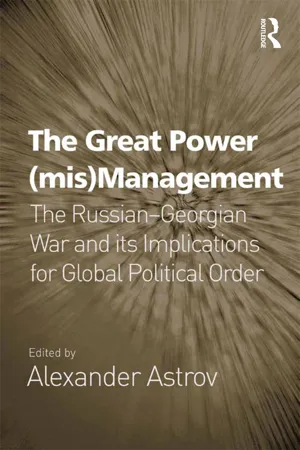
The Great Power (mis)Management
The Russian–Georgian War and its Implications for Global Political Order
- 206 pages
- English
- ePUB (mobile friendly)
- Available on iOS & Android
eBook - ePub
The Great Power (mis)Management
The Russian–Georgian War and its Implications for Global Political Order
About this book
Drawing on the empirical case of the Russian-Georgian war of 2008, the book explores the theoretical underpinnings of the idea of 'great power management' first articulated within the English School of International Relations. The contributors to the volume approach this idea from a variety of theoretical perspectives, ranging from policy-analysis to critical theory, but all of them are addressing the same question: What does the Russian-Georgian war of 2008 tell us about great power management as an institution of international society?
Chapter 1
Great Power Management Without Great Powers? The Russian–Georgian War of 2008 and Global Police/Political Order
Right after the outbreak of the Russian–Georgian war of 2008, there was a lot of talk about a paradigm-shift in international relations. The Financial Times quoted Estonian president, Toomas Ilves, as saying: ‘What we have seen is a complete paradigm shift in the security architecture of Europe. Everything we have done has been based on the assumption that Russia won’t engage in aggression … That premise is no longer operable … The threat is not military but Russia’s jingoistic rhetoric is unsettling. We live in post-modernist 21st-century Europe but we have a Russia which acts in a 19th-century pre-modern way’ (Wagstyl et al. 2008). The sentiment clearly echoed an argument advanced already prior to the war and reiterated immediately after it: ‘History’s back’ (Kagan 2008a, 2008b): The final triumph of democracy announced after the end of the Cold War as ‘the end of history’ was but a brief aberration from the ongoing (hi)story of great-power confrontation in which geoeconomics will never overcome geopolitics, since the enemies of democracy – Putin’s Russia among them – have learned the trick of not only achieving economic growth without democratization but also turning their thus enhanced power against democracy, both at home and abroad.
How much credence should we give to such statements though? After all, less than half a year after the war, the new American administration initiated a pragmatic ‘reset’ of US–Russian relations. In addition, the foreign minister of Poland, a state whose president stood shoulder to shoulder with his Baltic colleagues in Tbilisi, was now boasting of rapprochement with Russia, and was quizzed by his hosts at the influential US Council on Foreign Relations on the possible lessons in pragmatism American foreign-policy makers could take from this (CFR 2009). In light of this, on a more theoretical note, how can we ascertain a paradigm-shift in world politics, generally, and decide whether it was caused by one conflict in particular?
Contemporary International Relations (IR) theory offers more than one analytical tool for answering such questions. The one employed in this volume comes from the English School and there are two interrelated reasons for that. First, the English School presents itself as a broad theoretical church capable of accommodating a variety of approaches without a priori committing its members to any of the more restrictive positions (Little 2000). However, for this very reason, many of its tools lack in precision. Yet, why not take this as an invitation for meaningful theoretical work? Especially so, given that the English School, in its ‘classical’ formulation, does have something to offer which seems to be immediately relevant for the case at hand; namely, the idea of ‘great power management’.
Great power management, according to Hedley Bull, is an institution of international society and like other such institutions – war, diplomacy, international law and the balance of power – it is what gives international society its ‘visible expression’ (Bull 1977: 37). Bull’s discussions of the individual institutions invariably culminate in the argument that each represents international society as such. Thus, diplomats, ‘even in the pristine form of messengers, are visible expressions of the existence of rules to which states and other entities in the international system pay some allegiance’ (172). None of the institutions are immune to change, but when change happens, it signifies a shift in the very structure of the society of states. So, if there is a paradigm-shift in world politics, it should find its expression in the operation of the institutions of international society.
For sure, the Russian–Georgian war can be meaningfully analysed by focussing on any of the five institutions. Still, great power management stands out in this respect, and not only because Russia’s blunt assertion of its spheres of influence has stirred most of the paradigm-shift talk. To begin with, from the point of view of successful great power management, as it is presented by Bull, this war should not have happened in the first place. This seems to present an analyst with two choices: either great power management, as a clearly defined set of practices, was mishandled by some of the actors, or, again, as such clearly defined practice, it is no longer working in a changing international society. Therefore, all that is left, is to pick the right methodological tools for an investigation of both options.
Unfortunately, there is no such thing as a ‘clearly defined’ practice of great power management. For reasons to which I shall return shortly, Bull’s initial discussion of it is marked with significant theoretical tensions. Furthermore, it would not be an exaggeration to say that, in spite of some important work published later (Cf.: Watson 1992, Hurrell and Ngaire Woods 1999, Buzan and Wæver 2003), theoretical attention given to great power management is minuscule in comparison to that attracted by other institutions. Therefore, this volume aims at providing prior work in clarifying the meaning of the institution itself.
Needless to say, by calling this exercise ‘prior work’, I do not mean that all analysis of the Russian–Georgian war should be put to one side until the meaning of great power management is elucidated. Rather, it is by examining the various aspects of the war that individual chapters highlight different sides of Bull’s initial analysis or bring in new themes not to be found in it. In so doing, they rely on different (meta)theoretical frameworks, so as to explore the range of possibilities rather than to test a single hypothesis. What, hopefully, still endows the volume as a whole with some measure of coherence, is that all of them are addressed to the same question: What does the Russian–Georgian war of 2008 tell us about great power management as an institution of international society?
To avoid the impression that this is a gap-filling exercise, in the remainder of this introduction, I want to build a case for the importance of great power management as such, and to argue that, far from being a relic of the past or a secondary addition to other institutions, great power management is one of the defining practices of international society, which indeed deserves more theoretical attention. I argue that what makes it significant in a practical sense and theoretically intriguing, is the peculiar dualistic structure of not only the anarchical society of states but the Western mode of ordering generally. The dualism in question may be described as that of anarchical sovereignty and, to allude to Michel Foucault’s famous concept, anarchical governmentality. The idea of great power management implies this dualism but does not make it explicit enough. Once explicated, it allows one to see how greatness, power and management, rather than being arbitrarily thrown in to constitute a definition, form an apparatus, or dispositif in Foucault, crucial for any ordering (Agamben 2009).
I begin by taking a closer look at the history-is-back argument mentioned earlier and showing how it can be related to Bull’s account of great power management and Foucault’s discussion of the two ‘technological assemblages’ characteristic of the Westphalian system: politics and ‘police’. (Throughout, the latter term is used in inverted commas to distinguish the specific mode of governance denoted by it in Foucault from the more familiar practices of law-enforcement). I then identify tensions in Bull’s analysis and address them by drawing on Foucault’s one. Throughout, I set Foucault’s governmentalist and the English School’s broadly juridical approaches to ordering alongside, and sometimes against, each other, so as to show how the idea and practices of greatpowerhood, once taken to stand for more than mere preponderance in force, draw on the resources of both approaches and therefore can only be grasped by reference to both.
Politics and ‘Police’
Although the claim that the Russian–Georgian war signifies a return to great power confrontation was advanced from the neoconservative side in the US, it is safe to say that its acceptance went far beyond this particular intellectual grouping. In itself, this is hardly surprising given that Russia has never really concealed its great-power ambitions, or in fact, can hardly imagine itself in any other role (Hopf 2002). On closer reading, however, the argument is marked with important tensions not only in its account of the contemporary situation but also in how it understands that very ‘history’ which it attempts to bring back. At the very least, its presentation of the nineteenth century significantly differs from almost every major account this period receives in IR. This is not to say that these accounts themselves are unproblematic. In fact, it is two specific tensions in Bull’s discussion of great power management that I address in this section by introducing Foucault’s analysis of the Westphalian order.
Which history is back?
Returning first to the neoconservative claim of a paradigm-shift, it is based on the premise that ‘international order does not rest on ideas and institutions alone’ but ‘is shaped by configurations of power’. Yet, the specific configuration of power threatened at present by great power autocracies turns out to rest precisely on the balance between ideas and institutions, democracy and autocracy, so that the ‘optimists in the early post-Cold War years were not wrong to believe that a liberalizing Russia and China would be better international partners. They were just wrong to believe that this evolution was inevitable’ (Kagan 2008a). Put differently, the argument does not question, let alone abandon, the-end-of-history paradigm itself but merely expects its fulfillment in the longer run. In the meantime, since the run might be too long for small states like Georgia to endure, democracies led by the United States should speed up the genuine end of history through decisive political action.
This conclusion might well be welcomed by those who support a certain view of democracy while rejecting the teleology of Hegelian History if it were not for a number of difficulties. First, it does not take a ‘great power autocracy’ to accept that difference of opinion is in the very nature of democracy (Mouffe 2009), as well as the analytical tools with which we evaluate its quality (Kratochwil 2006). Why, then, present as a threat the fact that ‘when Russians speak of a multipolar world, they are not only talking about the redistribution of power. It is also the competition of value systems and ideas that will provide “the foundation for a multipolar world order”’ (Kagan 2008a). This is especially so, given that, in the case of the Georgian war, at least some representatives of Russian foreign-policy elites went out of the way to indicate their willingness to forego differences in value systems for the sake of great power cooperation in the field of global security (Lavrov 2008).
Related to this is the second difficulty, best seen once the argument is compared to both realist and liberal positions, which take the interplay of international order and democracy seriously. Thus, for Henry Kissinger, as a representative of realism, the neoconservative contention that ‘history is back’ in the form of great power competition between democracy and autocracy also characteristic of the nineteenth century, does not make any sense at all. In his theoretical framework, there was no single, homogeneous ‘nineteenth century’ but three distinct, incompatible configurations of international order: the Concert of Europe, Bismarckian Realpolitik and the uncontrolled arms race that followed. Each of these orders not merely had its own technique of power-handling but rested on a distinctive worldview. The ‘rationalist’ world of Metternich, in which the statesman had to understand the underlying ‘order of things’ and to bring political organization in accordance with it, was succeeded by the ‘empiricist’ order of Bismarck, in which no underlying principle of legitimacy was needed since power was believed to be able to legitimize itself. Long before the ‘great power autocracies’ of today learned how to achieve economic growth without democratization, Bismarck decoupled the binary orthodoxy of his age: liberalism and nationalism. The nationalistic aspirations of Prussia were achievable without liberalization and could, if needed, supply power required for balancing liberalism at home and abroad (Kissinger 1968). So, liberalism, as well as Metternich’s rationalism, serves here as an ideational framework for the interpretation of power; that is, as the means for the attainment of an end, which itself remained the same since the Peace of Westphalia order.
In what may well be the strongest liberal affirmation of the role of democracy in the construction of international order, John Ikenberry (2000) retains this ends-means relationship. To be sure, the order he has in mind is radically different from Kissinger’s, based not on realist balancing but cooperative institutions buttressed by a ‘constitutional bargain’ between a dominant power and lesser states. The ambition to achieve such a bargain is present in international relations, again, since the defeat of Napoleon; its success depends on the number of democratic states around. Still, here as well, democracy is neither more nor less than a variable in both practical and theoretical equations which, if balanced, point towards order, stability and peace.
In the neoconservative argument, and in the Bush Doctrine, this relationship between democracy and order is reversed. Analysing this reversal, David Chandler (2004, 2005) notices that in cases when democracy is judged to be lacking, order established for the purpose of its promotion invariably brackets that very contestation of ideas and values which should be part and parcel of democracy. In itself, this dynamic may be dismissed as almost trivial. To enjoy stable order, it is sometimes necessary to go through an upheaval, be it a revolution or a dictatorship; ‘traditional’ societies have to go through an often torturous process of modernization to reap the fruits of modernity. Whatever the analytical and normative value of such dismissals in general, in the specific context of international relations, the demotion of order from its place as the end of all politics has special significance, not least because of the explicit codification of this place of order in the Westphalian arrangements.
It may well be the case that the Westphalian norm of non-intervention has never really amounted to anything more than a form of ‘organized hypocrisy’ (Krasner 1999); or that hierarchical relations continued to exist well into the post-1648 world (Lake 2009). However, neither the routine intervention into the affairs of other states, nor the acceptance by some of these states of the authority of such interventions (Hobson and Sharman 2005) repudiates what Foucault (2007: 300) presented as the defining characteristic of the Westphalian system, in which ‘instead of a sort of absolute eschatology that posits an empire, a universal monarchy as the culminating point of history, we have what could be called a relative eschatology, a precarious and fragile eschatology, but towards which it really is necessary to strive, and this relative eschatology is, in short, peace. … Peace will no longer come from unity, but from non-unity, from plurality maintained as plurality’. Whereas contemporary Western diplomats responded to Russia’s longstanding ambition to (re)establish its sphere of influence with a stringent dichotomy – ‘Either the ex-Soviet countries are independent states, or they are not’ (Rachman 2008). Foucault (2007: 299) reads both the inequalities in state-power and the existence of spheres of influence as being not merely compatible with but also necessary for the operation of the Westphalian system.
This is also true with Bull’s take on great power management. From the outset, however, this initial take is marked with two tensions. To begin with, while the whole of Bull’s discussion of great powers and international order is premised on the explicitly stated idea that great powers are such not merely by fact but also by right, he nevertheless holds to the idea of the sovereign equality of states: ‘If states were equal in power as they are in law, … then it is difficult to see how … international conflicts could ever be settled and laid to rest, or the claims of any one state definitely granted or denied’ (Bull 1977: 205–6). So, while inequalities in power are obvious, it is not clear whether great powers are indeed equal with the rest in law. He then defines great power management as consisting of two distinct practices: ‘great powers manage their relations with one another in the interest of international order’, and not least by preserving the general balance of power; they ‘exploit their preponderance in relation to the rest of the international society’, by acting either in concert or unilaterally (206). However, the first of these two practices clearly overlaps with what Bull otherwise defines as a separate institution of international society, balance of power.
Both tensions may result from a certain blind spot in the English School’s approach generally. Bull intends to avoid ‘domestic analogy’ as a way of theorizing international order by analogy with the state. Hence his commitment to the principle of the sovereign equality of states which, although producing an international ‘state of nature’, does not require further transition to a global commonwealth. So, when ‘domestic analogy’ sneaks back in, this time in the form of the distinction between the rulers and the ruled, he links it conceptually not to any developments in the international law but to the practice of the balance of power, even at the expense of analytical clarity. Ironically, what is blurred through such linking is a deep historical and conceptual continuity between the practices of balancing and ruling; continuity, central for Foucault’s analysis of security to which I now turn, so as to prepare some ground for a possible delinking of great power management from the balance of power.
Instruments and technologies of inter-state governance
As has been mentioned already, the defining characteristic of the Westphalian arrangement for Foucault is plurality. Plurality, neither supported by the previous system of right nor ordered towards some future unity, requires its own principle of organization, and this is what the balance of power is (Foucault 2007: 299). It is maintained through three instruments, and Foucault’s analysis of the first two of these – war and diplomacy – is roughly analogous to respective discussions by Bull, pointing in each case to the ‘idea of veritable society of states’ (303). The third instrument, however, what Foucault calls ‘a permanent military apparatus’ (305) does not have direct analogues in Bull, and this is where a transition to something rather different from the English School’s account of the society of states begins.
The logic of the permanent military apparatus links individual states’ domestic systems with the principle of the balance of power. In so far as the Westphalian system is an ever changing relation of forces, it is not enough to know this relation at any given moment (through diplomacy) or to adjust it as need be (through war). States have to possess an entirely different grasp on their own force as well. The need to maintain a navy, a costly venture even in time of peace, necessitates and enables sweeping financial reform in England, for example (Brewer 1989). Similarly wide-ranging legal reforms and new agricultural policies are introduced because, having learned how to mobilize increasingly large armies, early-modern states still had to learn how to disband them without turning major war-endings into civil disorders (Innes 1994). The implications for international order run deeper still.
If the first three instruments of the society of states are classed by Foucault as ‘political-military’, there also emerges a whole new toolbox that states develop to maintain the European balance – ‘police’: ‘From the seventeenth-century “police” begins to refer to the set of means by which the state’s forces can be increased while preserving the state in good order’; but, since in the newly-created field of forces ‘there will be imbalance if within the European equilibrium there is a state, not my state, with bad police’, action must be taken in the name of the balance of power so that ‘there is good police, even in other states’ (Foucault 2007: 313–15). Obviously, apart from the suggestion that intervention in the name of good governance may have earlier origins than the Bush Doctrine, the fact that domestic politics may have ‘international sources’ is not lost on IR (Gourevitch 1978). The connection between ‘police’, Machiavellianism, mercantilism and the state’s ambition to manage its human resources is also well studied (Wallerstein 1980, Hont 1990, Pocock 1990). My interest here is in a somewhat different and more general point related to the continuity mentioned earlier or to another ‘domestic analogy’.
Underlying Foucault’s exploration of the multifaceted connection between the rise of ‘police’ and the requirements of the European equilibrium is his more general focus on the relation between ethics, economics and politics that had been destabilized long before the Peace of Westphalia. At least since Machiavelli and reactions to his writings, ‘the doctrine of the Prince or the juridical theory of the sovereign constantly try to make clear the discontinuity between the Prince’s power and any other form of power, which involves explaining, asserting and founding this discontinuity’ (Foucault 2007: 94) as, for example, the discontinuity between ethics (self-governance), economics (governance of the household) and politics (governance of the whole; that is, that state). In contemporary IR, such explanations and assertions usually emphasize the primacy of politics (Buzan and Little 2001). Starting with Hans Morgenthau’s insistence on the political character of his realism; through Kenneth Waltz’s Theory of International Politics, ‘political’ because international structure, as the organizing pri...
Table of contents
- Cover Page
- Title Page
- Copyright Page
- Contents
- List of Figures and Tables
- List of Contributors
- Preface
- 1 Great Power Management Without Great Powers? The Russian–Georgian War of 2008 and Global Police/Political Order
- 2 From Katechon to Intrigant: The Breakdown of the Post-Soviet Nomos
- 3 Great Power Misalignment: The United States and the Russo-Georgian Conflict
- 4 Russia and NATO After the Georgia War: Re-Actualizing the Great Power Management Prospects
- 5 Russia and EU’s Competitive Neighbourhood
- 6 The Georgian-Russian Conflict: Acute, Frozen or Settled?
- 7 Pragmatic Foreign Policy: Managing Power Differentials in the Wider European Society of States
- 8 A Society of the Weak, the Medium and the Great: Southeast Asia’s Lessons in Building Soft Community among States
- 9 Glorification and its Modes: Emulation, Recognition and Acclamation
- Bibliography
- Index
Trusted by 375,005 students
Access to over 1.5 million titles for a fair monthly price.
Study more efficiently using our study tools.
Frequently asked questions
Yes, you can cancel anytime from the Subscription tab in your account settings on the Perlego website. Your subscription will stay active until the end of your current billing period. Learn how to cancel your subscription
No, books cannot be downloaded as external files, such as PDFs, for use outside of Perlego. However, you can download books within the Perlego app for offline reading on mobile or tablet. Learn how to download books offline
Perlego offers two plans: Essential and Complete
- Essential is ideal for learners and professionals who enjoy exploring a wide range of subjects. Access the Essential Library with 800,000+ trusted titles and best-sellers across business, personal growth, and the humanities. Includes unlimited reading time and Standard Read Aloud voice.
- Complete: Perfect for advanced learners and researchers needing full, unrestricted access. Unlock 1.5M+ books across hundreds of subjects, including academic and specialized titles. The Complete Plan also includes advanced features like Premium Read Aloud and Research Assistant.
We are an online textbook subscription service, where you can get access to an entire online library for less than the price of a single book per month. With over 1.5 million books across 990+ topics, we’ve got you covered! Learn about our mission
Look out for the read-aloud symbol on your next book to see if you can listen to it. The read-aloud tool reads text aloud for you, highlighting the text as it is being read. You can pause it, speed it up and slow it down. Learn more about Read Aloud
Yes! You can use the Perlego app on both iOS and Android devices to read anytime, anywhere — even offline. Perfect for commutes or when you’re on the go.
Please note we cannot support devices running on iOS 13 and Android 7 or earlier. Learn more about using the app
Please note we cannot support devices running on iOS 13 and Android 7 or earlier. Learn more about using the app
Yes, you can access The Great Power (mis)Management by Alexander Astrov in PDF and/or ePUB format, as well as other popular books in Law & Public Law. We have over 1.5 million books available in our catalogue for you to explore.