- 160 pages
- English
- ePUB (mobile friendly)
- Available on iOS & Android
eBook - ePub
About this book
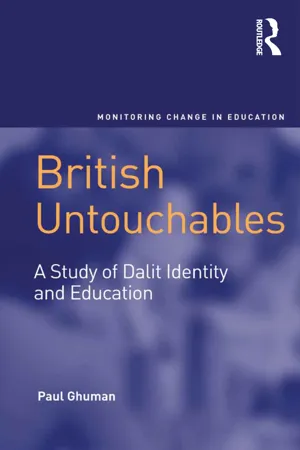
Dalits, formerly called 'untouchables', remain the most oppressed community in India, and indeed in South Asia and have, until recently, been denied human and civic rights. On emigration to the UK and other Western countries they faced a double disadvantage: caste discrimination and racial discrimination from 'white' society. However, in the late 1990s, second-generation Dalit professionals challenged their caste status and Brahmanism in the West and in South Asia. This work provides a major study on the issues facing the education of Dalit children and young people growing up in Britain. The book is based on extensive fieldwork and uses a qualitative research methodology, including in-depth interviews with parents, teachers and children, and detailed observations in homes, schools and places of worship e.g. gurdwaras. It offers a detailed view of areas such as socialisation of children, schooling and education, examination success, parental perceptions of education, bilingualism, acculturation patterns, cultural conflicts and caste and social identities. Central to this work, too, is a thorough introduction to the religious concepts that underpin the notion of 'untouchability' in Hinduism. This is a significant contribution to this under-researched community by a scholar who is one of the leading authorities on the education of South Asian children in Britain.
Information
Chapter 1
Introduction
This book presents a story of Indian Dalit communities who have settled in the English Midlands. I have written extensively on the problems of Indian and South Asian young people in the UK and North America. I thought that Dalit (formerly called Untouchables) young people should not be any different in their life styles, world outlook, and social adjustment than their peers of other castes. However, on one of my research trips to Birmingham, I happened to talk to a parent who identified himself as a Dalit. When I remarked: ‘You mean Harijan’, he insisted that he likes to call himself a Dalit (oppressed person) and explained that: ‘Harijan is a condescending term coined by Gandhi who condoned “casteism”, and we totally reject it.’ We entered into further discussion and he told me that there is a serious caste problem in multicultural schools where a majority of the students are of Indian, Pakistani and Bangladeshi origins. He went on to narrate his own bitter experiences of caste prejudice and discrimination in India. He was not allowed to drink water from the water pump belonging to a high caste person and was made to sit outside the classroom by his teachers. Furthermore, high caste people in his village used him as an errand boy. In the UK he was discriminated against by Jat people in a gurdwara who told him he was told not to distribute prasad to the congregation, as he is not of pure caste.
Our exchanges brought back many memories from my childhood memories (1950s), which I have probably blotted out since I have lived in Britain for over 50 years. I recalled that we were told that Chamar (who originally worked with leather) farm workers were to use their own utensils for drinking and eating. Should they forget to bring these along, they were to drink water/lassi by cupping their hands. We had to avoid touching their cupped hands in case our jugs might become polluted and have to be purified by burning them with hot charcoal. I also remembered that even respectable Chamars were made to sit in lower positions (on stools) than high caste Jats and Rajputs. In our village there were many other indignities heaped upon them and their households, regarding which I now feel ashamed and partly guilty. Their status was put down to their karmas in previous lives. However, there were other farming families (including my mother’s) who insisted that farm labourers should be accorded proper respect and dignity. They instructed their offspring to show them due respect by calling them baba, if elderly, and uncle, if they were older, and so on. Some even treated them as family members.
My case study of a village in the Punjab reveals that such slights and insults thankfully belong to a bygone era and that the material and social conditions of Chamars and Valmikis in villages have changed significantly, though it has been an uphill struggle. However, I was dismayed to read a summary of a research report in The Hindu (29 January 2010: 13) released by the Chairman of the Indian University Grant Commission. It is based on a survey of 1589 villages in Gujarat, India. According to its authors, the shameful practices noted above are still common in rural areas of Gujarat. I quote: ‘The Dalit passengers were required to vacate seats in government owned State transport buses for non-Dalit passengers … Even in tea kiosks, cups were separated for the Dalits and such customers were required to clean their own utensils … Dalit students were not served water in schools. They were expected to go home or carry their own water with them.’ It is clear that progress in abolishing caste discrimination in India is very patchy and it varies from region to region, for instance urban areas in north India are a great deal more progressive than rural areas in the south (see Chapter 2). Jadhav, a distinguished Dalit economist (2002: 3), makes a poignant comment in his autobiography:
The 3,500-year-old caste system in India is still alive and violently kicking. In cities they will tell you, ‘the Caste system is a thing of the past, it now exists only in villages.’ Go to the villages, and they will tell you, ‘oh no. Not here, maybe in some other village.’ Yet open the matrimonial section of any newspaper and you will find an unabashed and bewildering display of the persistent belief in caste and sub-caste … Consciously or subconsciously, Indians, whether in their own country or abroad, still make judgments based on caste.
The above encouraged me to read extensively on the subject. I was deeply moved and humbled by the personal sacrifices and struggles of Dalit leaders – especially of Baba Phule, Dr Ambedkar, Mangoo Ram, and Kanshi Ram – to secure justice and dignity for their communities. I visited Dalit temples and bhavans in the UK. I learned that communities which I thought were well integrated with other Indian communities were not so. In order to make a contribution to fostering an understanding of their situation in the UK, the idea of a research project took shape. I am glad to say that my efforts have borne fruit and I hope that the findings of the project will make scholars and others undertake further research, and encourage social workers and teachers to initiate practical projects on this subject.
After five years researching the topic, I realize now my ignorance of the struggles, sacrifices, and nobility of the aforementioned Dalit leaders who fought sohard (as others are still doing) to claim their basic human rights. Thanks to their Herculean efforts, Mayawati was able to become Chief Minister of Uttar Pradesh (UP), India in 1995 – the first Dalit woman to hold such a position, and – again reached this position which she has occupied since 2006. Their heroic struggle is on a par with the leaders of other oppressed people such as Nelson Mandela and Dr Martin Luther King.
The New Constitution of India, formally adopted on 26 January 1950, outlawed untouchability and agued for affirmative action for Dalits, and in 2010 India proudly celebrated its sixtieth anniversary as a democratic Republic. The Chairman of the Constitution Committee was Baba Sahib Dr Ambedkar, a Dalit, sometimes referred to as the father of the Constitution. His vision and ideas inspired future generations of Dalit leaders who have succeeded in their endeavours to make political and economic gains for their respective communities. However, much remains to be accomplished in this area. My own study makes a contribution to the social and educational aspects of Dalits in the UK.
In my view, all children and young people of Indian/South Asian origin (and indeed others) should benefit from studying the history and religious underpinning of the caste system. It should be a singular lesson in humanity and will teach them to be sensitive and caring individuals and to fight for social equality and the common good of all people.
Dalits, formerly called ‘Untouchables’, remain the most oppressed community in India (and indeed in South Asia), who, until recently, have been denied human and civic rights for almost two millennia. On emigration to the UK and other Western countries, they face a double disadvantage: caste discrimination from their fellow countrymen and racial discrimination from white society. Initially, the community remained invisible among visible South Asians, for three main reasons. First, it was to the advantage of first generation immigrants that they fuse their identities under the all encompassing Asian identity1 (ascribed by Western host societies) to escape caste discrimination. Second, the community was not cohesive and united enough to assert its own identity. Third, there were very few educated and professional leaders who could energize and mobilize the whole community. However, in the late 1980s the second generation Dalit professionals emerged to challenge their low caste status and Brahmanism,2 both in the West and in South Asia (Leslie, 2003; International Conference on Dalit Human Rights, 2000; Padmasuri, 1997). According to Caste Watch (2010), a Dalit organization in the UK, there are at least 50,000 Dalits in Britain, although estimates range as high as 200,000. An Indian-origin MP from Southall, London, asserts that caste-based thinking is built into the fabric of the estimated 3.5 million South Asians3 living in Britain, constituting approximately 5.7 per cent of the population. He says it is not a Hindu issue but affects South Asian people of all religions (ACDA, 2010). There are over 166 million Dalits4 in India and they constitute 16 per cent of the total population, but in some states, like the Punjab, their proportion is a great deal higher – nearly 29 per cent (Census of India, 2001).
The Untouchables of India have endured centuries of exclusion, humiliation, discrimination, and indeed dehumanization from high-caste people. Their situation was worse than that of African-Americans in the US until recent times (circa 1950s) because they were denied the basic human rights in their own country. They were not brought in as slaves from abroad but were free indigenous men and women (Ad Dharmis) who were subjected to degrading treatment for over two millennia.
There has been little research published on this community, or on their children’s education, in the UK. Although caste organization and differentiation are to be found in the whole of South Asia, this book deals with Dalit communities who have emigrated from India. (Readers who are interested in the Pakistani Muslim Dalits and caste system are referred to the excellent Chapter 4 in Shaw’s book (2000).) This research makes an original contribution by investigating problems and challenges facing Dalit communities who have settled in the UK, having immigrated in large numbers in the 1960s and 1970s along with their high-caste countrymen/women. Manusmriti (Olivelle, 2004), a classic Hindu law text, assigns them no place in the Chaturvarna (four castes) of society but places them outside the mainstream, which literally means they are ‘outcaste’, without any rights and privileges except to carry out the most degrading work of society. Their chores included the removal of dead animals, cleaning cowsheds and toilets, and sweeping roads. This was justified by invoking the twin concepts of karma and dharma. Karma implied that one’s deeds in a previous life are responsible for one’s present condition, ergo one should accept one’s social position as a punishment or reward for previous bad or good deeds – a form of fatalism. Dharma5 is a broad notion which implies one’s duty, responsibility, obligation and so on to carry out one’s caste occupational roles and prescribed duties. It was argued by caste Hindus that these ‘outcastes’ they are engaged in dirty and filthy work and become permanently polluted, they should be forced to live outside village boundaries. Surprisingly, a recent Report by Sharma (2008) published by the Hindu Council in the UK has offered a spirited defence of caste divisions on specious grounds. A detailed critique of the Report is given in the next chapter.
Gandhi (1927) called dharma, swadharama, and was of the view that caste divisions were, on the whole, for the benefit of society. However, he denounced untouchability and said it was against the spirit of Hindu holy texts such as the Gita and Mahabharata. Dalit leaders now condemn Gandhi as an apologist for the caste divisions. For example, Mayawati, the chief minister of Uttar Pradesh (UP), India, calls him a nattick bazz, a cheap dramatist.
In south India until the 1930s Dalits (Deliege, 1999) were not allowed to enter villages without prior warning, so that high-caste people could get out of their way; even their shadow was considered to be polluting. Hence the term Achute in Hindi – Untouchables – has been used both by Indians and foreigners.6 Although the economic and social lives of Untouchables have improved through education, affirmative action, and their own political skills since the Independence of India in 1947, they still form the bottom layer of Indian society. The present situation is summarized by the distinguished historian, Bayly (1999: 368):
Both under the British and in independent India, the Indian State has had a remarkable capacity to reinforce crucial elements of caste. This has occurred both through specific policies of social reform or caste-based ‘uplift’ … It has been, above all, the power of the pollution barrier that has been extended and reinforced in this way …
This is the structural view of a historian but the following more personal and subjective statement makes a similar point by an established anthropologist, Deliege (1999: 199):
Untouchability persists, and one might even say that, from a certain point of view, it is thriving in spite of modern ideologies. All one has to do to be convinced of this is to talk with a high-caste peasant. One day an Udayar farmer in Tamil Nadu told me a story about a love affair similar to the one carried by Times magazine that I cited at the outset. There, too, the young people have been killed by the girl’s father, and the father calmly explained that it was the only thing to do; he too would kill his children if they eloped with a Harijan (untouchable).
Deliege goes on to report that this sort of attitude is also to be found amongst the urban elite who consider themselves modern and progressive.
As noted above, Dalits, along with their other countrymen, immigrated to the UK and Western countries in the 1960s to seek their fortune. A retired man who was allowed to remain in the UK with his daughter expressed his feelings with exhilaration and joy:
Every morning when I get up I salaam this country many times for providing me with accommodation, health care, and other amenities. In my Indian village I was treated as a piece of dirt. I would have perished … Here, I am respected as a person like any other high-caste person. It is a wonderful country. May Bhagvan’s [God’s] blessing be showered upon it.
This book is based on extensive fieldwork and uses qualitative research methodology, which includes in-depth interviews with parents, teachers, and children, and detailed observations in gurdwaras, bhavans, homes, and schools in Birmingham and the English West Midlands. A small-scale case study in the Punjab was undertaken to broaden the research base and to give it a wider meaning and perspective. The research was carried out over a period of five years and extended formal and informal group discussions were important aspects of data collection, as were the textual sources. In total, 104 students, teachers, school governors and community leaders were interviewed (and many others were interviewed informally). To obtain a broader perspective on the issues, samples in the study also include high-caste people. Furthermore, the researcher attended Dalit conferences and meetings to observe and discuss matters relating to the main themes of the book. The main perspective of the narrative is embedded within social psychology but perspectives and insights from other disciplines (for example, anthropology and sociology) also form an important part of the story.
The book pursues three interrelated themes: the reproduction of caste and its awareness among Indian immigrants in the UK; the role of religious institutions and other agencies in perpetuating caste consciousness; and the role of education and Dalit-led initiatives in counteracting the negative affects of caste prejudice and discrimination.
Chapter 2 gives a brief history of caste organization and differentiation in India since the times of Manu circa first century BCE.7 It traces the challenges mounted by the Buddha and his followers to Brahmanism. Gautama Buddha reinterpreted the concept of karma (which is the lynchpin of the caste system) by stressing the agency of human beings and their free will. He admitted into his sanga both Untouchables and women. The next serious challenge was mounted by saints of the Bhakti movement (twelfth-mid-eighteenth century CE)8 who argued that we are all born of ‘One Divine Light’ and that anyone can achieve nirvana irrespective of their caste, creed, or gender. To achieve nirvana one does not need not to go through purification rituals, pilgrimages to holy places, and personal and animal sacrifices. Devotion to God with all one’s heart is what is required. Bhagat Kabir and Guru Ravidas Ji were the movements most popular protagonists. Sikh gurus also followed this aspect of the Bhakti movement and denounced caste and gender discrimination, but their followers have generally retained Hindu caste divisions. Indeed, caste differentiation has been the source of bitter division within Sikh communities in the UK, Europe and North America. We refer to this matter frequently in the text. The chapter concludes with a discussion of the highly significant contribution of Dr Ambedkar to the Dalit cause and presents an up-to-date picture of the Dalits’ political success in terms of the historic election of Ms. Mayawati (a Dalit) to the position of Chief Minister of Uttar Pradesh, the most populous state of India. This event is of course not as momentous as the election of Barack Obama ...
Table of contents
- Cover Page
- Title Page
- Copyright Page
- Contents
- Glossary of Terms
- Acknowledgements
- List of Tables
- List of Abbreviations
- A Note on Terminology
- 1 Introduction
- 2 Origin and Theories of the Caste System
- 3 A Case Study of Untouchables in a Punjabi Village: Class a New Avatar of Caste
- 4 Family, Social and Religious Organization of Dalits
- 5 Voices of Young People
- 6 Teachers’ and Parents’ Views on Caste and Educational Matters
- 7 Reflections and Application
- Bibliography
- Appendix A: Six Case Studies
- Appendix B: Questionnaires for Interviews
- Author Index
- Subject Index
Trusted by 375,005 students
Access to over 1.5 million titles for a fair monthly price.
Study more efficiently using our study tools.
Frequently asked questions
Yes, you can cancel anytime from the Subscription tab in your account settings on the Perlego website. Your subscription will stay active until the end of your current billing period. Learn how to cancel your subscription
No, books cannot be downloaded as external files, such as PDFs, for use outside of Perlego. However, you can download books within the Perlego app for offline reading on mobile or tablet. Learn how to download books offline
Perlego offers two plans: Essential and Complete
- Essential is ideal for learners and professionals who enjoy exploring a wide range of subjects. Access the Essential Library with 800,000+ trusted titles and best-sellers across business, personal growth, and the humanities. Includes unlimited reading time and Standard Read Aloud voice.
- Complete: Perfect for advanced learners and researchers needing full, unrestricted access. Unlock 1.5M+ books across hundreds of subjects, including academic and specialized titles. The Complete Plan also includes advanced features like Premium Read Aloud and Research Assistant.
We are an online textbook subscription service, where you can get access to an entire online library for less than the price of a single book per month. With over 1.5 million books across 990+ topics, we’ve got you covered! Learn about our mission
Look out for the read-aloud symbol on your next book to see if you can listen to it. The read-aloud tool reads text aloud for you, highlighting the text as it is being read. You can pause it, speed it up and slow it down. Learn more about Read Aloud
Yes! You can use the Perlego app on both iOS and Android devices to read anytime, anywhere — even offline. Perfect for commutes or when you’re on the go.
Please note we cannot support devices running on iOS 13 and Android 7 or earlier. Learn more about using the app
Please note we cannot support devices running on iOS 13 and Android 7 or earlier. Learn more about using the app
Yes, you can access British Untouchables by Paul Ghuman in PDF and/or ePUB format, as well as other popular books in Social Sciences & Educational Policy. We have over 1.5 million books available in our catalogue for you to explore.