- 198 pages
- English
- ePUB (mobile friendly)
- Available on iOS & Android
eBook - ePub
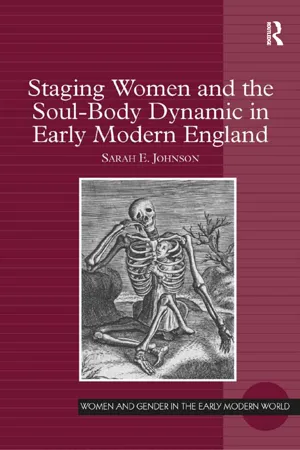
Staging Women and the Soul-Body Dynamic in Early Modern England
About this book
Though the gender-coded soul-body dynamic lies at the root of many negative and disempowering depictions of women, Sarah Johnson here argues that it also functions as an effective tool for redefining gender expectations. Building on past criticism that has concentrated on the debilitating cultural association of women with the body, she investigates dramatic uses of the soul-body dynamic that challenge the patriarchal subordination of women. Focusing on two tragedies, two comedies, and a small selection of masques, from approximately 1592-1614, Johnson develops a case for the importance of drama to scholarly considerations of the soul-body dynamic, which habitually turn to devotional works, sermons, and philosophical and religious treatises to elucidate this relationship. Johnson structures her discussion around four theatrical relationships, each of which is a gendered relationship analogous to the central soul-body dynamic: puppeteer and puppet, tamer and tamed, ghost and haunted, and observer and spectacle. Through its thorough and nuanced readings, this study redefines one of the period's most pervasive analogies for conceptualizing women and their relations to men as more complex and shifting than criticism has previously assumed. It also opens a new interpretive framework for reading representations of women, adding to the ongoing feminist re-evaluation of the kinds of power women might actually wield despite the patriarchal strictures of their culture.
Information
Chapter 1
Puppeteer and Puppet
Gender and Early Modern Puppetry
Belike you mean to make a puppet of me.
– Katharina in The Taming of the Shrew (4.3.103)
Puppetry brings to a sharp focus the interrelationship between representations of women and cultural inscriptions of the soul-body dynamic. This chapter locates Vindice’s dark puppetry of Gloriana’s skull in Middleton’s The Revenger’s Tragedy (1606–1607) and the comic puppetry in Jonson’s Bartholomew Fair (1614) within the contexts of the puppet’s cultural history in early modern England and the puppet’s facility as a metaphor for the soul-body relationship. I argue for a crucial and productive difference between how the puppet signifies as metaphor and how it signifies as performative object. Metaphorically speaking, to call someone a puppet in seventeenth-century England amounted to an insult, as it would today, insinuating mental vacuousness, superficiality, and an inability to act unless under someone else’s control. One significant difference in early modern usage is that the term ‘puppet’ was much more gendered than in today’s usage. This metaphorical reading of the puppet as a sign for the empty, the subordinate, the controlled does not, however, translate to the puppet onstage. The performing puppet often holds a special fascination for audiences and an uncanny capacity to signal meaning apart from the puppeteer’s intentions. In light of the feminization of the puppet as it overlaps with the feminization of the body in the soul-body relationship, this difference between the metaphorical invocation of the puppet and actual puppet performance – or, to put it differently, the onstage puppet’s disruptive signifying power – holds positive implications for the representation of women more broadly. In both The Revenger’s Tragedy and Bartholomew Fair puppetry presents a misogynistic view of women and yet, in some ways, works to overturn this view.
The appearance of puppets on the commercial playhouse stage is not the same thing as a puppet performance on a street corner or at a fair. Scott Cutler Shershow describes the human theatre’s relationship with puppet theatre as one of ‘cultural subordination’ and ‘appropriation’, observing uses of the puppet ‘as metaphor, metadramatic device, or discursive standard of reference – by writers who also define puppet theater as a mode of culture somehow “lower”, less literary and more popular, than their own texts’.1 This perception of puppet theatre as ‘a debased version of the human stage’ comes in part from its location ‘in the marginal social spheres of carnival, fairground, and marketplace’, but it also comes from a ‘master system of representation … conceived as a descent of primary to secondary, “truth” to image’. In other words, ‘the puppet would be to the player as the player is to the author: one step closer to formless materiality, and one step farther from that postulated if irretrievable “truth” from which is said to spring the multitudinous re-creations of theatrical performance’.2 Shershow’s explanation returns us to the Platonic hierarchy of true form over imperfect copy, spirit over matter, with the puppet, of course, as copy and matter. Perhaps the main difference between puppets in motions3 performed at markets or in the streets and puppets on the playhouse stage has to do with the enactment of this hierarchy on the playhouse stage.
On the playhouse stage puppets were not the clear main attraction, but were subordinated as a thematic complement to broader issues in the unfolding human drama. Puppets in motions at festivals and fairs, moreover, communicated to their audiences in large, broad strokes; they wore exaggerated facial features and spoke rather simple, roughshod verse, as discussed further on. The playhouse appropriation of puppet performance, however, sets puppetry in critical or interrogative relation with other elements of the play’s wider narrative in a way that allows the puppet to convey meaning more subtly than it likely would in a motion – even if the puppet looked and behaved much as it would in a fairground performance. A play’s juxtaposition of the act of puppetry with the various other relationships and actions it depicts, I posit, adds to this subtlety by fully exploiting the puppet’s metaphorical significance alongside its effect as a performative object – a metaphorical significance that draws on the puppet’s ‘low’ or debased status. In this chapter, I accept George Speaight’s definition of a puppet as ‘an inanimate figure moved by human agency’,4 a definition that excludes automata, but is flexible enough to allow for a consideration of unconventional puppets that appear on the playhouse stage – such as a human skull in The Revenger’s Tragedy – within the context of the cultural associations surrounding puppetry as a familiar form of street entertainment.
To set up my discussion of what might be at stake for women in theatre’s invocation of puppetry, I turn first to Katharina’s recognition in The Taming of the Shrew (1592–1594) that her new husband is like a puppet master. At a point when she is exasperated at being denied a desirable gown and cap through Petruchio’s pretences that the tailor has marred them, Katharina’s voiced suspicion that Petruchio must want to make her his puppet is a shrewd one. Beyond referring to how Petruchio is asserting control over her appearance by refusing her the choice of her own garments, Katharina’s puppet metaphor points to something even more sinister in Petruchio’s behaviour. Petruchio might initially imagine his ‘peremptory’ nature meeting the ‘proud-minded’ Katharina as ‘two raging fires’ that ‘consume the thing that feeds their fury’ when they meet, or as ‘extreme gusts’ of wind that ‘blow out fire and all’,5 but clearly he is not interested in a mutual subduing. All the consuming or blowing out must take place within Katharina. Petruchio expects his will to replace Katharina’s as the animating spark of her behaviour, and even take precedence over her own perceptions. This expectation is evident in his dizzying progression from deciding his wife’s apparel to insisting that before he and Katharina will journey to her sister’s wedding, ‘It shall be what o’clock I say it is’ and not what time Katharina knows it is (4.3.191). In Plato’s division of the soul, which remained influential into the seventeenth century, the will or ‘spirited element’ is one of the soul’s faculties, the ‘natural ally’ of reason in the Phaedrus and corresponding to the body’s heart in the Timaeus.6 Multiple early modern English writers on the topic acknowledge that ‘some’ people divide the soul, or just the highest part of the soul (the rational soul), into understanding and will. These writers also draw a distinction – although in different ways – between the will and appetite, with the will serving the soul and the appetite encompassing physical urges.7 I take up the connection between will and soul at more length in Chapter 2; here, I just want to underline the usual placement of the will within the highest part of the soul – the part designed to guide and govern the self. Ultimately, Petruchio seeks to render Katharina an inanimate object, to drain her of her soul insofar as it encompasses her independent will by making her body ‘passing empty’ of food and energy – literally a weak and hollow vessel ready to receive his inspiration or direction (4.1.178). He appears to succeed. At the play’s end, when Petruchio summons Katharina to demonstrate her obedience before the community at Bianca’s wedding feast, Katharina’s first words to Petruchio are ‘What is your will, sir, that you send for me?’ Then, when delivering the speech that Petruchio commands her to give, she calls that woman who is ‘not obedient to [her husband’s] honest will’ a ‘foul contending rebel / and graceless traitor’ (5.2.104, 162–4).
And yet, at these moments when Katharina seems most puppet-like – as when, on Petruchio’s absurd order, she throws her cap underfoot in front of the astonished wedding guests before lecturing the women present on the ‘duty they do owe their lords and husbands’ (135) – she is perhaps most beyond her puppeteer’s control. Petruchio could have ventriloquized her final speech, in that it praises husbands so cloyingly and disparages women at such length for not believing their husbands to be their infinite superiors. But the excessiveness of this performance of Petruchio’s will (depending on its delivery, and in keeping with Katharina’s sharp wit) undercuts its purported message about wifely subordination as natural. And this tactic of undercutting the message is beyond credible reproach, since any objection would force Petruchio and the men to admit that their own expectations sound over the top. Instead of truly becoming a puppet to her husband’s will, Katharina arguably provides a puppet-like parody of Petruchio’s notion of an ideal wife. Recent female directors of Shrew have certainly picked up on the possibility and potential of Katharina’s disingenuous delivery of these final lines,8 but the text itself hints that this rendering of the submission speech would not be so far-fetched even in Shakespeare’s time. None of the husbands gathered at the wedding feast, for instance, has made the kind of self-sacrifices that Katharina praises so highly: not one of them has had to commit ‘his body / To painful labor both by sea and land’ or to ‘watch the night in storms, the day in cold’ in order to provide for his wife (152–4). Instead, they have all enjoyed a significant increase in finances, thanks to their new wives’ dowries. If the implied mockery or criticism is lost on Petruchio and the wedding guests, it need not be lost on the audience.
Petruchio is not alone on the early modern stage in his desire to turn a woman into his puppet. In addition to the examples from The Revenger’s Tragedy and Bartholomew Fair on which this chapter will focus, instances of men trying to puppet women both dead and alive turn up in a variety of Jacobean plays. In John Marston’s Sophonisba (1606), for example, Masinissa makes Sophonisba’s body a trophy to his honour after she has consumed poison to save him from his dilemma of either rendering his wife as a prize to the Roman general Scipio or breaking his oath to that general. Masinissa carefully orchestrates the public presentation of Sophonisba’s body to Scipio: after a dramatic introduction he parades her body to the accompaniment of music (perhaps carried in a chair, as her body was borne offstage in the previous scene), and ‘adorns’ her corpse, most likely with the decoration he has just received from Scipio.9 As he transfers his ornament to the dead Sophonisba, Masinissa fittingly declaims ‘On thee, loved creature … / Rest all my honour’ (5.4.53–4, emphasis added), appropriating her body as an image of his own ‘glory’, ‘virtue’, and ‘fame’ – and procuring the status of ‘Rome’s very minion’ as a result (42, 47). In The Tempest (1610), too, Prospero uses a number of spirits as puppets to do his bidding,10 but perhaps he most resembles a puppet master when he demonstrates his ability to effortlessly remove Miranda from the conversation by casting her into a deep sleep and then reanimating her when it suits him, much as a puppeteer might cast aside his puppet and later take it up again. The Tyrant in The Lady’s Tragedy11 (1611), a play I discuss at length in Chapter 3, tells the corpse of the Lady who, to escape his lust, committed suicide, ‘I will possess thee’ (4.3.116). Obsessed with her body – the ‘house’ to which ‘the soul is but a tenant’ (5.2.3) – he has it dressed, painted, and positioned (‘Keep her up, / I’ll have her swoon no more’) to his liking (101–2).12 And in Philip Massinger’s The Duke of Milan (1621–1622?), the perfidious Francisco, disguised as a doctor, brags that through artifice he can convince the duke that the dead duchess lives again. As a puppeteer animates the lifeless puppet’s body, Francisco claims that ‘by a strange vapour, / Which I’ll infuse into [the duchess’s] mouth’ he can ‘create / A seeming breath’ and ‘make her veins run high too, / As if they had true motion’.13 The duke’s friend Pescara confidently hires him to do so.
The early modern habits of thought that view puppets as feminine and women as more likely than men to be puppet-like are inescapably misogynistic. ‘Puppet’ is a variant of ‘poppet’, a term of endearment, especially for ‘a child or young woman’, with the sense of ‘darling’ or ‘pet’.14 ‘Poppet’ – as well as similar words in other Romance and Germanic languages, such as the French ‘poupée’ – likely derives from the Latin ‘puppa’, meaning ‘girl’ or ‘doll’.15 Etymologically, then, femininity connects with the diminutive, the little – and relatedly, the inconsequential – in the word ‘puppet’.16 Puppets, of course, are material objects fashioned to be controlled by an external agent. They are inherently manipulable and their purpose is often to please the sight and to entertain. Apart from its denotative meaning, by the late sixteenth century the word ‘puppet’ held the derogatory connotation of ‘a person, esp. a woman, whose (esp. gaudy) dress or manner is thought to suggest a lack of substance or individuality’.17 Besides the etymological roots of the word ‘puppet’, the puppet’s need to be externally governed, its passivity, and its superficiality fit well with women’s prescribed subordinate position to men in the patriarchal society of seventeenth-century England.18 The hand puppet’s hollowness without the puppeteer resonates with th...
Table of contents
- Cover
- Title Page
- Copyright Page
- Dedication
- Table of Contents
- Acknowledgements
- Note on Texts
- Introduction Women and the Soul-Body Dynamic
- 1 Puppeteer and Puppet
- 2 Tamer and Tamed
- 3 Ghost and Haunted
- 4 Observer and Spectacle
- Conclusion Thomas Browne’s ‘great and true Amphibium’
- Works Cited
- Index
Trusted by 375,005 students
Access to over 1.5 million titles for a fair monthly price.
Study more efficiently using our study tools.
Frequently asked questions
Yes, you can cancel anytime from the Subscription tab in your account settings on the Perlego website. Your subscription will stay active until the end of your current billing period. Learn how to cancel your subscription
No, books cannot be downloaded as external files, such as PDFs, for use outside of Perlego. However, you can download books within the Perlego app for offline reading on mobile or tablet. Learn how to download books offline
Perlego offers two plans: Essential and Complete
- Essential is ideal for learners and professionals who enjoy exploring a wide range of subjects. Access the Essential Library with 800,000+ trusted titles and best-sellers across business, personal growth, and the humanities. Includes unlimited reading time and Standard Read Aloud voice.
- Complete: Perfect for advanced learners and researchers needing full, unrestricted access. Unlock 1.5M+ books across hundreds of subjects, including academic and specialized titles. The Complete Plan also includes advanced features like Premium Read Aloud and Research Assistant.
We are an online textbook subscription service, where you can get access to an entire online library for less than the price of a single book per month. With over 1.5 million books across 990+ topics, we’ve got you covered! Learn about our mission
Look out for the read-aloud symbol on your next book to see if you can listen to it. The read-aloud tool reads text aloud for you, highlighting the text as it is being read. You can pause it, speed it up and slow it down. Learn more about Read Aloud
Yes! You can use the Perlego app on both iOS and Android devices to read anytime, anywhere — even offline. Perfect for commutes or when you’re on the go.
Please note we cannot support devices running on iOS 13 and Android 7 or earlier. Learn more about using the app
Please note we cannot support devices running on iOS 13 and Android 7 or earlier. Learn more about using the app
Yes, you can access Staging Women and the Soul-Body Dynamic in Early Modern England by Sarah E. Johnson in PDF and/or ePUB format, as well as other popular books in Literature & Literary Criticism. We have over 1.5 million books available in our catalogue for you to explore.