eBook - ePub
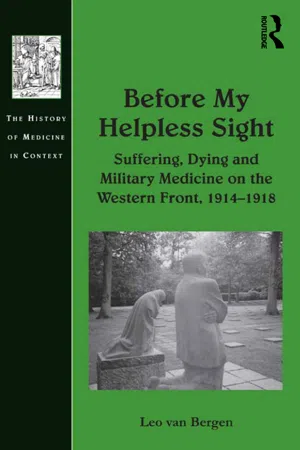
Before My Helpless Sight
Suffering, Dying and Military Medicine on the Western Front, 1914–1918
- 538 pages
- English
- ePUB (mobile friendly)
- Available on iOS & Android
eBook - ePub
Before My Helpless Sight
Suffering, Dying and Military Medicine on the Western Front, 1914–1918
About this book
Despite the numerous vicious conflicts that scarred the twentieth century, the horrors of the Western Front continue to exercise a particularly strong hold on the modern imagination. The unprecedented scale and mechanization of the war changed forever the way suffering and dying were perceived and challenged notions of what the nations could reasonably expect of their military. Examining experiences of the Western Front, this book looks at the life of a soldier from the moment he marched into battle until he was buried. In five chapters - Battle, Body, Mind, Aid, Death - it describes and analyzes the physical and mental hardship of the men who fought on a front that stretched from the Belgian coast to the Swiss border. Beginning with a broad description of the war it then analyzes the medical aid the Tommies, Bonhommes and Frontschweine received - or all too often did not receive - revealing how this aid was often given for military and political rather than humanitarian reasons (getting the men back to the front or munitions factory and trying to spare the state as many war-pensions as possible). It concludes with a chapter on the many ways death presented itself on or around the battlefield, and sets out in detail the problems that arise when more people are killed than can possibly be buried properly. In contrast to most books in the field this study does not focus on one single issue - such as venereal disease, plastic surgery, shell-shock or the military medical service - but takes a broad view on wounds and illnesses across both sides of the conflict. Drawing on British, French, German, Belgian and Dutch sources it shows the consequences of modern warfare on the human individuals caught up in it, and the way it influences our thinking on 'humanitarian' activities.
Chapter 1
Battle
Introduction
Changes on the eve of war
The years leading up to the First World War saw huge change in a wide variety of fields, many of them crucial to the business of war. The European nation states built extensive rail networks, enabling them to move large bodies of troops up to a battle-front quickly. Military offensives became easier to organize, as did defensive consolidations, even though the more traditional means of transport that took soldiers from the rail-head up to the line remained vital and often caused delay.1 The numbers involved were huge. In the second half of the nineteenth century conscription was reintroduced in almost all European countries, most of which had abandoned it after the Napoleonic Wars. The ease of mobilization and the growth of armies made management essential, requiring the introduction of general staffs.2 The disadvantages of this would become apparent in wartime; the absence of commanding officers fighting alongside their men and inspiring them widened the gulf between the ordinary soldier and his general.
Armies were equipped with more and better weaponry. During the Napoleonic Wars one artillery piece had been fielded for every hundred soldiers; by 1914 the number had risen to six, each capable of twenty times the rate of fire, while infantry weapons had eight times the rate of fire and ten times the range. By 1914 a company of 300 men could deploy firepower equivalent to that of the entire 60,000 strong army commanded by the Duke of Wellington at the Battle of Waterloo.3 Wilhelm Lamszus, author of Menschenschlachthaus. Visionen des Krieges (The Human Slaughterhouse: Scenes from the War That Is Sure to Come), published in 1912, realized after watching a military exercise that a future war would bear no resemblance to 1870–71. ‘It is as if death’, he wrote, ‘had thrown his scythe onto the scrap-metal heap and become a machine operator.’4
This kind of firepower was of course very expensive, but money was available. Military expenditure had remained fairly stable for many years, but it rose dramatically in 1912–14, actually doubling in Germany’s case. This is not to say that the Germans were spending more per head of population on their armed forces than any other nation. That honour went to Great Britain, but British expenditure was concentrated on the navy, which would play a relatively minor role in the coming war.5
Bigger armies with improved firepower expanded the battlefield enormously. Paradoxically, despite being part of a larger force, an individual soldier’s view of a battle, limited at the best of times, became even more restricted. He could see nothing but emptiness or chaos. When war came, millions of soldiers would be killed by an enemy they had never laid eyes on, even though he was sometimes extremely close.6 Battles were longer, too, lasting several months rather than a few days, and they followed each other in quick succession, since seasonal factors were becoming less important in deciding when to fight or cease fighting, and the necessary reserves could be brought up promptly and in ever greater numbers.7 Breaks between battles were quiet in name only. Every lull in the fighting involved elements of combat and therefore fear. There was never a complete respite. To say all was quiet on the front could mean that a day had passed on which only a couple of thousand men were killed instead of ten thousand.8
At the same time, the battlefield became deeper. In earlier wars a man could often observe the fighting without too much risk to himself; now he was safe only several miles from the front. Ernst Jünger described a group of soldiers killed by a shell as they swam in a stream a long way behind the lines.9 In this sense too the First World War was a new type of conflict. In all ages men have been forced out of hearth and home and onto the Procrustean bed of a disciplined army, had their wills channelled by rigid restrictions, been compelled to eat whatever was served up to them and to sleep wherever they were ordered to lie down, taught to kill and destroy in ways strictly forbidden to them as civilians. But the entirely realistic fear that they could be killed at any moment made the First World War a much harsher test than any conflict before it, even for men enjoying excellent physical and mental health.10
All this led to a huge increase in death and destruction in battle. In the nineteenth and twentieth centuries as a whole, wartime casualties fell steadily in percentage terms as tactics were adapted to changing circumstances, but there were cyclical exceptions to the structural trend, and practically all the battles of 1914–18 were among the exceptions.11
The main problem was that while the advantage lay with the defending armies, only offensive action could bring victory. As a result, two weapons and one instrument came to typify the Great War: the heavy guns deployed by the artillery, the machine-guns carried by the infantry, and the surgeons’ scalpels. In many ways the war of movement of the first few months had more in common with Napoleonic battles of a century before than with the butchery that occurred a short time later at Ypres. People came out to watch the troops going off to war. Bringing up the rear of each battalion as it marched through Belgium and France in August 1914 were a handful of machine-guns and a couple of medical officers. They would soon demonstrate how much war had moved on. The machine-gun quickly became a dominant battlefield weapon – each German or British battalion had one or two in August 1914 and between twenty and thirty by 191812 – while medical services grew to unprecedented levels. War and medicine, destruction and repair, barbarism and progress were soon discovered to be opposite sides of the same coin. The machine-gun and the scalpel exemplified the fact that all those developments that had been such a boon to humanity in the preceding century – advances in transport, production, communications, technology and health care – could be used in pursuit of total destruction. French doctor and writer Georges Duhamel provided an apt description of the field hospital he worked in by calling it ‘the first great repair-shop the wounded man encounters after he leaves the workshop of trituration and destruction that operates at the front’. A highly technical civilization was restoring what it had itself destroyed. In Duhamel’s view the Great War was a consequence of the use of science and technology without compassion or humanity. On an unprecedented scale, science, previously regarded as neutral, objective and self-consciously international, had placed itself at the service of national war efforts, both in the laboratory and in the mechanisms by which propaganda was disseminated. Philosopher of history R.G. Collingwood was a wartime member of Admiralty Intelligence and after the war ended he was one of the men put in charge of preparations that led up to the Treaty of Versailles (an outcome that he regarded as a failure). He fulminated against the way the word ‘civilization’ was interpreted predominantly in terms of natural science:
The War was an unprecedented triumph for natural science. Bacon had promised that knowledge would be power, and power it was: power to destroy the bodies and souls of men more rapidly than had ever been done by human agency before. This triumph paved the way to other triumphs: improvements in transport, in sanitation, in surgery, medicine, and psychiatry, in commerce and industry, and, above all, in preparations for the next war.13
The sheer number of shells that flew across the skies of France and Belgium between 1914 and 1918 was immense, and artillery became the paradigmatic weapon of modern warfare. The British alone fired some 170 million shells. Shortly before his death at Frianville in March 1915, German soldier August Hopp reacted to the almost constant torrent of explosives by saying that you could no longer tell one explosion from another. The entire hill before him was like a mountain spewing fire.14
The artillery seemed perfectly suited to support an attacking force. Heavy guns could destroy enemy positions from far behind the lines and the lighter field guns could knock out machine-gun posts and individual riflemen. It quickly emerged that this was merely an appealing theory. The many rolls of barbed wire laid in front of enemy positions could be fired upon, certainly, but even when blasted to pieces they remained a serious obstacle. The trenches themselves were narrow and dug in a crenellated or zigzag pattern, so shells that did not land precisely on target had almost no effect at all. Methods of determining the exact position of a target had grave limitations. Aerial photography was in its infancy, and although it improved greatly as the war went on, it remained a makeshift business, aside from the fact that the weather was by no means always favourable for taking pictures. Even if artillerymen had good photographs, weather conditions were often too poor for any use to be made of them.
Artillery fire, were it to have the effect the army leadership was hoping for, would have to be extremely accurate and the gunners properly trained. Neither was the case. Although they had a devastating impact at Liège, Verdun, the Somme and Passchendaele, the masses of shells fired before every battle repeatedly failed in their allotted task: the destruction of enemy positions before troops started to advance. Ahead of their attack along the Menin Road during the Third Battle of Ypres in 1917, the British managed to deploy 300 artillery pieces and 500 field guns, with stocks of 3.5 million shells available. They consumed almost half the ammunition before battle commenced, but German artillery was left largely intact.
Even had this been otherwise, even had the targets been visible and the shells fired with precision, a still more colossal quantity of shells would have been needed to knock out enemy troops and destroy their defences. Despite the huge industrial muscle mobilized to bring immense quantities of shells to the front, supplies of ammunition were never sufficient. The front line was simply too long. The number of heavy guns and shells on each side was tiny in relation to the miles and miles of trenches that would have to be destroyed.
There were attempts to resolve this by having troops advance while a protective torrent of shells fell ahead of them: the creeping barrage. Here the problems of lack of precision and inadequate communications came into play. Many shells fell short, exploding amid the troops rather than ahead of them, so that men were killed by their own side. They called it being hit by ‘a friendly’, a characteristi...
Table of contents
- Cover Page
- Title Page
- Copyright Page
- Contents
- List of Illustrations
- Acknowledgements
- Introduction
- 1 Battle
- 2 Body
- 3 Mind
- 4 Aid
- 5 Death
- Afterword
- Bibliography
- Index
Trusted by 375,005 students
Access to over 1.5 million titles for a fair monthly price.
Study more efficiently using our study tools.
Frequently asked questions
Yes, you can cancel anytime from the Subscription tab in your account settings on the Perlego website. Your subscription will stay active until the end of your current billing period. Learn how to cancel your subscription
No, books cannot be downloaded as external files, such as PDFs, for use outside of Perlego. However, you can download books within the Perlego app for offline reading on mobile or tablet. Learn how to download books offline
Perlego offers two plans: Essential and Complete
- Essential is ideal for learners and professionals who enjoy exploring a wide range of subjects. Access the Essential Library with 800,000+ trusted titles and best-sellers across business, personal growth, and the humanities. Includes unlimited reading time and Standard Read Aloud voice.
- Complete: Perfect for advanced learners and researchers needing full, unrestricted access. Unlock 1.5M+ books across hundreds of subjects, including academic and specialized titles. The Complete Plan also includes advanced features like Premium Read Aloud and Research Assistant.
We are an online textbook subscription service, where you can get access to an entire online library for less than the price of a single book per month. With over 1.5 million books across 990+ topics, we’ve got you covered! Learn about our mission
Look out for the read-aloud symbol on your next book to see if you can listen to it. The read-aloud tool reads text aloud for you, highlighting the text as it is being read. You can pause it, speed it up and slow it down. Learn more about Read Aloud
Yes! You can use the Perlego app on both iOS and Android devices to read anytime, anywhere — even offline. Perfect for commutes or when you’re on the go.
Please note we cannot support devices running on iOS 13 and Android 7 or earlier. Learn more about using the app
Please note we cannot support devices running on iOS 13 and Android 7 or earlier. Learn more about using the app
Yes, you can access Before My Helpless Sight by Leo van Bergen in PDF and/or ePUB format, as well as other popular books in History & World History. We have over 1.5 million books available in our catalogue for you to explore.