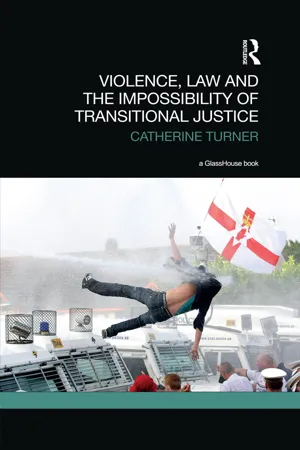
The field of transitional justice has expanded rapidly since the term first emerged in the late 1990s. Its intellectual development has, however, tended to follow practice rather than drive it. Addressing this gap, Violence, Law and the Impossibility of Transitional Justice pursues a comprehensive theoretical inquiry into the foundation and evolution of transitional justice. Presenting a detailed deconstruction of the role of law in transition, the book explores the reasons for resistance to transitional justice. It explores the ways in which law itself is complicit in perpetuating conflict, and asks whether a narrow vision of transitional justice – underpinned by a strictly normative or doctrinal concept of law – can undermine the promise of justice. Drawing on case material, as well as on perspectives from a range of disciplines, including law, political science, anthropology and philosophy, this book will be of considerable interest to those concerned with the theory and practice of transitional justice.
- 194 pages
- English
- ePUB (mobile friendly)
- Available on iOS & Android
eBook - ePub
Violence, Law and the Impossibility of Transitional Justice
Chapter 1Introduction
DOI: 10.4324/9781315695044-1
1.1 What is ‘transitional justice’?
Transitional Justice [n]: the full range of processes and mechanisms associated with a society's attempts to come to terms with a legacy of large-scale past abuses, in order to ensure accountability, serve justice and achieve reconciliation.
This definition of transitional justice first appeared in a report published in 2004 by the Secretary General of the United Nations on the ‘Rule of Law and Transitional Justice in Conflict and Post-Conflict Societies’.1 For transitional justice scholars and activists, its publication represented a watershed.2 It was the moment in which transitional justice – a concept that had emerged less than a decade previously3 – became institutionalised and was given definite form in international policy. Since the publication of the Report, this definition has been cited extensively as the generally accepted definition of ‘justice’ in the aftermath of war, violence or repression. The effect of the codification of transitional justice in this, and subsequent, United Nations reports has been the emergence of an institutionalised model, with a clearly defined list of options for post-conflict states seeking to address an abusive past.4 These include trials, truth commissions and reparations, which can all be used in pursuit of justice. The model is characterised by its use of law as a means of moving conflicted societies from a state of war, conflict or repression, towards peace and justice.5 A normative model is intended to transcend politics, thereby ensuring that just outcomes are achieved through the application of objective standards that incorporate principles of justice.6
1 Report of the Secretary General on the Rule of Law and Transitional Justice in Conflict and Post Conflict Societies (UN Doc. S/2004/616, 2004), para. 8. The mechanisms may include individual prosecutions, reparations, truth-seeking, institutional reform, vetting and dismissals, or a combination thereof.
2 JelenaSubotić, ‘The Transformation of International Transitional Justice Advocacy’ (2012) 6International Journal of Transitional Justice 106, 116.
3 See Paige Arthur, ‘How “Transitions” Reshaped Human Rights: A Conceptual History of Transitional Justice’ (2009) 31 Human Rights Quarterly 321.
4 See also United Nations, ‘The Rule of Law and Transitional Justice in Conflict and Post-Conflict Societies: Report of the Secretary General to the Security Council’ (UN Doc. S/2011/634, 2011).
5 See generally Ruti Teitel, Transitional Justice (Oxford University Press 2000).
6 Ibid. Discussed in Chapter 2.
The study and practice of transitional justice has more recently been characterised as a ‘field’ of inquiry.7 In drawing the distinction between a ‘field’ and a ‘discipline’, Bell defines transitional justice as comprising ‘both a sphere of activity and a sphere of academic knowledge, with a praxis relationship between the two’,8 and a field of activity held together by a common claim to legitimacy rather than a more coherent ‘discipline’ with its own common procedures and methods.9 The effect of the institutionalisation of transitional justice is therefore not limited to the evolution of academic discourse. In very practical terms the conceptualisation of transitional justice as a distinct field of endeavour has profoundly influenced the way in which it has developed in practice.10 The model therefore engages a number of different levels, from academia to policy and practice. This looser definition of ‘field’ is intended to allow transitional justice to accommodate divergent disciplinary perspectives within a more or less common framework of understanding as to its purpose. This book argues that the effect of the institutionalisation of transitional justice at the international level has been to create a ‘theatrical space’ within which efforts at post-conflict peace-making must play out.11 There is a clearly defined model of ‘transitional justice’ within which efforts are both designed and evaluated. In this context it asks whether, as a ‘field’, transitional justice continues to accommodate divergent perspectives, or whether the effect of this institution has been to create new sites of silence and exclusion.
7 Christine Bell, ‘Transitional Justice, Interdisciplinarity and the State of the “Field” or “Non-Field”’ (2009) 3 International Journal of Transitional Justice 5.
8 Ibid. 7.
9 Ibid.
10 For a good overview, see Subotic (n. 2).
11 Jacques Derrida, On Cosmopolitanism and Forgiveness, Mark Dooley and Michael Hughes tr. (Routledge 2001) 29.
1.2 Aim of the book
While the field of transitional justice has expanded rapidly since the term first emerged, its development has been largely reactive to practice. Theorising has tended to follow practice rather than drive it.12 While research is now beginning to exert a more discernable impact on policy in some areas,13 transitional justice remains a field in which theory has not managed to keep pace with practice.14 This work seeks to address this gap by presenting a comprehensive theoretical inquiry into the foundations of the field of transitional justice and the way in which it has evolved. This does not take the form of a historical account or evaluation of the field,15 but rather of a more focused deconstruction of how the ways in which transitional justice has been conceptualised have influenced its ability to deliver the underlying goal of establishing lasting peace. In particular, the book presents a detailed deconstruction of the role of law in transition. To do this, it addresses three key themes that underpin all work in and on transitional societies: violence, law and justice. Using these themes to illustrate underlying theoretical arguments, the book is structured around three key objectives. The first is to present a detailed analysis of the foundational assumptions of transitional justice and the ways in which these have shaped the field, focusing in particular on the role of law in transition. The second is to challenge the assumption of a linear progression from conflict to peace that underpins much of the theory and practice in this field. The final objective is to illustrate the ways in which a narrow vision of transitional justice, underpinned by a strictly normative concept of law, can undermine the promise of justice in transition. It therefore seeks to ask some of the big questions that have been absent from transitional justice research to date.16
12 Good examples of the theorisation of practice include Diane Orentlicher, ‘Settling Accounts: The Duty to Prosecute Human Rights Violations of Prior Regimes’ (1991) 100 Yale Law Journal 2539, identifying a normative ‘duty to prosecute’ in international law, and Priscilla Hayner's extensive study of truth commissions that laid the groundwork for the inclusion of such commissions within the definition of transitional justice: Priscilla Hayner, ‘Fifteen Truth Commissions – 1974–1994’ (1994) 16 Human Rights Quarterly 597.
13 See, for example, Louise Mallinder, Belfast Guidelines on Amnesty and Accountability (Transitional Justice Institute 2014). See also UN Women, A Window of Opportunity: Making Transitional Justice Work for Women, 2nd edn (United Nations 2010).
14 See Kieran McEvoy, ‘Beyond Legalism: Towards a Thicker Understanding of Transitional Justice’ (2007) 34 Journal of Law and Society 411; Harvey Weinstein, ‘Editorial Note: The Myth of Closure, the Illusion of Reconciliation: Final Thoughts on Five Years as Co-Editor-in-Chief’ (2011) 6 International Journal of Transitional Justice 1.
15 This has been done by Arthur (n. 3).
16 McEvoy (n. 14).
These objectives are addressed by drawing on the work of Jacques Derrida, and in particular his approach of deconstruction,17 to explore the dynamics of transitional justice. Deconstruction for these purposes is characterised as an ongoing process of questioning. Rather than searching for a solution to the dilemmas of transitional justice, deconstruction requires awareness of oppositions, of differences and divisions, and a willingness to work with difference rather than supress it.18 The work therefore deconstructs some of the core assumptions upon which transitional justice is based, and in so doing generates new insights into some of the more persistent problems of transition. Throughout the book deconstruction is translated into a language that is familiar to transitional justice scholars generally, but also to lawyers in particular.19 This requires a focused approach to the transitional justice literature. Although a relatively new field of inquiry, transitional justice has already generated a very significant volume of literature. Due to the scope of this work, and its aim to deconstruct fundamental assumptions, it has been necessary to be selective in the texts used. The texts that have been chosen are those that either define the field, or that subject it to substantial critique, thereby exposing its limits. Finally, in order to illustrate how deconstruction can further our understanding of transitional justice, the book draws on the example of the transition in Northern Ireland. Therefore, texts that specifically address that particular case have also been chosen. These are then used to illustrate broader trends in transitional justice. The aim is to set up a dialogue between the singular example of Northern Ireland and the general theoretical argument. The discussion of Northern Ireland is not a ‘case study’ that generates new empirical research on the Northern Ireland conflict, but rather presents a re-reading of existing literatures as a means of demonstrating how deconstruction can cast new light on seemingly intractable problems.
17 For a basic explanation of deconstruction see Jacques Derrida, ‘Letter to a Japanese Friend’ in Peggy Kamuf and Elizabeth G Rottenberg (eds), Psyche: Interventi...
Table of contents
- Cover Page
- Half Title Page
- Series Page
- Title Page
- Copyright Page
- Table of Contents
- Acknowledgements
- Dedication
- 1 Introduction
- 2 Transitional justice: the constitution of the field
- 3 Introducing uncertainty: deconstruction and transitional justice
- 4 Violence
- 5 Law
- 6 Justice
- Conclusion: the impossibility of transitional justice?
- Bibliography
- Index
Trusted by 375,005 students
Access to over 1.5 million titles for a fair monthly price.
Study more efficiently using our study tools.
Frequently asked questions
Yes, you can cancel anytime from the Subscription tab in your account settings on the Perlego website. Your subscription will stay active until the end of your current billing period. Learn how to cancel your subscription
No, books cannot be downloaded as external files, such as PDFs, for use outside of Perlego. However, you can download books within the Perlego app for offline reading on mobile or tablet. Learn how to download books offline
Perlego offers two plans: Essential and Complete
- Essential is ideal for learners and professionals who enjoy exploring a wide range of subjects. Access the Essential Library with 800,000+ trusted titles and best-sellers across business, personal growth, and the humanities. Includes unlimited reading time and Standard Read Aloud voice.
- Complete: Perfect for advanced learners and researchers needing full, unrestricted access. Unlock 1.5M+ books across hundreds of subjects, including academic and specialized titles. The Complete Plan also includes advanced features like Premium Read Aloud and Research Assistant.
We are an online textbook subscription service, where you can get access to an entire online library for less than the price of a single book per month. With over 1.5 million books across 990+ topics, we’ve got you covered! Learn about our mission
Look out for the read-aloud symbol on your next book to see if you can listen to it. The read-aloud tool reads text aloud for you, highlighting the text as it is being read. You can pause it, speed it up and slow it down. Learn more about Read Aloud
Yes! You can use the Perlego app on both iOS and Android devices to read anytime, anywhere — even offline. Perfect for commutes or when you’re on the go.
Please note we cannot support devices running on iOS 13 and Android 7 or earlier. Learn more about using the app
Please note we cannot support devices running on iOS 13 and Android 7 or earlier. Learn more about using the app
Yes, you can access Violence, Law and the Impossibility of Transitional Justice by Catherine Turner in PDF and/or ePUB format, as well as other popular books in Law & Law Theory & Practice. We have over 1.5 million books available in our catalogue for you to explore.