eBook - ePub
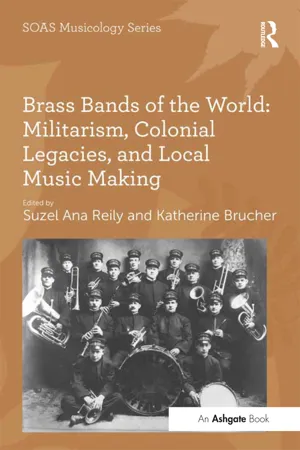
Brass Bands of the World: Militarism, Colonial Legacies, and Local Music Making
- 268 pages
- English
- ePUB (mobile friendly)
- Available on iOS & Android
eBook - ePub
Brass Bands of the World: Militarism, Colonial Legacies, and Local Music Making
About this book
Bands structured around western wind instruments are among the most widespread instrumental ensembles in the world. Although these ensembles draw upon European military traditions that spread globally through colonialism, militarism and missionary work, local musicians have adapted the brass band prototype to their home settings, and today these ensembles are found in religious processions and funerals, military manoeuvres and parades, and popular music genres throughout the world. Based on their expertise in ethnographic and archival research, the contributors to this volume present a series of essays that examine wind band cultures from a range of disciplinary perspectives, allowing for a comparison of band cultures across geographic and historical fields. The themes addressed encompass the military heritage of band cultures; local appropriations of the military prototype; links between bands and their local communities; the spheres of local band activities and the modes of sociability within them; and the role of bands in trajectories toward professional musicianship. This book will appeal to readers with an interest in ethnomusicology, colonial and post-colonial studies, community music practices, as well as anyone who has played with or listened to their local band.
Information
Chapter 1
Brass and Military Bands in Britain – Performance Domains, the Factors that Construct them and their Influence
This chapter focuses on military and brass bands as they have developed in Britain since the late eighteenth century. Despite the title, it is not entirely insular because several themes dealt with here lead necessarily to a discussion of music making in other European countries, the USA (which provides one of my case studies) and some other formerly colonized territories. The emphasis falls on history because it is my contention that historical processes have had several enduring influences: perhaps most importantly, they have shaped the fundamental idea of the ‘band’, as it is understood in the pages of this book, and ‘banding’ (a common enough term among brass band players), as a relatively distinct sphere of activity that stands apart from, but is also related to, other forms of instrumental music making. The most powerful manifestation of the historical legacy is to be found in the way that British bands sound, but it can also be detected in several cultural and value systems that have their origins in the same process. It is a process that has been nurtured by certain historical ‘events’ and by the mutually influential relationships that bands have had with their ‘audiences’ (a term to be understood in its broadest sense). The role of audiences has a special importance because the cultural assumptions and interactions created by this relationship and developed alongside banding have helped shape the way British bands sound. Those of us who regularly or occasionally listen to bands have our receptors tuned in a particular way to defined values and expectations, and bands respond obligingly if subconsciously. The sound world of bands is predictable to listeners and this can be taken as evidence of the maturity of its idiom.
The idea that a clearly defined and identifiable species of music making is a consequence of a historical legacy to which social, economic and cultural factors have contributed can, of course, be easily applied to other forms of music making. But my primary argument here is that the idea of banding in Britain can only be properly explained by reference to the detail and the more general trend of its social and cultural history, because it is this that leads bands to occupy a particular place defined principally by the way they perform and consequently sound. I call this a ‘performance domain’. Performance domains also have another defining characteristic and that is the durability of their basic musical make-up. This is why various forms of banding can be seen as performance domains. Brass and military bands in Britain share this important characteristic: they have remained persistently unaltered in their fundamentals since they took on what we can loosely call their ‘finished form’. For military bands, this occurred in the third quarter of the nineteenth century; for brass bands, it was a couple of decades later. As I argue below, these moments are not ascribed in an arbitrary way; they can be defined and accounted for evidentially and with relative precision. But what is certain is that the most powerful factor that distinguishes bands from many other forms of music making is the constancy of the performance domain in which they reside, and in consequence, the constancy of the soundscapes to which they give issue. I am not merely describing musical style or genre here, for many recognized styles have been the subject of radical change; the fundamentals of their musical language and performance idioms have undergone massive upheavals and transformations with the result that their values and modes of expression have evolved to the extent that they are fundamentally different from the point where they started: romanticism and the avant-garde, tailgate and bebop, ballads and hard rock are examples. This is less the case with performance domains such as British bands and banding where the fundamental parameters – instrumentation, musical language, musical values, audience expectations and so on – have remained more or less self-contained and intact. This constancy should not be confused with stagnation, because, somewhat paradoxically, banding as a whole can be characterized by its vitality and subscription to modern life at the expense of retrospection: it adds to the quality of life of those who play and listen, repertoire is always being added to, and dialogues are almost always about the present rather than the past. The constancy has something to do with the fact that banding is essentially about performance, and this sense is also central to the relationship between bands, communities and even the country as a whole. It is, however, less a matter of conservatism than of identity, and it follows the basic reasoning that music is essentially a means of communication. Military and brass bands as individual groups have lucid identities because they share a true and confident understanding of what their idiom is and what society expects from their endeavours.
The History Question
As I have already made clear, history is of vital importance in this argument, but one of the persistent errors in writings about British brass and military bands (and perhaps wind bands more generally) comes from the tendency to link them, in the worst cases causally and seamlessly, with ancient precedents of the wind instrument ensemble: seeing, for example, the modern brass or military band as a descendant of the instrumental groups populated mainly (but not exclusively) by tromboni and cornetti that prevailed before the eighteenth century. The tendency comes in part from the proximity that modern players feel to some early repertoires because arrangements of them for modern instruments are so numerous and popular.1 But it also derives from an odd and somewhat affected inclination on the part of writers since the nineteenth century to begin their surveys of banding as it was at the time of their writing – a subject about which they usually knew a great deal – with a prefatory romp through what they regarded as the relevant segments of Western music history – a subject about which, almost invariably, they knew considerably less. Jacob Kappey, the author of the first entries on bands in the first edition of Grove’s Dictionary, opened his article by proclaiming that: ‘The history of the development of wind instrumental music is so closely interwoven with the social state of Central Europe in the middle ages, that it is almost impossible to sketch the one without the other’.2
The problem with Kappey’s approach is that it positions the historical development unproblematically as linear and progressive. Several authors of didactic texts on military instruments made the same assumption, and even the impressive polymath Henry George Farmer, the author of the most reliable histories of British military bands, displays a hint of it too. Each of them got it mostly wrong, and if the practice has any interest for our purposes here, it is because they seem to have shared a belief that the story of a relatively modern phenomenon (as I will argue it to be in this chapter) needed to be dignified and perhaps even legitimized by reference to historical pedigree. This then is one of the features of the band as it is understood in the pages of this book. Its sub-cultural status is a consequence of its relative modernity, a condition that has been subjected for much of its history to a comparison with Western art music history – its values, repertoires and often its core practices. One of the interesting features about banding is the interplay between what are often the contrasting values of this comparison.
Two groupings especially occupied the thoughts of early writers on bands: the so-called alta bands (known originally just as alta – ‘bands’ is a modern suffix) that emerged in the fifteenth century (or perhaps a little earlier) and those wind bands variously called waits, Stadtpfeifer and piffari, which had the common characteristic that they were employed, and their functions largely configured, by civic governments. Alta were wind groups, usually of no more than three or four in number, and they generally included double reed instruments (usually shawms) and a species of brass instrument that was a form of trumpet. The evidence for alta is mainly iconographical, though documentary fragments, some of which contain musical texts, also survive. It leads to the conclusion that these were essentially dance bands, given the name alta because they played ‘loud music’. Their interest to modern scholars rests on two primary factors. The first is organological: the brass instrument, not a single specimen of which survives, is believed by most to be an instrument with a single telescopic slide – what we now refer to as the ‘Renaissance slide trumpet’, a precursor of the modern trombone, with a capability of sounding diatonic melodies through much of its range, rather than being restricted to the notes of a single harmonic series.3 The second feature is related to the melodic character of the instruments used in these bands: they provide one of the first examples from that period of ‘independent’ instrumental ensemble music, a repertoire that is one step removed from vocal music – only one step, because the polyphonic patterns apparently improvised by the wind players (as evidenced by the musical texts related to them) were woven around a fixed melody – a cantus firmus – that was invariably derived from vocal music, usually popular song.
The civic groups can be shown to have a yet older ancestry and a much longer period of existence, but their repertoires before the seventeenth century are obscure. Civic payment inventories show them to have had different types of instrumentation at different times and in different places, but trumpets and other loud instruments were always prominent, because they were needed for various signalling functions. Leaving aside the broad features of their instrumental make-up, these bands shared two important features: they were unambiguously and consistently professional, and while they seem to have freelanced whenever opportunities arose, their main roles were formal and determined by those who employed them. In the Middle Ages, waits were watchmen who also sounded the hours: they quite literally marked the passing of time. But there is an abundance of evidence to show that because they were often the only local sources of professional instrumentalists, they also played for various sacred and secular ceremonials; and individual members of town bands also regarded themselves as freelancers with the benefit of a basic income from the local civic authorities. We know, for example, that even J. S. Bach called on town band players for the trombonists who performed in the small group of his cantatas that included those instruments. While alta were a thing of the past by the later sixteenth century, town bands continued to thrive, but both their instrumentations and their place in the music profession changed as the music establishments of aristocratic courts and the larger ecclesiastical foundations increased in importance. Trumpeters in court establishments were usually a discrete group, remunerated as such and with defined roles, many of which were highly symbolic.
By the end of the sixteenth century, large sophisticated professional groups with mixed instrumentation, which were to be the basis of what became known as orchestras, were in existence. Their players were professionals who learned through dynastic apprenticeships. They were musically literate, and though they decorated composed melodic lines with formulaic ornaments, they worked in a culture in which the creative process and all that flowed from it was configured largely by what composers wrote down. This was the consolidation of a long historical process that led to the elements upon which most of the practices of Western instrumental art music are largely based. The consequence of new instrumental genres was the development of clear, and to an extent internationally shared, idioms of instruments in the core of Western art music culture (essentially those included in the modern symphony orchestra), the idea of virtuosity as a virtue (note the similarity of the words) in its own right and, in the West, the concept of the audience as a separate body that simply listened to instrumental music and the way it was performed, often without recourse to any extra-musical purpose or function.
Should we regard any of these or other developments that occurred before the late eighteenth century as being related in an important way to the development of the ‘band’ as the word is deployed in the pages of this book and particularly this chapter? My contention is that the development of ‘bands’ has to be seen separately: there was no unbroken tradition that stretched from the early modern period to the nineteenth century and beyond; furthermore, almost none of the conditions that led to banding existed before the nineteenth century. Town and village bands existed in the eighteenth century and certainly the nineteenth, often to support hymn singing and to accompany seasonal rituals, and we dismiss them at our peril as important constituents in the story of vernacular music and its incorporation into wider aspects of music culture; but military and brass bands must be attributed to a different trajectory of history. The impetus came largely in the nineteenth century from the coincidence of a wide range of demographic, economic, commercial, technological and cultural upheavals. Many of the instruments that made up military and brass bands were not invented before this time, and more critically the formation of both species relied on the mobilization of large numbers of the lower social classes with some powers of economic and social self-determination, a state that simply did not prevail before industrialization and its resultant urbanization was well underway. It is probably more accurate to analogize the origination of the band in the sense it is used here with the big bang than the theory of evolution, and if a further metaphor were needed, we need look no further than the meaning of the word ‘band’ and how it changed as the eighteenth century passed into the nineteenth.
‘Band’ as a Cultural Expression
‘Band’ was used from the Renaissance to mean a group of men formed for a united purpose – particularly soldiers. The regular use of the word to mean a group of musicians appears to have emerged at the time of the Restoration of the English monarchy, when Charles II famously recruited his ‘band of four and twenty fiddlers’ to play in the French style. ‘Band’ as essentially a large ensemble of musical instruments of any type was thus used through much of the eighteenth century, even as the modern use of the word ‘orchestra’ was taking root. ‘Orchestra’ in ancient Greek referred to the ground level of a theatre, but even in the late sixteenth century it was being used in Italy as a description of the group of instrumentalists that occupied that space. This was not the case in England. Handel would have called his orchestra a ‘band’, and this is the word that eighteenth-century concert-goers would have looked for in newspapers to assure themselves that the oratorio or opera they had booked for would have a group of instrumentalists in attendance. But a clear and important shift in meaning occurred in the closing decades of the eighteenth century. The very large group of instrumentalists assembled at Westminster Abbey in 1784 for the Handel Commemoration was referred to by Charles Burney as a band: ‘[i]n order to render the band as powerful and complete as possible it was determined to employ every species of instrument’.4 The review of the event in the Public Advertiser mentions that ‘[t]he Band was said to have 515 [players]’.5 Soon after this, the word ‘orchestra’ started being used as the usual word for a large group of players. In 1807, in his Hints to Young Composers, John Marsh persistently uses ‘orchestra’.6 It is, of course, impossible to define the exact point when the change of meaning occurred, but the abandonment by Marsh of the word ‘band’ in favour of ‘orchestra’ is especially interesting. Marsh was a polymath who, somewhat unusually for polymaths of the time, displayed merit in most of the diverse fields to which he contributed. He was at...
Table of contents
- Cover Page
- Title Page
- Copyright Page
- Contents
- List of Figures and Tables
- List of Musical Examples
- Notes on Contributors
- Foreword by Charles Keil
- Acknowledgements
- Introduction: The World of Brass Bands
- 1 Brass and Military Bands in Britain – Performance Domains, the Factors that Construct them and their Influence
- 2 Western Challenge, Japanese Musical Response: Military Bands in Modern Japan
- 3 Battlefields and the Field of Music: South Korean Military Band Musicians and the Korean War
- 4 From Processions to Encontros: The Performance Niches of the Community Bands of Minas Gerais, Brazil
- 5 The Representational Power of the New Orleans Brass Band
- 6 Soldiers of God: The Spectacular Musical Ministry of the Christmas Bands in the Western Cape, South Africa
- 7 Composing Identity and Transposing Values in Portuguese Amateur Wind Bands
- 8 Playing Away: Liminality, Flow and Communitas in an Ulster Flute Band’s Visit to a Scottish Orange Parade
- 9 From Village to World Stage: The Malleability of Sinaloan Popular Brass Bands
- Bibliography
- Discography
- Index
Trusted by 375,005 students
Access to over 1.5 million titles for a fair monthly price.
Study more efficiently using our study tools.
Frequently asked questions
Yes, you can cancel anytime from the Subscription tab in your account settings on the Perlego website. Your subscription will stay active until the end of your current billing period. Learn how to cancel your subscription
No, books cannot be downloaded as external files, such as PDFs, for use outside of Perlego. However, you can download books within the Perlego app for offline reading on mobile or tablet. Learn how to download books offline
Perlego offers two plans: Essential and Complete
- Essential is ideal for learners and professionals who enjoy exploring a wide range of subjects. Access the Essential Library with 800,000+ trusted titles and best-sellers across business, personal growth, and the humanities. Includes unlimited reading time and Standard Read Aloud voice.
- Complete: Perfect for advanced learners and researchers needing full, unrestricted access. Unlock 1.5M+ books across hundreds of subjects, including academic and specialized titles. The Complete Plan also includes advanced features like Premium Read Aloud and Research Assistant.
We are an online textbook subscription service, where you can get access to an entire online library for less than the price of a single book per month. With over 1.5 million books across 990+ topics, we’ve got you covered! Learn about our mission
Look out for the read-aloud symbol on your next book to see if you can listen to it. The read-aloud tool reads text aloud for you, highlighting the text as it is being read. You can pause it, speed it up and slow it down. Learn more about Read Aloud
Yes! You can use the Perlego app on both iOS and Android devices to read anytime, anywhere — even offline. Perfect for commutes or when you’re on the go.
Please note we cannot support devices running on iOS 13 and Android 7 or earlier. Learn more about using the app
Please note we cannot support devices running on iOS 13 and Android 7 or earlier. Learn more about using the app
Yes, you can access Brass Bands of the World: Militarism, Colonial Legacies, and Local Music Making by Katherine Brucher, Suzel Ana Reily,Katherine Brucher, Suzel Ana Reily, Katherine Brucher in PDF and/or ePUB format, as well as other popular books in Media & Performing Arts & Music. We have over 1.5 million books available in our catalogue for you to explore.