The Spanish Civil War (1936-1939) pitted conservative forces including the army, the Church, the Falange (fascist party), landowners, and industrial capitalists against the Republic, installed in 1931 and supported by intellectuals, the petite bourgeoisie, many campesinos (farm laborers), and the urban proletariat. Provoking heated passions on both sides, the Civil War soon became an international phenomenon that inspired a number of literary works reflecting the impact of the war on foreign and national writers. While the literature of the period has been the subject of scholarship, women's literary production has not been studied as a body of work in the same way that literature by men has been, and its unique features have not been examined. Addressing this lacuna in literary studies, this volume provides fresh perspectives on well-known women writers, as well as less studied ones, whose works take the Spanish Civil War as a theme. The authors represented in this collection reflect a wide range of political positions. Writers such as Maria Zambrano, Mercè Rodoreda, and Josefina Aldecoa were clearly aligned with the Republic, whereas others, including Mercedes Salisachs and Liberata Masoliver, sympathized with the Nationalists. Most, however, are situated in a more ambiguous political space, although the ethics and character portraits that emerge in their works might suggest Republican sympathies. Taken together, the essays are an important contribution to scholarship on literature inspired by this pivotal point in Spanish history.
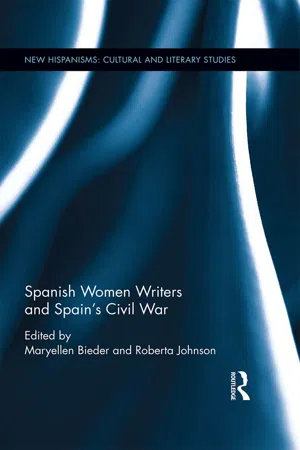
- 250 pages
- English
- ePUB (mobile friendly)
- Available on iOS & Android
eBook - ePub
Spanish Women Writers and Spain's Civil War
About this book
Information
1 María Zambrano’s Enduring Drama
Remembering the Spanish Civil War
María Zambrano, an exceptional Spanish philosopher of the twentieth century, was a philosopher of the poetic; that is to say, her use of the word was intensely lyrical, and fraught with the ambiguous and polysemical nature of poetry. Enrique de Rivas describes Zambrano’s innate poetic self: “[P]odrían imaginar que su modo de expresarse simbólica y metafóricamente era producto de una voluntad profesional, de un ejercicio intencional del filosofar. Pero tengo para mí que era todo lo contrario; era el resultado de una manera de estar en las cosas, que no era filosofar, sino poetizar” (n.p.) [You could imagine that her way of expressing herself symbolically and metaphorically was a product of a professional choice, of an intentional exercise of philosophizing. But I believe it was exactly the opposite; her style was the result of a way of being in things that was not philosophizing, but rather poeticizing].1 In addition and not surprisingly, Zambrano’s practice of the then nascent art of literary criticism reveals her profound sensibility to the power of literature as philosophical treatise.2 Her ability to demonstrate Spain’s idiosyncrasies through weaving archetypical literary figures and tropes into intrahistorical interpretations is one of her greatest talents.3
But as Zambrano would also explain, writing was not just poetic, and literature was not just a vehicle for arriving at the quintessence of philosophy. Philosophy was also a means to remember, to be consequential, so that history does not cease to exist or is not distorted. María Zambrano embodied philosophy in this sense. She considered herself as part of what she called the “Generation of the Bull”; she identified with, above all, the intellectuals who suffered through the Civil War, who experienced death or exile as a result of it, and who, I would add, remembered through writing. She explains in a 1937 article, “A los poetas chilenos de ‘Madre España’” [To the Chilean poets from “Mother Spain”], written while in Chile to commemorate the solidarity of writers there with the Republican cause: “Yes con la poesía y con la palabra, es con la razón creadora y con la inteligencia activa en conjunción con esa sangre que corre a torrentes, como hay que forjar este Renacimiento del pueblo español que traerá un mundo nuevo para todos los pueblos” (96) [And it is with poetry and with the word, with creative reason and with active intelligence in conjunction with that blood that runs in torrents, that we can forge this Renaissance of the Spanish people that will bring a new world to all nations].4
For Zambrano, just as the intellect and its artistic products were weapons to change the world, they were also the tools with which to console Spain’s people. And the intellectuals were responsible for saving Spain, a principle that she elucidates in her war disquisitions written between 1936 and 1939 and included in Los intelectuales en el drama de España. Ensayos y notas (1936–1939) [The Intellectuals in Spain’s Drama. Essays and Notes] (LIDE). She felt that poetry was the best medium to express the tragedies of war. Her essays on Antonio Machado and Pablo Neruda5 included in the volume are testimonies to this conviction, as are her close friendships with many of Spain’s and Latin America’s poets throughout her life, all experiences that would inspire her in the development of her philosophy, which she would call la razón poética [poetic reason]. For instance, Zambrano’s evolving theory of poetic reason is visible in her essay “Pablo Neruda o el amor a la materia” [Pablo Neruda or the love of matter] where she speaks of Neruda’s prolificity as a poet: “[P]odría vivir el descanso si el ser poeta no consistiera precisamente en no poder descansar de serlo—como el filósofo también” (LIDE 160) [he would be justified as a poet; he could live in peace, if being a poet did not consist precisely of being unable to rest from being [a poet]—just like the philosopher]. Philosophy, like poetry, was a way of life according to Zambrano, and she manifested this symbiosis throughout her life.
LIDE underwent diverse editions and iterations. There are four editions of the essays. The first was published in Santiago de Chile in 1937 by Editorial Panorama and includes Parts I and II. The second edition, published forty years later by Editorial Hispamerca,6 includes a prologue written by the author in 1977 and Parts I and II, in addition to many articles Zambrano published during the War (between 1937 and 1939), mostly in the journal Hora de España.7 The third edition, entitled Senderos [Paths], was published in 1986 by Anthropos; it includes all the articles from the second edition and her essay or drama, La tumba de Antígona [The tomb of Antigone] (1967), with a short prologue by Zambrano, written in 1985, placed before the 1977 prologue. The latest version of LIDE came out in 1998, published by Editorial Trotta, entitled Los intelectuales en el drama de España y escritos de la guerra civil [LIDE and writings on the Civil War], with a prologue and a political chronology of Zambrano’s life between 1928 and 1939 by Jesús Moreno Sanz. This edition includes a number of articles not found in the Hispamerca edition, mostly from just before and after the War. This essay will concentrate on the Hispamerca edition, given its significance as a unique series of essays recovered after the end of the Franco regime. Although I will briefly take into consideration Zambrano’s 1977 preface in light of the incipient democracy in Spain and her reaction to it, this essay will concentrate on her work during the War years, not on the evolution of her post-bellum thinking.8
María Zambrano never considered herself a feminist, nor did she join any women’s groups in Madrid. From a very early age, she seemed to see herself as an ageless metaphysical being, disinterested in gender. She started out as a rationalist—thanks to her father, the Krausist Blas Zambrano and her early mentor, José Ortega y Gasset.9 Yet she became conflicted about strictly rational thought as she matured as a person and as a philosopher and developed her theory of poetic reason. She hoped to rise above the double standard imposed on the women of her times. She attempted to transcend all the ordinary clichés and concepts about life, especially the concept of men and women living in constant conflict. She nearly always spoke of the person or the being. As Santiago Bolaños sees it, Zambrano was a “very uncommon woman,” who while living in a provincial town like Segovia (between 1909 and 1924) nevertheless held “European (modern and avant-garde)” ideas about life.10 Santiago Bolaños also comments on the fact that the 1928 column Zambrano published in the Madrid daily El Liberal called “Mujeres” [Women] reveals that she envisioned the ideal couple as equals (Zambrano, Cartas inéditas 37–38).11 For instance, in one essay that describes the civic duties of young Spaniards, Zambrano remarks that “todos—hombres y mujeres—estamos obligados a hacer política” (La aventura de ser mujer [The adventure of being a woman] 82) [all of us—men and women—are obliged to work in politics].
In the “Mujeres” articles, Zambrano demands that women take their rightful place in history, instead of living under patriarchal rules (Ortega 89). Women—including young and working-class women—must not be enslaved by men and must all be given dignity as political actors (Ortega 103). In her last column in November 1928, Zambrano exhorts women not to hide behind customs that have been created to keep them on the straight and narrow; rather, they should go out into the city and observe the world to build up their spirits (Ortega 107). Just as Zambrano herself took to the streets in the late 1920s and during the Republic, having experiences that helped mold her into an exceptionally modern and accomplished woman, she wished to inspire other women to do the same. The country was ripe for women to become visible and transcend the mediocrity in which they had been kept. The philosopher was observing this phenomenon in her own political activity, her teaching at the Instituto Escuela [School Institute], and her contacts with other women who had come to the forefront in the fields of education, law, literature, and art.12
Thus Zambrano became one of the salient female protagonists of the seething political scenario in Madrid at the end of the 1920s. She had already begun her political activity in 1928 in the Federación Universitaria Estudiantil [Spanish University Student Federation], and then in the Liga de Educación Social [League of Social Education].13 In 1930 Zambrano witnessed the demise of the Primo de Rivera dictatorship. The following year, the Second Spanish Republic was proclaimed. Zambrano witnessed the coming of the Republic in Madrid’s historic center—La Puerta del Sol—as King Alphonse XIII fled the country, and dictator Miguel Primo de Rivera’s replacement, Dámaso Berenguer, resigned. That same year she published her first political and philosophical treatise, Horizonte del liberalismo [Horizon of liberalism], in which she speaks of politics as “la actividad humana más intensa” [the most intensely human activity], signaling her desire to live a life of political commitment to liberal, revolutionary ideals. In addition to teaching Metaphysics at the Universidad Central [Central University], Zambrano began traveling around the country to participate in Republican/Socialist rallies. She was even approached to run for congress, an offer she refused so that she could pursue her work in philosophy.
Zambrano continued her impassioned political and intellectual life as she witnessed the growing rift between the center-left coalitions and those of the right. She began attending literary gatherings at cafés, publishing in progressive journals, and making contact with other writers and artists. In 1933 she joined Las Misiones Pedagógicas [The Pedagogical Missions], a Republican-inspired organization founded to educate Spaniards and to enrich the cultural life of the working class in towns around Spain. By 1934, she began diverging from Ortega y Gasset’s teachings and creating her own philosophical thought, which would become grounded in her writing on the Civil War. In 1935, she became one of the first women to hold a weekly salon at her home for other intellectuals—men and women of like ideas. Her immersion in the study of the literary classics would be one of the elements that would lead her to create her philosophy of poetic reason. Well aware of what was to come, Zambrano and her group of friends established La Alianza de Intelectuales Anti-Fascistas [Alliance of Antifascist Intellectuals] in April 1936, and when the War began, the group organized cultural activities in Madrid and also in hospitals and at the fronts where they could reach the combatants.
By summer 1936, the violence had escalated into a full Civil War. Shortly thereafter, María traveled to Chile—via the Panamá Canal with a stop in Havana—and began writing what would become the first articles of LIDE, Parts I and II.14 According to Jesús Moreno Sanz, the salient characteristics of this “first moment” of Zambrano’s war writing are the anguish of coming to terms with the Civil War and the urgency of trying to understand how that war had come about (Zambrano, LIDE y escritos 27). In addition, she writes with a restlessness that reveals her discomfort at having “abandoned” her country at the onset of the War.
In the shortest essay of “Part I,” entitled “La inteligencia y la revolución” [The intelligentsia and the revolution], the author sets the stage for describing the role of the intellectual as warrior: “Si otros ofrecen su vida sobre la tierra helada de las trincheras, no hará nada de más el intelectual arriesgando su existencia de intelectual, aventurando su razón en este alumbramiento del mundo, que se abre camino a través de la sangre” (LIDE 24) [If others offer their lives on the frozen earth of the trenches, the intellectual cannot do anything but risk her or his existence as an intellectual, venturing his or her reason in this birth of the world, where a pathway is opened up through blood]. Juan Fernando Ortega Muñoz quotes Zambrano at the beginning of Part I: “Intentemos de nuevo encontrar la razón del mundo, no de las cosas, sino de los sucesos. Aventurarse en el laberinto terrible de los sucesos” (LIDE 24) [Let us again attempt to find the reason of the world, not of things, but of events. (Let us) venture into the terrible labyrinth of events]. Ortega Muñoz proposes that here Zambrano attempts to enter into the intrahistory of Spain through a “metaphysical analysis” that parallels a “metahistorical analysis” (130–31). In her second and longer section, “La Inteligencia y el Fascismo” [The intelligentsia and fascism], Zambrano outlines the history of Western rationalism in order to point out that in spite of our idealistic espousal of reason, humankind has thwarted its advancement because of its propensity for rationality’s antitheses: passion, subterfuge, infantilism, and rebellion. Hers is not a rigorous study of fascism; it is, rather, an artistic and sociological appraisal akin to the ruminations of a cultural historian, albeit an emotionally involved historian. She writes about how fascism developed out of disillusionment, which is “desesperación impotente de hallar salida a una situación insostenible” (LIDE 30) [impotent desperation to find a solution to an unsustainable situation], that is—underneath its fictitious spirituality—inherently violent. For Zambrano, Spain’s only hope in the face of this counterfeit movement is communist revolution. And this is what the philosopher had briefly observed as she left Spain for Chile at the onset of the War: that the “fascismo mistificador” (LIDE 34) [fascist mystification] of medieval heroism espoused by the Right—the “Holy” Crusades15—quickly “faded,” while resolute militias recruited from leftist organizations of diverse, although largely Marxist-inspired affiliations, gained strength.
In the third section of Part I, entitled “El fascismo y el intelectual en España” [Fascism and the intellectual in Spain] the philosopher explains that Spain’s exceptionalism has caused it to become prey to the violent movement. According to Zambrano, Spain did not possess Europe’s greedy bourgeoisie or a capitalist society that could cause envy among the working class. Rather, the country was gripped by nostalgia for the past glories of colonization, and the desperation and the impotence of the military whose hunger for land and power led them to the bloody wars against ...
Table of contents
- Cover
- Half Title
- Title Page
- Copyright Page
- Table of Contents
- Introduction: Spanish Women Writers and Spain’s Civil War
- 1 María Zambrano’s Enduring Drama: Remembering the Spanish Civil War
- 2 Living the War, Writing the War: Poetic Figuration in Mercè Rodoreda’s La plaça del Diamant
- 3 Spaces of Enclosure in Liberata Masoliver’s Barcelona en llamas
- 4 Hybrid Discourses and Double Voices: Re-evaluating the Spanish Civil War in Mercedes Salisachs’s Novels
- 5 The Last Battle: Fuertes and the Politics of Emotion in Her Late Civil War Poems
- 6 The Theater of Maria Aurèlia Capmany and the Reverberations of Civil War (History, Censorship, Silence)
- 7 Carmen Laforet’s Inspiration for Nada (1945)
- 8 Carmen Martín Gaite’s Concept of Ruins
- 9 Novels as History Lessons in Ana María Matute’s Primera memoria (1960) and Demonios familiares (2014): From Betrayal to Solidarity
- 10 The Phantasm of Civil War in Josefina Aldecoa’s Novelistic Trilogy
- 11 Impossible Neutrality: Civil War and Melodrama in Marina Mayoral’s Novels
- 12 Montserrat Roig and the Civil War: Questions of Genre, Gender, and Authorial Presence
- 13 Family Documents, Analogy, and Reconciliation in the Works of Carme Riera
- 14 Dead Woman Walking: “Historical Memory,” Trauma, and Adaptation in Dulce Chacón’s La voz dormida
- List of Contributors
- Index
Trusted by 375,005 students
Access to over 1.5 million titles for a fair monthly price.
Study more efficiently using our study tools.
Frequently asked questions
Yes, you can cancel anytime from the Subscription tab in your account settings on the Perlego website. Your subscription will stay active until the end of your current billing period. Learn how to cancel your subscription
No, books cannot be downloaded as external files, such as PDFs, for use outside of Perlego. However, you can download books within the Perlego app for offline reading on mobile or tablet. Learn how to download books offline
Perlego offers two plans: Essential and Complete
- Essential is ideal for learners and professionals who enjoy exploring a wide range of subjects. Access the Essential Library with 800,000+ trusted titles and best-sellers across business, personal growth, and the humanities. Includes unlimited reading time and Standard Read Aloud voice.
- Complete: Perfect for advanced learners and researchers needing full, unrestricted access. Unlock 1.5M+ books across hundreds of subjects, including academic and specialized titles. The Complete Plan also includes advanced features like Premium Read Aloud and Research Assistant.
We are an online textbook subscription service, where you can get access to an entire online library for less than the price of a single book per month. With over 1.5 million books across 990+ topics, we’ve got you covered! Learn about our mission
Look out for the read-aloud symbol on your next book to see if you can listen to it. The read-aloud tool reads text aloud for you, highlighting the text as it is being read. You can pause it, speed it up and slow it down. Learn more about Read Aloud
Yes! You can use the Perlego app on both iOS and Android devices to read anytime, anywhere — even offline. Perfect for commutes or when you’re on the go.
Please note we cannot support devices running on iOS 13 and Android 7 or earlier. Learn more about using the app
Please note we cannot support devices running on iOS 13 and Android 7 or earlier. Learn more about using the app
Yes, you can access Spanish Women Writers and Spain's Civil War by Maryellen Bieder,Roberta Johnson in PDF and/or ePUB format, as well as other popular books in Literature & European Literary Criticism. We have over 1.5 million books available in our catalogue for you to explore.