eBook - ePub
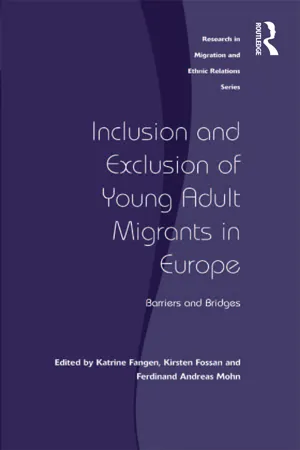
Inclusion and Exclusion of Young Adult Migrants in Europe
Barriers and Bridges
- 298 pages
- English
- ePUB (mobile friendly)
- Available on iOS & Android
eBook - ePub
Inclusion and Exclusion of Young Adult Migrants in Europe
Barriers and Bridges
About this book
Inclusion and Exclusion of Young Adult Migrants in Europe presents analyses of research carried out during the course of the EUMARGINS research project, exploring the inclusion and exclusion of young adult immigrants across a range national contexts, including the Nordic welfare states, old colonial countries, Southern European nations and the Eastern European region. Scrutinising legal, policy and historical sources, as well as participation in labour market and education systems, this volume engages with multiple social arenas and spheres, to integrate research and provide a cohesive investigation of the dynamics of each national setting. In addition to the chapters focused on individual national contexts (Estonia, France, Italy, Norway, Spain, Sweden and the UK), the book also provides a comprehensive transnational analysis, developing a comparative perspective and explaining the overarching research framework. A carefully organized and comprehensive exploration of the exclusion and inclusion of young adult migrants in Europe, Inclusion and Exclusion of Young Adult Migrants in Europe will appeal to social scientists with interests in migration, population change, integration and exclusion.
Information
Chapter 1
Introduction: Turning Adult, Becoming Nationalized
Katrine Fangen and Ferdinand Andreas Mohn
This book is a product of the first research phase of EUMARGINS,1 a research project endeavouring to enhance our understanding of inclusion and exclusion processes among young adults of immigrant background. The purpose of this phase has been to analyse secondary data in order to answer the following question: How is the inclusion and exclusion of young adults with immigrant backgrounds framed by different aspects of the host society context?
What young adults of immigrant background experience as inclusion and exclusion on the individual level is framed by different contextual factors such as the type and volume of immigration in each country, the actual degrees of poverty and inequality, the political tone, the climate of the media, cultural tensions and European politics. The empirical context of our research is seven European countries, namely Norway, Sweden, the United Kingdom, Estonia, Spain, Italy and France. Although all seven countries in our study are European, there are great differences when it comes to their histories of immigration, immigration and integration policies, social benefits, education systems and labour market structures. What obstacles and opportunities are young adults of immigrant background facing in today’s Europe? Finding out how juridical, political, economic and cultural contexts are framing their processes of inclusion and exclusion is of vital importance to the young adults themselves, to the host societies they have joined, and to the European Union.
The EU has developed a set of ten primary indicators to measure social exclusion, including persistent low income levels, long-term unemployment, living in jobless households and being an early school leaver not in further education or training (Social Protection Committee 2001).2 Gaining access to education and employment is a critical stage in the lives of young people in general, but statistics show that young immigrants face greater barriers than young people from the majority population (for example, Feliciano and Rumbaut 2005, Olsen 2009). Descendants of immigrants, on the other hand, occasionally perform on the same level or even better than the majority population in some countries (Olsen 2009). The same holds for certain ethnic minority groups such as the Indian and Chinese in the UK (Fry et al. 2008). Nevertheless, in most European countries, the picture of ethnic inequality in general prevails (Kalter and Kogan 2006). Occasionally, public discourses justify or excuse the prevalence of ethnic inequalities by claiming that immigrants have themselves to blame (Van Dijk 1992: 94). Such a perspective distracts attention from the responsibility of receiving governments, and fails to take into account the role of discrimination and prejudices, and the evident gap in material resources for the continuing ethnic inequality in society. The fact that Europe is ageing means that there will be a growing need for young people to fill jobs in sectors where there is a need for stability in the labour force (Esping-Andersen 2002: 3). This could imply a perception of young adult immigrants as a much-needed resource, and thus give them easier access to the education system and the labour market. However, in times of financial crisis, immigrants are often the first to be denied access to jobs (Rogstad 2000). It is therefore an open question whether the future trends go towards more inclusion or more exclusion of young adult immigrants in Europe.
The European Context – and Our Selection of Countries
The European Continent has seen a steep increase in foreign-born residents in recent decades (Penninx 2006: 7). The EU is seen as both the cause (through successive enlargements) and a possible alleviator of migratory pressures. The right to free movement of people is one of the fundamentals of the internal European market (Brady 2008). However, the external borders of Europe provoke allusions to walls – exemplified through the notion of ‘Fortress Europe’ (Lavenex 2001: 856).
While ‘unity in diversity’ is the motto of the EU (Baykal 2005) – which aims to defend common values such as freedom, peace and solidarity in a Union made up of many cultures and languages – there are other concerns implicit in the migration and integration policies. According to an official EU website, one of its main objectives is ‘to better manage migration flows by a coordinated approach which takes into account the economic and demographic situation of the EU’ (European Commission 2007). An important priority is to fight illegal migration, but on the other hand it is underlined that the EU needs migrants in certain sectors and regions in order to deal with its economic and demographic needs. As for integration policies, a top priority of the EU agenda is to promote full participation in the labour market and immigrants are seen as ‘an important pool of potential entrepreneurs in Europe’ (Commission of the European Communities 2007). European policy makers try to achieve economic and political integration, while they also try to protect and promote cultural and linguistic pluralism (Extra and Yagmur 2002). Carrera (2006) points out that the notion of integration as incorporated in national policies is often restrictive in nature, and does not facilitate immigrants’ social inclusion or fair treatment, equality, nondiscrimination and respect for diversity, which according to the Tampere European council should be at the heart of a common immigration policy in the EU.
Although immigration policies are Europeanized through treaties signed by most European countries, there remain national differences in immigration and integration policies, as well as welfare regimes, that cause both obstacles and opportunities for young adults of immigrant background in different countries. Our selection of countries is warranted by the variety of dimensions along which they can be compared and discussed.
First of all, we cover both the North-South axis and the East-West one, which enables us to study a variety of regimes and their welfare policies, border control, economic situations and much more. Participating institutions come from: Northern Europe – represented by Norway and Sweden, with the ‘Scandinavian’ welfare state model, according to Esping-Andersen’s (2002: 14) typology, characterized by a broad and quite generous income safety net ‘[which] is demonstrably an effective bulwark against poverty’ – and the United Kingdom, with a ‘liberal welfare model’ (Esping-Andersen 2002: 15). Southern Europe, in our case France, Italy and Spain, are run by a ‘continental European welfare model’ (Esping-Andersen 2002: 16–17), characterized by ‘an overly transfer-biased social policy [which] is, arguably, an ineffective response to social exclusion’ (Esping-Andersen 2002: 17). Furthermore, the Italian and Spanish system is based on decentralization, reliance on family solidarity, a large informal sector and a recent history of authoritarian politics (Millar and Middleton 2002). Eastern Europe, represented by Estonia, has a different historical, political and economic situation following the collapse of the Soviet Union. The country has a fairly well developed welfare system, but it is not as extensive as the Nordic model, and unemployment benefits are insufficient for basic subsistence (see Chapter 4).
Second, nation-states with both long-term and recent immigration experience are represented in the research. France has been a net immigrant country for over 100 years, whereas the reception of immigrants in Italy and Spain spans only about two decades (Penninx 2006: 8). Labour-driven migration with a temporary orientation dominates entry into Spain, and short-period residence and work permits are often found to be obstacles to long-term integration (Kalter and Kogan 2006: 262) – a situation that largely holds for Italy as well. Still, Southern Europe has erected a symbolic fence as protection against the global south. As the gateway to Europe from Africa and Asia, these areas are characterized by larger flows of migrants, and correspondingly tougher conditions compared to the situation in Northern Europe. While countries from Scandinavia have a similarly brief history of net immigration, their economic conditions are radically different – and their geographic location makes their inflows more easily regulated.
Third, there is the composition of the immigrant population in terms of legal, political and cultural status – which reflects different migration histories. Thus whether the immigrant has come as a refugee, an asylum seeker or as an economic migrant, whether she represents people with a history of domination recently transformed into minorities, or ethnic minorities which because of the colonial past have a long representation in the country – are all factors that may contribute to their conditions of exclusion and inclusion. We seek to convey different inclusion and exclusion patterns of migrants belonging to the same category (for example, refugee or labour migrant), depending on country of reception and residence.
Fourth, there are substantial differences in access to citizenship, in particular between to what degree the countries emphasize most a citizenship conferral system based on jus soli, jus sanguinis or jus domicili (most of the countries have a combination of these, but with very different emphasis).
Analytical Framework
Research questions on several levels guide our study. What challenges and opportunities are young adult immigrants and descendants facing in different countries? What is their rate of participation in education, labour and leisure compared with young people without immigrant background? How is the complex interplay of ethnicity, class background, migration history, gender and urban context influencing their lives? Through an investigation of how juridical, political, economic and cultural patterns are framing processes of inclusion and exclusion, we seek to understand to what degree these factors are local – and to what extent similar mechanisms operate in several national contexts. A bottom line in conducting our research efforts is the desire to uncover the barriers that impede inclusion – and to shed light upon the factors that may create exclusion. Therefore, theories of social exclusion are central to our understanding. In addition, youth sociology, and in particular the branch that focuses on the transition to adulthood, is central, as are theories of immigrants’ incorporation into a new society.
Social Exclusion3
As argued by Esping-Andersen (2002: 3), the post-war welfare state has succeeded in equalizing living conditions, but it has failed to deliver its promise of disconnecting opportunities from social origins and inherited handicaps. Despite the idea that everyone can choose their own identity and life-plan, social exclusion and systematic inequalities according to class, gender and ethnicity are all still facts.
Even with its prominent role in the European public and scientific discourse, social exclusion remains a contested term and it is framed in different ways by different authors (Middleton et al. 2003: 5). Nevertheless, late in 2001 the Social Protection Committee of the EU (part of the Directorate-General Employment and Social Affairs) adopted a set of commonly agreed indicators for social exclusion. The main impetus for this achievement arose through the agreement at the Lisbon European Council to promote social inclusion as a key strategy of the EU. However, as argued by Feres et al. (2002), there is no reason to believe that the sensitivity of indicators is the same across countries or across indicators.
According to Room (1999: 167), it is important both for policy and explanatory purposes to disentangle different elements of hardship and also to identify the interrelationship for example between financial poverty and poor housing, between educational failure and lack of skills on the job market, between deprived childhoods and subsequent patterns of health and sickness. The way in which exclusion occurs is dependent on young people’s belonging to a plurality of disadvantaged categories. On the one hand, young immigrants sometimes face greater barriers if they do not speak the dominant language fluently, or if they do not feel comfortable with the cultural codes or do not know how to cope with different sectors of society (Fekjær 2007). On the other hand, research shows that young people with immigrant backgrounds often have extra drive, because they expect to face challenges (Lauglo 2000). Descendants with certain national backgrounds occasionally also perform better than the majority population (Daugstad 2009; Chapter 3 in this volume). It is, however, important to clarify in what arenas the young adults are included and on whose terms, and also what field of possibilities they have.
During later years, it has been common to speak of a new social exclusion perspective, which is better suited to the analysis of the more heterogeneous, multicultural and complex societies (Body-Gendrot 2002). Social scientists highlight different aspects that they think should be included when analysing the societal changes that create new conditions for the social exclusion of young people. Sernhede (2002) underlines the growing inequalities in Europe, and the development of the two-thirds societies (societies in which two-thirds enjoy the benefits of affluence, while one-third are locked into poverty or near-poverty (Headey et al. 1993)), whereas Room (2005) emphasizes that the focus should be extended beyond poverty and should not solely be on the individuals, but also on their material and physical surroundings. Weil et al. (2005) highlight the need to focus on relationships and interactions among and between excluded and included groups and communities. Proponents for the interactionist perspective argue that the focus should not be only on differences between immigrants and non-immigrants, but rather on the intersection of variables (for example, Modood 2007). Social class is brought in to make the picture of ethnic inequality less one-dimensional (Fangen 2010). Finally, Weil et al. (2005) argue that an enhanced emphasis on time contributes to a more dynamic view than the one given by static structural explanations. Last but not least, exclusion does not only occur within the unit of the national state. A transnational perspective is better suited to including the whole range of inclusion and exclusion processes experienced by immigrants and their descendants (Wimmer and Schiller 2003).
It is impossible to go into depth on all these aspects in one book. However, we draw on some of these perspectives by focusing on the social exclusion found in different contexts, thus underlining the multi-dimensional aspect of social exclusion (Room 1995). The underlying question is: ‘What is it that contributes to the social exclusion of young adult immigrants and descendants in different social settings?’4 In this book, we examine selected arenas in which social exclusion comes about: the education system, the labour market, civil society, crime and politics. We also investigate how social exclusion can be caused by immigration policies, public discourses, cultural practices and attitudes.5
According to a dominant social scientific view, a young person is socially excluded at some moment in time if the person is currently outside the structured arenas of school and work, and also has a high probability of remaining outside in the near future, given that the economy is in (or returns to) a ‘normal’ state (Raaum et al. 2009: 175). The extent to which different indicators serve as risk factors for the social exclusion of young people varies between different European countries. Tsakloglou (2003: 32, 35) found that in general there is a lower probability of young adults remaining in deprivation than the population at large. However, a movement from full-time work to unemployment was strongly correlated with poverty for young adults in all the countries compared (Austria, Germany, Greece, Portugal and the UK), and especially so in the UK. However, this study did not single out differences by immigrant or native background, which is the object of our concern.
A process of social exclusion is a process of ‘losing ground’ in a number of arenas simultaneously, such as the labour mar...
Table of contents
- Cover Page
- Title Page
- Copyright Page
- Contents
- List of Figures
- List of Tables
- List of Contributors
- 1 Introduction: Turning Adult, Becoming Nationalized
- 2 Spain: Irregular Lives in the Southern Rim of Europe
- 3 The UK: Imperial Spectres, New Migrations and the State of ‘Permanent Emergency’
- 4 Estonia: A Post-Soviet Predicament
- 5 Italy: Unreceptive Climate and Forced Adulthood
- 6 Norway: The Pitfalls of Egalitarianism
- 7 France: Diversity in the Republican Nation
- 8 Sweden: Being a Stranger in the ‘People’s Home’
- 9 Assessing the Situation: Cross-National Comparison
- Index
Trusted by 375,005 students
Access to over 1.5 million titles for a fair monthly price.
Study more efficiently using our study tools.
Frequently asked questions
Yes, you can cancel anytime from the Subscription tab in your account settings on the Perlego website. Your subscription will stay active until the end of your current billing period. Learn how to cancel your subscription
No, books cannot be downloaded as external files, such as PDFs, for use outside of Perlego. However, you can download books within the Perlego app for offline reading on mobile or tablet. Learn how to download books offline
Perlego offers two plans: Essential and Complete
- Essential is ideal for learners and professionals who enjoy exploring a wide range of subjects. Access the Essential Library with 800,000+ trusted titles and best-sellers across business, personal growth, and the humanities. Includes unlimited reading time and Standard Read Aloud voice.
- Complete: Perfect for advanced learners and researchers needing full, unrestricted access. Unlock 1.5M+ books across hundreds of subjects, including academic and specialized titles. The Complete Plan also includes advanced features like Premium Read Aloud and Research Assistant.
We are an online textbook subscription service, where you can get access to an entire online library for less than the price of a single book per month. With over 1.5 million books across 990+ topics, we’ve got you covered! Learn about our mission
Look out for the read-aloud symbol on your next book to see if you can listen to it. The read-aloud tool reads text aloud for you, highlighting the text as it is being read. You can pause it, speed it up and slow it down. Learn more about Read Aloud
Yes! You can use the Perlego app on both iOS and Android devices to read anytime, anywhere — even offline. Perfect for commutes or when you’re on the go.
Please note we cannot support devices running on iOS 13 and Android 7 or earlier. Learn more about using the app
Please note we cannot support devices running on iOS 13 and Android 7 or earlier. Learn more about using the app
Yes, you can access Inclusion and Exclusion of Young Adult Migrants in Europe by Kirsten Fossan, Katrine Fangen,Kirsten Fossan,Ferdinand Andreas Mohn in PDF and/or ePUB format, as well as other popular books in Social Sciences & Anthropology. We have over 1.5 million books available in our catalogue for you to explore.