eBook - ePub
African Identity in Post-Apartheid Public Architecture
White Skin, Black Masks
- 320 pages
- English
- ePUB (mobile friendly)
- Available on iOS & Android
eBook - ePub
About this book
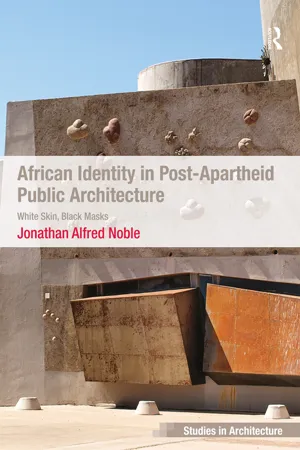
Since the end of Apartheid, there has been a new orientation in South African art and design, turning away from the colonial aesthetics to new types of African expression. This book examines some of the fascinating and impressive works of contemporary public architecture that 'concretise' imaginative dialogues with African landscapes, craft and indigenous traditions. Referring to Frantz Fanon's classic study of colonised subjectivity, 'Black Skin, White Masks', Noble contends that Fanon's metaphors of mask and skin are suggestive for architectural criticism, in the context of post-Apartheid public design. Taking South Africa's first democratic election of 1994 as its starting point, the book focuses on projects that were won in architectural competitions. Such competitions are conceived within ideological debates and studying them allows for an examination of the interrelationships between architecture, politics and culture. The book offers insights into these debates through interviews with key parties concerned - architects, competition jurors, politicians, council and city officials, artists and crafters, as well as people who are involved in the day-to-day life of the buildings in question.
Information
1
Introduction
In writing this book, I have wished to produce a reading of recent South African architecture in celebration of one of Africa’s finest critical thinkers, Frantz Fanon. The title for this book, On Questions of African Identity in Post-Apartheid Public Architectural Design, 1994–2009: White Skin, Black Masks, was chosen with reference to Fanon’s classic study of colonised subjectivity in his renowned book Black Skin, White Masks (BS).1 I contend that the metaphors of mask and skin – as gleaned from Fanon’s title – are suggestive for architectural criticism in the context of post-apartheid public design. Fanon’s non-essentialist theories of race, culture and identity provide a theoretical framework for dealing with the visionary quality of the new architecture and its relation to dominant versus repressed (African) forms of architectural expression – political and aesthetic themes that are central to the book as a whole. White Skin, Black Masks also recognises the fact that the new architecture of the last few years has mostly been designed by white architects – designers who have been asked to adopt an African persona in design.2 And in most cases, these designs have initiated gestures that move architectural discourse in an appropriate direction. On this point, it may be noted that political/aesthetic questions as to what constitutes authentic (or inauthentic) African identity, authentic (or inauthentic) African expression in design are a recurring theme of the book.
Due to the destructive legacy of colonial and apartheid rule, the terms of reference for a new public architecture are far from clear. This circumstance, although tied to a bleak history, might also be seen as an important opportunity because it invites all South Africans to ask fundamental questions of their personal and collective belonging. In the absence of clear public or private grammars, recent public designs have begun to experiment with new forms of political imagination. Topical questions of African identity and imaginative dialogue with African landscapes, craft and indigenous traditions have inspired fascinating and impressive works of architecture. These projects represent a unique moment in the history of a nation and raise important political, social and aesthetic issues that warrant careful consideration.
Beginning with South Africa’s first democratic election of 1994, this book considers public buildings that resulted from architectural design competitions. The prevalence of public design competitions, in the early post-apartheid period, is significant for it marks a departure from the past, where ‘public matters’ were controlled by the apartheid state and where design competitions were not common. Consideration of design competitions provides a useful way to study architectural and ideological debates, to ascertain why certain imaginations are selected and others rejected and may be used to inform interpretation of the buildings that evolve from this process.
A key question has concerned which projects to include in the book. Crucial in this regard has been the choice between covering a wide range of designs, or a select few studied in substantial detail. I chose the latter, opting to write detailed histories of five projects because this approach provides a better scope for the study of unique circumstances, particular dialogues and debates, and the architectural responses that result from these interesting processes. In each case, I consider various schemes that were submitted to the competition process, so the five case studies cover a fair number of designs. A positive feature of the new public architecture in South Africa today is its rich and diverse quality. The five case studies – spanning Chapters 2–6 – were selected for their political and architectural prominence, and showcase substantially different kinds of architecture, set in equally diverse locales. The book is attentive to the unique qualities of each case, but the narrative also raises more general, theoretical questions as to the representation of identities, culture and subjugated histories, and how these concerns impact on our conception of architecture.
Unfortunately, archival information for urban and architectural studies is virtually non-existent in South Africa. My research, of necessity therefore, has centred upon interviews with key parties concerned – architects, competition jurors, politicians, council and city officials, artists and crafters, and people who are involved in the day-to-day life of the buildings in question. During these interviews, I requested copies of documentary evidence and in this way, I began to build up a substantial archive of research documents – papers that are cited in this book. This approach has enabled me to position different subjectivities and to derive architectural interpretation from these perspectives.
Although there is a growing body of new literature on the subject of ethnicity – which includes wide-ranging social studies of ethnic and racial differences – scarce study has been made of the relationships that exist between architecture and racialised identity.3 Lesley Naa Norle Lokko’s edited book, White Papers, Black Marks: Architecture, Race, Culture has made a timely and unique contribution to the study of architecture and race.4 It is worth noting that with respect to established architectural perspectives, Lokko states that ‘blacks, either as Africans or as diasporic cultures, have historically had nothing to say about architecture – as a consequence, architecture has had little to say in response’.5 Lokko furthermore maintains that working through the intertwined categories of race and architecture requires a stepping back from the ‘traditional formal qualities’ of architecture. My own work, however, moves in a different direction, in response to an emerging body of architectural design – works that warrant careful study of the aesthetics and materiality of buildings, the intentions of the architect and client, as well as a consideration of various forms of public reception.
We shall now proceed with a theoretical discussion of Fanon, and questions of postcolonial identity, to prepare a theoretical ground for the empirical case studies that follow in subsequent chapters.
Identifications
Questions of identity in design are commonly approached from the perspective of regionalist, contextual study, or in terms of some assumed genus of the nation. These approaches are limited since a contextual study of the post-apartheid city often fails to acknowledge that ‘urban context’ was produced by the dominance of colonial and apartheid practices, and therefore risk repeating what should be questioned while a preoccupation with nationalism places overly institutionalised restrictions upon the wider issues pertinent to a cultural politics of identity. This book has sought to resist these approaches and, instead, has taken its lead from theories of postcolonial subjectivity.
What is subjective identity, and how does it feature in questions of cultural politics? The French political philosopher, Etienne Balibar, is helpful when he suggests that we should not so much speak of identity, but rather of the more fluid processes of identification:
[i]n reality there are no identities, only identifications: either with the institution itself, or with other subjects by the intermediary of the institution. Or, if one prefers, identities are only the ideal goal of processes of identification, their point of honor, of certainty or uncertainty of their consciousness, thus their imaginary referent.6
Identifications are always performed in relation to others. The politics of identity involves motions of solidarity, through which we imaginatively construct the ‘we’ of political participation. Balibar emphasises the positioned, plural and participatory nature of this undertaking – a point that requires identifications to be studied in their contextual specificity. Identities are also inter-subjective and linguistically constituted, and are mediated through various types of media, including works of architecture.
I take it as given that architecture today is required to operate within the highly differentiated field of modern – or, if you prefer, postmodern – society. And for which reason, I have wanted to resist homogenising concepts, such as the idea of an ‘African style’, or of some unified conception of ‘African architecture’. Not all buildings are equally suited for raising questions of cultural identity, and when issues of cultural identity are raised, the terms of reference are bound to differ from one building type to the next. Public buildings, such as the projects studied in this book, are loaded with explicit symbolic significance. As Norberg-Schulz explains: ‘public building embodies a set of beliefs or values, it ought to appear as an “explanation,” which makes the common world visible.’7 In presenting recent public designs, I have sought to uncover the particularity of each case. And in doing so, my research has not so much focused upon an ‘objective’ set of buildings, but rather upon the social discourses that circulate these projects, and the varied forms of identification that have resulted from these circuits.
Black Skin, White Masks
Born in 1925 at Fort-de-France, the capital of Martinique, Frantz Fanon grew up in a French-speaking, middle-class family. He studied psychiatry at Lyon Medical School, obtaining his thesis in 1951. After completing his studies, Fanon moved to Algiers where he took up a post at Blida-Joinville Psychiatric Hospital. His experiences there as a psychiatrist provided invaluable insights into the pathologies of the colonised black subject, insights which later fed his early work Black Skin, White Masks (BS).8 By 1956, Fanon had given up his position with the hospital, and left Algiers. He became a full-time revolutionary, devoting many years of his life to the cause of the Algerian revolution. He also travelled to Ghana and Mali, with the hope of developing anti-colonial solidarity across the Sahara. He died on 6 December 1961, his thought steeped in the issues and revolutionary thinking of his time.9 And yet despite this fact, I hope to show that Fanon’s work speaks for today, and with remarkable clarity.
Fanon wrote two books of seminal importance, BS and The Wretched of the Earth (TWE).10 BS discusses ambivalences of subjective identity and a sense of inferiority that is induced by colonisation. TWE, his later work, by contrast concerns violence and revolt against colonial rule. A different Fanon can be made to emerge, depending on how one relates these rather different works. An important methodological issue begins to emerge. Is BS merely a prelude to TWE, or may we choose to read these works on their own terms – an important question that cannot be wrestled with here. Suffice to say that in the context of this study, BS provides a helpful entry into questions of African postcolonial identity – this being the precise issue that recent public architecture has sought to address.
Fanon’s Prose
We shall now move to consider a reading of Fanon’s text, BS, one that will open useful avenues for architectural interpretation. First-time readers of BS will undoubtedly be struck by the unique character of Fanon’s prose. His thought is dense and multilayered, energetic and rich. The text progresses in a somewhat jerky fashion as the reader is made to jump from one section to the next, a jump which often brings with it the surprise of a different voice. The many voices that appear to speak through his work provide momentary perspectives. There are moments of intense subjectivity, moments of sober calm, moments of humour, moments of philosophical reflection, as well as moments of detached analysis. As noted by Kobena Mercer, Fanon’s writing traverses a wide range of registers: ‘autobiographical, clinical, sociological, poetical, philosophical, political’.11 The polyvalent character of Fanon’s thought is derived from his attempt to confront the impossibility of the colonial circumstance. How to be free in a world where the black man12 is blocked and choked by white rule: ‘[a]ll round me the white man, above the sky tears at its navel, the earth rasps under my feet, and there is a white song. All this whiteness that burns me.’13
Fanon is not afforded the luxury of choice: he is compelled to search for freedom down diverging avenues. His book is not some artfully staged eclectic mix of ideas, but rather a quest motivated by an ethical intention. Philosophical considerations are not treated as autonomous signs belonging to closed loops of thought, but as vehicles in an urgent search for freedom. Fanon’s text is not free of self-contradiction, nor easily resolved into a singular coherence. This has, no doubt, been perplexing for many readers of BS. Yet if, as I have suggested, Fanon’s philosophical resolve can be read as a commitment to work through momentary propositions, then we are surely relieved of the need to systematise his thought.14 Indeed, does not Fanon explicitly tell us as much?
I do not come with timeless truths. My consciousness is not illuminated with ultimate radiances.15I leave methods to the botanists and the mathematicians. There is a point at which methods devour themselves.16I have not wished to be objective. Besides, that would be dishonest: It is not possible for me to be objective.17
Subjectivity and Colonial Rule
The fragmentary, indeed the aesthetic character, of Fanon’s pro...
Table of contents
- Cover
- Half Title
- Title Page
- Copyright Page
- Table of Contents
- Dedication
- List of figures
- Foreword
- Acknowledgements
- 1 Introduction
- 2 Imagination and Identification, Part 1: The Mpumalanga Legislature, Nelspruit
- 3 Imagination and Identification, Part 2: The Northern Cape Legislature, Kimberley
- 4 ‘We the People’, Part 1: The Constitutional Court of South Africa at Constitution Hill, Johannesburg
- 5 ‘We the People’, Part 2: The Walter Sisulu Square of Dedication, Kliptown
- 6 Honouring Our Other ‘We’: Freedom Park, Pretoria
- 7 Conclusion
- Bibliography
- Index
Trusted by 375,005 students
Access to over 1.5 million titles for a fair monthly price.
Study more efficiently using our study tools.
Frequently asked questions
Yes, you can cancel anytime from the Subscription tab in your account settings on the Perlego website. Your subscription will stay active until the end of your current billing period. Learn how to cancel your subscription
No, books cannot be downloaded as external files, such as PDFs, for use outside of Perlego. However, you can download books within the Perlego app for offline reading on mobile or tablet. Learn how to download books offline
Perlego offers two plans: Essential and Complete
- Essential is ideal for learners and professionals who enjoy exploring a wide range of subjects. Access the Essential Library with 800,000+ trusted titles and best-sellers across business, personal growth, and the humanities. Includes unlimited reading time and Standard Read Aloud voice.
- Complete: Perfect for advanced learners and researchers needing full, unrestricted access. Unlock 1.5M+ books across hundreds of subjects, including academic and specialized titles. The Complete Plan also includes advanced features like Premium Read Aloud and Research Assistant.
We are an online textbook subscription service, where you can get access to an entire online library for less than the price of a single book per month. With over 1.5 million books across 990+ topics, we’ve got you covered! Learn about our mission
Look out for the read-aloud symbol on your next book to see if you can listen to it. The read-aloud tool reads text aloud for you, highlighting the text as it is being read. You can pause it, speed it up and slow it down. Learn more about Read Aloud
Yes! You can use the Perlego app on both iOS and Android devices to read anytime, anywhere — even offline. Perfect for commutes or when you’re on the go.
Please note we cannot support devices running on iOS 13 and Android 7 or earlier. Learn more about using the app
Please note we cannot support devices running on iOS 13 and Android 7 or earlier. Learn more about using the app
Yes, you can access African Identity in Post-Apartheid Public Architecture by Jonathan Alfred Noble in PDF and/or ePUB format, as well as other popular books in Politics & International Relations & Architecture General. We have over 1.5 million books available in our catalogue for you to explore.