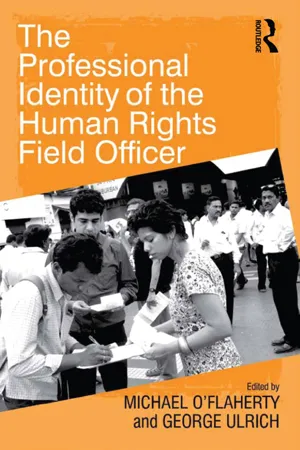
eBook - ePub
The Professional Identity of the Human Rights Field Officer
- 486 pages
- English
- ePUB (mobile friendly)
- Available on iOS & Android
eBook - ePub
The Professional Identity of the Human Rights Field Officer
About this book
The important and groundbreaking volume, The Professional Identity of the Human Rights Field Officer, completes the study of human rights field work begun in the earlier The Human Rights Field Operation: Law Theory and Practice (2007: Ashgate). Building on the critique of the field's historical development and current situation featured in the earlier volume, O'Flaherty, Ulrich and their fellow contributors focus on the specific responsibilities of the individual human rights officer, and concentrate on vital issues of professionalism beyond the confines of any specific organization. Their expansion of the analysis in the case studies section of the first volume has resulted in an up to date global edition of significant academic interest to anyone within the field of human rights law.
Chapter 1
The Professional Identity and Development of Human Rights Field Workers
Michael O’Flaherty and George Ulrich1
Professionalism and Professionalisation
Early in 1994, one of the present authors (O’Flaherty) set out from Zagreb to Sarajevo to establish a human rights field office of the United Nations (UN). Travelling alone, he drove a jeep packed with valuable electronic equipment across the various combat zones and front lines of Bosnia-Herzegovina without the benefit of a security briefing, a communications system, or even a puncture-repair kit. Having arrived in the Bosnian capital, miraculously unscathed, he was under vague instructions to report back to Geneva on ‘the human rights situation’ and otherwise had carte blanche – there were neither templates for the reports nor guidelines regarding any of the ethical, technical and organisational challenges he would confront. He survived the experience and, hopefully, did some useful work.
His experience was by no means unique, as human rights field work at that time was in its very early stages and was subject to a process characterised by improvisation, adaptation, and learning by doing. In the decade-and-a-half that has since passed, the international community has undertaken an increasing number of human rights field operations and has on this basis generated a highly valuable body of experience which in turn has led to the definition of working methodologies and operational procedures.2 In this context, the work of human rights field officers has begun to take on the traits of a distinct professional identity. The present chapter seeks to explore this process of professionalisation with a view to identifying at what stage it may presently rest and what directions it might take for the future.
The process of professionalisation has been described as ‘an informal process begun by practitioners who perceive there to be exacting standards required of their activities which make it necessary to exclude amateurs’.3 Drawing on observations of such well-established specialist groups as medical doctors, lawyers and theologians, as well as more newly formed professions such as, for example, psychiatry and humanitarian assistance, commentators have suggested that the core elements for a professional group are: 1) a set of shared values, 2) a body of scientific knowledge, and 3) systems to apply that knowledge.4 They have observed that professional identity is communitarian, since the professional cannot work in complete isolation from fellow-professionals.5 They also argue that professionalism implies a form of service to those who can benefit from an application of the specialist scientific knowledge. This latter point at least in part counters concerns that the process of professionalisation may be no more than the erection of a ‘closed shop’ with a view to protecting vested interests and aggrandisement of the group.6
Increasingly, the language and categories of professionalism are being employed to describe human rights work.7 It has become commonplace to describe this as a professional calling and the individual human rights worker, accordingly, is considered to have a discrete professional identity. Within the broader category of ‘human rights professionals’, a significant sub-group, that of human rights staff of intergovernmental organisations who are working in field environments, has been subject to particular scrutiny because of the scale of their deployment and the extent to which many of the primary challenges, complications and demands of human rights work come to the fore in the context of operations in conflict, post-conflict and other emergency or developmental situations. This analytical focus is also being adopted in the present chapter, so while many of the findings may in fact be attributable to human rights professionals generally, the primary focus of the investigation is on the work and professional identity of human rights field officers of intergovernmental organisations (HRFOs).
The analysis in what follows is undertaken in a series of stages moving from the general to the specific. Following a brief overview of the history of human rights field operations from 1991 through 2008, the question is raised: what is at stake in a process of professionalisation, and in particular, why is it important to professionalise the work of HRFOs? Next, it is inquired whether the three main components identified as central to the development of a profession – that is, shared values, a body of scientific knowledge, and procedures and systems to apply that knowledge – exist in a reasonably well-defined form with reference to human rights work. Turning then to the actual situation on the ground, we seek to take stock of the extent to which these components have come together in generating an actual sense of professional identity and culture of professionalism for human rights field workers. In conclusion, some remaining challenges are identified and suggestions are made for measures that may contribute to reinforcing the existing momentum and further consolidating the profession.
It must be noted, generally, that the views presented in this chapter are to a large extent informed by the findings of a research project ‘Consolidating the Profession: The Human Rights Field Officer’. This inter-disciplinary and multi-institutional project was implemented in the period 2004–08.8 It sought to identify the professional parameters of human rights field work and to generate empirical and qualitative findings, analysis, guidance and training materials intended to enhance the process of professionalisation. Project papers are reproduced in the Annex to the present volume. In the latter parts of this chapter, we will focus particular attention on some of the main project outputs, notably the results of surveys conducted in 2004 and 2008 and a set of Guiding Principles for Human Rights Field Officers.
A Brief History of Human Rights Field Operations, 1991–2008
The first human rights field workers of inter-governmental organisations were deployed to El Salvador in 1991,9 and rapidly thereafter to Cambodia,10 Haiti11 and former Yugoslavia.12 The year 1994 saw the establishment of a field programme in Rwanda.13 While deployed principally by the UN, human rights officers were also to be found in the field programmes of the Organization of American States (OAS)14 and the then Conference on Security and Cooperation in Europe (CSCE).15 In each case, the deployment of human rights officers constituted an urgent response to the threat or consequences of grave abuses on the ground.16 The profusion of such initiatives in the early 1990s is related to the contemporary optimism regarding multilateral peace-related responses to conflicts.17
As was observed at the outset of this chapter, the deployment of human rights field workers preceded the development of any institutional support systems that could give them appropriate substantive and administrative guidance. Indeed, the deployment came ahead of even a sense of what precise function they should perform. To the extent that they were mandated at all, human rights focused on the investigation and reporting of violations of international human rights law (with a firm emphasis on conflict-related civil and political human rights violations) and the training of national law enforcement officials.18 The staff themselves came from a wide variety of backgrounds, most with a legal education and many with experience in non-governmental organisations and diplomacy. Recruitment was often done in a great rush (albeit it could take many months for the contracts to issue), was occasionally not at all transparent, and much store was placed in a candidate’s ability to relocate to the field as quickly as possible. All human rights officers were ‘international’, that is, not nationals of the countries in which they would work. Very few recruits received training either before travelling to the field operations or in-service. Only the most senior staff delivered end-of-service de-briefs and then generally at their own initiative.
The deployment of human rights officers continued through the 1990s, including in a profusion of missions across Africa, in Liberia,19 Angola,20 Sierra Leone21 and elsewhere22 and within the framework of the UN’s efforts in East Timor.23 The East Timor mission ultimately became a form of transitional government and it, together with the mission in Kosovo, delivered novel responsibilities for human rights programming.24 The Organisation for Security and Cooperation in Europe (OSCE) assumed responsibility for large programmes in countries of the former Yugoslavia.25 The UN deployments took a variety of forms, with many as components of peacekeeping operations.26 In a small number of cases, the field programmes were under the guidance of the Office of the UN High Commissioner for Human Rights (OHCHR).27 A modest incremental improvement occurred in the provision of guidance and support to field officers through the 1990s. UN recruitment procedures grew more systematic and there were sporadic occurrences of pre-deployment briefings (especially for the heads of missions) and in-service training. Independent initiatives, such as the expert consultations organised by the Aspen Institute,28 were generating elements of a field work doctrine – for instance, regarding the need to balance monitoring activities with programmes of capacity building and the importance of addressing violations of economic, social and cultural rights as well as of civil and political rights.
The early years of the new millennium witnessed significant developments. The publication in 2000 of a ‘Report of the Panel on United Nations Peace Operations’, the so-called ‘Brahimi Report’,29 triggered a process of the mainstreaming of attention to human rights in peacekeeping operations with a concomitant raising of the profile of the discreet human rights units of such missions, as seen for instance in the operations deployed to Afghanistan, Liberia and the Democratic Republic of Congo. At the same time, the OHCHR grew more assertive in deploying its own personnel to the field; thus commenced the practice of placing an OHCHR expert within the UN ‘country teams’, initially in Sri Lanka and Nepal. In 2003, the OHCHR also re-established the practice, previously seen in just one instance – the opening of a Cambodia office, of putting in place follow-on missions to take over human rights functions of departing peace operations. Such an office was, for instance, established for Angola. In 2005, the then UN High Commissioner for Human Rights, Louise Arbour, declared that her Office would become more present on the ground, ‘in a sustained manner’. That year, she established programmes in Nepal and Uganda. As of the end of 2007, OHCHR had 11 country offices. It was also supporting the work of 17 human rights programmes of peacekeeping operations, and deployed human rights advisors to UN country teams in 13 countries. The OHCHR also maintained eight regional offices across the world.30 Notably, as of 2005 approximately 16 per cent of the staff of human rights field operations were reported to be nationals of the country in which they were deployed31 – a notable change from the early days. Developments during this decade regarding delivery to HRFOs of vocational, methodological and training guidance and support are discussed further below.
Why Professionalisation?
The very brief and incomplete historical survey presented above demonstrates the extent to which a human rights field sector has emerged: a significant cadre of officers, deployed to a wide range of challenging locations, and all united in the goal of the promotion and protection of human rights. The following sections will examine the extent to which they can be categorised as members of a shared profession. As a first step towards taking stock of this, it will be helpful to elaborate more specifically what is at stake in a process of professionalisation. In particular, why is it important to professionalise the work of HRFOs? We wish in this connection to point to four primary considerations.
To work for an international human rights mission, firstly, means to administer a sensitive public mandate with corresponding obligations of rigorous conduct and accountability. This is in one way or another true of all professional activity, yet human rights work in the field is by its very nature particularly volatile and charged and hence all the more in need of standardised operational procedures, institutional safeguards, monitoring and regulation. This, in essence, is what professionalisation is about. The context in which the HRFO operates is typically one of recent traumatisation, deep-seated social imbalances, imminent violence and widespread urgent needs. In such situations, disparate voluntary interventions based on benevolence clearly mark an inadequate response and in fact entail a risk of compounding the existing problems. Interestingly, the vocation of humanitarian assistance, which shares many traits with human rights field work and operates in similarly charged conditions, h...
Table of contents
- Cover Page
- Title Page
- Copyright Page
- Contents
- Notes on Contributors
- Introduction
- 1 The Professional Identity and Development of Human Rights Field Workers
- 2 The Guiding Principles for Human Rights Field Officers Working in Conflict and Post-Conflict Environments: A Commentary
- 3 The Statement of Ethical Commitments of Human Rights Professionals: A Commentary
- 4 A Fresh View on Protection: The Human Rights Field Officer’s Perspective
- 5 New Models for Human Rights Capacity Building in the Field: Human Rights Field Officers and Relief and Development Professionals
- 6 Human Rights Field Officers Working for the Most Vulnerable: Internally Displaced Persons
- 7 Human Rights Field Officers Working for the Most Vulnerable: Children
- 8 Human Rights Field Officers Working for the Most Vulnerable: Women
- 9 Emerging Issues for Human Rights Field Officers: Monitoring Economic, Social and Cultural Rights
- 10 Emerging Issues for Human Rights Field Officers: Responses to Terrorism
- 11 Emerging Issues for Human Rights Field Officers: Support for Criminal Justice
- 12 Emerging Issues for Human Rights Field Officers: Freedom of Expression, Opportunities and Challenges
- ANNEX: THE PROCEEDINGS OF THE PROJECT, ‘CONSOLIDATING THE PROFESSION: THE HUMAN RIGHTS FIELD OFFICER’
- Bibliography
- Index
Trusted by 375,005 students
Access to over 1.5 million titles for a fair monthly price.
Study more efficiently using our study tools.
Frequently asked questions
Yes, you can cancel anytime from the Subscription tab in your account settings on the Perlego website. Your subscription will stay active until the end of your current billing period. Learn how to cancel your subscription
No, books cannot be downloaded as external files, such as PDFs, for use outside of Perlego. However, you can download books within the Perlego app for offline reading on mobile or tablet. Learn how to download books offline
Perlego offers two plans: Essential and Complete
- Essential is ideal for learners and professionals who enjoy exploring a wide range of subjects. Access the Essential Library with 800,000+ trusted titles and best-sellers across business, personal growth, and the humanities. Includes unlimited reading time and Standard Read Aloud voice.
- Complete: Perfect for advanced learners and researchers needing full, unrestricted access. Unlock 1.5M+ books across hundreds of subjects, including academic and specialized titles. The Complete Plan also includes advanced features like Premium Read Aloud and Research Assistant.
We are an online textbook subscription service, where you can get access to an entire online library for less than the price of a single book per month. With over 1.5 million books across 990+ topics, we’ve got you covered! Learn about our mission
Look out for the read-aloud symbol on your next book to see if you can listen to it. The read-aloud tool reads text aloud for you, highlighting the text as it is being read. You can pause it, speed it up and slow it down. Learn more about Read Aloud
Yes! You can use the Perlego app on both iOS and Android devices to read anytime, anywhere — even offline. Perfect for commutes or when you’re on the go.
Please note we cannot support devices running on iOS 13 and Android 7 or earlier. Learn more about using the app
Please note we cannot support devices running on iOS 13 and Android 7 or earlier. Learn more about using the app
Yes, you can access The Professional Identity of the Human Rights Field Officer by George Ulrich, Michael O'Flaherty in PDF and/or ePUB format, as well as other popular books in Law & International Law. We have over 1.5 million books available in our catalogue for you to explore.