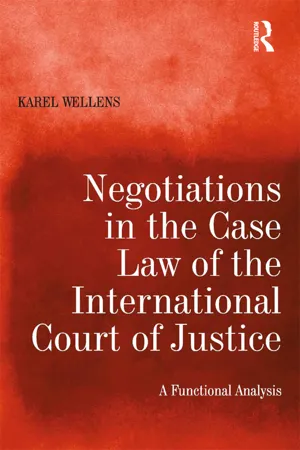
eBook - ePub
Negotiations in the Case Law of the International Court of Justice
A Functional Analysis
- 358 pages
- English
- ePUB (mobile friendly)
- Available on iOS & Android
eBook - ePub
Negotiations in the Case Law of the International Court of Justice
A Functional Analysis
About this book
This book examines the multifunctional role negotiations play in the jurisprudence of the International Court of Justice. Prior negotiations may be necessary to bring to the surface and clarify the legal aspects of a dispute before its submission to the ICJ. Negotiations may play a potential and parallel role during the course of the proceedings; results of negotiations may find their way into the judicial reasoning and may even form part of the basis of the judicial settlement. The Court's judgment may require further negotiations for its implementation. A failure of this process may bring the parties back before the Court. This volume presents a detailed and critical examination of the case law of the ICJ through the prism of the functional interaction between negotiation and judicial settlement of disputes. In cases where legal interests of third States are involved this functional interaction becomes even more complex. The focus is not on the merits of each individual case, but on the Court's contribution and clarification of this functional interplay. The systematic analysis of the Court's jurisprudence makes this book essential reading for those involved with and studying international law and justice.
Negotiations in the Pre-Adjudicative Phase
Chapter 1
The Multifunctionality of Negotiations as Means for the Peaceful Settlement of Disputes and their Status under International Law
Introduction
A preliminary question that immediately presents itself is a definitional and conceptual one. The various options of approaching this issue are almost unlimited. Different disciplines and branches will produce a variety of doctrinal definitions, as already indicated in the preliminary chapter.
As far as international law is concerned we could turn to the renowned classical international law dictionaries in order to compare their definitions of negotiations.
It is sufficient at this stage to recognize that negotiation ‘is a process which at many points not only has significant international legal implications’ but ‘is itself also an institution of international law. Negotiation is, indeed, at the crossroads of international law and diplomacy’;1 as to the latter, negotiation is its central function.2
How would one define in more precise terms this instrument of negotiations : exploratory talks3 of a non-committal nature, a mere exchange of views, diplomatic correspondence (the object of this daily practice between governments is to solve problems arising from opposite views and opinions)4 and exchanges, disputations, consultations, high-level meetings, conference diplomacy ? Is there room to make a distinction between ‘direct’ and ‘indirect’ negotiations ?5
With regard to ‘parliamentary diplomacy’ we could already note that ‘the negotiation of solutions of international problems within the framework and through procedures of an organized body acting under established rules of procedure, such as the General Assembly of the United Nations’6 has been recognized by the Court ‘as one of the established modes of international negotiation’.7 Moreover, if ‘the question in issue is one of mutual interest to many States, there is no reason why each of them should go through the formality and pretence of direct negotiation with the common adversary State, after they had participated in the collective negotiation with the same State in opposition’.8
In assessing the real potential of conference diplomacy in terms of its contribution to the peaceful settlement of disputes (PSD) one has to be aware of ‘an aspect of propaganda and an element of rigidity which may be harmful to sound negotiation’.9
‘Informal negotiations’ do ‘ imply that statements made by one or the other party are non-committal and should not be taken as final’.10 The non-committal nature carries with it the possibility that such statements or positions taken could later be used in proceedings before the Court.
Furthermore, the ‘borderline between negotiations, consultations and more general diplomatic representations is not at all well-defined, although one generally recognizes that negotiations involve the bringing of discussions into a sharper focus and more adversarial posture than was the case previously’,11 a characteristic feature which is particularly relevant for the functional interaction with adjudication.
The object and purpose of this study, however, appear to justify postponing the question of a judicial definition until a later stage as the analysis of the Court’s case law will gradually reveal how the ICJ itself has been struggling with the issue. Perhaps the Court has used various definitions, albeit not always in a consistent manner; approaching the issue maybe on an ad hoc basis, that is until its recent judgment in the CERD case.
Revisiting the functional interaction in the concluding observations will allow us to follow the winding road the Court has been following until in its 2011 judgment it was bound to rule not only on the threshold to find the existence of negotiations, but also to consider ‘their adequate form and substance’ and to determine ‘to what extent they should be pursued before it can be said the precondition [of prior negotiations] has been met’,12 issues we will deal with in following chapters of this study.13
The functional role of international law within the process of negotiations, both within and outside the context of PSD, has been succinctly and very aptly described by Arthur Watts. At the very least international law ‘forms the unavoidable background to international negotiations, standing as the silent witness to diplomatic transactions; at the other extreme, where the difference between the parties involves a dispute as to their rights and obligations, international law will be in the forefront of the negotiations’.14 According to Bilder, States will in the latter scenario bargain merely ‘in the shadow of the law’.15
To the extent that international law is seen by the parties ‘as a body of binding rules ultimately enforceable through a third party arbiter’, ‘parties negotiate “in the shadow of the law”, meaning their prospects of success should the matter be litigated’.16
Proliferation of international law rules ‘accompanied by a legalization of international discourse’ and a ‘trend toward the “judicialization” of the conduct of diplomacy’, ‘bearing witness of the improvements in the modalities of peaceful settlement of disputes’17 is bound to have an impact on the role of law during negotiations as a means of peaceful settlement of disputes.
The unifying tread of our study is limited to exploring the judicial approach by the ICJ towards the functional interaction between negotiations and resort to the Court.
A brief look at the role of negotiations outside the context of peaceful settlement of disputes may provide us with useful elements for the subsequent analysis.
1.1 The Role of Negotiations outside the Context of Peaceful Settlement of Disputes
Although ‘[t]here is never complete equality of will or pressure from two parties in the direction of negotiations between them’,18 ‘[s]hifts in the balance of power between parties may exert significant influence on a decision to open negotiations, on the process of negotiations, and on the frequency and substance of agreements reached’.19
Negotiations do play an important role in relations between States as a mechanism to produce instruments governing their respective and collective conduct as members of the international community.20 If negotiation is ‘to be compulsory’ then ‘the circumstances in which the obligation arises, as well as its content, need careful definition, or an allegation of a failure to carry out the agreed procedure may itself become a dispute issue’.21
The Legal Basis of the Obligation to Negotiate
A conventional basis
Although negotiation may still ‘widely [be] regarded as essentially a voluntary process’,22 the duty to negotiate has gradually evolved in becoming ‘one of the general principles of contemporary international law’23 – although perhaps not as a matter of customary international law,24 and which may of course be incorporated in treaty provisions.
The intention expressed by certain powers to continue to administer particular territories ‘until other arrangements had been agreed’ with the UN imply that negotiations will have to take place. Attempts by one party to modify, directly or indirectly, the terms of an existing legal situation requires and is conditioned by the consent of the other party, thus implying negotiations.25
Article VI of the NPT provides us with the best-known example of a pactum de negotiando and of a distinct pactum de contrahendo as each State Party ‘undertakes to pursue negotiations in good faith on effective measures relating to the cessation of the nuclear arms race at an early date and to nuclear disarmament, and on a treaty on general and complete disarmament under strict and effective control’. Both pacta are distinct in terms of the subject-matter and of the timing.26
In its 1996 Nuclear Weapons Advisory Opinion the Court stressed that the legal importance ‘of that obligation goes beyond that of a mere obligation of conduct; the obligation involved here is an obligation to achieve a precise result – nuclear disarmament in all its aspects – by adopting a particular course of conduct, namely the pursuit of negotiations on the matter in good faith’.27 The Court left no doubt that the vast majority of the international community is facing in this regard a twofold obligation, namely to pursue and to conclude the negotiations.28
General obligations, to be interpreted in light of the object and pur...
Table of contents
- Cover Page
- Half-Title Page
- Title Page
- Copyright Page
- Table of Contents
- Acknowledgements
- Introduction
- Preliminary Chapter: The Dynamics of Negotiations as a Process from an International Relations Perspective: A Brief Visit
- Part I: Negotiations in the Pre-Adjudicative Phase
- Part II: Negotiations and the Adjudicative Phase
- Part III: Negotiations During the Post-Adjudicative Phase
- Conclusions Revisiting the Functional Interaction between Negotiations and Judicial Settlement by the International Court of Justice
- Index
Trusted by 375,005 students
Access to over 1.5 million titles for a fair monthly price.
Study more efficiently using our study tools.
Frequently asked questions
Yes, you can cancel anytime from the Subscription tab in your account settings on the Perlego website. Your subscription will stay active until the end of your current billing period. Learn how to cancel your subscription
No, books cannot be downloaded as external files, such as PDFs, for use outside of Perlego. However, you can download books within the Perlego app for offline reading on mobile or tablet. Learn how to download books offline
Perlego offers two plans: Essential and Complete
- Essential is ideal for learners and professionals who enjoy exploring a wide range of subjects. Access the Essential Library with 800,000+ trusted titles and best-sellers across business, personal growth, and the humanities. Includes unlimited reading time and Standard Read Aloud voice.
- Complete: Perfect for advanced learners and researchers needing full, unrestricted access. Unlock 1.5M+ books across hundreds of subjects, including academic and specialized titles. The Complete Plan also includes advanced features like Premium Read Aloud and Research Assistant.
We are an online textbook subscription service, where you can get access to an entire online library for less than the price of a single book per month. With over 1.5 million books across 990+ topics, we’ve got you covered! Learn about our mission
Look out for the read-aloud symbol on your next book to see if you can listen to it. The read-aloud tool reads text aloud for you, highlighting the text as it is being read. You can pause it, speed it up and slow it down. Learn more about Read Aloud
Yes! You can use the Perlego app on both iOS and Android devices to read anytime, anywhere — even offline. Perfect for commutes or when you’re on the go.
Please note we cannot support devices running on iOS 13 and Android 7 or earlier. Learn more about using the app
Please note we cannot support devices running on iOS 13 and Android 7 or earlier. Learn more about using the app
Yes, you can access Negotiations in the Case Law of the International Court of Justice by Karel Wellens in PDF and/or ePUB format, as well as other popular books in Law & Criminal Law. We have over 1.5 million books available in our catalogue for you to explore.