- 218 pages
- English
- ePUB (mobile friendly)
- Available on iOS & Android
eBook - ePub
About this book
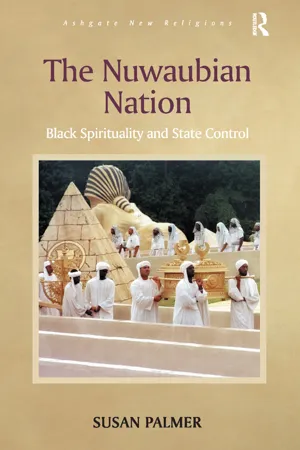
The Nuwaubian Nation takes the reader on a journey into an African-American spiritual movement. The United Nuwaubian Nation has changed shape since its inceptions in the 1970s, transforming from a Black Hebrew mystery school into a Muslim utopian community in Brooklyn, N.Y.; from an Egyptian theme park into an Amerindian reserve in rural Georgia. This book follows the extraordinary career of Dwight York, who in his teens started out in a New York street gang, but converted to Islam in prison. Emerging as a Black messiah, York proceeded to break the Paleman's spell of Kingu and to guide his people through a series of racial/religious identities that demanded dramatic changes in costume, gender roles and lifestyle. Dr. York's Blackosophy is analyzed as a new expression of that ancient mystical worldview, Gnosticism. Referring to theories in the sociology of deviance and media studies, the author tracks the escalating hostilities against the group that climaxed in a Waco-style FBI raid on the Nuwaubian compound in 2002. In the ensuing legal process we witness Dr. York's dramatic reversals of fortune; he is now serving a 135-year sentence as his Black Panther lawyer prepares to take his case to the Supreme Court. This book presents fresh and important insights into racialist spirituality and the social control of unconventional religions in America.
Information
Chapter 1
“Don’t Believe Me, Check it Out for Yourself!”
Who is Dr. Malachi Zador York?
Forty years ago in New York City, a young man of 22 named Dwight York was released from jail and founded a spiritual circle with his close friends called “Ansar Pure Sufi.” Since then it has grown, changed names, and mutated rapidly. Over the years York has led his movement through its many phases, trying on and then discarding charismatic titles as if they were masks. His prison wardens know him as Inmate #17911, serving a 135-year sentence in the “supermax” security federal prison in Florence, Colorado, known as the “Alcatraz of the Rockies.” Sheriff Howard Sills of Eatonton G.A., who assisted in York’s arrest, brands him, “the most heinous criminal in the history of the United States.” Journalists portray York as a “cult leader” or “con artist” who exploits the gullible members of his “black militant,” “quasi-religious” “sect.” Orthodox Sunnis denounce York as a fake Muslim, as a Mahdi “pretender” and “blasphemer.”
But Dr. York’s African-African supporters insist he is an innocent man who was framed, silenced, and “brought down” by a “conspiracy” of disgruntled ex-members who colluded with the “White Power Structure.” Malik Zulu Shabazz of the New Black Panther Party (who is York’s lawyer) calls him “a great leader of our people.a victim of an open conspiracy by our enemy.” And as for his disciples, he is their “Master Teacher,” their “Savior,” come to awaken the sleeping African-Americans, to help them break the “Spell of Kingu,” to arm them with “Right Knowledge.”
Despite these conflicting perceptions, Dr. York’s critics and supporters have one thing in common—passion.
It is difficult to get a sense of who Dwight York is through reading his writings. Visitors to the All Eyes on Egipt bookstores1 can browse through the 450-odd booklets (“scrolls”) that are authored, edited, or plagiarized under various noms de plumes. In these pages, the curious reader will encounter a bewildering array of esoteric topics culled from seemingly incompatible sources—mystical Islam, “scientific” theories in UFO lore, American Blackosophy, Edgar Cayce’s writings, U.S. Patriot conspiracy theories, Black Freemasonry…. A far better sense of Dr. York may be gained from watching the man in action; by viewing DVDs of his Savior’s Day appearances in Georgia during the late 1990s, or of his sermons in the Brooklyn mosque during the Ansaaru Allah days in the 1980s.2 On film he appears as a robust middle-aged man, handsome, confident, and thoroughly enjoying himself.
His discourse is riveting—but not what one might expect from a conventional religious leader. He does not formulate doctrines, relate moral parables or explain ideas in a coherent fashion. Rather, he shakes the very foundations of belief. He mocks mainstream religions and attacks orthodox doctrines, Christian, Muslim and Jewish. He plays his audience. They roar with laughter and shout out responses to his questions as he relentlessly punctures their preconceptions, challenges their social conventions, and assaults their deepest conceptions of “Reality.” “Don’t believe me! Do your own research! Check it out for yourself!” is the leitmotiv running through all his discourses.
His rhetorical style brings to mind some of the more controversial and sophisticated mystics of our age—Georg Gurdjieff, Krishnamurti, Bhagwan Shree Rajneesh, Chogyam Trungpa Rinpoche, Franklin Jones, E.J. Gold, John de Ruiters, to name a few.3 Highly original and playful in their approaches to religious language, they all point to the ineffable, mysterious nature of direct spiritual experience. They tell their audience to “wake up!” to seize the moment, to “become your own guru.” Like these better-known spiritual teachers, Dr. York’s discourse is self-consciously metaphorical and filled with paradox and humor.
Unlike them, however, Dr. York is a black man who speaks to African-Americans. His rhetoric is steeped in Black nationalist ideas and concepts borrowed from Marcus Garvey, Noble Drew Ali, Elijah Muhammad, Stokely Carmichael and the other inspirational mentors within the American school of Blackosophy. His peculiar brand of racialism does not correspond to the religious “fundamentalism” of the Nation of Islam, or to the radical political philosophy of the Black Panthers. Rather, it belongs to the ancient, esoteric schools of Gnosticism. Dr. York’s ideas are not meant to build a church or to bring about a social revolution, but rather to function as a pedagogical device to awaken his disciples from “sleep.” In one of his more succinct statements, he declares his mission as follows: “I have devoted my visit to this planet to the resurrection of the mentally dead, which I affectionately refer to as mummies.”4
For future historians studying the “alternative altars”5 of Black History, Dwight York will occupy an important place in its gallery of messiahs, prophets, mystics and philosophers. These men or women proposed creative practical solutions to the socio-economic problems of their people. Many forged his/her own theodicy, trying to make sense of a people’s 400-odd years of suffering since the slave trade came to the Americas. The result has been to imbue the African-American experience with an uplifting moral and spiritual significance.
Dwight York is acutely conscious of his place in this gallery—and he recreates the ongoing narrative of the Black Jeremiad in America in such a way as to reinforce his own charismatic claims. In The Holy Tablets (the Nuwaubian bible) this becomes quite apparent:
But they all knew a savior was coming. Some thought it was Marcus Garvey who wanted to go back to Africa. Others thought Noble Drew Ali, others thought it was Elijah Muhammad or his teacher, W.F.D. Muhammad. Others thought it was Clarence 13X, even others thought it was Martin Luther King, some said it was Rap Brown or Stokely Carmichael from the 60s. Or Eldridge Cleaver or Bobby Seale, some thought it was Ron Karenga or Leroi Jones. Some think it’s Warith D. Fard, son of Elijah Muhammad; Others think it is Minister Louis Farrakhan or Yahweh ben Yahweh or Ben Ammi Carter. And even others think it is themselves and the list of saviors goes on…. From the early 1900s all the way up to 1970 A.D. when something new started happening [sic]. A teaching unlike any other started spreading.6
York relies on his mentors, he adopts their vocabulary, extrapolates on their messages—and even reproduces their texts. Some he will later denounce as his competitors.
Dr. York firmly plants his message within the American social context of the 1960s: the race riots, the rise of the Black Panthers, and the struggle for social justice and the beginnings of Black Pride. As he explains, “this made way for the first part of our liberation…what I have to give would liberate the mind of the Nubian Nation and the physical will follow.”7 He portrays himself as a young spiritual seeker during the tumultuous period of Black nationalism in the 1960s, in Harlem and New York, and his writings show a keen interest in the “spiritual politics” of the era, particularly in the internecine struggles and problems of the succession occurring within the Nation of Islam—a situation he was quick to capitalize on. Dr. York was keenly awareness of new fashions as they appeared on the Black spirituality scene, and he was quick to incorporate them into his movement.
The Origins of the Nuwaubian Movement
Like many prophets in Blackosophy, Dwight York’s birth and origins remains shrouded in mystery.8 York claims he was born in the Sudan on 26 June 1945. The FBI report supplies the same date, but states that he was born in the state of Maryland. Bilal Phillips claims that York is ten years older, born in 1935, and that he revised his birth date in order to bolster his claim to be the great-grandson of the Sudanese Mahdi, whose rebirth was prophesied to occur in the West exactly one hundred years later. Phillips bases his argument on a 1974 edition of The Muslim Prayer Book (Edition 12), published by the AAC. In this book, he claims, York’s birth date is featured as “1935,” but from 1975 on the date “1945” was pasted on, obscuring the old date. In 1977, after York changed his title to “Al Mahdi,” a large picture of York was featured on the inside cover with his new signature and birth date (“and this was quite obviously pasted on”)—Phillips’ point being that York wanted to fit the hadith that proclaims a reformer or mujeddid will be sent every 100 years.9
Little is known of Dwight York’s father. Even York’s son, Jacob, admits he knows very little about his grandfather: “My dad’s father was a topic that was hush hush in the family. There was a rumor going around that he was a gangster, a pimp…spent time in jail—not a good role model for his son.”10 York announced in 1973 that his true biological father was Al Haadi Abdur Rahman al Mahdi, the grandson of the famous Mahdi Muhammad Ahmad (1845–85) who led an uprising against the British in Sudan.11
The young Dwight York worked as an assistant to an antique shop owner, and married her daughter, Dorothy Mae Johnson, when they were both 18-years-old. She bore him five children. Dr. York’s son, Jacob, described Ms. Johnson as, “the only woman he was ever actually legally married to.”12
York confesses in his 1989 book, Rebuttal to the Slanderers, that he was involved in a New York youth gang in his teens, and became a “youthful offender.” According to the 1993 FBI report, York has a criminal record. It states that, in June 1964 he was charged with statutory rape; in October 1964 with possession of a dangerous weapon and resisting a police officer. York received a three-year prison sentence on 6 January 1965. He spent some time in prison at the Elmira Reception Center but was paroled on 20 October 1967.13
The Nation of Islam has a strong missionary outreach in the U.S. prison system. Like Malcolm X, York may have encountered Muslim missionaries during his stay in prison and converted to Islam.14 On his release in 1967, he began to attend the Islamic Mission of America, Inc. Mosque on State Street, founded by a West Indian, Sheikh Daoud Faisal, who became his only living spiritual teacher. Sheikh Daoud (1891–1980) had set up two temples attracting African-Americans in Philadelphia and in Harlem, and was reported in the newspapers as having 100,000 followers. His mission was to establish a peaceful Muslim community, a theocracy under the laws of Allah. To this end, he purchased the Talbot Estate in East Fishkill, Duchess County, N.Y. This became a famous spiritual retreat for Black Muslims, called “Medina Salaam.” Sheikh Da...
Table of contents
- Cover
- Half Title
- Title Page
- Copyright Page
- Dedication
- Table of Contents
- List of Illustrations
- Acknowledgments
- List of Acronyms
- Preface: “Overstanding” the Nuwaubians
- 1 “Don’t Believe Me, Check it Out for Yourself!”
- 2 Holy Madness, Crazy Wisdom
- 3 The Ansaaru Allah Community
- 4 Tama Re: The FBI Raid on a “Sovereign Nation”
- 5 Dr. York’s Trials
- 6 Regressing into the Millennium
- 7 Black Messiahs in America: Religious Leaders or Racketeers?
- Bibliography
- Index
Trusted by 375,005 students
Access to over 1.5 million titles for a fair monthly price.
Study more efficiently using our study tools.
Frequently asked questions
Yes, you can cancel anytime from the Subscription tab in your account settings on the Perlego website. Your subscription will stay active until the end of your current billing period. Learn how to cancel your subscription
No, books cannot be downloaded as external files, such as PDFs, for use outside of Perlego. However, you can download books within the Perlego app for offline reading on mobile or tablet. Learn how to download books offline
Perlego offers two plans: Essential and Complete
- Essential is ideal for learners and professionals who enjoy exploring a wide range of subjects. Access the Essential Library with 800,000+ trusted titles and best-sellers across business, personal growth, and the humanities. Includes unlimited reading time and Standard Read Aloud voice.
- Complete: Perfect for advanced learners and researchers needing full, unrestricted access. Unlock 1.5M+ books across hundreds of subjects, including academic and specialized titles. The Complete Plan also includes advanced features like Premium Read Aloud and Research Assistant.
We are an online textbook subscription service, where you can get access to an entire online library for less than the price of a single book per month. With over 1.5 million books across 990+ topics, we’ve got you covered! Learn about our mission
Look out for the read-aloud symbol on your next book to see if you can listen to it. The read-aloud tool reads text aloud for you, highlighting the text as it is being read. You can pause it, speed it up and slow it down. Learn more about Read Aloud
Yes! You can use the Perlego app on both iOS and Android devices to read anytime, anywhere — even offline. Perfect for commutes or when you’re on the go.
Please note we cannot support devices running on iOS 13 and Android 7 or earlier. Learn more about using the app
Please note we cannot support devices running on iOS 13 and Android 7 or earlier. Learn more about using the app
Yes, you can access The Nuwaubian Nation by Susan Palmer in PDF and/or ePUB format, as well as other popular books in Theology & Religion & Religion. We have over 1.5 million books available in our catalogue for you to explore.