eBook - ePub
Science and Spectacle in the European Enlightenment
- 176 pages
- English
- ePUB (mobile friendly)
- Available on iOS & Android
eBook - ePub
Science and Spectacle in the European Enlightenment
About this book
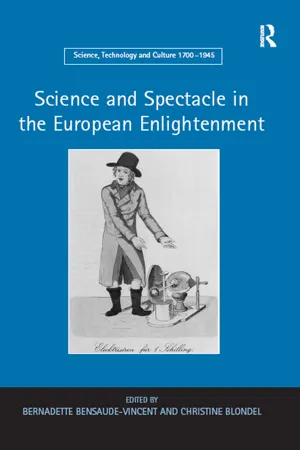
Air-pumps, electrical machines, colliding ivory balls, coloured sparks, mechanical planetariums, magic mirrors, hot-air balloons - these are just a sample of the devices displayed in public demonstrations of science in the eighteenth century. Public and private demonstrations of natural philosophy in Europe then differed vastly from today's unadorned and anonymous laboratory experiments. Science was cultivated for a variety of purposes in many different places; scientific instruments were built and used for investigative and didactic experiments as well as for entertainment and popular shows. Between the culture of curiosities which characterized the seventeenth century and the distinction between academic and popular science that gradually emerged in the nineteenth, the eighteenth century was a period when scientific activities took place in a variety of sites, ranging from academies, and learned societies to salons and popular fairs, shops and streets. This collection of case studies describing public demonstrations in Britain, Germany, Italy and France exemplifies the wide variety of settings for scientific activities in the European Enlightenment. Filled with sparks and smells, the essays raise broader issues about the ways in which modern science established its legitimacy and social acceptability. They point to two major features of the cultures of science in the eighteenth-century: entertainment and utility. Experimental demonstrations were attended by apothecaries and craftsmen for vocational purposes. At the same time, they had to fit in with the taste of both polite society and market culture. Public demonstrations were a favourite entertainment for ladies and gentlemen and a profitable activity for instrument makers and booksellers.
Chapter 1
The Laboratory, the Workshop, and the Theatre of Experiment
One of the great myths with which experiments have been often burdened is that they either have proved self-evident (and thus readily reproducible) or, at crucial moments, have even appeared fundamental to our comprehension of the world. Such ‘eureka’ notions are inherently rhetorical. In the course of their replication and display these epistemological dramas served, in the early-modern world, to provide authority to an exercise that was, at its heart, one of translating the burden of truth away from faith and authority to evidence, through experimental observation. In this essay, I wish to explore the diffusion of the spectrum of experimentation that appeared so compelling to eighteenth-century observers of the scientific scene such as Voltaire or Diderot. It is my contention that experiment and dramatic demonstrations, driven especially by the promise of the practical, established an effective framework for the spectacular operating far beyond the esoteric confines of natural philosophical theory – most especially, through the use of curious and fabulous instruments.
The emphasis on method – specifically on the evolving link between experiment, public replication and demonstration – would magnify the role of the philosophical consumer. In Britain, for example, public debates frequently followed the publication of the Philosophical Transactions of the Royal Society. Inherently, private and public were realms much less distinct than the structures of early scientific societies implied. Consequently, the spectacle and the promotion of laboratory experience would matter as much, if not more, than the library. Authority and audience converged – notably, in the eighteenth century, in the theatre of demonstration, replication and dispute. For some philosophers, giving public lectures might even take precedence over their commitments to the imprimatur that had emanated from the heights of the Royal Society or of the Académie des Sciences. John Theophilus Desaguliers, Newtonian and demonstrator to the Royal Society, was once rebuked by Newton in 1725 for failing to present sufficient experiments to the Society. Desaguliers’s undiplomatic reply was to offer demonstrations of experiments he had already happily provided to paying audiences at his public lectures.1 For three decades he successfully exploited interest in the latest discoveries and disputes of natural philosophy, whether concerning the problematic optical notions of Newton or arguments with Leibniz over occult attractions across void space. Many of these conflicts involved problems related to unseen and hotly contested forces such as gravity, magnetism or electricity.
The urgency of utility was the foundation of many a public demonstration. Thus, by mid century, debates over the nature and, ultimately, even the usefulness and efficacy of electrical phenomena were especially popular as well as immensely controversial. Benjamin Franklin would expose this in famous disputes over the shape of the lightning rod.2 Usefulness had become a powerful rhetorical device. For example, as Paola Bertucci has reported, in 1747 a Mr Booth of Dublin, who had seemingly cured a paralytic arm by applying electric shocks, inquired of the experimentalist Benjamin Wilson whether he should send his account to the illustrious Royal Society for their approbation or to the much more widely circulated Gentlemen’s Magazine (which, in any case, commonly reported on matters revealed in the Philosophical Transactions).3 For the philosophically inclined, there were increasingly many venues other than the Royal Society. Philosophical controversies explicitly invited a public adjudication. And there could be little drama without an audience. The widening gyre of forms of experimentation ultimately represented a challenge to the seeming impermeability of early modern social as well as philosophical boundaries.
Experimental Spaces
To justify experiment may now seem a peculiar necessity. But in the early-modern world, experimental method was far from unproblematic. The relation between experiment and demonstration was blurred by experimental accounts intended more to assert nature’s facts than to reveal the route to discovery. Demonstrations thus became ever more significant for seemingly crucial experiments – for the aristocratic and diplomatic visitors to the Royal Society as much as for subscribers at many a public lecture. The appearance of the king or nobility at Desaguliers’s trials of strength by mechanical means both eliminated mystery and secured Newton’s laws.4 But, more importantly, the influence of a Newtonian rhetoric became profound in the eighteenth century. One would find in the works of the practical chemists, notably in Robert Dossie’s Institutes of Experimental Chemistry (1759), an utter aversion to system makers that was worthy of any of Newton’s disciples. Dossie declared the need for ‘induction from facts’.5
The spectrum of experiment meant geographic dispersal as well. Demonstrations were far from a cosmopolitan affair, although such vast metropoles as London or Paris, easily the largest cities in Europe in the eighteenth century, certainly provided the desired audiences for the experimentalists. When, in the early part of the century, the Reverend William Whiston came down from Cambridge and the Reverend John Theophilus Desaguliers from Oxford, they had the latest Newtonian experience in their pockets. The result was careers that spanned over four decades and impetus to a new industry of lectures, which became hotly contested by many interlopers in the provinces as well. But it was likewise notable that the Reverend Stephen Hales, one of the auditors of the first Cambridge Professor of Chemistry Giovanni Francesco Vigani, set upon exploring chemical reactions even after Hales, too, had removed from Cambridge in 1709 to take up duties as minister of the Thames market town of Teddington.6 Newtonian clergymen scattered their creed widely and on fertile ground. Now anonymous in many cases, those who did the laboratory work actually did matter.7 Credible replication required skill and demanded an audience. Showmen and witnesses needed each other for experiment to matter.
Newton’s gospel was far beyond Cambridge and London. The disciples of Descartes or Leibniz who stubbornly disputed Newton’s doctrine of forces held an apparently hopeless position in the face of the overwhelming tide of Newtonian demonstrators. Willem s’Gravesande imported Newton’s philosophy into the Netherlands after having attended Desaguliers’s lectures in London in 1716. Desaguliers likewise ventured across the North Sea in 1731 and 1732 as he undertook lecture tours of the Netherlands. But it was also in France, in the aftermath of Voltaire’s proselytizing Letters concerning the English nation (1733), that lecturers shaped the theatre of experiment. In the 1750s, the Abbé Nollet adapted his electrical researches to provide public displays as part of his protracted dispute with Benjamin Franklin over the causes of electricity. Electricity prompted quite extraordinary displays throughout Western Europe: boys could be suspended by silk threads to create a static attraction, as was done in London by Stephen Gray or in Paris by Charles Dufay or Nollet; shocks might be dispersed through a line of guards or priests, or even applied to unsuspecting country folk on bridges crossing the Thames.8 Experiment evolved into spectacle. If, to many an audience, serious philosophy was submerged in fleeting entertainment, this nonetheless had also profound implications for the everyday practice of experiment. Replication of the dramatic enticed as much as entertained. Thus, by 1800, in the ‘Fantasmagorie’ of Etienne Gaspard Robertson in Paris, electrical sensations could be produced by friction machines or voltaic piles in displays involving ‘more than fifty people’.9 And even a sense of practical consequence was not to be excluded by the spectacular. This was particularly well demonstrated when, in a dispute over pointed or blunt ends for lightning rods, Benjamin Wilson built a massive conductor 155 ft in length in London’s Pantheon to represent a cloud discharging before a carefully selected audience including George III. He was also the director of the private theatre of the Duke of York. Wilson knew the value of the dramatic, even if the immediate and more mundane issue was the protection from lightning of the king’s armouries.10
During the eighteenth century, and often since, the dramatic was all too readily dismissed as shallow entertainment, pandering to a pedestrian market for magic shows and village strongmen. To have let such a rigid notion stand belies a critical goal of expanding the understanding of physical principles. But the distinction between the private laboratory and the public audience may be misleading. As David Gooding suggests, the investigation of nature in the laboratory was, in any case, dependent on a public philosophical discourse. The apparent isolation of the laboratory bench from the notions received among a widening audience was largely artificial.11 In the early eighteenth century audience magnified the credibility of natural philosophy. There was, therefore, a market place where natural philosophy was more than commodity; it was a place where experimental philosophy triumphed. Just as reports in the public press diluted the exclusivity of fellowship in private societies, philosophical displays became as essential as private experiments. Audiences were the mirror in which replication was confirmed. For this reason alone, demonstration devices became as crucial as the apparatus on a private bench. Moreover, public knowledge and practical benefit was a link not always to be broken.
Apparatus
Many makers ensured the laboratory did not remain an exclusive preserve. Not all instruments were either supremely accurate or sophisticated. Controversy soon arose over the efficiency and the accuracy of many instruments, especially those that might be used on a private laboratory bench or in the field, such as those of the instrument maker George Graham, used by Maupertuis to determine the shape of the earth.12 Moreover, careers were made by those able to contrive apparatus for the delights of electrical or magnetic display – such as that of Gowin Knight, who invented a device for creating artificial magnets, or those of the later electrical instrument maker Edward Nairne. Some devices were much in demand, even at considerable expense, but others opened experimental doors at a much cheaper rate. Yet, it is obvious that makers such as Graham, Knight and later Nairne and Blunt might have a substantial custom, however costly some of their apparatus.13 Of course, skills in experimental and instrumental design were widely sought, but instruments also served various purposes such as magnifying a curiosity or even invoking a mechanical, or medical, benefit. Indeed, the Swedish engineer Marten Triewald had reported to the Royal Society on his electrical experiments and evidently amassed one of the largest collections of demonstration devices in Europe prior to 1750. This was likewise later true of the vast armoury of Martinus van Marum in Haarlem. Even the engineer John Smeaton, elected to the Royal Society in 1753 as a ‘maker of Philosophical Instruments’, had so impressed Joseph Priestley that he used Smeaton’s improved air pump for experiments on specific gravities of air.14 As Bertucci has revealed, Nairne could supply devices designed by the electrician Tiberius Cavallo, the inventor William Nicholson and the Italian gentleman Alessandro Volta.15 The boundaries between maker, designer, merchant and user were not often precise.
The international trade in apparatus expanded rapidly in the eighteenth century. Certainly by the 1770s, few intent experimenters would be limited by the local instrument market. Leading natural philosophers and public lecturers trolled the same experimental networks and instrument makers’ shops. Hence, the Portuguese instrument maker, and probable industrial spy, Jean Hyacinthe de Magellan, sold instruments from London, sending Gowin Knight’s fashionable magnetic apparatus to courts in Spain and Portugal and numerous instruments to his contacts in France and the Netherlands. One can, for example, trace Magellan buying Wedgwood thermometers for his own trade and export.16 Similarly, the continuous rancour between Franklin and Nollet encouraged many to buy instruments in an attempt to replicate their hotly contested experiments. The international pace of these researches gathered even further momentum at the end of the century as a consequence of Italian reports of the voltaic pile and the spread of galvanism.17 And it was Alessandro Volta who, in his own attempt to build an array of experimental weaponry for the electrical wars, likewise purchased instruments from Magellan and built his battery upon hints originally received from William Nicholson in London. Interestingly for the traffic in industrial goods and instruments, Nicholson may well have served the pottery manufacturer Josiah Wedgwood as his commercial representative in Europe before settling in London as publisher, teacher and inventor.18
Philosophical conflict was a growth industry in the eighteenth century. To a large degree, these were instrumental wars. Furore arose, for example, between Magellan and his rival Cavallo over magnetism and the effectiveness of eudiometers to measure the salubrity of airs. During the 1770s, Magellan was assisting Priestley in the analysis of gases. In 1777 Priestley requested the industrialist Matthew Boulton, in Birmingham, to get for his experiments some ‘air as it is actually breathed by the different manufacturers in this kingdom and hope you will be so obliging as to procure me the proper samples from Birmingham’.19 Industrialism and urbanism induced a new climate of experimental urgency. And Dr. Thomas Beddoes of Bristol, the celebrated democrat and collaborator of James Watt, deplored the ‘new poisons arising daily in London’.20 Beddoes went on to be one of the greatest exponents ...
Table of contents
- Cover
- Half Title
- Title Page
- Copyright Page
- Table of Contents
- List of Figures
- Notes on Contributors
- Introduction: A Science Full of Shocks, Sparks and Smells
- 1 The Laboratory, the Workshop, and the Theatre of Experiment
- 2 Technology, Curiosity and Utility in France and in England in the Eighteenth Century
- 3 Amusing Physics
- 4 Experimental Physics in Enlightenment Paris: The Practice of Popularization in Urban Culture
- 5 Domestic Spectacles: Electrical Instruments between Business and Conversation
- 6 The Sale of Shocks and Sparks: Itinerant Electricians in the German Enlightenment
- 7 Between Commerce and Philanthropy: Chemistry Courses in Eighteenth-century Paris
- 8 Joseph Priestley and the Chemical Sublime in British Public Science
- 9 Chemistry on Stage: G.F. Rouelle and the Theatricality of Eighteenth-century Chemistry
- 10 Honoré Fragonard, Anatomical Virtuoso
- Index
Trusted by 375,005 students
Access to over 1.5 million titles for a fair monthly price.
Study more efficiently using our study tools.
Frequently asked questions
Yes, you can cancel anytime from the Subscription tab in your account settings on the Perlego website. Your subscription will stay active until the end of your current billing period. Learn how to cancel your subscription
No, books cannot be downloaded as external files, such as PDFs, for use outside of Perlego. However, you can download books within the Perlego app for offline reading on mobile or tablet. Learn how to download books offline
Perlego offers two plans: Essential and Complete
- Essential is ideal for learners and professionals who enjoy exploring a wide range of subjects. Access the Essential Library with 800,000+ trusted titles and best-sellers across business, personal growth, and the humanities. Includes unlimited reading time and Standard Read Aloud voice.
- Complete: Perfect for advanced learners and researchers needing full, unrestricted access. Unlock 1.5M+ books across hundreds of subjects, including academic and specialized titles. The Complete Plan also includes advanced features like Premium Read Aloud and Research Assistant.
We are an online textbook subscription service, where you can get access to an entire online library for less than the price of a single book per month. With over 1.5 million books across 990+ topics, we’ve got you covered! Learn about our mission
Look out for the read-aloud symbol on your next book to see if you can listen to it. The read-aloud tool reads text aloud for you, highlighting the text as it is being read. You can pause it, speed it up and slow it down. Learn more about Read Aloud
Yes! You can use the Perlego app on both iOS and Android devices to read anytime, anywhere — even offline. Perfect for commutes or when you’re on the go.
Please note we cannot support devices running on iOS 13 and Android 7 or earlier. Learn more about using the app
Please note we cannot support devices running on iOS 13 and Android 7 or earlier. Learn more about using the app
Yes, you can access Science and Spectacle in the European Enlightenment by Bernadette Bensaude-Vincent, Christine Blondel in PDF and/or ePUB format, as well as other popular books in History & World History. We have over 1.5 million books available in our catalogue for you to explore.