- 344 pages
- English
- ePUB (mobile friendly)
- Available on iOS & Android
eBook - ePub
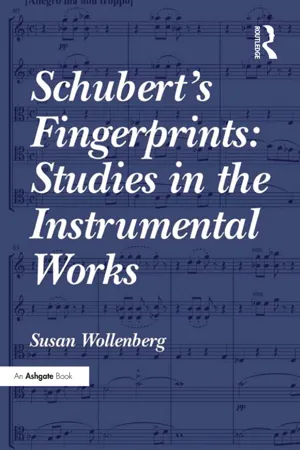
Schubert's Fingerprints: Studies in the Instrumental Works
About this book
As Robert Schumann put it, 'Only few works are as clearly stamped with their author's imprint as his'. This book explores Schubert's stylistic traits in a series of chapters each discussing an individual 'fingerprint' with case studies drawn principally from the piano and chamber music. The notion of Schubert's compositional fingerprints has not previously formed the subject of a book-length study. The features of his personal style considered here include musical manifestations of Schubert's 'violent nature', the characteristics of his thematic material, and the signs of his 'classicizing' manner. In the process of the discussion, attention is given to matters of form, texture, harmony and gesture in a range of works, with regard to the various 'fingerprints' identified in each chapter. The repertoire discussed includes the late string quartets, the String Quintet, the E flat Piano Trio and the last three piano sonatas. Developing ideas which she first proposed in a series of journal articles and contributions to symposia on Schubert, Professor Wollenberg takes into account recent literature by other scholars and draws together her own researches to present her view of Schubert's 'compositional personality'. Schubert emerges as someone exerting intellectual control over his musical material and imbuing it with poetic resonance.
Information
Chapter 1
Introduction
Schubert’s musical persona was first transformed for me in my teens, at a memorable New Year’s party hosted by my parents’ neighbour Raphael Gonley, a BBC music producer and keen amateur baritone, and his wife Rosalind, a professional cellist. We had each been asked to bring a piece of music to play, and one group introduced me to the beauties of his String Quintet, D 956,1 with their performance of its first movement. The second theme, in its initial scoring for the two cellos, embedded itself firmly in my memory, as did those lapidary transitional moments that precede it.2 As an undergraduate in the late 1960s, I was fortunate one summer vacation to be at the Edinburgh Festival in a year when such luminaries as the Amadeus Quartet, and Isaac Stern with Eugene Istomin and Leonard Rose, were performing the ‘late’ chamber works of Schubert. Of the varied impressions left by this experience, perhaps the most vivid was formed by the unprecedentedly explosive slow movement of the G major String Quartet, D 887. From these beginnings grew an abiding interest in Schubert’s instrumental music that has constantly resurfaced in my work since.3
When I first started to read more widely on the subject, I encountered an article by Eric Blom entitled ‘[Franz Schubert:] His Favourite Device’.4 It seemed to me then, and increasingly as I came to know the piano and chamber works more intimately, that with Schubert it was very much a question of a whole range of ‘favourite devices’ marking his instrumental style with its special character or ‘compositional personality’. As Robert Schumann put it: ‘Only few works are as clearly stamped with their author’s imprint as his’.5 When, later, I was invited by Derrick Puffett to give a paper in his series of Analysis seminars at Wolfson College, Oxford in the 1980s, I called it ‘Some Schubert Fingerprints’. These two notions – that of the ‘favourite device’ and the ‘fingerprint’ – have become melded together in my outlook on Schubert as I have continued to study his music closely over the past two decades.
Schubert was also transformed for me from the 1960s onwards through reading various ‘life and works’ studies, and other volumes devoted to aspects of the composer and his music. Reflecting afresh on the portrayal of Schubert in the literature, I have the impression that of the canonic quartet of Viennese masters, he has been the most subject on the one hand to essentially derogatory critical evaluation, and on the other hand to quite sweeping changes in the attitudes shown towards him and his work. (While some of these shifts in perception are influenced by fashions in musicology more generally, they have also been fuelled by developments within the increasingly complex field of Schubert scholarship.6) As an undergraduate I pencilled in my copy of Arthur Hutchings’s Schubert (published in the influential Master Musicians series) my strong objections to some of the author’s judgements. Among passages that particularly jarred with my growing sense of Schubert’s depths was the assertion that whereas ‘with Beethoven the quartet reached a mystical world, at once the farthest and the innermost region attained by any musician, Schubert gives us nothing but beauty’.7 Repeatedly Schubert is demoted to a lower level. Summoning Hadow’s comparison of Schubert with Keats (with reference to Schubert’s ability ‘to enchant us by sheer sensuous beauty’) to support his points, Hutchings declares that ‘we must be careful to have Schubert before Beethoven on our programmes’.8 In observing that ‘the difficulty lies entirely with the heavy responsibility handed on by his predecessors, especially Beethoven’, it seems that Hutchings uses this assessment against Schubert, thus perpetuating the problem.9
Where Schubert’s depths are glimpsed here, they are regarded as out of character. Thus the G major Quartet, D 887, is pronounced as being ‘least typical of its composer’ and its finale as illustrating ‘a new and quite un-Schubertian kind of audacity’.10 It is significant that at the time Hutchings was writing, the G major work could be described as ‘neglected by musicians’ in favour of the D minor Quartet, D 810 (‘Death and the Maiden’) that preceded it. Hutchings was evidently still coming to terms with this music when he wrote of D 887: ‘Does it not, perhaps, give us some indication of the next technical advances he would have made? Would the Schubert we do not know have proved, in his middle or third period, a deeper artist than the enchanting poet?’11 The Schubert we are able to appreciate now, in the twenty-first century, is that deeper artist.
Two particular strands in Schubert criticism may be extracted at this point from Hutchings’s writing. One recurrent element already highlighted is the comparison with Beethoven (among others), to Schubert’s disadvantage. Another is the view of Schubert as childlike, fun-loving and ‘most convivial of the great musicians’.12 Both of these have undergone profound changes in the past half-century. To take some examples of the nuances with which they have been treated more recently: Carl Dahlhaus evokes the Beethoven comparison, in his account of Schubert’s Quartet D 887, first movement, in order to delineate more precisely Schubert’s individual approach to form, which Dahlhaus values on its own terms.13 Hugh Macdonald in his study of Schubert’s ‘volcanic temper’ compares Schubert’s musical outbursts to Beethoven’s, and concludes that Schubert’s have the more disturbingly violent effect.14 And Elizabeth McKay’s new sifting of the documentary evidence enables her to place Schubert’s happier moods in the context of his bipolar nature, for which she makes a convincing case.15
Prior to these examples, the author who first transformed Schubert for me, in the wake of my reading of Hutchings, was Maurice Brown, with his biography of the composer.16 The shift in attitude that Brown’s work represents became so embedded subsequently in ways of thinking about Schubert, that its revelatory qualities could easily now be forgotten. (The book’s dedication to Otto Erich Deutsch is clearly significant.17) Brown situated his account of Schubert expressly in its historiographical context when, in his foreword, he declared his wish to ‘present the composer’ not only in the light of ‘a century of discovery and research’, but also ‘in so far as [the discoveries] concern the aims and ideals of modern biography in general’.18 For Brown, Schubert is seen as having ‘suffered perhaps more than his fellow composers’ from a ‘fairy-tale approach to the musical creator’; as Brown puts it, ‘We ask today for an interpretation of his character based on something deeper and more suggestive than that of the simple-hearted but idle Viennese Bohemian, who composed in a state of “clairvoyance”’.19
The image evoked by Brown here is linked with that of Schubert’s composing as ‘sleepwalker’ and of his alleged impatience with revising his work. The abiding impressions of Schubert’s spontaneity derived from the memoirs of his friends need to be viewed in perspective. While in many cases he clearly was able to pen his first thoughts rapidly, the manuscript sources, as well as revealing his ‘compositional facility’,20 bear witness to the careful revision and amplification which he applied subsequently. Youens encapsulated these processes apropos of Winterreise, D 911: ‘He evidently wrote the first versions of the songs in Part I at great speed. Nevertheless, the effort of which Schubert spoke to his friends is also apparent in the large number of revisions and emendations’.21
Brown’s firmly espoused change of approach to the subject impacts on our perceptions of Schubert’s music. Indeed his biography includes, besides details of the works composed (and those published) in each year of Schubert’s life, evaluative commentary on the works themselves. In a generally appreciative account of the G major Quartet, D 887, it is notable that Brown (with a very different slant from Hutchings) responds specifically to the newness that this work carries within it: discussing its opening major–minor gestures he perceives that ‘its novelty is still a striking feature even today, when our ears are shocked by nothing’.22 And of the ‘famous, almost notorious episodes’ in the slow movement, he notes, in an observation that is a salutary reminder of the limits of analysis, that ‘even if on paper Schubert’s devices can be explained, in sound they are extraordinary’, and ‘no attempt is made to placate the ear’.23
Besides the chronologically arranged chapters on the life and works, an inserted chapter on ‘The Artist’ and a concluding chapter on, essentially, Schubert reception (‘His Century and Ours’) add further valuable perceptions. In Brown’s final chapter, a critical survey of the literature (and the attitudes that formed around Schubert) is threaded through the author’s account of how the composer and his music fared after his lifetime. The quality of Brown’s enthusiasm for his subject shines through his choice of quotation with which to end, taken from a review of the facsimile edition of the autograph manuscript of Winterreise, published in 1955: ‘Perishable leaves, fading traces … he who examines them with the heart, and not with the clumsier outward intelligence, to him they are magic mirrors, in which such a thing as the creative spirit is to be perceived.’24
Reflecting on the earlier phases of Schubert scholarship, Brown observed that Willi Kahl’s ‘catalogue of all the writings on Schubert between 1828 and 1928’ numbered ‘nearly 2,000 items’, which by the end of 1928 had risen to 3,000.25 Many more thousands of items have been added in the years since.26 Another turning-point came with the publication of the New Grove Dictionary, featuring the entry on Schubert newly commissioned from Maurice Brown and Eric Sams.27 Over the three decades since then, the Schubert literature has grown and branched in a variety of directions. Particularly not...
Table of contents
- Cover Page
- Dedication
- Title Page
- Copyright Page
- Contents
- List of Figures
- List of Music Examples
- Acknowledgements
- List of Abbreviations
- Note on the Format of Music Examples and Figures
- 1 Introduction
- 2 ‘His Favourite Device’: Schubert’s Major-Minor Usage and its Nuances
- 3 Poetic Transitions
- 4 Schubert’s Second Themes
- 5 Schubert and Mozart
- 6 Schubert’s Violent Nature
- 7 Threefold Constructions
- 8 Schubert’s Variations
- 9 ‘Heavenly Length’
- 10 Concluding Remarks: ‘Whose Schubert?’
- Select Bibliography
- Chronology of Schubert’s Instrumental Works Discussed
- Index of Schubert’s Works
- General Index
Trusted by 375,005 students
Access to over 1.5 million titles for a fair monthly price.
Study more efficiently using our study tools.
Frequently asked questions
Yes, you can cancel anytime from the Subscription tab in your account settings on the Perlego website. Your subscription will stay active until the end of your current billing period. Learn how to cancel your subscription
No, books cannot be downloaded as external files, such as PDFs, for use outside of Perlego. However, you can download books within the Perlego app for offline reading on mobile or tablet. Learn how to download books offline
Perlego offers two plans: Essential and Complete
- Essential is ideal for learners and professionals who enjoy exploring a wide range of subjects. Access the Essential Library with 800,000+ trusted titles and best-sellers across business, personal growth, and the humanities. Includes unlimited reading time and Standard Read Aloud voice.
- Complete: Perfect for advanced learners and researchers needing full, unrestricted access. Unlock 1.5M+ books across hundreds of subjects, including academic and specialized titles. The Complete Plan also includes advanced features like Premium Read Aloud and Research Assistant.
We are an online textbook subscription service, where you can get access to an entire online library for less than the price of a single book per month. With over 1.5 million books across 990+ topics, we’ve got you covered! Learn about our mission
Look out for the read-aloud symbol on your next book to see if you can listen to it. The read-aloud tool reads text aloud for you, highlighting the text as it is being read. You can pause it, speed it up and slow it down. Learn more about Read Aloud
Yes! You can use the Perlego app on both iOS and Android devices to read anytime, anywhere — even offline. Perfect for commutes or when you’re on the go.
Please note we cannot support devices running on iOS 13 and Android 7 or earlier. Learn more about using the app
Please note we cannot support devices running on iOS 13 and Android 7 or earlier. Learn more about using the app
Yes, you can access Schubert's Fingerprints: Studies in the Instrumental Works by Susan Wollenberg in PDF and/or ePUB format, as well as other popular books in Media & Performing Arts & Music. We have over 1.5 million books available in our catalogue for you to explore.