- 192 pages
- English
- ePUB (mobile friendly)
- Available on iOS & Android
eBook - ePub
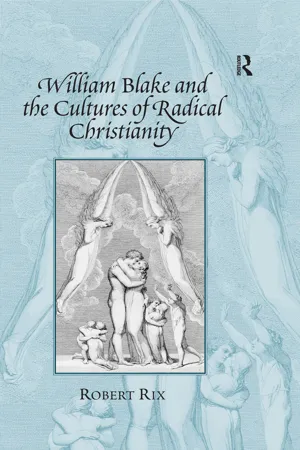
William Blake and the Cultures of Radical Christianity
About this book
This study traces the links between William Blake's ideas and radical Christian cultures in late eighteenth-century England. Drawing on a significant number of historical sources, Robert W. Rix examines how Blake and his contemporaries re-appropriated the sources they read within new cultural and political frameworks. By unravelling their strategies, the book opens up a new perspective on what has often been seen as Blake's individual and idiosyncratic ideas. We are also presented with the first comprehensive study of Blake's reception of Swedenborgianism. At the time Blake took an interest in Emanuel Swedenborg, the mystical and spiritual writings of the theosophist had become a platform for radical and revolutionary politics, as well as numerous heterodox practices, among his followers in England. Rix focuses on Swedenborgianism as a concrete and identifiable sub-culture from which a number of essential themes in Blake's works are reassessed. This book will appeal not only to Blake scholars, but to anyone studying the radical and sub- culture, religious, intellectual and cultural history of this period.
Chapter 1
Religious Themes and Early Contexts
This first chapter introduces three interconnected themes which determine Blake’s thinking throughout the corpus of his work. For Blake, these themes constitute the epitome of religious life. Their appearance in his writing makes it possible to provide a workable perspective on his position in the late eighteenth-century cultural and religious debates.
The first two themes were widely proscribed in the public debate as respectively enthusiasm (Greek, enthousiasmos, to be inspired by a god) and antinomianism (Greek, anti ‘against’, nomos ‘law’). They were primarily pejorative terms used by conservative detractors about tendencies believed to undermine religious and social authority. These beliefs cannot be plotted on the religious map of eighteenth-century England with any accuracy. They may best be described as approaches or attitudes shared by a number of often very different individuals or groups. Blake used the term ‘enthusiast’ about himself and his writing as a badge of honour on several occasions. His writing also presents a determined anti-legalism, rejecting laws and orthodox morality, which may classify as antinomianism – albeit this is a name of opprobrium to which neither Blake nor other believers of similar beliefs would confess.
For Blake, the promotion of these themes is critical for the establishment of a unifying faith of the spirit, a millennial state of harmonious coexistence, which constitutes the third theme. It is not one which can be discussed in isolation; it overlaps with the two first themes, as the end in view, when the human spirit is truly inspired and liberated from legalistic demands.
To limit a potentially broad discussion of cultural phenomena, I will, as far as possible, focus upon the examination of the three themes within concrete frameworks. In this respect, the recent discovery of a connection between Blake’s family and the Moravian Church is a useful point of departure. Even if this milieu contrasts with Blake’s ideas in as many areas as it yields similarities, it is useful as a case study from which it is possible to bring into view the cultural significance of the above-mentioned themes in the eighteenth century.
Moravianism and the Religion of the Heart
Information about Blake’s religious upbringing is relatively scant. We know that he was christened on 11 December 1757 in St James Church, Piccadilly (BR 9). Since this meant that he was received into the Church of England, it would seem to indicate that his parents would have held Anglican sympathies. However, spurred on by a testimony from William Muir, the nineteenth-century printer of Blake’s works, Margaret Ruth Lowery searched for the Blake family's connections to the Moravian Church.1 The 'Blake' couple which she found on a Moravian Church register of 1743 cannot have been Blake's parents, as she suggested, since we now know that Blake's mother was called Catherine Armitage until 1752. Recently, new documentation has turned up, however.
It appears that Catherine, for a time, joined the Moravians and others who shared their ideas at the Fetter Lane Society, London. This occurred while she was still married to her first husband, Thomas Armitage. Recently letters of application to join the Moravian Church written by Thomas and Catherine Armitage have turned up. These plead an intensity of faith that should convince the elders of one's fitfulness to join the congregation.2 Due to a lack of any further church records containing her name, it seems Catherine left the congregation shortly before marrying her second husband James Blake on 15 October 1752. Thus, Moravianism and the religious culture (not strictly Moravian) it inspired at Fetter Lane may have provided the foundation on which Blake's thinking was to develop.
Blake’s writings show no tell-tale signs of the more distinctive traits of Moravian practice. Yet, Moravianism played a key-role in preparing the ground for an awakening of a religion of the heart in England, which was seen to combat the lethargic and complacent attitude of the eighteenth-century Church. The Moravian moment was instrumental in what has come to be known under a broad definitional canopy of Evangelicalism, a term covering a number of reformist tendencies both in and outside the Church of England. The influence of this wider religious development on Blake’s writing is undeniable.
To enable a discussion of the three above-mentioned influences, as they were embodied in Moravian culture, a brief historical overview is in order. Moravianism originated as a pre-Lutheran reform movement, reacting against widespread church corruption in Moravia and Bohemia in the late fourteenth century. It was born out of a wish to return to the unsullied practices and purity of early Christianity. At the beginning of the eighteenth century, the church was persecuted, but found a haven in Saxony under the patronage of Count Nicholas Ludwigvon Zinzendorf (1700—1760). He injected into the movement a good measure of mystic esotericism, which influenced the rhetoric and practices of the congregations. The negative outcome of this, according to a popular encyclopaedia of religion at Blake's time, was that Moravians made it 'their study to speak and write in order not to be understood'.3 This was an accusation habitually levelled at the cultures discussed in this book, and Blake also had to defend his obscurity on a number of occasions.
In early 1738, Moravianism was exported to England through the missionary work of the prolific preacher Peter Boehler. Moravians established permanent base in England, with congregations in Yorkshire, Bedford, Derbyshire, Cheshire, Wiltshire and Herefordshire. Moravians often founded their societies on already existing religious groups. This was possible as the Moravian Church saw itself as ecumenical, working to return Christianity to its radical basis and thereby unite the various denominations. In the English-speaking world, Moravians became the foremost exponents of Continental Pietism, whose hallmarks were the promotion personal faith and the newness of life which comes through affective devotion.4
Moravian influence on Methodism, the most significant religious movement in the eighteenth century, is easy to track. On 7 February 1738, the day Boehler arrived in England, he met with John Wesley. Together they drew up the statutes of a society, which in 1742 was licensed as the ‘Moravian Brethren, formerly of the English Communion’. It was through Wesley’s Methodist mission that Moravianism came to influence the awakening of a ‘religion of the heart’, which significantly changed the religious landscape in Britain in the course of the eighteenth century.5
The position of the Moravian Church in eighteenth-century Britain was fairly unique. By an Act of Parliament, Acta Fratrum of 1749, it received recognition as an Episcopal church and was therefore officially in alliance with the Church of England. At the same time, its congregations were only allowed to practise if they were licensed as dissenting chapels. In a Church-political sense, this meant that Moravians were both dissenting and established at the same time.
The practices of Moravians in eighteenth-century England are well-documented.6 Certainly, far from everything related to Moravian life is useful for an understanding of Blake. The strict control over the congregational members, the emphasis on atonement, and the rule of the Elders are not the kind of religion Blake would advocate in his writing. Moreover the distinctive Passion-centred symbolism of sucking the wounds of the crucified Jesus, by which Moravianism was recognized, does not register in his vocabulary or imagery.7 Yet, some of the religious attitudes that were associated with Moravianism (often by believers who were not part of a Moravian congregation) are worth considering, especially those that drew censorious comments.
One was the extensive use of communal singing. It is possible that the Moravians' tradition of hymn-singing may have influenced the young Blake. His collection Songs of Innocence (1789) was called 'songs' for a reason; it is known from several sources that these verse compositions were written with musical accompaniment. The earliest account we have of Blake singing his own songs in public was at the time he visited the literary salons of Rev A.S. and Mrs. Mathew, at 27 Rathbone-Place, in the 1780s.8
Count Zinzendorf had brought the appreciation of the arts, cherished among the nobility of Old Europe, to bear on the Moravian congregations. Moravian worship differed from the usual Pietist rejection of aesthetic pleasures. According to Colin Podmore, the culture of celebrating the Divine through painting, architecture, music etc. affirmed ‘the world in all its breadth and fullness’.9 Song especially became became an important dimension of Moravian devotion, as Zinzendorf insisted that the truths of the Christian religion are best communicated in poetry and song, rather than systematic theology or scholastic polemics.10
Not only music, but also painting was important to Moravian worship. In the English Moravian congregation houses, a number of paintings were displayed during the so-called 'love feast', a specific Moravian kind of worship in which a light meal was shared and religious experiences were exchanged. The paintings were often displayed without frames as an indication that they were not objects to be limited within an aesthetic framework, but that the spectator could become part of the spirituality the pictures represented.11 Zinzendorf himself had had a mystical experience when visiting an art museum in Düsseldorf, where he saw the Italian artist Domenico Feti's early seventeenth-century painting Ecce Homo. He subsequently dedicated his life to service to Christ. Blake would similarly have a mystical experience after visiting the Truchsessian Gallery of pictures exhibited in London. In a letter to his patron William Hayley (23 Oct. 1804), he enthuses that upon seeing this collection of paintings: 'I was again enlightened with the light I enjoyed in my youth' (E 756).
It is worth a speculation that Blake's central concept of 'joy' in the Songs of Innocence (1789) may have had a precursor in the Moravian's hymns, which stressed 'the childlike celebration of the Christian, freed from guilt and sin', as one critic summarizes them.12 In Moravian hymnody, Christ as the lamb was a pervasive emblem. Taking into consideration the channels of possible influence, Margaret Ruth Lowery's detection of a 'striking resemblance' between Blake's 'The Lamb' (Songs of Innocence, 1789) and the Moravian hymnodist James Hutton's 'O Lamb of God so mild' may therefore deserve a second hearing.13 Blake's child speaker describes Christ as 'a Lamb ... meek & he is mild', to which he adds the simple lines: 'He became a little child:/ I a child & thou a lamb' (E 9). This may echo the familiarity with Christ which resonates in Moravian hymns. Yet, Blake was undoubtedly familiar with Charles Wesley's derivative, but very popular, 'Gentle Jesus, meek and mild' with its address to Christ as 'gentle, meek, and mild;/ thou wast once a little child', which was included in Hymns for Children (1763).14
...Table of contents
- Cover
- Half Title
- Title
- Copyright
- Contents
- Acknowledgements
- Abbreviations
- Introduction
- 1 Religious Themes and Early Contexts
- 2 Libertines, Liberators and Legislators
- 3 Swedenborgianism
- 4 From Swedenborg to Radical Politics
- 5 International Swedenborgians in London
- 6 The Divine Image
- 7 The Marriage of Heaven and Hell as Satire
- 8 The Visionary Marketplace
- Conclusion
- Bibliography
- Index
Trusted by 375,005 students
Access to over 1.5 million titles for a fair monthly price.
Study more efficiently using our study tools.
Frequently asked questions
Yes, you can cancel anytime from the Subscription tab in your account settings on the Perlego website. Your subscription will stay active until the end of your current billing period. Learn how to cancel your subscription
No, books cannot be downloaded as external files, such as PDFs, for use outside of Perlego. However, you can download books within the Perlego app for offline reading on mobile or tablet. Learn how to download books offline
We are an online textbook subscription service, where you can get access to an entire online library for less than the price of a single book per month. With over 1.5 million books across 990+ topics, we’ve got you covered! Learn about our mission
Look out for the read-aloud symbol on your next book to see if you can listen to it. The read-aloud tool reads text aloud for you, highlighting the text as it is being read. You can pause it, speed it up and slow it down. Learn more about Read Aloud
Yes! You can use the Perlego app on both iOS and Android devices to read anytime, anywhere — even offline. Perfect for commutes or when you’re on the go.
Please note we cannot support devices running on iOS 13 and Android 7 or earlier. Learn more about using the app
Please note we cannot support devices running on iOS 13 and Android 7 or earlier. Learn more about using the app
Yes, you can access William Blake and the Cultures of Radical Christianity by Robert Rix in PDF and/or ePUB format, as well as other popular books in History & World History. We have over 1.5 million books available in our catalogue for you to explore.