- 202 pages
- English
- ePUB (mobile friendly)
- Available on iOS & Android
eBook - ePub
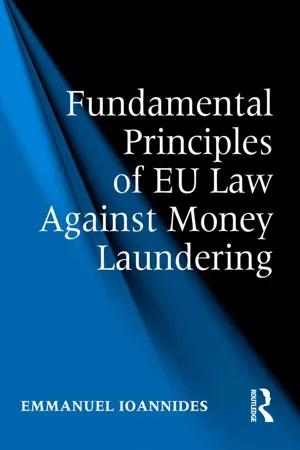
Fundamental Principles of EU Law Against Money Laundering
About this book
This book critically analyses fundamental principles of EU law for the control of international economic crime. Discussing how the reporting system and the exchange of information are at the heart of the global anti-money laundering regime, the study also looks at the inferential force of financial intelligence in criminal proceedings and the responsibilities this places on prosecutors and criminals alike. The author closely examines the application of Article 8(2) of the European Court of Human Rights for the retention and movement of the fingerprints, cellular samples and DNA profiles of unconvicted persons, and argues the incompatibility with the ECHR, along with the effect of socially stigmatising unconvicted persons. The work concludes with exploring how financial regulation has, inter alia, shifted responsibility to businesses and financial institutions to become more transparent and accountable to financial regulators and tax authorities. This critical analysis is essential reading for law students and the Judicial Body, as well as financial crime investigators and regulators.
Basic Principles
Chapter 1
The Rationale of Money Laundering Controls
The Objectives of Anti-Money Laundering Laws
The 12 Conceptual Objectives
After having set out the principal political priorities of the European Union’s agenda in the area of freedom, justice and security, it would be appropriate to set out the conceptual scene of money laundering countermeasures. Money laundering countermeasures mainly aim to:
1. Protect and promote the stability, integrity and reputation of the financial system1 and, at the same time, protect citizens against crime and terror.2
2. Provide a disincentive to economically motivated serious crime through the reduction of profit3 and the drastic decrease of the inflow of dirty4 money that can finance further crime and terror.
3. Provide effective tools for the conviction of money laundering offenders and the prosecution of predicate offences through the international network of Financial Intelligence Units assembled by the Egmont Group; and the engagement of financial institutions in the fight against money laundering.5
4. Make criminal wealth vulnerable upon it entering the formal economy,6 assist in the rapid tracing of criminal assets, and promote civil recovery action domestically and abroad.7
5. Eradicate to the maximum possible degree unfair competition,8 corporate and financial malpractice,9 market abuse and insider dealing,10 fraud11 and tax evasion.12
6. Provide a new generation of smarter and more cost-effective tools for the tracing of criminal proceeds. Member States are expected to apply these tools within the framework of an adopted strategy that is based on the principles of effectiveness, proportionality and engagement of stakeholders from the public and private sectors.
7. Facilitate the extraction of information from private sector stakeholders13 concerning the identity of those persons engaged in apparently suspicious transactions and, at the same time, provide for a system of multiple checks14 of commercial, financial and personal data15 by law enforcement and intelligence agencies at the national, regional and international levels.
8. Provide a mechanism for the continuous revision and clarification of universally adopted proactive and reactive tools against the laundering of criminal proceeds; increase the level of accountability and private sector engagement;16 and promote the sharing of knowledge and understanding of newly emerging typologies of money laundering and terrorism financing activity.17
9. Tighten controls on persons holding positions of trust in the public and private sectors and, more specifically, prevent corrupted political leaders from siphoning off taxpayers’ money.18 The deeper notion of this objective has to do with the prevention and control of the accumulation of unaccountable wealth in the wrong hands and the prevention and control of illicit enrichment as a whole.19
10. Promote and enhance good governance, best practices, transparency and corporate social responsibility.
11. Increase financial regulatory and law enforcement activity in regard to capital flight from hot areas through the informal value transfer system,20 and assist in resolving the problem of how funds are actually transferred from the European Union to destinations such as North Africa without traceable money21 transfer22 orders.
12. Enhance the international initiatives to improve poor governance23 and combat systemic corruption24 in non-cooperative countries and territories.25
Justifications for the Extension of the Anti-Money Laundering Regime
Some Reflections on the Position before Making Drugs Illegal
In the past, gambling was banned, but in present times governments are running lotteries. In the nineteenth century, morphine and opium were not illegal in Europe and in America. Godfrey’s Cordial syrup, which contained opium, was widely used to make Victorian babies quieter. Surprisingly, cocaine was the base of numerous remedies for the cold. The non-alcoholic version of French Wine Cola not only contained traces of coca, but also became the top-selling soft drink. Marijuana was used by Queen Victoria to ease the pains of menstruation. Opium was smuggled into China by British merchants in order to balance the purchase of tea for export to Britain. In 1887, America banned opium imports from the Chinese, but allowed those by Americans because the opium import tax was one of the main sources of federal revenue.26 In other words, the main driver for changing the position of legality or illegality is moral outrage, which is usually backed by vested interests.27
Perhaps, the position of governments before making drugs illegal reflects Hans Kelsen’s philosophical understanding of justice as social happiness. Should that be the case, then one could further construe that this social happiness is an inspiration that varies with time and place, just as human expectations vary. Dr Kris Hinterseer provided an alternative realistic explanation for the application of relaxed money laundering controls as he entertained the theorem that governments at times will either wittingly or unwittingly compromise money laundering controls in order to achieve their political objectives and political priorities.28
It is only rational not to take excessive comfort from the general philosophical presumption that drugs were made illegal due to the transformation of social happiness into moral outrage. All the more so, the inquiry into the reasons that must have led governments to wage war on drugs is of particular legal interest. It is also important to keep in mind that it actually took several decades from 1887 to the 1930s for heavy and habitual drug use to substitute medical or casual drug use, as the youth, in particular, increasingly experimented with different types of narcotic and highly addictive psychotropic substances. Drug trafficking and drug dealing evolved in parallel to the different periods of demand for people’s experimentation with the herb and the resin of cannabis (1930s), heroin (1970s), cocaine (1980s), and crack cocaine and chemically synthetic drugs (1990s onwards).29
Perhaps, the experimentation with different types of narcotics was a fashion trend, which inevitably became a major problem of addiction and a lucrative market of the illicit economy. The phenomenon caused loss of human life, the rise of fatal and non-fatal offences against the person, and the rise of serious offences. The blending of criminal proceeds with lawful wealth30 became the darling of drug traffickers, drug dealers and money launderers.31
Taken together, the above submissions raise the central issue of state intervention in the sphere of the person’s sovereignty.32
The general principle to consider is that, in the ordinary course of life, it is only over our own bodies and minds that we are sovereign. However, it is equally important to appreciate that, in the context of drug trafficking, drug dealing and drug use, this general principle fails the penal test because our sovereignty extends to harm the physical and moral wellbeing of ourselves and of others. Consequently, it is against the particular legal background of state intervention in the interests of the protection of public interest,33 legal goods34 and public morals that one should notionally seek to identify the first justification for the extension35 of the global anti-money laundering regime.36
Justification 1: The War on Drugs
Money laundering became a major policy issue at the G7 Summit in 1989.37 The United States invited the other Summit participants to join the fight against drugs and to cooperate to establish a task force that would deter and disrupt criminal finance, which was seeping through the banking system and the financial system as a whole.38 The commonly held view is that, ever since, the Financial Action Task Force has been recognised as the foremost international standard setter of universal norms against money laundering.39
As Dr Amandine Scherrer rightly observed, the objectives of the original 1990 Recommendations of the Financial Action Task Force should be classified into three main categories: the improvement of anti-money laundering systems at the national level; the enhancement of international cooperation; and the facilitation of the financial system to effectively combat money laundering.40
Furthermore, Dr Scherrer envisioned the aforementioned three categories...
Table of contents
- Cover Page
- Half-Title Page
- Title Page
- Copyright Page
- Contents
- Table of Cases
- List of Journal Abbreviations
- Preface
- Introduction The Guide to Understanding AML Law
- PART I BASIC PRINCIPLES
- PART II ADVANCED PRINCIPLES
- Bibliography
- Index
Trusted by 375,005 students
Access to over 1.5 million titles for a fair monthly price.
Study more efficiently using our study tools.
Frequently asked questions
Yes, you can cancel anytime from the Subscription tab in your account settings on the Perlego website. Your subscription will stay active until the end of your current billing period. Learn how to cancel your subscription
No, books cannot be downloaded as external files, such as PDFs, for use outside of Perlego. However, you can download books within the Perlego app for offline reading on mobile or tablet. Learn how to download books offline
Perlego offers two plans: Essential and Complete
- Essential is ideal for learners and professionals who enjoy exploring a wide range of subjects. Access the Essential Library with 800,000+ trusted titles and best-sellers across business, personal growth, and the humanities. Includes unlimited reading time and Standard Read Aloud voice.
- Complete: Perfect for advanced learners and researchers needing full, unrestricted access. Unlock 1.5M+ books across hundreds of subjects, including academic and specialized titles. The Complete Plan also includes advanced features like Premium Read Aloud and Research Assistant.
We are an online textbook subscription service, where you can get access to an entire online library for less than the price of a single book per month. With over 1.5 million books across 990+ topics, we’ve got you covered! Learn about our mission
Look out for the read-aloud symbol on your next book to see if you can listen to it. The read-aloud tool reads text aloud for you, highlighting the text as it is being read. You can pause it, speed it up and slow it down. Learn more about Read Aloud
Yes! You can use the Perlego app on both iOS and Android devices to read anytime, anywhere — even offline. Perfect for commutes or when you’re on the go.
Please note we cannot support devices running on iOS 13 and Android 7 or earlier. Learn more about using the app
Please note we cannot support devices running on iOS 13 and Android 7 or earlier. Learn more about using the app
Yes, you can access Fundamental Principles of EU Law Against Money Laundering by Emmanuel Ioannides in PDF and/or ePUB format, as well as other popular books in Law & Criminal Law. We have over 1.5 million books available in our catalogue for you to explore.