eBook - ePub
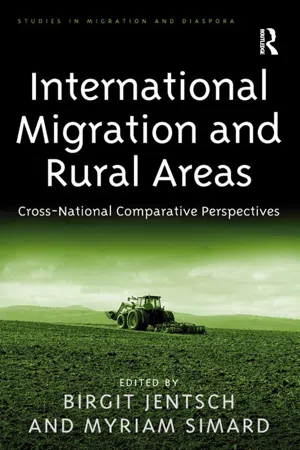
International Migration and Rural Areas
Cross-National Comparative Perspectives
- 218 pages
- English
- ePUB (mobile friendly)
- Available on iOS & Android
eBook - ePub
International Migration and Rural Areas
Cross-National Comparative Perspectives
About this book
While immigrants are still predominantly choosing urban areas to locate to, there is now increasing evidence of immigration to rural areas which poses its own challenges for those relocating, from the scarcity of high quality jobs to the provision of public and private services. Addressing the shortcomings in current research, this book employs an innovative approach by exploring this relationship from a cross-national, comparative, global perspective. It draws lessons from case studies across a range of geographical and political contexts, including Canada, the USA, Ireland, Scotland, Greece and Russia. Bringing together migration experts from a range of academic disciplines, International Migration and Rural Areas contributes to conceptual developments and also identifies policy concerns which can be pursued at national, sub-national and supra-national levels. As such, it will appeal to policy makers, as well as scholars across a range of disciplines, including geography, politics, demography, social policy, sociology and anthropology.
Information
Chapter 1
Introduction: Key Issues in Contemporary Rural Immigration
Myriam Simard and Birgit Jentsch
A distinguishing feature of immigration since the era of industrialization up to the late 20th century has been its urban orientation. Since immigrants settled mainly in metropolitan areas, research focused primarily on the characteristics of these urban immigrants, the integration challenges and opportunities they encountered, as well as the strategies they employed to overcome difficulties. In the 1990s, migration researchers developed an interest in the role of locality in migration processes, and the argument was advanced that much closer attention must be paid to the ‘city as context’ (Brettell 1999). Terms such as ‘global city’ and ‘gateway city’ have been used to focus analyses on the connections between cities and their migrant populations.
However, a relatively new feature in European migration is the significant and growing impact it has had on peripheral and rural areas. Immigrants have been employed in the labour intensive agricultural sector. In addition, the expansion of other non-agricultural activities like tourism and provisions for leisure and recreation have resulted in demands for types of labour not available from the locally established population (Kasimis and Papadopoulos 1999). In Southern Europe, there has been a relatively steady stream of migrants to rural areas since the 1990s, in part connected with the comparatively large, labour-intensive agricultural sector there (Kasimis 2005). In the same decade in Eastern Europe, net migration from ex-USSR states to Russian rural areas amounted to more than two million (out of a total of six million) (Ivakhnyuk). In some Northern European countries, such as Ireland and Scotland, rural areas have particularly benefited from the 2004 EU enlargement. The subsequent inflow of immigrants have turned Ireland and Scotland into countries of immigration, when their history has been very much characterised by emigration. Increasing evidence suggests that the majority of migrant workers from the 2004 accession states1 have found employment in rural areas rather than the traditional migration centres. High proportions have registered in the more peripheral parts, for example the Highlands and Islands, and lower proportions than expected have been attracted to London and the common destination cities within Scotland – Edinburgh, Glasgow and Dundee (Danson and Jentsch). Some Scottish rural NHS Boards reported that they were dealing with 800 to 1,000 new migrants each month (Watt and McGaughey 2006).
Similarly, in the USA, recent evidence indicates that immigrants are increasingly arriving in small cities and their peripheral towns, as well as in rural areas. For example, over the 1990s, the number of Hispanics (who make up the vast majority of immigrants in rural areas) more than doubled in the non-metro parts of 20 states, mostly in the South and Midwest (Jensen and Yang). In Canada, immigrants’ urban orientation is still dominant. In 2006 nearly two thirds (62.9 per cent) of the immigrant population settled mainly in three metropolitan areas, namely Toronto (Ontario), Vancouver (British-Colombia) and Montreal (Quebec) (Simard).2 However, some changes have emerged, particularly highlighted with the last population census in 2006, which counted 628,295 immigrants in predominantly rural regions in Canada, mainly in agriculture, transformation and services (Beshiri et al. 2009, 2004, 2002). Since the 1990s, immigrants seem indeed to have moved increasingly to small urban and rural communities, mainly prompted by policies and programmes which were developed at different levels (federal, provincial and municipal), and which have supported the regionalisation of immigrants (Carter et al. 2008; CIC 2001). Yet, this trend has differed in strength by province. Some provinces have clearly benefited more than others, with British Columbia, Yukon Territory, Ontario and Alberta being the main gainers in the last decade. In fact, it appears that not only in Canada, but globally, national immigration programmes have increasingly aimed to include smaller regions, which had been neglected as possible destinations by new immigrants (Akbari 2008).
Despite these developments, recent academic literature in Europe has paid scant attention to immigration to rural areas, although a growing number of policy and practice oriented research reports emerged in the UK and Ireland following EU enlargement in 2004 and the associated marked increase in rural immigration in these two countries. In North America, only few books have covered rural populations or industries, but are now either dated (for example, Goldfarb 1981; Friedland and Nelkin 1971), or focused on particular aspects of rural immigration, such as the US guestworker programme, which has often provided agricultural workers. An established body of literature on the US does exist, focusing on the presence of migrant workers in rural California. However, the literature on the recent movement of immigrant groups to other rural areas is only gradually evolving (Jensen and Yang). The situation in Canada is similar. Historical and ethnographic studies have been conducted on ethnic communities settling in rural provinces, particularly in west Canada, but there are still very few contemporary studies which concern themselves with immigrants’ and rural communities’ experiences.3
Why is immigration to rural areas an important topic worthy of academic investigation, and in need of policy and practice development? A more balanced geographical distribution of immigrants can benefit immigrants themselves, as well as their urban and rural host communities and their new country as a whole. Too often, immigrants in metropolitan areas have found themselves segregated, in poor quality and expensive housing, and suffering from high unemployment and poverty rates as large cities have been struggling with the burden of absorption. By contrast, for decades, rural and remote areas have been afflicted by depopulation trends, mainly due to the exodus of young people to urban areas, low birth rates and an ageing population. Maintaining an adequate population base has become a challenge in many places (Wulff et al. 2008; Reimer 2007). As the chapters in this book illustrate, such trends seem to be shared by the vast majority of rural communities in the developed world.
Analysts have recognised that immigration cannot be the single solution to repopulation, but could contribute an important component to a healthier demographic, economic and socio-cultural profile in rural areas. Certainly in the context of wider local and regional development strategies it holds considerable promise. A larger population can help to overcome a shortage of labour, increase local tax revenues and support the sustainability of public and private services in rural communities. It is also likely to produce active citizens and engaged community members, such as entrepreneurs and volunteers (Hall Aitken and INI 2007; Simard 1994). This can result in a virtuous cycle where well-serviced rural areas may be attractive to a number of groups, those who once out-migrated as well as internal in-migrants and immigrants (Jentsch 2006). However, with the lack of research evidence on rural immigration issues – such as the nature, causes and effects of such migration – it has been difficult to formulate policies and practices which can support rural immigrants and the receiving communities. The development of theories and concepts, which would help to understand this new reality, has been hampered for the same reason.
Barriers to Rural Immigration
Given the potential immigration has for rural areas, it is important to recognise and address obstacles to the attraction and retention of immigrants to rural areas. Internationally, there have generally been strong positive correlations between the size of cities and the growth of their foreign born populations, as well as the retention of these populations (Burstein 2007). Barriers to an increase in immigration to rural areas, which have been identified by several authors, include immigrants’ perception of a lack of opportunities and services in rural areas to an extent which in many cases does not reflect reality (Rose and Desmarais 2007). Possible misperceptions of rural areas can be linked to the fact that such places are at a distance from the centres of economic and political power, resulting in a deficiency of accurate information available to immigrants (Reimer 2007).
At the same time, many rural (and especially remote) areas do tend to have limited labour markets, with employment that is less diverse, yields less competitive salaries, and offers fewer career advancement opportunities than tends to be the case in larger centres. Even if a person found a suitable post, such a situation can also pose problems for their partner’s search for appropriate employment. Other barriers frequently mentioned in the literature refer to the fact that there is often a mismatch between rural immigrants’ qualifications and the needs of the local economy, a lack of a reliable public transport system, and a shortage of affordable, good quality accommodation.
Long distances and low population density certainly impact on the extent and range of social, cultural and institutional services. Such services tend to be less available in rural areas than in cities. Since lifestyle and family concerns (including good quality educational facilities) have been shown to be very important to immigrants, a deficiency in public (and private) services can often undermine the selection of rural communities as a destination by immigrants (Wulff et al. 2008). In addition, rural areas tend to lack large immigrant communities when this condition has been identified as significant in attracting new immigrants (Akbari 2008). Related to this, social network structures are weaker, but such networks seem crucial to the long term retention of immigrants. They can provide knowledge of, as well as confidence and support in, a destination (Green and Hardill 2003). Furthermore, locally established community members may not welcome immigrants, as they may perceive them as competitors for local jobs, even when there is in fact an unmet demand for labour. Related barriers, of which there is informal evidence, include locally established people’s concerns for the protection of local values to an extent which may stimulate and strengthen exclusion, racism and discrimination (Reimer et al. 2007; Dey and Jentsch 2001). These barriers are critical as research on rural immigration has demonstrated the importance immigrants attach to ‘social connectedness’, that is to social interactions between immigrants and the locally established population (Wulff et al. 2008), to overcome, for instance, their social and cultural isolation when they first arrive.
Given the challenges rural areas face when depopulation could mean the disappearance of a community, it is tempting to adopt a solely instrumental approach when promoting rural immigration. However, as Burstein (2007) has argued in the Canadian context, instead of highlighting economic benefits and self-interests, it is possible to focus on diversity as a good in itself. This has particular relevance for countries which regard diversity as one of their core values. Where countries have ‘branded’ themselves in this way, that is where their national citizenship and immigration programmes clearly reflect this value, it is only consistent to argue for regional policies that promote racial, ethnic, religious and cultural diversity.
Aims and Objectives of the Book
In order to contribute towards bridging the research gap on the relationship between immigrants and rural localities of settlement in the contemporary context, this book is underpinned by two main aims. One is broadly concerned with immigrants’ and receiving communities’ experiences, and the other with conceptual development, especially of the concept of integration and its meaning in rural contexts. As to the former, we wish to examine the causes and nature of immigration to rural areas. We also aim to analyse the consequences and challenges of immigration for rural communities, and conversely, the impact of rural localities of settlement on immigrants’ engagement with economic, social, and cultural processes. These analyses include identifying those factors in rural localities which attract international migrants, and which support them in integration processes, as well as those factors which affect the opposite. Regarding the latter aim, the different uses of the term integration will be examined in the various geographical, socioeconomic, cultural and political contexts covered in this book. This will allow us to show the complexity and variability of this concept, including the multiple factors of structural and circumstantial nature which affect integration processes. Throughout, the particularities of rural immigration experiences are to be explored and highlighted in this book.
A cross-national approach is adopted, which refers to studies of rural immigration from a range of geographical and political contexts in the Euro-Atlantic region. The book also benefits from the contributions of a multidisciplinary team of authors. The fact that it brings together complementary bodies of literature in different languages, especially French and English, has further enriched the analysis. The book examines experiences in North America (Canada and the USA), Southern Europe (with a focus on Greece) Northern Europe (Ireland and Scotland) and Eastern Europe (Russia). Hence, it draws on the wide-ranging experiences of established receiving countries in North America, as well as of European countries, which have only recently become (again) countries of immigration.
Russia bisects the European and Eurasian migration system. After 70 years of strict immigration restrictions under the Soviet period, it has since 1992 received rural and urban immigrants of diverse backgrounds and characteristics. Significant groups of immigrants to the Russian Federation include ethnic Russian and Russian speaking people from other Soviet republics. Moreover, especially in Russia’s Far East, Chinese citizens have become a dominant rural migrant group (Ivakhnyuk). Greece – as well as other Southern European countries – have recorded a significant immigration increase in urban and rural areas since the 1980s. The majority of Greece’s foreign population has come from Albania, Bulgaria and Romania (Kasimis). Scotland and Ireland are traditionally sending states but have particularly benefited from urban and rural immigration following EU enlargement in 2004, with Poles having constituted by far the largest national grouping in both countries (Coakley and Mac Éinrí Danson and Jentsch). Canada and the USA are traditional receiving states in the New World, the majority of rural immigrants having come from Latin America for the USA (Jensen and Yang) and from a mix of European and more recently non European countries for Canada (Simard). The two countries are also considered to have had considerable experiences with immigrants’ integration – a key concern of this book.
A cross-national comparison of immigration in a rural context can provide us with different angles from which to examine immigrants’ and receiving communities’ experiences. The various national (and sub-national) contexts will therefore facilitate an analysis of the relationship between place of settlement, migrants’ profiles and their experiences. These contexts will also help us to reflect what integration means for rural areas.
Cross-National Comparisons – Some Methodological Issues
Rural immigration is a relatively new subject area of investigation with no easily comparable datasets or bodies of literature, and with significant differences in the nature, causes and consequences of immigration in the different countries and regions covered in this book. While a common framework of issues was developed in the preparation phase of the book, which was to be covered by all chapters, it was not considered helpful to offer chapters with uniform structures, or to give the identified issues equal importance in all chapters. Too rigid an approach would have compromised contributors’ ability to cover the contemporary and key concerns in their respective country or regions. It would also have constrained the ability to benefit from the different disciplinary backgrounds of the authors, and the different perspectives they were able to take on similar issues, resulting in deeper insights.
Even with the different scopes of the chapters, common and overlapping themes and issues have emerged, which have lent themselves usefully to cross-national as well as intra-national comparisons. Such themes include the reasons for migration to rural areas; the profiles of immigrants in those spaces; their experiences and integration processes in rural host communities; and the impacts of immigrants on rural communities. We found that while chapters differed in their foci, they were often able to usefully complement each other. For example, while most chapters focus on immigrants in basic skilled employment, the Canadian contribution concentrates on immigrants in professional posts and related issues of retention. Some commonalities still exist between this and the other chapters, since many professionals have spent some time in basic ...
Table of contents
- Cover
- Title Page
- Copyright Page
- Table of Contents
- List of Figures and Tables
- Notes on Contributors
- Acknowledgements
- Series Editor’s Preface
- 1 Introduction: Key Issues in Contemporary Rural Immigration
- 2 Taken by Surprise: New Immigrants in the Rural United States
- 3 Retention and Departure Factors Influencing Highly Skilled Immigrants in Rural Areas: Medical Professionals in Quebec, Canada
- 4 From Enthusiasm to Perplexity and Scepticism: International Migrants in the Rural Regions of Greece and Southern Europe
- 5 Migration to Rural Ireland: A North Cork Case Study
- 6 The New Scottish Rural Labour Market: Processes of Inclusion and Exclusion
- 7 Immigrants and Receiving Communities in Rural Russia: Experiences from the Central European and the Far East Regions
- 8 Conclusion: Comparative Perspectives on Rural Immigrants’ Integration
- Index
Trusted by 375,005 students
Access to over 1.5 million titles for a fair monthly price.
Study more efficiently using our study tools.
Frequently asked questions
Yes, you can cancel anytime from the Subscription tab in your account settings on the Perlego website. Your subscription will stay active until the end of your current billing period. Learn how to cancel your subscription
No, books cannot be downloaded as external files, such as PDFs, for use outside of Perlego. However, you can download books within the Perlego app for offline reading on mobile or tablet. Learn how to download books offline
Perlego offers two plans: Essential and Complete
- Essential is ideal for learners and professionals who enjoy exploring a wide range of subjects. Access the Essential Library with 800,000+ trusted titles and best-sellers across business, personal growth, and the humanities. Includes unlimited reading time and Standard Read Aloud voice.
- Complete: Perfect for advanced learners and researchers needing full, unrestricted access. Unlock 1.5M+ books across hundreds of subjects, including academic and specialized titles. The Complete Plan also includes advanced features like Premium Read Aloud and Research Assistant.
We are an online textbook subscription service, where you can get access to an entire online library for less than the price of a single book per month. With over 1.5 million books across 990+ topics, we’ve got you covered! Learn about our mission
Look out for the read-aloud symbol on your next book to see if you can listen to it. The read-aloud tool reads text aloud for you, highlighting the text as it is being read. You can pause it, speed it up and slow it down. Learn more about Read Aloud
Yes! You can use the Perlego app on both iOS and Android devices to read anytime, anywhere — even offline. Perfect for commutes or when you’re on the go.
Please note we cannot support devices running on iOS 13 and Android 7 or earlier. Learn more about using the app
Please note we cannot support devices running on iOS 13 and Android 7 or earlier. Learn more about using the app
Yes, you can access International Migration and Rural Areas by Myriam Simard, Birgit Jentsch in PDF and/or ePUB format, as well as other popular books in Scienze sociali & Antropologia. We have over 1.5 million books available in our catalogue for you to explore.