- 252 pages
- English
- ePUB (mobile friendly)
- Available on iOS & Android
eBook - ePub
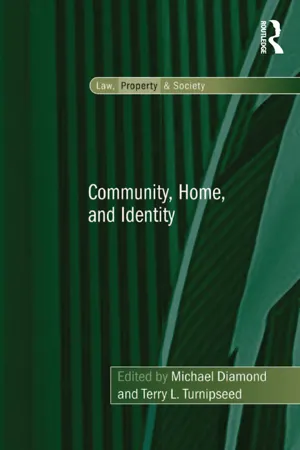
Community, Home, and Identity
About this book
Community, home, and identity are concepts that have concerned scholars in a variety of fields for some time. Legal scholars, sociologists, anthropologists, psychologists, and economists, among others, have studied the impacts of home and community on one's identity and how one's identity is manifested in one's home and in one's community. This volume brings together some of the leading thinkers about the connections between community, home and identity. Several chapters address how the law and lawyers contribute (or detract) from the creation and maintenance of community and, in some cases, the conscious destruction of communities. Others examine the protection of individual and group identities through rules related to property title and use of such things as Home and 'identity property'.
Chapter 1
Bordered Lands: Land Use, Legal Culture, and Community Development in the Nineteenth-Century Southwest
Allison Brownell Tirres
The county of El Paso, Texas, in the year 1870 was a quintessential frontier community. Located in the far western tip of Texas, it was difficult to reach from any major metropolis. Although officially a part of Texas, the lack of any railroad connection and the presence of hostile Indian tribes in this period made for a long, dangerous journey to and from other population centers in the region. El Paso was also a community on the borderline, bordered to the west by New Mexico, and to the south by Mexico.1 The population of only 4,000 was predominantly of Mexican descent.2 Many of its residents had lived in the region since before the Mexican-American War, when the US gained the El Paso area (and more than one-third of Mexico’s northern territories) in the Treaty of Guadalupe-Hidalgo.3 Due in large part to its isolation and its preexisting Mexican legal and cultural traditions, El Paso in 1870 was a hybrid place, where American law was present but practiced in Spanish, where those of Mexican and American descent served side-by-side in the institutions that governed the county, and residents still celebrated Mexican Independence Day along with the Fourth of July.4
El Paso, Texas, in the year 1890 was a very different place. The population of the county had quadrupled, to more than 15,000. The city of El Paso saw even greater population growth, from a few hundred residents in 1870 to more than 10,000 in 1890.5 The majority was still of Mexican descent, but now the population of those of Anglo-American descent was growing steadily.6 Travelers could now reach El Paso by not one, but four different major railway lines, which connected the county not only to other parts of Texas, but also to San Francisco, St Louis, and Mexico City. These demographic changes had ramifications for legal culture. The old adobe courthouse, where those of Mexican and American descent had sat side-by-side to administer justice, was now replaced by an imposing brick edifice in a European style, where those who spoke only Spanish were no longer allowed to serve on juries as they had for decades before. By the end of the decade, juries were no longer a Mexican-American majority, trials were no longer conducted largely in Spanish, and residents were chastised for celebrating Mexican holidays. The balance of power had shifted from one racial/ethnic group to another. In the span of only 20 years, El Paso changed from a close-knit, multicultural frontier community to a burgeoning, increasingly racially segregated border metropolis.
El Paso County was not the only community to undergo dramatic change after the arrival of the railroads.7 This is a familiar story in nineteenth-century history, of the ways that the railroads altered the character of the cities and towns they passed through, creating boom towns out of previously isolated enclaves.8 The scholarship tends to portray these things as inevitably linked: the railroads brought greater settlement, which changed the nature of formerly small towns, contributing to their modernization and urbanization. While there is truth to this general characterization, it is also clearly deficient.9 We must go beyond demographic determinism if we are to understand the ways that communities change over time. It was not merely the arrival of more people that changed El Paso. These changes were the product of specific moves by local residents to reshape the area, particularly to whitewash its Mexican past while also promoting its transnational future as a cross-border trade hub.10 Law and lawyers were key elements in the transformation of El Paso from an isolated, frontier community to a burgeoning border metropolis. The legal profession paved the way for the railroads’ arrival by altering patterns of land use. As local politicians and merchants then sought to attract more settlers to the area, they targeted the area’s unique legal culture as a problem, seeking to change not just the way land was used and owned—from communally to individually—but also to change the way law was practiced and enforced. This involved moving the county seat from a Mexican-American town to a predominantly Anglo-American one and tearing down the old adobe courthouse. These moves shifted the balance of power in the county, leading to greater segregation not just in the courthouse, but also in neighborhoods, schools, and social venues. Land ownership and patterns of land use were both reflections of and contributors to the creation of greater inequality in the community.
In many respects, this is a distinctly nineteenth-century story. It portrays community development in a particular era, when western land was still cheap and plentiful, the railroads were a major innovation, and racial hierarchies were firmly entrenched, if sometimes more fluid than we might expect. Yet there are remarkable overlaps with contemporary society. We continue to live in a world in which technological change can spark shifts in wealth, equality and opportunity. We are not, despite some recent assertions to the contrary, in a post-racial era: de facto residential and educational segregation continues in many towns and cities in this country, El Paso included.11 Urbanization and modernization—which today might be referred to as “gentrification”—bring decidedly mixed blessings, as they did in the 1880s and 1890s.12 On the one hand, such changes in a community can bring greater prosperity and stability. On the other, they can bring greater racial stratification and socioeconomic inequality. As in the nineteenth century, law and lawyers continue to play a powerful role in these processes of change. The legal profession can be instrumental either in ensuring more egalitarian communities or in undermining them. The historical portrait discussed in this essay, of one community’s experience with rapid development, thus has things to tell us not only about the nineteenth-century borderlands, but also about pitfalls in urban planning and development today.
The chapter begins by tracing the involvement of local attorneys in shifting land-ownership patterns in the county, in anticipation of the arrival of the railroads. Lawyers played key roles in making sure the railroad would come through their particular locale. Transforming the community was not only about attracting the railroads, however, but also about encouraging greater settlement. The second part of this chapter describes how lawyers, politicians, and others sought to recreate the area’s legal culture, in the interest of attracting settlers as well as facilitating Anglo-American legal and political dominance. This change in legal culture was part of a broader shift towards Americanization and segregation. The third part of the chapter describes the ways that the built environment of the county changed, as well as the racial/ethnic make-up of its neighborhoods and public spaces. The railroads may have provided a catalyst for these dramatic changes, but it took individual actors to make such change actually happen in the community.
Lawyers and Land
By 1884, not just one but four railroad lines met in El Paso, connecting the county to both coasts and to the interior of Mexico.13 The arrival of these transcontinental railroads in the El Paso area—running east to west and north to south—was understandably met with great excitement on the part of most residents of El Paso, for a whole host of reasons. For merchants, it promised a method of shipping and receiving goods as well as a new clientele to buy their goods. For farmers, it meant the opening of bigger and better markets for their crops. For ranchers, it provided a faster and more efficient method of shipping beef cattle. For all residents who had traveled between El Paso and other parts of Texas or the rest of the country, the railroads promised a safer, faster means of transport. Beyond the functional advantages, the railroad also had symbolic power, as a potent sign of progress and civilization. The tracks connected a once isolated frontier to the major centers of population in the nation.
The railroads did not arrive in El Paso due to chance or luck. Their arrival was the product of more than three decades of speculation and planning on the part of the area’s legal elite. Importantly, lawyers’ efforts to ensure a path through the county had a profound impact on land ownership, even before the tracks themselves were laid down. As land ownership changed, so did the political and economic fortunes of El Paso’s population.14
There were three primary ways in which local attorneys altered patterns of land ownership in the county: securing land titles, purchasing land for eventual development, and using town incorporation to place more land in the market, doing away in the process with communally held lands. Each of these processes guaranteed the railroads one of their most important assets: land. Land was an essential precondition for railroad development. While railroads were granted the rights of eminent domain, exercising this power could prove expensive and time-consuming. Many railroad corporations preferred either to accept donations of land, at no cost to them, or to buy land outright.15 In El Paso, the railroads did not need to exercise eminent domain. Thanks to the local legal profession, El Paso delivered the land they needed, either for free or for a nominal fee. By 1886, railroad corporations owned or controlled almost one-third of all land in El Paso County.16
Addressing the land needs of the railroad met with particular challenges in this part of the country, due the insecurity of land titles after the US/Mexico War. When the US government received more than 500,000 square miles of Mexican territory after the war, it pledged to recognize all preexisting (Mexican) land rights.17 Attempting to ascertain the status of land in the Southw...
Table of contents
- Cover Page
- Title Page
- Copyright Page
- Contents
- List of Contributors
- Preface
- Acknowledgements
- 1 Bordered Lands: Land Use, Legal Culture, and Community Development in the Nineteenth-Century Southwest
- 2 ‘Shaping the Place’ and the Ability to Exclude: Housing and Localism in England
- 3 De-concentrating Poverty: De-constructing a Theory and the Failure of Hope
- 4 Evaluating Legal Models of Affordable Home Ownership in England
- 5 Foundations of Federal Housing Policy
- 6 Evolving Ethical Standards in Property Law: A Study of Regulatory Perspectives Toward Home Mortgage Lending Transactions
- 7 Identity Property and the Inheritance of Family Cottages
- 8 The ‘Context’ of Home: Cohabitation and Ownership Disputes in England and Wales
- Bibliography
- Index
Trusted by 375,005 students
Access to over 1.5 million titles for a fair monthly price.
Study more efficiently using our study tools.
Frequently asked questions
Yes, you can cancel anytime from the Subscription tab in your account settings on the Perlego website. Your subscription will stay active until the end of your current billing period. Learn how to cancel your subscription
No, books cannot be downloaded as external files, such as PDFs, for use outside of Perlego. However, you can download books within the Perlego app for offline reading on mobile or tablet. Learn how to download books offline
Perlego offers two plans: Essential and Complete
- Essential is ideal for learners and professionals who enjoy exploring a wide range of subjects. Access the Essential Library with 800,000+ trusted titles and best-sellers across business, personal growth, and the humanities. Includes unlimited reading time and Standard Read Aloud voice.
- Complete: Perfect for advanced learners and researchers needing full, unrestricted access. Unlock 1.5M+ books across hundreds of subjects, including academic and specialized titles. The Complete Plan also includes advanced features like Premium Read Aloud and Research Assistant.
We are an online textbook subscription service, where you can get access to an entire online library for less than the price of a single book per month. With over 1.5 million books across 990+ topics, we’ve got you covered! Learn about our mission
Look out for the read-aloud symbol on your next book to see if you can listen to it. The read-aloud tool reads text aloud for you, highlighting the text as it is being read. You can pause it, speed it up and slow it down. Learn more about Read Aloud
Yes! You can use the Perlego app on both iOS and Android devices to read anytime, anywhere — even offline. Perfect for commutes or when you’re on the go.
Please note we cannot support devices running on iOS 13 and Android 7 or earlier. Learn more about using the app
Please note we cannot support devices running on iOS 13 and Android 7 or earlier. Learn more about using the app
Yes, you can access Community, Home, and Identity by Terry L. Turnipseed, Michael Diamond in PDF and/or ePUB format, as well as other popular books in Law & Law Theory & Practice. We have over 1.5 million books available in our catalogue for you to explore.